Why Influencer Marketing is Important for Bangladeshi Businesses in 2026
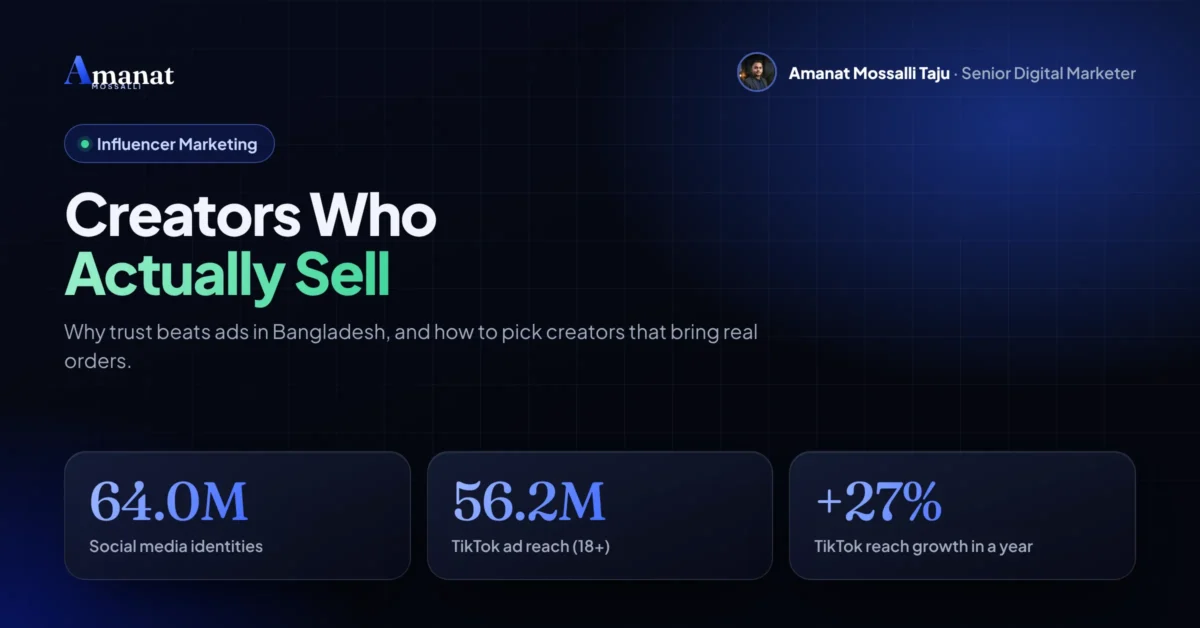
Bangladeshi buyers trust a familiar face more than a polished ad. Here is how to pick creators who sell, what they cost, and how to know what you got back.

A woman who makes homemade achar in Khilgaon messaged me one Friday afternoon in 2025. She sold from a Facebook page with about 4,000 followers. She was a little frustrated. Her boosted posts got likes but almost no orders.
So she’d tried something else. She sent two jars of mango achar to a food vlogger she liked, with no brief and no code. The vlogger ate it on camera, said it was nice, and never said the page name. The video passed 30,000 views in a week. She got three orders.
That one mistake, a missing page name, is the whole reason this guide exists. She was right about creators. She was wrong about how to use them.
The real answer to why influencer marketing is important for Bangladeshi businesses is simpler than any budget. People here trust a familiar face more than an ad. A creator who talks in natural Bangla puts your product in front of the exact buyers you want. Their trust comes with it.
I’m Amanat Mossalli Taju, a Dhaka-based digital marketer who has worked with 235+ brands. I’ve watched creator deals sell out stock, and I’ve watched them burn money. Both are in here, with the sums.
What Does Influencer Marketing Look Like in Bangladesh?
It means paying or partnering with content creators on Facebook, TikTok, YouTube or Instagram so they show your product to their followers. That can be one video, a product review, a live session, or a months-long brand ambassador deal.
And it’s not only celebrities. Most deals today happen with everyday creators. Food vloggers in Old Dhaka. Beauty creators in Chattogram. Tech reviewers, and mothers who post parenting tips at night after the kids sleep.
Follower ranges for these groups differ from one agency to the next. The Financial Express article I cite below uses 10,000 to 100,000 followers for a micro-influencer. Don’t get stuck on the labels.
The only question that matters is whether the creator’s audience matches your buyer.
Why Influencer Marketing Is Important for Bangladeshi Businesses Right Now
Because trust is the hardest thing to buy online in Bangladesh. Creators already have it. Too many buyers have been burned by fake pages. So they listen to someone they’ve watched for months, not to a stranger’s ad.
The numbers back the fear. The Bangladesh Bureau of Statistics ran an ICT survey for 2024-25. Only 14.4% of people had bought anything online, The Daily Ittefaq reported in June 2026. Among those who don’t, 75.8% said they prefer to see or touch the product first.
A creator holding your product on camera is the closest thing to touching it. That’s the job you’re paying for.
The audience is also huge and still growing. DataReportal’s Digital 2026 Bangladesh report counts 64.0 million social media user identities. TikTok’s ad reach among adults rose 27% in a year to 56.2 million.
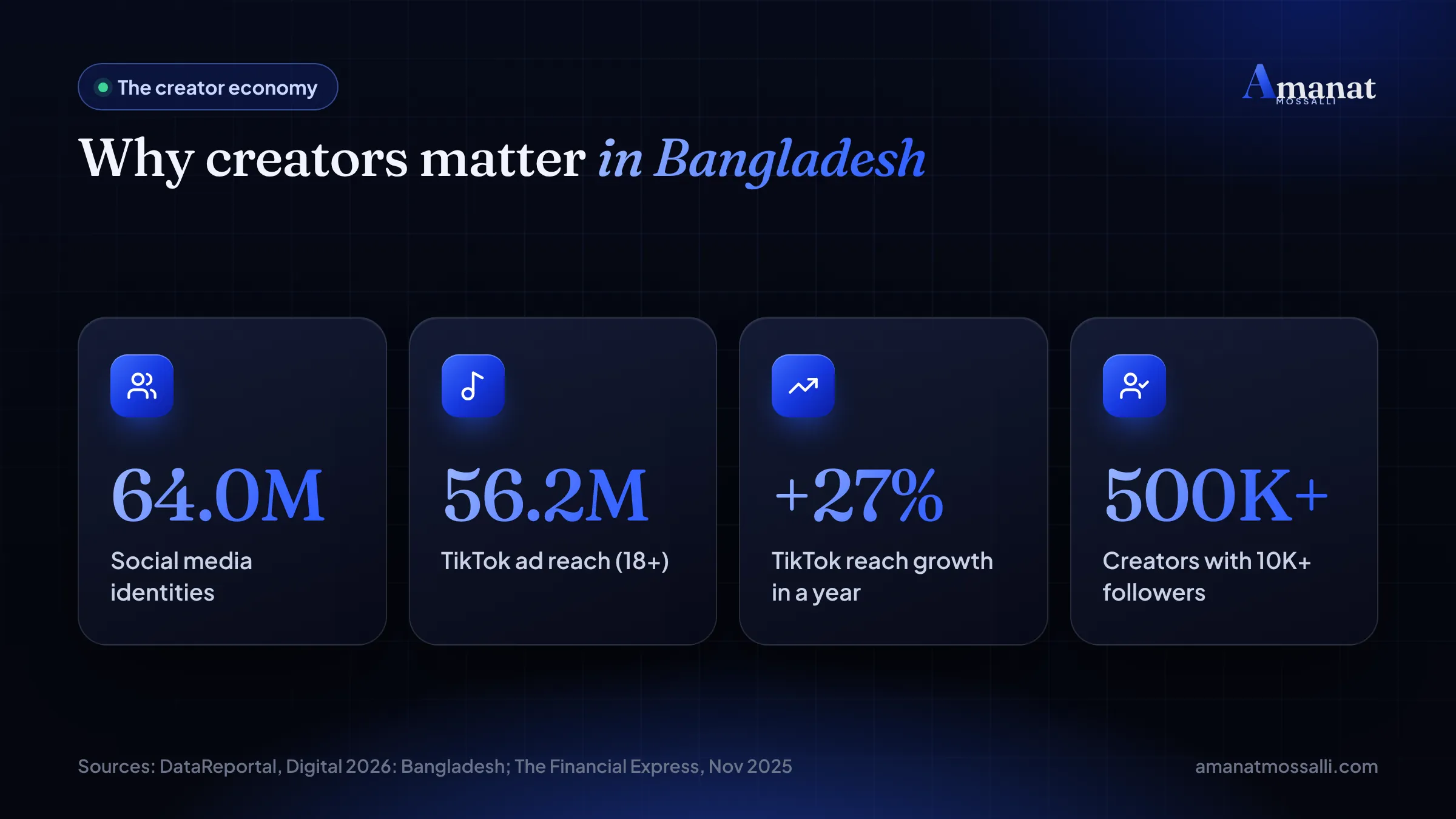
According to The Financial Express, Bangladesh has more than 500,000 local creators with over 10,000 followers. The same article cites Statista, which projects the influencer advertising market to grow from US$30.4 million in 2024 to US$45.3 million by 2028.
Six reasons it works so well here
- 1Word of mouth is king. Bangladeshis ask friends and family before buying. A creator feels like a friend.
- 2Bangla content wins. Creators talk the way buyers talk, with local jokes and references.
- 3It reaches ad-blind people. Many young users scroll past brand ads but stop for creators they follow.
- 4You get content to reuse. One good creator video can become your best ad for months.
- 5It costs less than TV or big celebrities. A handful of micro-influencers can cost less than one celebrity post.
- 6It speeds up launches. Many creators posting in the same week makes a new product feel like it’s everywhere.
Even the biggest brands here think this way. bKash launched its Student Account with more than 50 creators in one campaign, according to a press release in The Daily Star. Each explained how to open the account in their own style.
A brand that size can afford any media it likes. For a student product, it still put creators at the centre of the launch.
Does it suit what you sell?
Mostly yes, if you sell what people already buy online. In that BBS survey, 70.3% of online shoppers bought clothing, footwear or sporting goods. Food and groceries came next at 34.6%, then medicine at 21.0% and cosmetics at 17.9%.
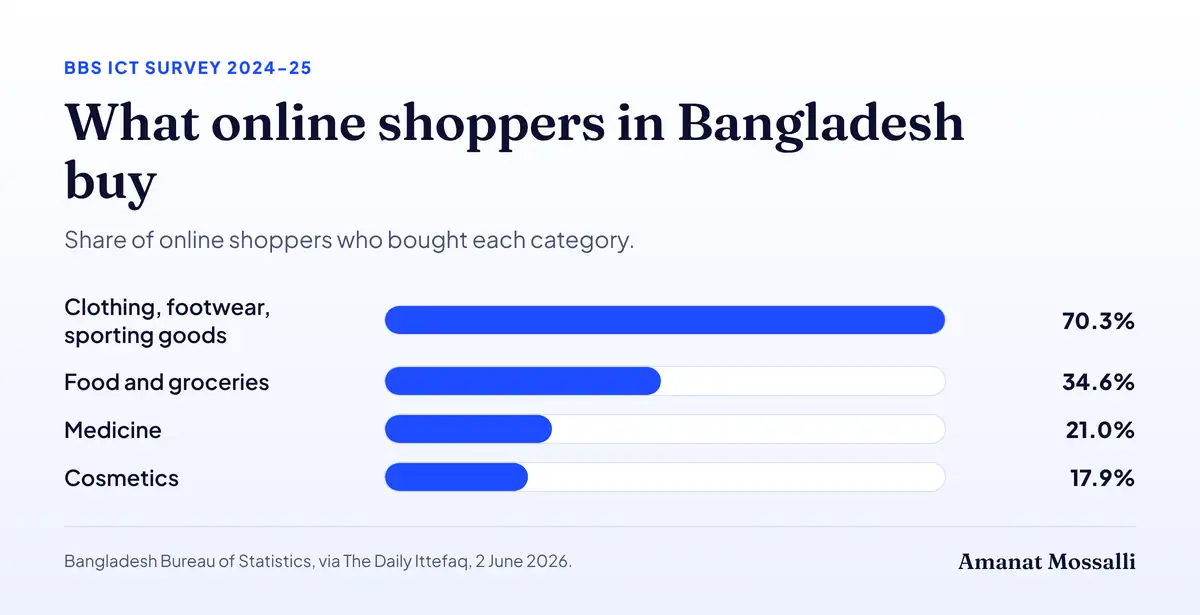
Those are the categories where a face and a try-on do the most work. A B2B machinery supplier will get less from a TikTok creator than from a good Google listing.
Micro-Influencers or Celebrities: Which Should You Pick?
Micro-influencers, for most small and mid-size businesses. They cost less, their audience is tighter, and their followers tend to act on their advice.
The engagement gap is real. Figures cited by The Financial Express put micro-influencers on Instagram at 3.86% average engagement, against 1.21% for the biggest accounts. Those are global figures, not Bangladeshi ones, so treat them as a direction.
Celebrities still earn their fee for big launches and mass brands. If you sell phones, telecom packages or soft drinks, reach can matter more than depth of trust.
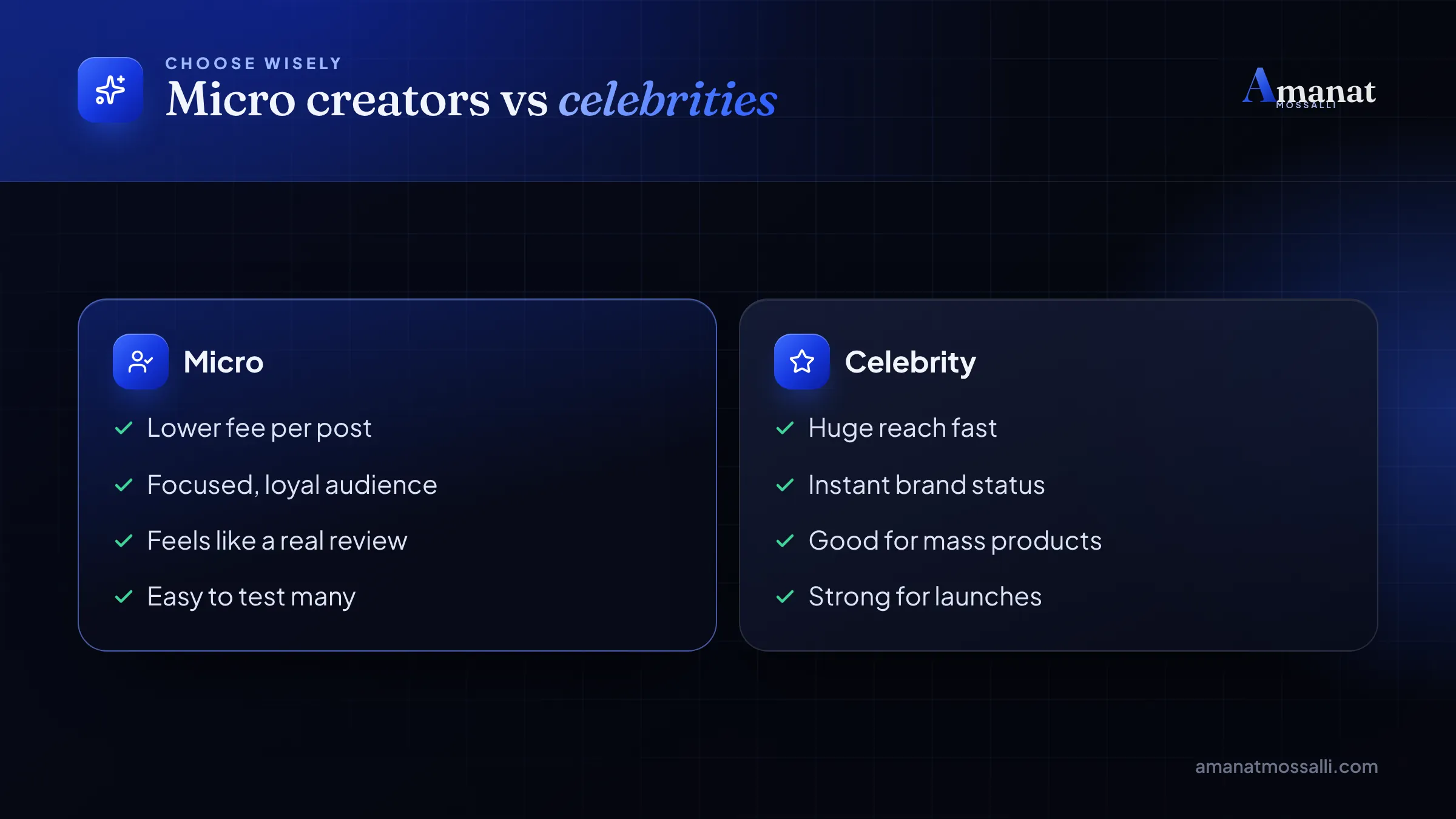
My usual advice is to test several micro creators first: three if the budget is tight, five to ten if it isn’t. Keep the ones who actually sell, and turn them into long-term partners. I’ve seen more brands win this way than with one expensive name.
How Much Does Influencer Marketing Cost in Bangladesh?
There’s no fixed price list, and anyone who gives you one is guessing. Influencer marketing cost in Bangladesh depends on the creator’s reach, niche and platform. It also depends on how many videos you want, and whether you can reuse them in ads.
I looked for a published rate card on 11 November 2026 and didn’t find one I’d trust. The closest hard fact is at the top end. Large influencers often charge fixed fees of several lakh taka per campaign, The Business Standard reported in June 2026.
Small creators may agree to free products plus a small fee. Always ask for a written quote.
| Deal type | How it works | Best for |
|---|---|---|
| Product barter | Free product in exchange for an honest post | Nano creators, new brands |
| Fixed fee per post | One price for a video, story or live | Most one-off campaigns |
| Fee + commission | Lower fee plus a share of sales via a code | E-commerce, clear tracking |
| Affiliate marketing | Commission only on tracked sales | Creators who already review your niche |
| Pay per thousand views | You pay for the views the content actually gets | Campaigns with many small creators |
| Brand ambassador | Monthly fee for several posts over months | Long-term trust and recall |
How to judge a quote when nobody publishes prices
You don’t need a market rate. You need two sums of your own. Here’s an example. Swap in your own figures.
Sum one: break-even orders. Add the fee, the free product and the courier. Divide by your profit per order.
| Line | Example |
|---|---|
| Creator fee for one video | Tk 8,000 |
| Product sent to the creator, at your cost | Tk 600 |
| Courier to the creator | Tk 130 |
| Total cost | Tk 8,730 |
| Your profit per delivered order | Tk 350 |
| Orders needed to break even | 8,730 / 350 = 25 |
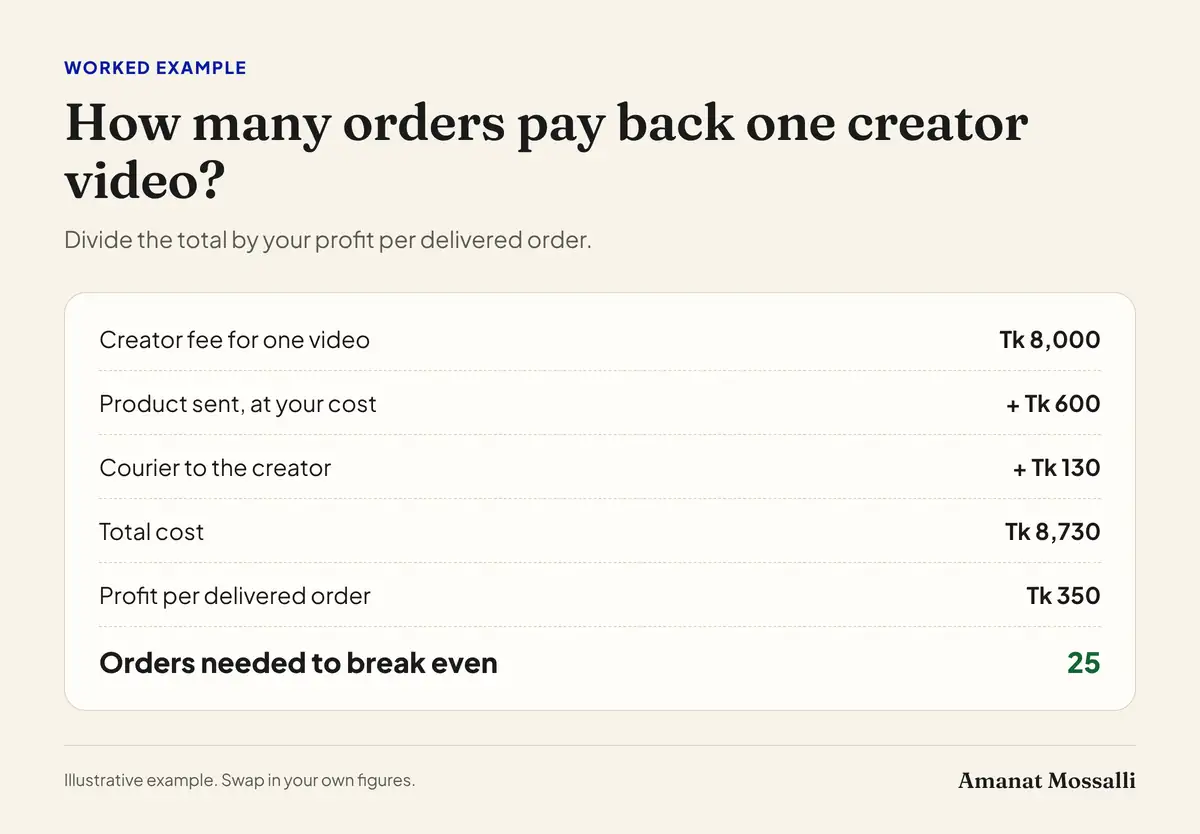
Now ask one honest question. Can this creator bring 25 delivered orders? If their last five videos average 40,000 views, 25 orders is one buyer per 1,600 views. That’s possible for a good match. If they average 3,000 views, it isn’t.
Sum two: cost per thousand views. Divide the fee by the creator’s average views, then multiply by 1,000. Here that’s 8,000 / 40,000 x 1,000, or Tk 200.
Compare that with the CPM in your own Ads Manager. If your ads reach a thousand people for far less, the creator has to earn the gap in trust. Often they do. Sometimes they don’t.
Stuck on a quote you can’t judge? Bring it to a free 15-minute call and we’ll run both sums on it together.
Pay a little extra for the right to use the video in your ads for three to six months. That one clause is often worth more than the post itself.
Then there are the hidden costs: product samples, delivery, your own time, and the ad budget to push the best videos further. Budget for those too. My Facebook ads cost guide helps with that last line.
The Creator Content That Sells Here
Content that looks like a real person using your product. Honest reviews, before-and-after clips, unboxing and “a day with” videos beat polished ads almost every time.
The right format depends on what you sell. This is the starting point I hand to clients by industry.
| Industry | Content that works | Best platform |
|---|---|---|
| Fashion and clothing | Try-on videos, Eid outfit ideas, styling one item three ways | TikTok, Facebook Reels |
| Food and restaurants | Honest taste tests, “is it worth the price?” visits | Facebook, TikTok |
| Beauty and skincare | Routines, 14-day results, how to spot fake products | Instagram, TikTok, YouTube |
| Gadgets and electronics | Unboxing, long-term reviews, comparisons | YouTube |
| Education and services | Student stories, explainer videos, live Q&A | Facebook, YouTube |
Don’t forget your own buyers either. Real customers posting their orders, with permission to reshare, act like free micro reviews. Ask for them in your delivery packet or in a follow-up message.
Ask every creator to show the product in the first three seconds. On Reels and TikTok, people decide to scroll or stay almost instantly.
Bangla or English? For most local audiences, natural Bangla connects better. So does the mixed Banglish people actually speak. Save English for premium, export or B2B audiences who expect it.
How Do You Choose the Right Influencer?
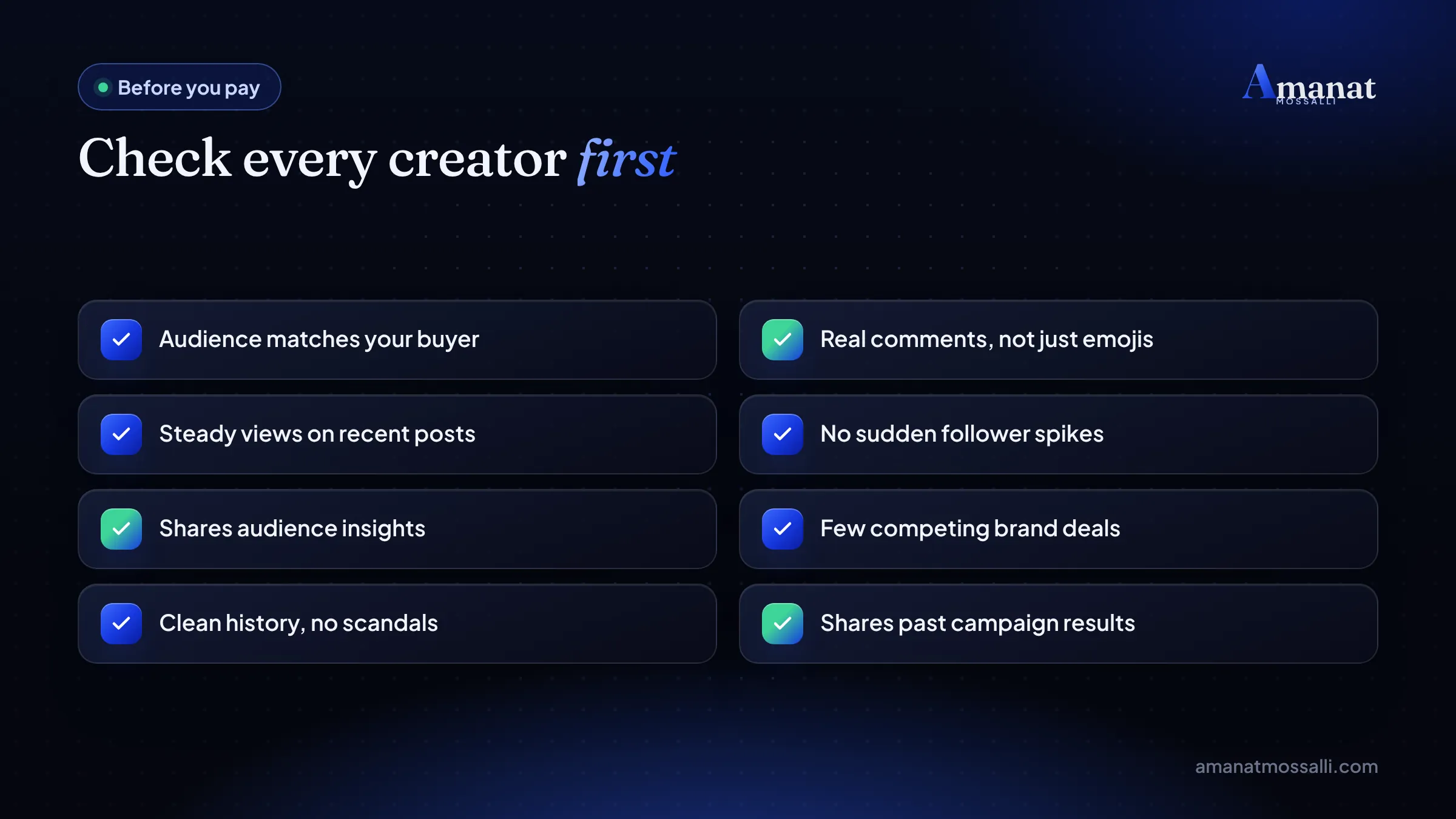
Pick a creator whose audience matches your buyer and whose comments show real, active people. Follower count is the last thing to look at.
Fake followers are a real problem here. The Financial Express article above names bot engagement and inflated metrics as issues that distort campaigns. So before you pay anyone, do a quick check.
The engagement sum
Take the creator’s last ten posts. Add up likes, comments and shares. Divide by ten, then by the follower count.
Say ten posts total 9,000 interactions on an account with 30,000 followers. That’s 900 per post, or 3%. A 30,000-follower account averaging 60 interactions per post is at 0.2%. Something is wrong there.
Then read the comments, all of them. Are people asking real questions, like price, size or where to buy? That’s an audience that buys.
Ask who the followers are
This step saves the most money. Social audiences in Bangladesh lean male. DataReportal’s Digital 2026 Bangladesh report puts TikTok’s adult ad audience at 70.1% male and Instagram’s at 65.4% male. Facebook’s is 63.1%.
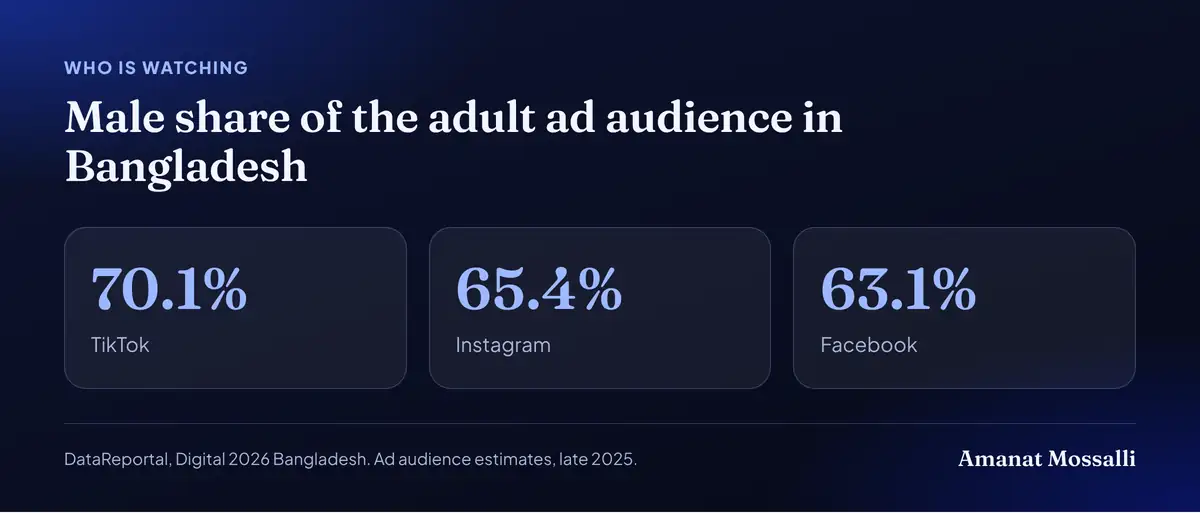
So a creator can have 80,000 followers and very few of the women you sell to. Looks tell you nothing. A beauty creator’s audience can be mostly men.
Ask for screenshots of their audience insights: age, gender and top cities. Honest creators share these without fuss. If someone refuses, move on.
An Influencer Marketing Strategy in Six Steps
A good influencer marketing strategy starts with one clear goal and ends with tracked sales. This is the process I run with clients.
A brief that fits in one message
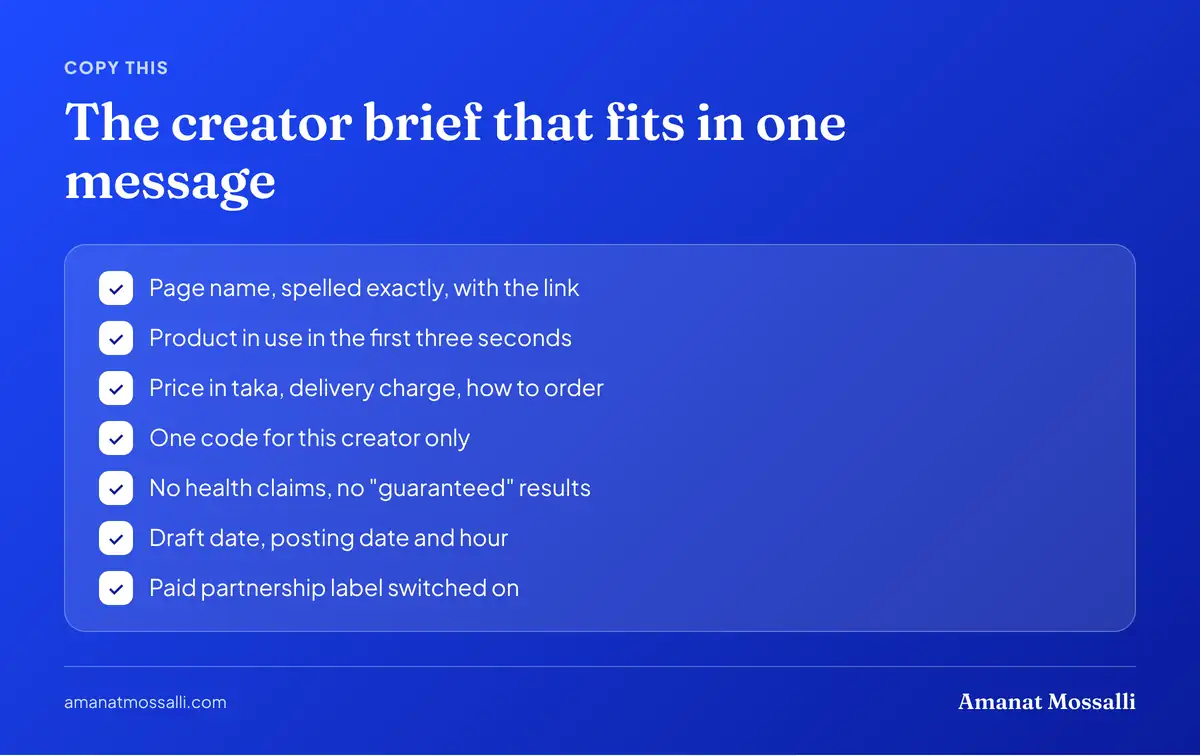
The pickle seller’s first try had no brief at all. This is what a short one looks like. It fits in a single WhatsApp message.
- Who we are: page name, exactly as it’s spelled, and the link.
- What to show: the product in use, in the first three seconds.
- Three facts to say: price in taka, delivery area and charge, how to order.
- Your code: one code for this creator only.
- Don’t say: any health claim, any “guaranteed” result, any dig at a rival.
- Dates: draft by one date, post on another, at a set hour.
- Label: the platform’s paid partnership tag switched on.
Don’t script every word. Bangladeshi audiences can smell a forced script from the first line. Give the creator the facts and let them tell it their way.
What the written agreement should cover
A page is enough for a small deal. A WhatsApp message both sides confirm is better than nothing. Cover these lines.
- Number and type of posts, with platforms.
- Fee, what triggers payment, and the payment date.
- Whether you see the draft first, and how many changes you get.
- How long the post must stay up.
- Ad usage rights: which platforms, how many months.
- Exclusivity: whether they can promote a direct rival that month.
- What happens if the post is late or never goes up.
Creators also work best inside a wider plan. My guide to social media marketing for Bangladeshi businesses shows how they fit with your own page, content and ads.
How Do You Turn Creator Videos into Partnership Ads?
You run them as Partnership Ads in Meta Ads Manager, with the creator’s permission. The ad can show the creator’s handle and your page together, so it keeps the creator’s trust and gets your targeting.
This is where most of the money gets made, and it’s the part I know best. I’ve managed more than $8M in Google and Meta ad spend. Inside an ad account, a creator video is one more creative that has to earn its budget.
An organic creator post reaches some followers once. The same video as an ad can reach the right buyers across Facebook and Instagram for weeks.
Permission comes in two forms. For a one-off, the creator generates a partnership ad code for that single post and sends it to you. For an ongoing deal, they approve your page at account level, so you don’t ask every time.
- Agree the permission type before the post goes live, not after.
- Start with the videos that got the best organic comments and saves.
- Test two or three hooks, the first seconds of the video, against each other.
- Retarget people who watched most of the video with a clear offer.
One caveat. Meta’s branded content rules expect a paid deal to carry the paid partnership label. Creator content you pay for should run in ads as Partnership Ads. Hide a paid deal as a normal user video and your ads can get rejected.
There’s a second edge to that rule. When a creator’s claim runs in your ad, the claim is yours too. Read every word before you put money behind it.
How Do You Measure Influencer Marketing ROI?
Track the sales each creator brings and compare them with what you paid. Views and likes are nice. They don’t pay salaries.
These simple tools make it possible, even for a small Facebook shop:
- Unique promo codes for each creator, like RAFI10 or NUSRAT10.
- Tracked links with UTM tags, so Google Analytics 4 shows where buyers came from.
- A simple landing page for the campaign, with the offer and an easy order form.
- Asking buyers “Where did you hear about us?” on Messenger or at checkout.
Then do the maths. Here’s an example sheet with three creators. Yours needs the same columns.
| Creator A | Creator B | Creator C | |
|---|---|---|---|
| Fee plus product and courier | Tk 8,730 | Tk 5,730 | Tk 3,730 |
| Orders using their code | 48 | 21 | 2 |
| Delivered and paid | 40 | 18 | 2 |
| Profit at Tk 350 per delivered order | Tk 14,000 | Tk 6,300 | Tk 700 |
| Result after cost | + Tk 5,270 | + Tk 570 | – Tk 3,030 |
| Decision | Sign for three months | Try once more with a new hook | Thank them and stop |
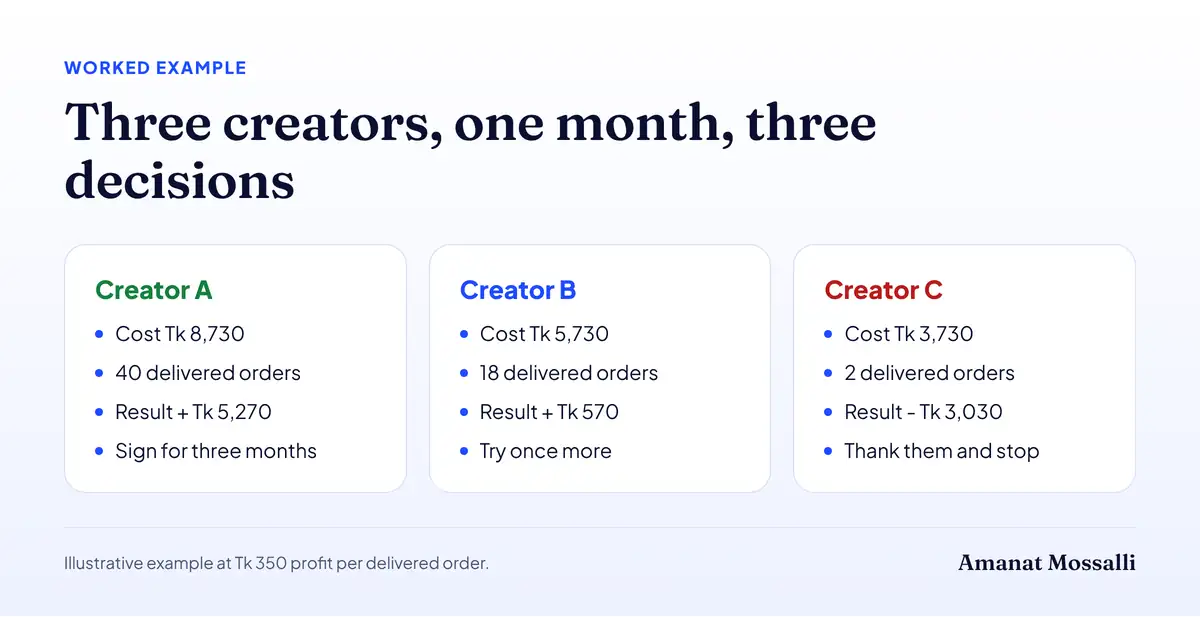
Count delivered orders, not orders. Cash on delivery is how 86.8% of online shoppers paid in the BBS survey, so some parcels always come back.
Watch repeat buyers over the next 60 to 90 days too. A good creator brings customers who come back, and that can turn Creator B into a winner.
Be honest with yourself about timing. Some creator posts sell on day one. Others mostly build recall, and the sales show up weeks later as people search your page by name. I still can’t predict which post will do which.
Influencer marketing won’t work if the product is weak, the price sits far above the market, or your page can’t handle the messages. Fix the business first, then spend on creators.
If you can’t see where your sales come from, fix that first. Clean tracking and analytics makes every creator decision easier.
Is Influencer Marketing Safe? Rules, Disclosure and Risks
It’s safe when you choose honest creators, disclose paid deals, and never let anyone make false claims. Most of the risk comes from skipping those basics.
What the law already says
Bangladesh’s Consumer Rights Protection Act 2009 covers false and misleading advertising. The maximum punishment is one year in prison, a fine up to Tk 2 lakh, or both, according to Lawyers Club Bangladesh’s explainer. I read it on 11 November 2026.
The same explainer notes that a buyer should complain within 30 days. A quarter of any fine collected goes to the person who complained. So unhappy buyers have a reason to file.
A creator’s exaggerated claim about your product can land on you. This is general guidance, not legal advice, so check with a lawyer for big deals.
What the platforms require
TikTok is specific. TikTok’s help page for creators says creators must turn on the commercial content disclosure setting when a post promotes a brand, product or service.
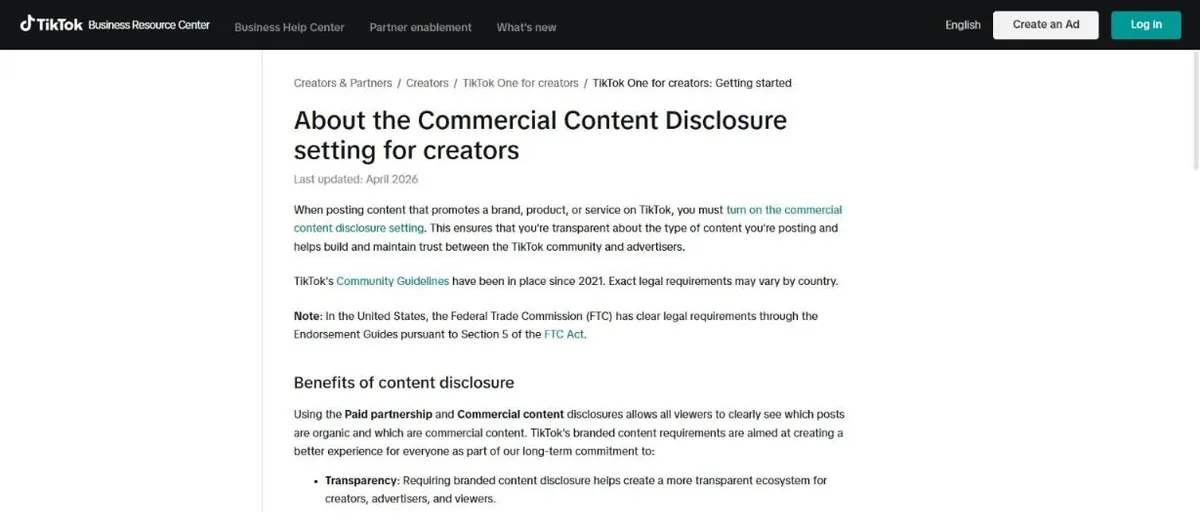
If TikTok spots undisclosed branded content, the creator gets a notice and 24 hours to respond. After that the video can lose its place in the For You feed. So hiding the deal can kill the reach you paid for.
On Facebook and Instagram, use the paid partnership label. Put both labels in your brief, in writing.
- Paying for reach without checking for fake followers and bot comments.
- Hiding paid deals. Buyers feel cheated when they find out, and platforms can penalise it.
- Letting creators make medical or “guaranteed” claims about your product.
- Working with creators who promote betting or scam apps. Their audience trust is already damaged.
- No written agreement on posts, dates, rights and payment.
- One-off posts only, then wondering why nobody remembers the brand.
One creator scandal can land on your page too. Check their last six months of content before you sign.
Where Do Creators Fit in Brand Building?
As one part of it, never the whole thing. Creators bring attention and trust. Your product, delivery and customer service have to keep that trust.
I learned this the hard way with a children’s clothing seller in Gazipur, before Eid in 2025. A family creator posted a try-on video of her cotton frocks on a Tuesday night. By Thursday she had more than 400 messages and stock for about half of them.
Her size chart said “2-3 years” and nothing else. Parents guessed. Roughly one in three of those first parcels came back, and the comments filled up with “size vul”. The video sold. The business behind it wasn’t ready.
We paused the ads on that video for three weeks. She added real measurements in inches to every size and put a cousin on the inbox at night. When we ran the same video again, returns dropped to about one in ten. Fix the basics first, then pay for attention.
Long-term partners build recall too. When the same TikTok influencers and YouTubers mention you every month, buyers start treating you as a known brand. That’s how small brands begin to compete with big ones.
For the full foundation, read how to make brand building in Bangladesh. For where all this is heading, see the future of digital marketing in Bangladesh.
FAQ: Why Influencer Marketing Is Important for Bangladeshi Businesses
Does influencer marketing work in Bangladesh?
How much do influencers charge in Bangladesh?
Are micro-influencers better than celebrities?
How do I find influencers in Bangladesh?
How do I spot fake followers?
Do influencers need to disclose paid posts?
Which platform is best for influencer marketing in Bangladesh?
So Should You Try Creators This Month?
If your product is good and your page answers messages, yes. Why influencer marketing is important for Bangladeshi businesses comes down to one word: trust. Creators already have it. Your job is to choose them carefully, let them stay honest, and track what they bring.
The pickle seller did try again. The second time round, she did it differently.
She picked three small food creators whose comments were full of “apu, price?” questions. Each got a short brief, a jar, and a code: one creator, one code. The videos went out on a Thursday evening, when people plan weekend meals.
Two creators brought orders. Between them, about 40 delivered jars in the first two weeks. The third brought nothing but kind words. She’d spent around Tk 9,000 in all on fees, jars and courier, so the month ended with a small profit, not a fortune. She now sends the two winners a new flavour every month.
Not a dramatic result, but a steady one. She finally knows which taka did what.
Her whole second campaign was three jars, three briefs and three codes. You can start the same way this week. Pick three creators. Do the break-even sum. Send the brief. Then let the codes tell you who to keep.

Amanat Mossalli Taju
Senior Digital Marketer & SEO Expert, Dhaka, BangladeshI have grown 235+ brands over more than seven years with SEO, Google and Meta Ads, server-side tracking, WordPress and AI automation. Half of my clients are in the UK, USA, Australia and Canada. Everything I write here comes from real client work.
Want this done for your business?
Book a free 15-minute call. I look at your site and ads before we talk, so you leave with clear next steps.