Top 20 Fast Growing Business in Bangladesh in 2026
A relative home from Qatar with savings and one question: which business? Twenty sectors growing in 2026, each with checked numbers, the risks, and a low-budget way in.

My phone rang on the second day of Eid. A cousin had just landed from Qatar after nine years, with his savings in a bank account and no plan beyond “something that’s growing”. He wanted one name. Which fast growing business in Bangladesh should he put his money into?
I couldn’t give him one name. I gave him this list instead, and the same warning I’ll give you: growth in a sector is a tailwind, not a guarantee.
Here’s the short version. The fastest growth right now is in light engineering, pharma exports, IT and software services, digital payments, e-commerce and rooftop solar. Below are 20 businesses and sectors, each with the latest number I could check in November 2026. Each one also has a way in for someone without crores of taka.
This is general guidance, not financial advice. Growth in a sector doesn’t mean profit for every business inside it.
| # | Sector | Latest checked signal |
|---|---|---|
| 1 | E-commerce and f-commerce | Card e-commerce about Tk 21.85 billion a month |
| 2 | Digital payments and fintech | Bangla QR mandatory from 1 July 2026; five digital banks approved |
| 3 | Software and IT services | Software exports up 54% (Jul to Nov FY26) |
| 4 | IT-enabled services | Up 16.74% in the same five months |
| 5 | Digital marketing services | Facebook ads reach 64 million people |
| 6 | AI automation services | Demand signal, no clean number |
| 7 | Creator economy and video | YouTube ads reach 49.8 million |
| 8 | Online education | Demand signal, no clean number |
| 9 | Light engineering | +21.77% in FY26, +16.51% in Q1 FY27 |
| 10 | Pharmaceuticals | +40.39% in Q1 FY27 |
| 11 | Leather and footwear | +14.74% in Q1 FY27 |
| 12 | Jute and eco products | +31.55% in Q1 FY27 |
| 13 | Home textiles | +11.94% in Q1 FY27 |
| 14 | Agro-processing and packaged food | Mixed: strong June, weak Q1 FY27 |
| 15 | Rooftop solar | About 667 MW industrial rooftop, per IEEFA |
| 16 | Logistics and courier | Grows with every online order |
| 17 | Healthcare and diagnostics | Demand signal, no clean number |
| 18 | Cloud kitchens | Demand signal, no clean number |
| 19 | Domestic tourism | Demand signal, no clean number |
| 20 | Home construction and interiors | Record $35.56 billion remittances in FY26 |
Where I write “demand signal”, I couldn’t find a reliable 2026 number. I’d rather say so than invent one. Every other figure is sourced in its own section below.
What's the fastest growing business in Bangladesh right now?
Light engineering, if you mean exports. Engineering products grew 21.77% in FY26. Software, if you mean digital: exports up 54% in the first five months of FY26.
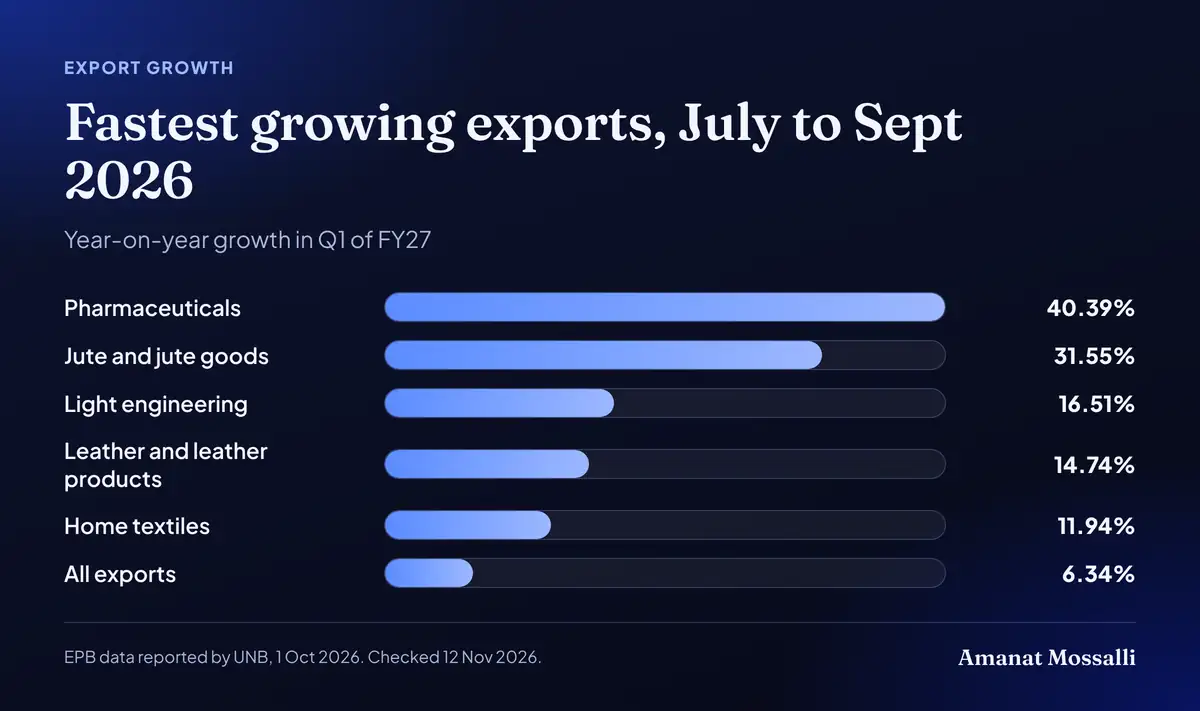
The newest data adds a twist. In the first quarter of FY27 (July to September 2026), pharmaceuticals grew fastest. EPB figures reported by UNB on 1 October 2026 show pharma up 40.39%. Jute goods rose 31.55%, light engineering 16.51% and leather 14.74%. Home textiles grew 11.94%. Total exports rose 6.34% to $13.09 billion. I checked all of these on 12 November 2026.
“Fast-growing” can mean two different things, though. A big industry growing fast, or a small market that’s just taking off. This list has both, and I’ll tell you which is which.
One quarter is not a trend. Pharma’s jump comes from a fairly small base, so a few big orders move the percentage a lot. I’d read the quarter as a signal to watch, then wait for the full year.
Garments are missing from my top 20 on purpose. Ready-made garments earned $38.7 billion in FY26, about 81% of all exports. Total exports actually dipped about 0.6% that year. Garments grew 6.10% in the first quarter of FY27, roughly in line with the total. The giant, not the runner.
Big is not the same as fast. Look for where the money is moving, not where it already sits.
How did I pick these 20?
Public data first, then what I see in client work. I’m Amanat Mossalli Taju, and for over seven years I’ve run marketing for 235+ brands. That means I watch which trades start asking for ads and SEO each year. A sector that suddenly needs customers online is usually a sector where money is moving.
- Recent growth data: export, payment or capacity numbers from FY26, FY27 or 2026 where they exist.
- Real demand: people and companies already paying for it.
- Room for small players: a small business can join without crores of taka.
- Marketing signals: sectors I see raising ad and SEO budgets.
The 20 sit in three groups: digital businesses, industry and export, and services and infrastructure. Easier to scan that way.
One honest limit. Some of the fastest growing industries in Bangladesh, like healthcare or cloud kitchens, have no clean public growth number for 2026. For those I describe the demand I can see. Business opportunities in Bangladesh are real, but only numbers you can check should guide big money. My cousin didn’t love hearing that.
What does the economy look like in 2026?
Past $500 billion for the first time, but growing slowly. The bright spots are remittances, digital adoption and a handful of export sectors.
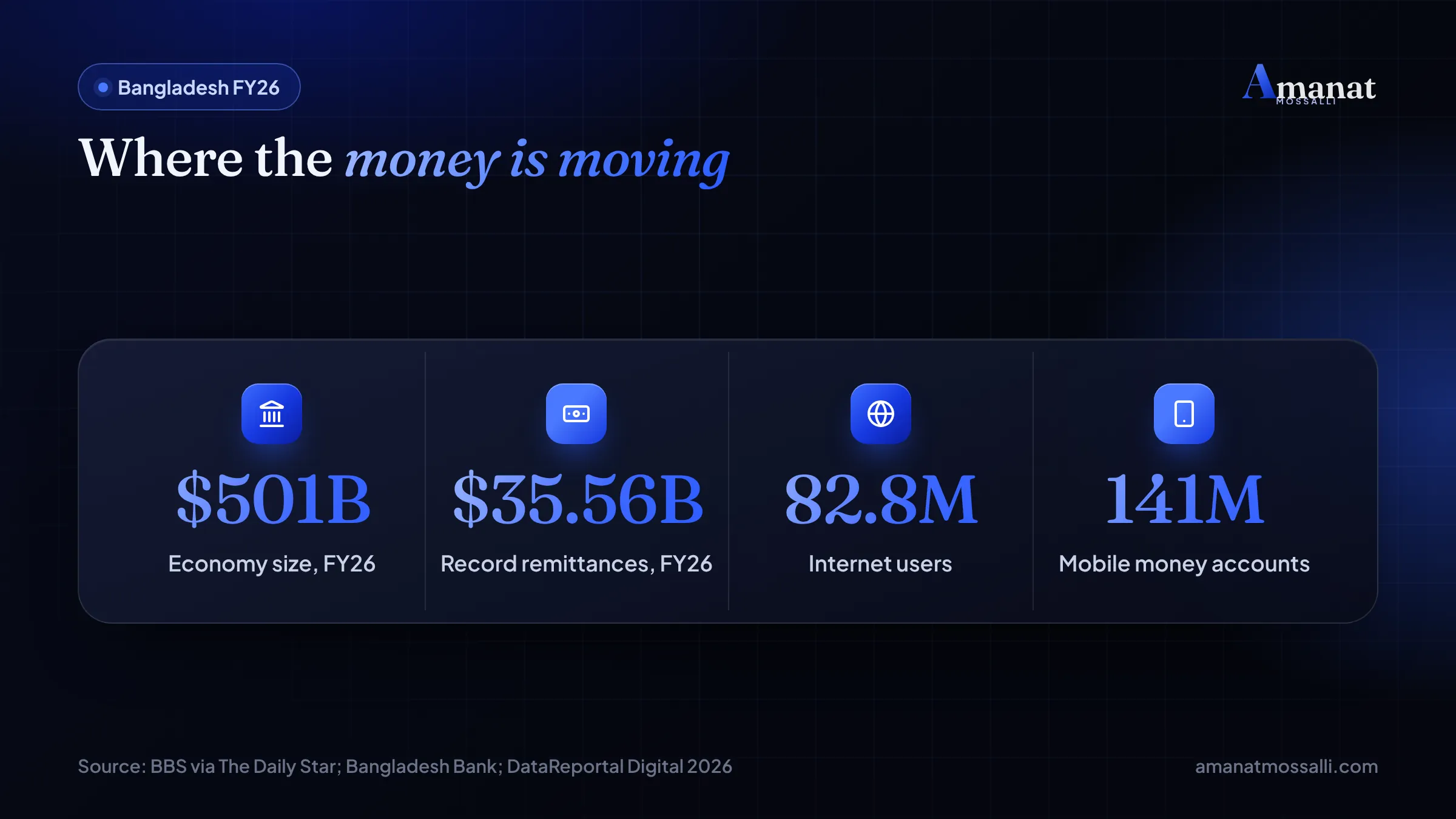
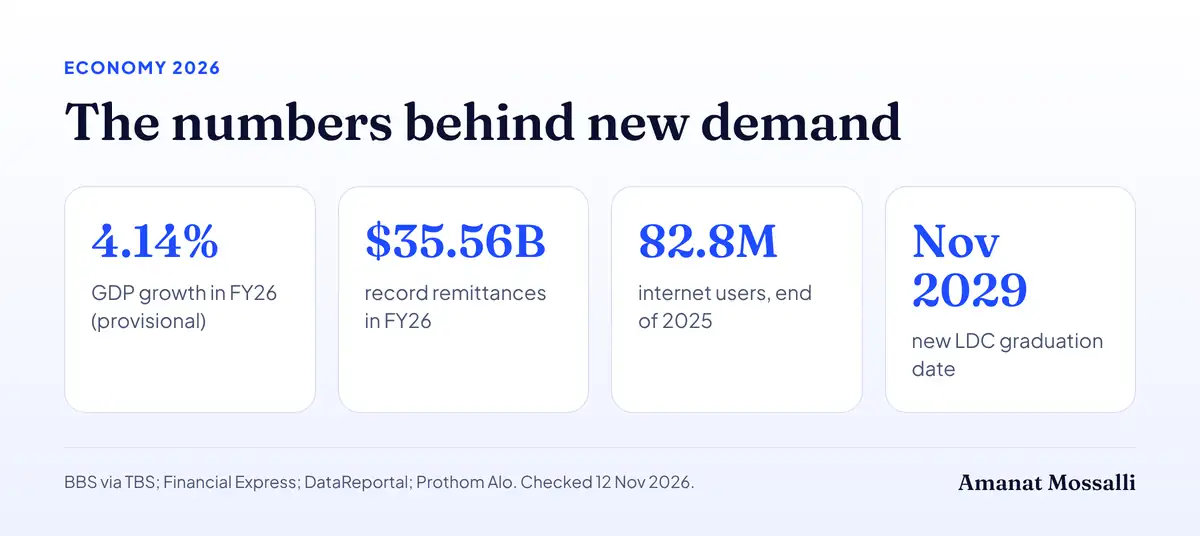
The Bangladesh Bureau of Statistics released its provisional FY26 numbers on 10 June 2026. The Business Standard reported GDP growth of 4.14%, up from 3.49% the year before. The economy reached about $501 billion. Per capita income rose to $3,020.
The weak spot is investment. The same report shows investment fell to 27.93% of GDP, from 28.54%. Businesses are cautious. So picking the right sector matters more in a slow year, not less.
The upside is real money in people’s pockets. The Financial Express reported record remittances of $35.56 billion in FY26, up 17.3% from $30.32 billion. And DataReportal’s Digital 2026 report counts 82.8 million internet users at the end of 2025.
One more change landed on 30 October 2026. The UN General Assembly postponed Bangladesh’s graduation from least developed country status by three years. Prothom Alo reports the new date as November 2029, instead of 24 November 2026. For exporters, that means LDC trade benefits stay in place for longer than planned.
Digital businesses growing fastest (1 to 8)
They need little capital, and they can sell to the whole world from a flat in Mirpur. IT exports, digital payments and e-commerce all show clear growth in the data.
1. E-commerce and f-commerce
Online selling keeps growing from a small base. Bangladesh Bank data reported by The Financial Express shows card-based e-commerce spending. It averaged about Tk 21.85 billion a month from August 2025 to June 2026. May 2026 was the high point, at Tk 24.67 billion.
Cards are only a slice, though. A BBS household survey for 2024-25, reported by The Daily Ittefaq, found 14.4% of people had bought something online. Of those buyers, 86.8% paid cash on delivery. Dhaka division led at 21.3%.
Read those two numbers together. Most of the country hasn’t bought online yet, and those who have still prefer cash. That’s room to grow, and a clue about how to sell.
Where a small business fits: start on Facebook, then move to your own website once orders are steady. Offer cash on delivery from day one.
2. Digital payments and fintech
Mobile financial services (MFS) like bKash handled about Tk 1.58 trillion in October 2025 alone, per Bangladesh Bank. The same data shows roughly 141 million accounts. One catch: Nagad hadn’t submitted data since March 2025, so the real total is higher.
Two 2026 changes matter more for a small business. Bangladesh Bank made the shared Bangla QR code compulsory nationwide on 1 July 2026. By 10 August, it had carried about Tk 1,500 crore across roughly 56 lakh payments, Ittefaq reported. Then on 24 September 2026, five digital banks got initial approval, including bKash Digital Bank, per The Financial Express.
Your way in: become an agent, or help shops set up QR, simple billing and payment reconciliation.
3. Software and IT services
According to The Daily Star, IT exports reached $269.84 million in July to November of FY26, up 13.54%. Software exports alone grew 54%, pushed by demand for AI-related work.
The foreign buyers are real. About half of my own clients are in the UK, USA, Australia, Canada and Europe. Not one of them hired from Dhaka because it was cheap alone. They stayed because the work arrived on time.
Where a small business fits: teams of three to five developers can win steady foreign clients.
4. IT-enabled services and freelancing
IT-enabled services, which include BPO (outsourced back-office work), earned $235.72 million in the same five months, up 16.74%. That’s most of Bangladesh’s IT export income.
Your way in: freelancers who build a small agency around one service grow fastest.
5. Digital marketing services
Local businesses are moving budgets online. DataReportal’s Digital 2026 report shows Facebook ads could reach 64 million people in Bangladesh and TikTok ads 56.2 million adults.
Where a small business fits: shops need help with ads, SEO and tracking, and most can’t hire in-house. This is my own trade, so I’m biased, but the demand is real.
6. AI automation services
Small businesses want chatbots, auto-replies and simple AI workflows, and few know how to set them up. The same Daily Star report ties the rise in software exports to AI-driven demand.
Your way in: chatbot setup for Facebook pages and clinics. Keep it simple and practical.
7. Creator economy and video production
Video drives buying decisions now. YouTube ads could reach 49.8 million people in Bangladesh in late 2025, according to DataReportal.
Where a small business fits: product video studios and creator agencies serve brands and creators alike.
8. Online education and skills training
Demand for practical skills like English, coding, design and marketing keeps rising as young people chase remote work. I couldn’t find a reliable 2026 market size, so judge this one on demand signals.
Your way in: teach one skill well, in Bangla, with real projects. No get-rich promises.
Industry and export sectors on the rise (9 to 14)
Light engineering, pharma, leather, jute and home textiles all grew in FY26 and again in the first quarter of FY27. These are the emerging sectors beyond garments.
9. Light engineering
Light engineering means small factories making machine parts, bicycles, tools and electrical goods. It was the star of FY26, with engineering exports up 21.77%, according to Export Promotion Bureau data reported by The Financial Express. Growth held at 16.51% in the first quarter of FY27.
Bicycles show the shape of it. The Financial Express reported $151.40 million in bicycle exports in FY26, up from $116.44 million. Most went to the European Union, and products now reach more than 40 countries.
Where a small business fits: small workshops can supply parts to bigger factories and exporters.
10. Pharmaceuticals
Medicine exports rose 9.7% to $194.63 million in July to April of FY26, per The Financial Express. Then came the 40.39% jump in the first quarter of FY27. Bangladesh makes about 95% of the medicine it needs and ships to more than 150 countries.
The pharmaceutical industry is still mostly big companies. Nearly all raw materials are imported, so a weak taka pushes costs up.
Your way in: pharmacy chains, medicine delivery and packaging suppliers grow with it.
11. Leather and footwear
Leather and leather product exports grew 7.09% in FY26 to about $1.23 billion, per EPB data. The first quarter of FY27 was stronger still, at 14.74%. Footwear brands are growing at home as well.
Where a small business fits: handmade leather goods sell well online, at home and abroad.
12. Jute and eco-friendly products
Jute and jute goods exports grew 7.75% in FY26 to $883.69 million. In the first quarter of FY27 they jumped 31.55%. Global buyers want plastic-free packaging and natural products.
Your way in: jute bags, decor and gift items suit small makers and Etsy-style selling.
13. Home textiles
Home textiles, like bedsheets, towels and curtains, grew 6.52% in FY26 and 11.94% in the first quarter of FY27. A natural next step for Bangladesh’s huge textile base.
Where a small business fits: local brands selling bedding and towels online with strong photos.
14. Agro-processing and packaged food
Agro-processing means turning farm products into packaged food, snacks and spices. Agricultural exports jumped 46.77% in June 2026 alone. Then they fell in the first quarter of FY27, so this one swings. At home, busy city families buy more frozen and ready-to-cook food every year.
Your way in: frozen snacks, spices and sauces can start small with good hygiene and the right licences. Sell at home first. Export later, once quality is steady.
Why does export growth matter to a small business? Every growing factory needs suppliers, packaging, transport, software and marketing. You don’t need to own a factory to earn from a growing sector. You can serve the ones that do.
Export numbers bounce around month to month. Look at full-year trends, not one good month, before you put money in.
Which service and infrastructure businesses are growing? (15 to 20)
Rooftop solar, logistics, healthcare, food delivery, tourism and home improvement. They grow because daily life is changing. More people live in cities, shop online and spend remittance income at home.
15. Rooftop solar and clean energy
Rooftop solar is taking off as factories face rising power tariffs. An IEEFA briefing note from 4 August 2026 counts about 667 MW across 239 establishments. Government data showed 418.1 MW by June 2026. The government targets 5,500 MW of new rooftop solar by 2030.
The same note lists two risks. Duty on industrial rooftop solar rises to 17%, from 1%. And net-metering connections still face delays, despite a fixed 10 to 15 day approval timeline. EPC firms (the companies that design and build these systems) hold a pipeline of more than 500 MW.
Where a small business fits: installers, maintenance teams and solar financing services are all in short supply.
16. Logistics, courier and warehousing
Every online order needs a rider, a hub and a warehouse. As e-commerce spreads to the districts, last-mile delivery and small warehouses grow with it.
Your way in: courier franchises and local delivery hubs in district towns.
17. Healthcare and diagnostics
Families still fly abroad for treatment, which tells you how much demand goes unmet at home. Diagnostic centres, home care and telemedicine keep expanding in cities and district towns.
Patients search online before choosing a doctor or clinic. In my experience, clinics that show up on Google Maps with real reviews get more bookings.
Where a small business fits: home sample collection, physiotherapy at home and health booking apps.
Two years ago an interior design firm from Bashundhara came to me. Their marketing was a vinyl banner on a tin fence near a construction site and word of mouth from one developer. The owner opened Search Console on my laptop for the first time that afternoon and didn’t know what he was looking at. We built a plain website with real project photos and set up a Maps profile. Then we ran a small Google Ads test aimed at people searching for flat interiors in Dhaka. The enquiries that arrived weren’t all good. Plenty wanted a full flat done for Tk 50,000. By the third month, he was getting about a dozen serious enquiries a month, and two or three became signed jobs. But the bigger lesson was the pattern. People with remittance money and a new flat were searching. Almost nobody in his trade was there to be found. He’s not the only one. More of my enquiries now come from clinics, solar installers and interior firms than from any other group. A few years ago these sectors barely advertised online. Now they fight over the same searches.
18. Cloud kitchens and food delivery
Cloud kitchens are delivery-only kitchens with no dining hall. Rent stays low and they sell through apps and Facebook.
Your way in: a focused menu with one strong item beats a long menu every time.
19. Domestic tourism and hospitality
Cox’s Bazar, Sylhet, Sajek and the Sundarbans fill up every holiday. A growing middle class travels more inside the country.
Where a small business fits: small resorts, tour operators and online booking pages for local tours.
20. Home construction and interiors
That record $35.56 billion in FY26 remittances has to go somewhere. Families spend a lot of it on homes, furniture and renovation. My cousin’s first purchase, before any business, was tiles.
Your way in: interior design, finishing work and home improvement outside Dhaka.
Test a growing sector with a small pilot
A sector’s growth tells you where to look. It doesn’t tell you whether your version will sell. So before my cousin touched most of his savings, we wrote a pilot on a napkin. Here it is, roughly as we sketched it.
His idea was a solar panel cleaning and maintenance service for factories near Gazipur. He’d run it with a friend who’s an electrician. The test had one goal: find out if factories would pay for maintenance, not just installation.
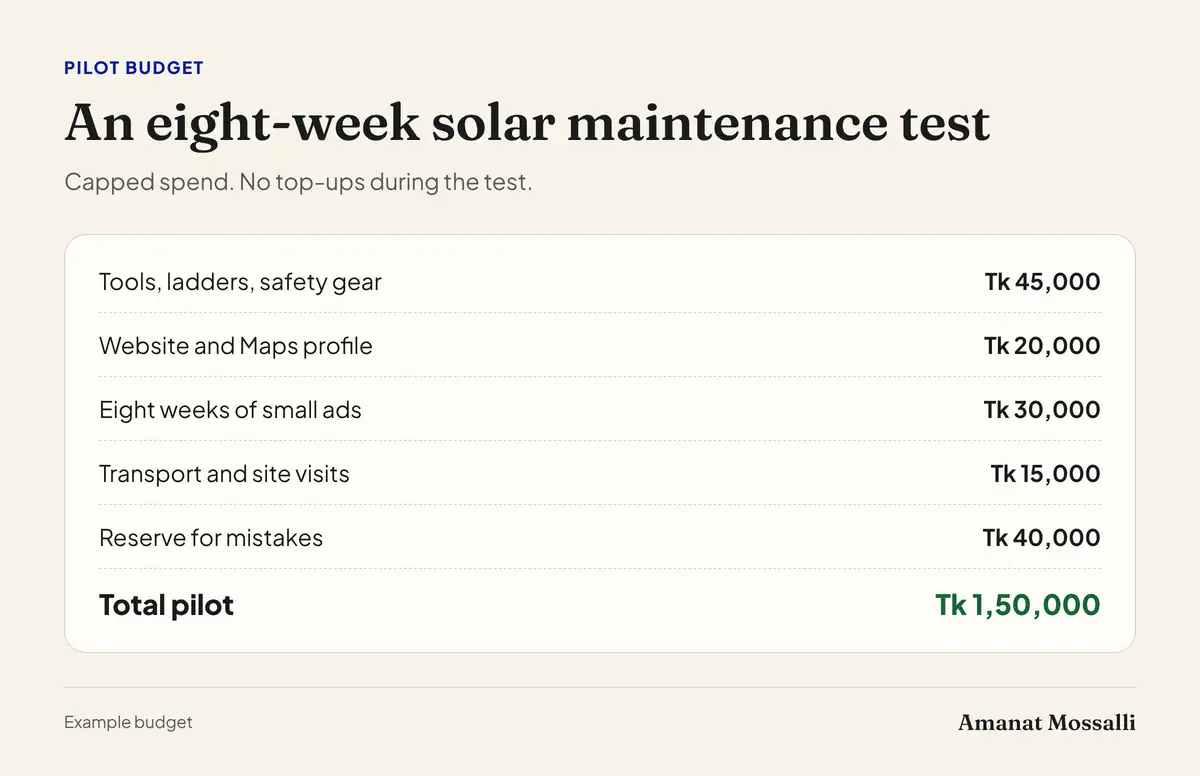
| Item | Budget | Why |
|---|---|---|
| Tools, ladders and safety gear | Tk 45,000 | Needed for any real job |
| Simple website and Google Maps profile | Tk 20,000 | Factory managers check before they call back |
| Eight weeks of small Google and Facebook ads | Tk 30,000 | To see who searches, not to scale |
| Transport and site visits | Tk 15,000 | Free inspections to start conversations |
| Reserve for mistakes | Tk 40,000 | Something always breaks |
| Total pilot | Tk 1,50,000 | Capped. No top-ups during the test. |
Then we wrote the rules down before spending a taka. This is the part most people skip.
- 1A clear win: at least three paid jobs in eight weeks, and one client asking for a monthly contract.
- 2A maybe: paid jobs, but no repeat interest. Change the offer, run four more weeks.
- 3A stop: plenty of free inspections, zero paid work. The sector grows, but this niche doesn’t pay.
The numbers will differ for your idea. The shape shouldn’t. A capped budget, a fixed time, and a written rule for what counts as a yes.
Which fast growing business in Bangladesh fits a small budget?
Digital services, f-commerce and small food brands. Solar, pharma and light engineering usually need far more capital and technical licences.
| Business | Rough entry budget | Risk level |
|---|---|---|
| Digital marketing or IT services | Tk 10,000 to 1 lakh | Low |
| F-commerce shop | Tk 30,000 to 2 lakh | Medium |
| Packaged food or snacks | Tk 50,000 to 3 lakh | Medium |
| Cloud kitchen | Tk 2 lakh to 8 lakh | Medium to high |
| Solar installation | Tk 5 lakh+ | Medium to high |
| Light engineering workshop | Tk 10 lakh+ | High |
Rough ranges, based on what I see with clients and business owners in Dhaka. Rent, equipment and licences can move them a lot. (I’d treat the top of each range as the realistic number.)
A solar maintenance pilot like my cousin’s sits below the solar installation line. Maintenance needs tools and skill. Installation needs stock, engineers and working capital.
Want ideas you can start online with less? See my list of the best online business ideas in Bangladesh, or read which business is most profitable in Bangladesh.
The risks nobody mentions at the tea stall
Crowding, policy changes and cash flow. A sector that grows fast pulls in a crowd of new competitors at the same time, and the crowd arrives before the profit does.
- Too many copycats: when everyone starts the same business, prices fall.
- Policy changes: new duties, VAT or licences can change your costs overnight. The rooftop solar duty rise from 1% to 17% is one 2026 example.
- Dollar and import costs: anyone importing raw materials feels every move in the exchange rate.
- Cash flow: big clients and exporters often pay late. Very late.
- Hype: a hot sector doesn’t fix a weak product or poor service.
The LDC delay cuts both ways. Exporters keep their trade benefits until November 2029. But the deadline hasn’t gone away. A business plan built on export margins should still ask what happens after 2029.
None of that means wait. It means start small, test demand, and keep six months of cash where you can’t easily spend it.
How does a new business grow fast here?
Pick a growing sector, serve one clear customer, and get found online early. Most of the growth problems I’m hired to fix are marketing problems, not product problems.
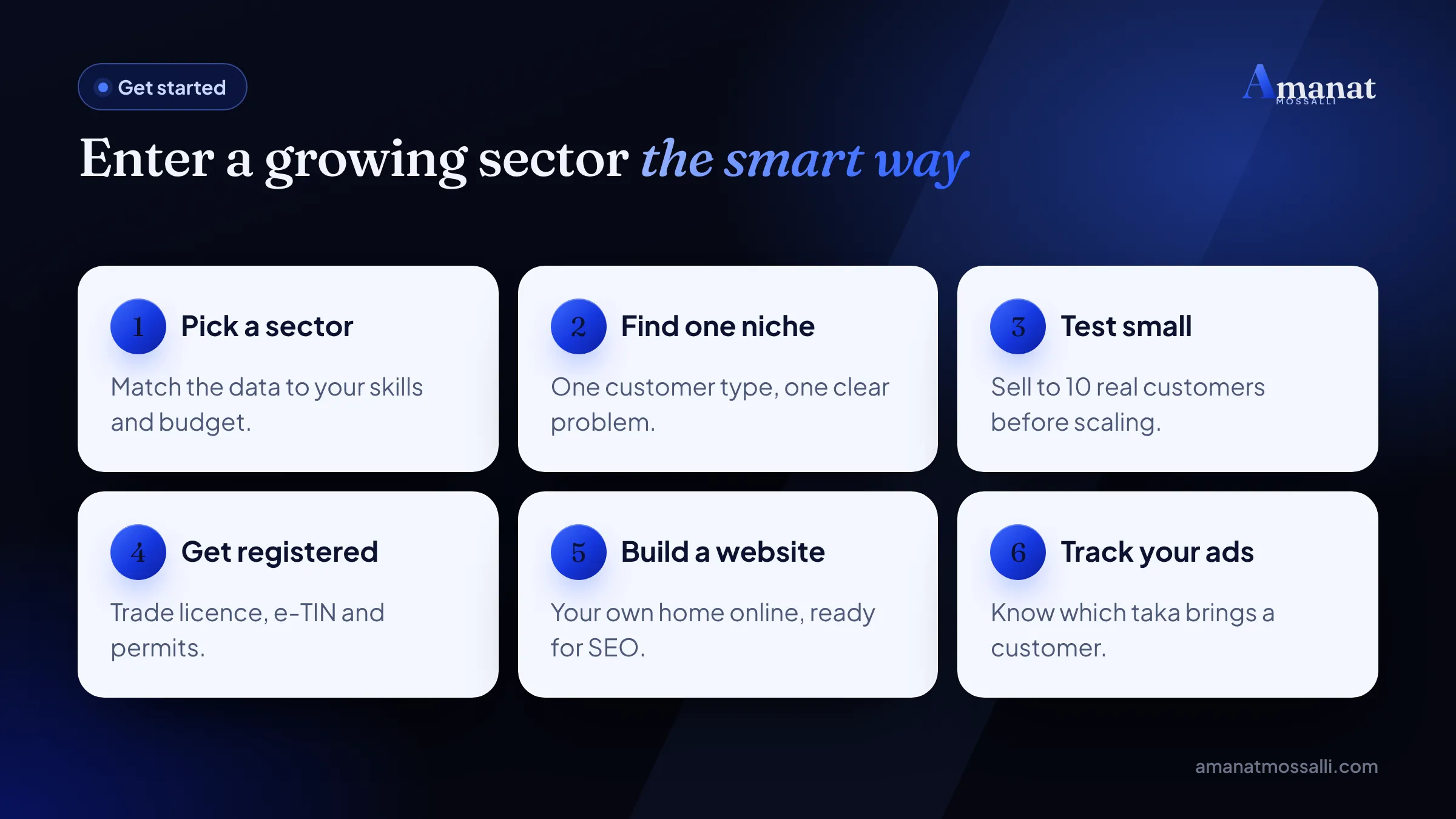
A website is the base. It’s where Google, AI tools and customers check that you’re real. I build fast business sites through my WordPress development service.
For the registration and setup side, read my guide on how to start a business in Bangladesh.
FAQ: Fast Growing Business in Bangladesh
What is the fastest growing industry in Bangladesh?
Which business is booming in Bangladesh in 2026?
Which business is best with low investment in Bangladesh?
Is the garment industry still growing in Bangladesh?
Is IT a good business in Bangladesh?
Is rooftop solar a good business opportunity in Bangladesh?
How do I know if a business idea will grow?
Quick recap
- Engineering exports grew 21.77% in FY26. Pharma led the first quarter of FY27 at 40.39%.
- IT exports rose 13.54% in July to November FY26. Software exports alone grew 54%.
- Rooftop solar is taking off, with a 5,500 MW government target for 2030.
- Most online buyers still pay cash on delivery, and most people haven’t bought online yet.
- LDC graduation moved to November 2029. Garments are still the giant, but big is not the same as fast.
One sector, one niche, this month
Choosing a fast growing business in Bangladesh gives you a tailwind. The tailwind only helps if the product, the service and the marketing are solid underneath it.
Pick one sector from this list. Find one niche inside it. Write a capped pilot, register properly, and build your online presence before you think you need it.
My cousin, for the record, is in week five of his pilot. Two factories have paid for a cleaning visit. One has asked for a quote on a quarterly contract, which is the signal we wrote down as a yes.
I don’t know yet if it’ll become a real business. I do know most of his savings are still in the bank. In a year when the whole economy grew 4.14%, that’s the order I’d want anyone to follow.

Amanat Mossalli Taju
Senior Digital Marketer & SEO Expert, Dhaka, BangladeshI have grown 235+ brands over more than seven years with SEO, Google and Meta Ads, server-side tracking, WordPress and AI automation. Half of my clients are in the UK, USA, Australia and Canada. Everything I write here comes from real client work.
Want this done for your business?
Book a free 15-minute call. I look at your site and ads before we talk, so you leave with clear next steps.