Which Business is Most Profitable in Bangladesh for 2026?
A Rampura dress seller's notebook said Tk 600 profit per dress. The real number was Tk 150. Ten business ideas compared on margin, capital and risk, with the costs people forget.

The notebook was school-exercise size, with a cartoon cat on the cover. A woman who sells dresses from a Facebook page in Rampura put it on my desk one Saturday afternoon last March. On the first page she had written one line and underlined it twice. It said “Profit per dress: Tk 600”. She wanted to know which business is most profitable in Bangladesh. Should she switch to something better?
We spent the next hour finding out that her real profit was about a quarter of that number.
So here is my short answer, before the long one. In 2026 the highest margins usually come from skill-based services like digital marketing, software and training, because they need almost no capital. Niche online brands, food and agro can pay well too, but margins are thinner and the risks are bigger.
The long answer is mostly arithmetic. I’m Amanat Mossalli Taju. Since 2020 I’ve worked on the marketing of more than 175 brands. So I see the good months and the bad ones in real numbers. Below you get the margin maths, the cost lines people forget, three worked examples in taka, and a break-even sum you can do tonight.
Which business is most profitable in Bangladesh right now?
One that sells your skill or knowledge, not stock. Digital marketing, software, design and coaching often keep a large share of each taka as profit.
Why? No inventory. No delivery charges, no returns. Your main costs are your time, a laptop, internet and some marketing.
High margin isn’t easy money, though. A service business only works if you’re properly good at the skill. It also grows slowly, because you only have so many hours.
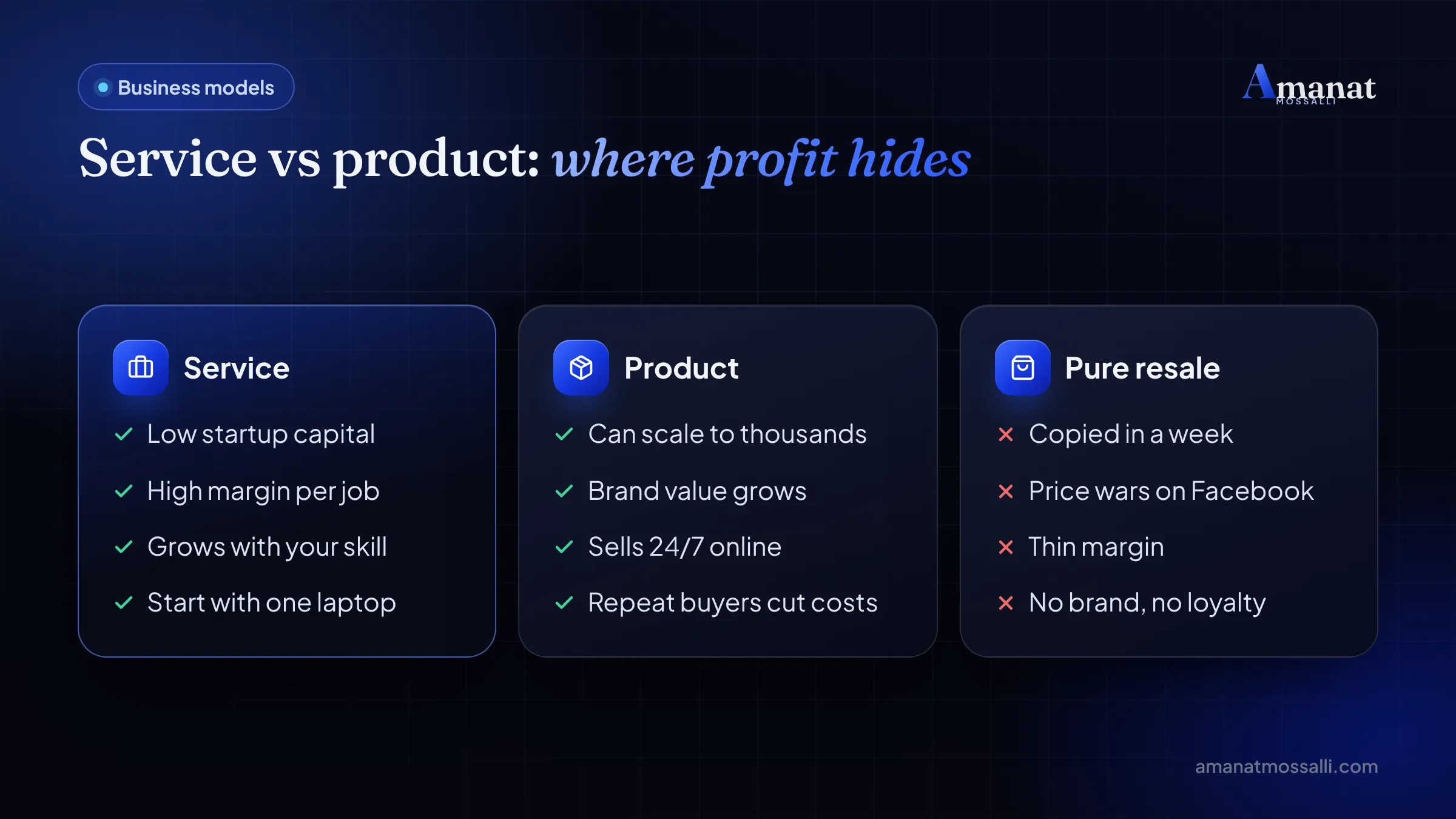
Product businesses are the mirror image. Smaller margin per item, but they scale. One good product can sell thousands of times from Teknaf to Tetulia.
So “most profitable” has two meanings, and people mix them up. One is the share of each sale you keep. The other is the total taka you take home in a year. A tutor can keep 80% of a small income. A snack brand can keep 12% of a very large one.
No single business is the most profitable for everyone. The best one sits where your skill, your capital and real demand meet.
What does profit margin really mean?
It’s the part of each sale you keep after costs. Sell for Tk 1,000, keep Tk 200 after everything, and your net margin is 20%.
Two kinds matter. Gross margin is price minus product cost. Net margin is what’s left after rent, salaries, ads, delivery, returns, fees and tax.
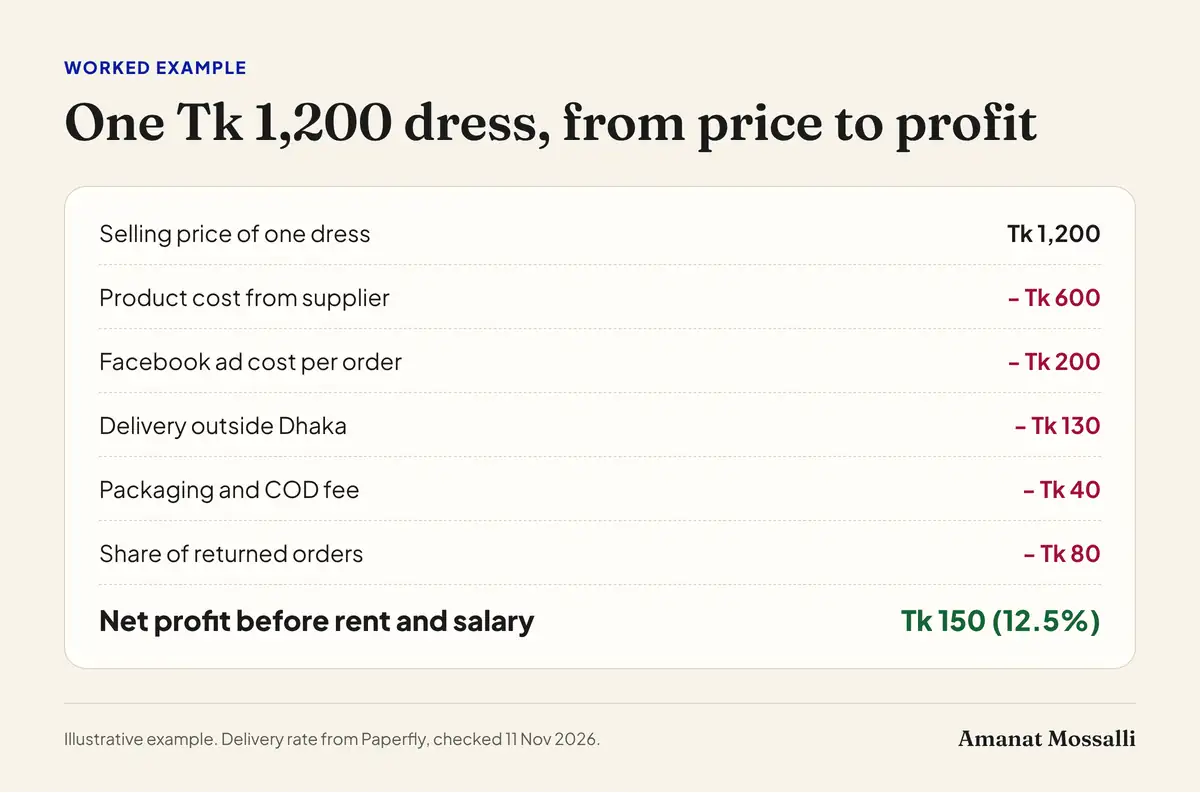
The Rampura notebook only had gross margin in it. Most new owners in Dhaka make the same mistake. Here’s roughly the sum we did together that afternoon.
| Item | Amount (example) |
|---|---|
| Selling price of one dress | Tk 1,200 |
| Product cost from supplier | Tk 600 |
| Gross profit | Tk 600 (50%) |
| Facebook ad cost per order | Tk 200 |
| Delivery outside Dhaka | Tk 130 |
| Packaging and COD fee | Tk 40 |
| Share of returned orders | Tk 80 |
| Net profit before rent and salary | Tk 150 (12.5%) |
These figures are an example, not an industry average. The pattern is very real. A 50% gross margin shrinks to a small net margin once every cost is in the column.
The delivery figure is a real rate. Paperfly charges Tk 70 inside the same city for parcels up to 1 kg. The rest of Bangladesh costs Tk 130, per its charges page. I checked it on 11 November 2026.
The cost lines that never reach the notebook
Gross profit is easy to know. The trouble sits in eight or nine small lines that nobody writes down. Here are the ones I ask about first, with real rates where I could confirm them.
| Cost line | What it really is | A confirmed figure |
|---|---|---|
| Courier | Charged per parcel, by zone and weight | Paperfly: Tk 70 same city, Tk 110 suburb, Tk 130 elsewhere, up to 1 kg. Tk 20 per extra kg. |
| Cash on delivery fee | A cut of the money the courier collects | Paperfly: 0% in the same city, 1% of the collected amount elsewhere. |
| Refused orders | You pay delivery for a sale that never happened | Paperfly: no extra return fee, but one attempted delivery charge applies. |
| Mobile payment fees | Fees to move money out of a business wallet | bKash Personal Retail Account: receiving payments is free. Bank transfer is listed at 1.3%. |
| Turnover tax | A tax on sales for small firms above a threshold | General rate 4%. The Tk 30 lakh enlistment threshold still applies. |
| Your own income tax | Tax on what the business pays you | First Tk 4 lakh is tax free for general taxpayers. The next Tk 3 lakh is taxed at 10%. |
| Inflation | Your costs rise even when your price doesn’t | 8.27% in October 2026, per BBS data. |
Sources, all opened on 11 November 2026. The courier rows come from Paperfly’s charges page, linked above. The wallet row comes from bKash’s Personal Retail Account page. That account also caps received payments at Tk 5 lakh a month.
The two tax rows come from PwC Bangladesh’s summary of the Finance Act 2026. The inflation figure is from The Financial Express, reporting the Bangladesh Bureau of Statistics on 9 November 2026.
I’m a marketer, not a tax adviser. Treat the tax rows as a prompt to ask an accountant where your shop falls. Don’t treat them as a ruling.
The inflation row deserves a second look. At about 8% a year, a profit of Tk 50,000 a month must reach Tk 54,000 next year. Otherwise you’ve taken a pay cut without noticing.
Three more lines have no public rate, yet they hurt just as much.
- Your own salary. If the business can’t pay you a wage, it isn’t profitable. It’s a hobby with invoices.
- Dead stock. The forty unsold pieces in the cupboard are profit you already spent.
- Discounts. A 10% Eid discount on a 20% margin gives away half your profit.
Ten business ideas, side by side
These are ten business types I see working in Bangladesh in 2026. I rate margin, startup capital and risk as low, medium or high. They’re my judgments from client work, not survey data, so argue with them.
| Business | Margin | Capital | Risk |
|---|---|---|---|
| Digital marketing or design services | High | Low | Medium |
| Software and IT services | High | Low to medium | Medium |
| Coaching, courses and skill training | High | Low | Medium |
| Niche online brand (own products) | Medium | Medium | High |
| Reselling on Facebook (f-commerce) | Low | Low | High |
| Cloud kitchen or home food | Medium | Low to medium | High |
| Agro business (poultry, fish, dairy) | Medium | Medium to high | High |
| Pharmacy or diagnostic services | Medium | High | Medium |
| Export of handicrafts or jute goods | Medium | Medium | Medium |
| Courier, logistics or rentals | Low to medium | High | Medium |
See the pattern? High-margin ideas need skill. Low-skill ideas come with thin margins and a crowd of competitors.
Three months on paper: a service, a brand and a kitchen
A table of “high” and “medium” only goes so far. So here are three example months in taka. I set the inputs to look like the businesses I work with. Change them to yours and redo the sums.
Model 1: a one-person ads and SEO service
| Line | Monthly (example) |
|---|---|
| Three local clients at Tk 25,000 | Tk 75,000 |
| Internet and backup power | Tk 3,000 |
| Software and tools | Tk 5,000 |
| Finding clients (ads, events, travel) | Tk 4,000 |
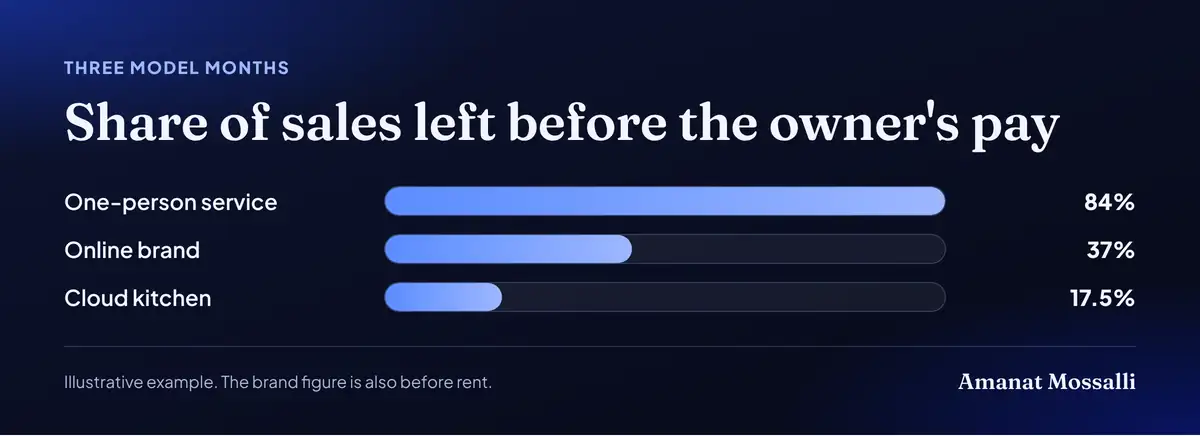
| Left before paying yourself | Tk 63,000 (84%) |
| A fair wage for your own hours | Tk 40,000 |
| True business profit | Tk 23,000 (31%) |
An 84% margin looks unbeatable. Then you price your own time, and it drops to 31%. That’s still excellent. The real limit is the ceiling. One person can serve only so many clients well.
Model 2: an online brand with its own product
Assume 300 orders dispatched at Tk 1,200, with one in ten refused at the door. The buyer pays the delivery charge on accepted orders. You pay it on refused ones.
| Line | Monthly (example) |
|---|---|
| Sales from 270 delivered orders | Tk 3,24,000 |
| Product cost at Tk 480 each (40%) | Tk 1,29,600 |
| Ads at Tk 150 per dispatched order | Tk 45,000 |
| Packaging at Tk 15 per parcel | Tk 4,500 |
| COD fee, 1% on 162 orders outside the city | Tk 1,944 |
| Delivery charge on 30 refused parcels | Tk 3,900 |
| One packing and support assistant | Tk 15,000 |
| Website, hosting and tools | Tk 3,000 |
| Left before rent and your own pay | Tk 1,21,056 (37%) |
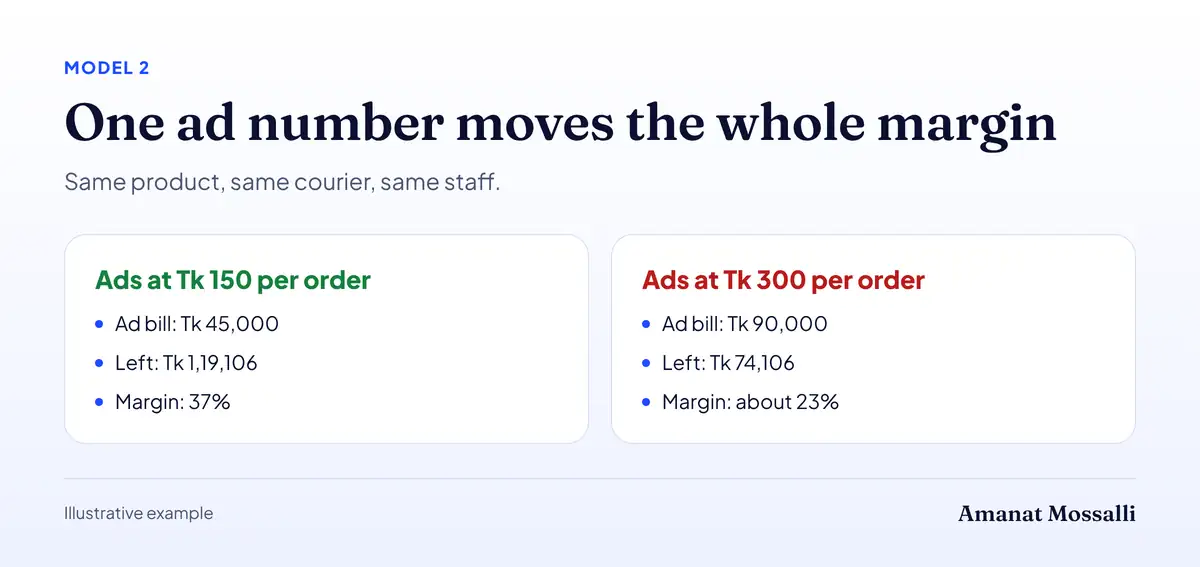
Now change one number. Let the ad cost per order climb from Tk 150 to Tk 300, which happens in a bad Eid season. The ad bill becomes Tk 90,000. What’s left falls to Tk 76,056, or about 23%.
Nothing else moved. Same product, same courier, same staff. That single line is why I say marketing decides who keeps the profit.
Model 3: a small cloud kitchen
Assume 600 orders a month at Tk 350, with 70% arriving through a delivery app. I’ve used a 25% app commission. That is an assumption, not a published rate.
| Line | Monthly (example) |
|---|---|
| Sales from 600 orders | Tk 2,10,000 |
| Food cost at 35% | Tk 73,500 |
| App commission, 25% of Tk 1,47,000 | Tk 36,750 |
| Packaging at Tk 20 per order | Tk 12,000 |
| Kitchen rent | Tk 15,000 |
| Cook and helper | Tk 28,000 |
| Gas and electricity | Tk 8,000 |
| Left before your own pay | Tk 36,750 (17.5%) |
Why 25%? Commission rates aren’t published, and they vary by restaurant. The best public record I found is old. In December 2021, The Business Standard reported the dispute between restaurants and delivery apps. Restaurant owners spoke of rates up to 30% or more. Foodpanda’s managing director used a 25% example on a Tk 200 order.
That report is five years old, so ask for your own rate in writing before you plan a menu. Notice what the model shows, though. The app took exactly as much as the owner did.
Here are the three models side by side, each before the owner’s own pay.
Break-even: the sum to do before you spend
Break-even is the number of sales you need each month before you earn your first taka of profit. It’s one division.
Break-even orders = fixed monthly costs ÷ what one order leaves behind.
Fixed costs are the bills that arrive whether you sell or not. Rent, salaries, tools, and your own wage. What one order leaves behind is its price minus every cost tied to that order.
Take the online brand from Model 2.
- 1Fixed costs. Assistant Tk 15,000, tools Tk 3,000, your own wage Tk 40,000. Total Tk 58,000.
- 2What one delivered order leaves. Tk 1,200 minus product, ads, packaging, COD fee and its share of refusals. About Tk 515.
- 3Divide. Tk 58,000 ÷ Tk 515 is about 113 delivered orders a month. Call it four a day.
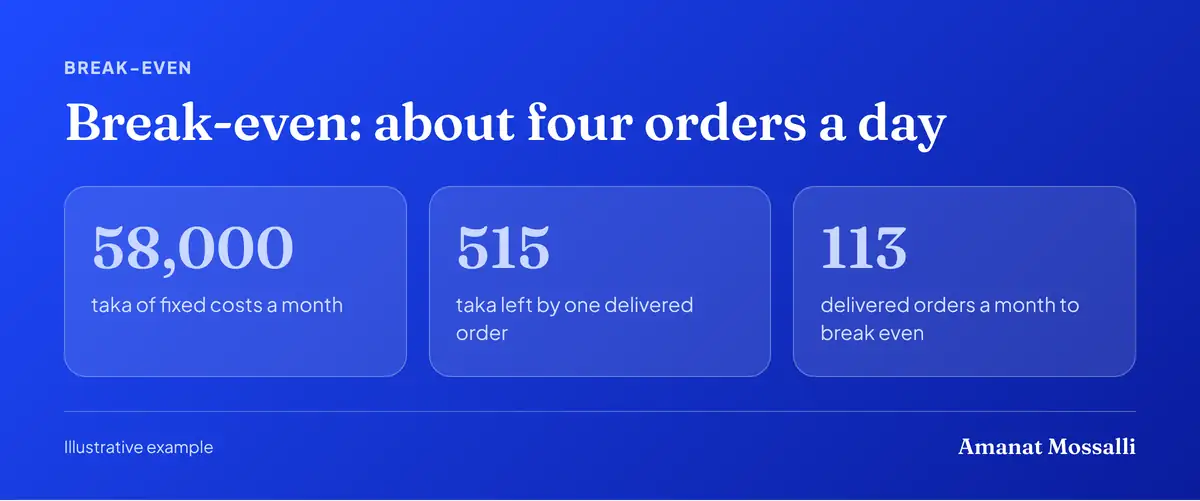
Four orders a day is a target you can test with a small ad budget. If you can’t reach it in a trial month, you’ve learned that cheaply.
Now do the same sum for a physical shop. Add rent, a deposit and a second salary to the fixed costs. The break-even often triples. That’s the honest reason I tell people to sell online first.
Why do IT and digital services win on margin?
Because the main input is skill, not stock. They’re the most profitable small business ideas with low investment, if you have the skill. A laptop and a decent internet line is the whole setup.
Demand is rising too. Export Promotion Bureau data reported by The Daily Star shows IT exports up about 14% year on year. That covers July to November of FY2025-26. The total was $269.84 million, and IT-enabled services made up $235.72 million of it.
The tax side helps as well. PwC’s Finance Act 2026 summary, linked above, says income from freelancing and content creation is exempt from income tax. Earlier, only IT-related freelance income had that treatment.
What you can sell
- SEO, Google Ads and Facebook ads management for local or foreign clients.
- Website and WordPress development.
- Graphic design, video editing and content writing.
- Software, apps and AI automation for small companies.
- Bookkeeping or virtual assistant services for overseas clients.
About half of my own clients are outside Bangladesh. They pay in dollars or pounds, and my costs stay in taka. That gap is where the margin lives.
Want to build the skill first? My guide to the best digital skills in Bangladesh shows which ones clients actually pay for. If you want the income route without a company, read how to earn money online in Bangladesh.
This fails if your skill is average. Clients compare you with the whole world. Spend 6 to 12 months getting properly good before you call it a business.
Is online business in Bangladesh still profitable?
Yes, if you build a brand rather than a page that resells what everyone else resells. The market is huge. So is the competition.
By the end of 2025, Bangladesh had 82.8 million internet users, per DataReportal’s Digital 2026 report. Meta’s tools showed an ad reach of 64.0 million people on Facebook.
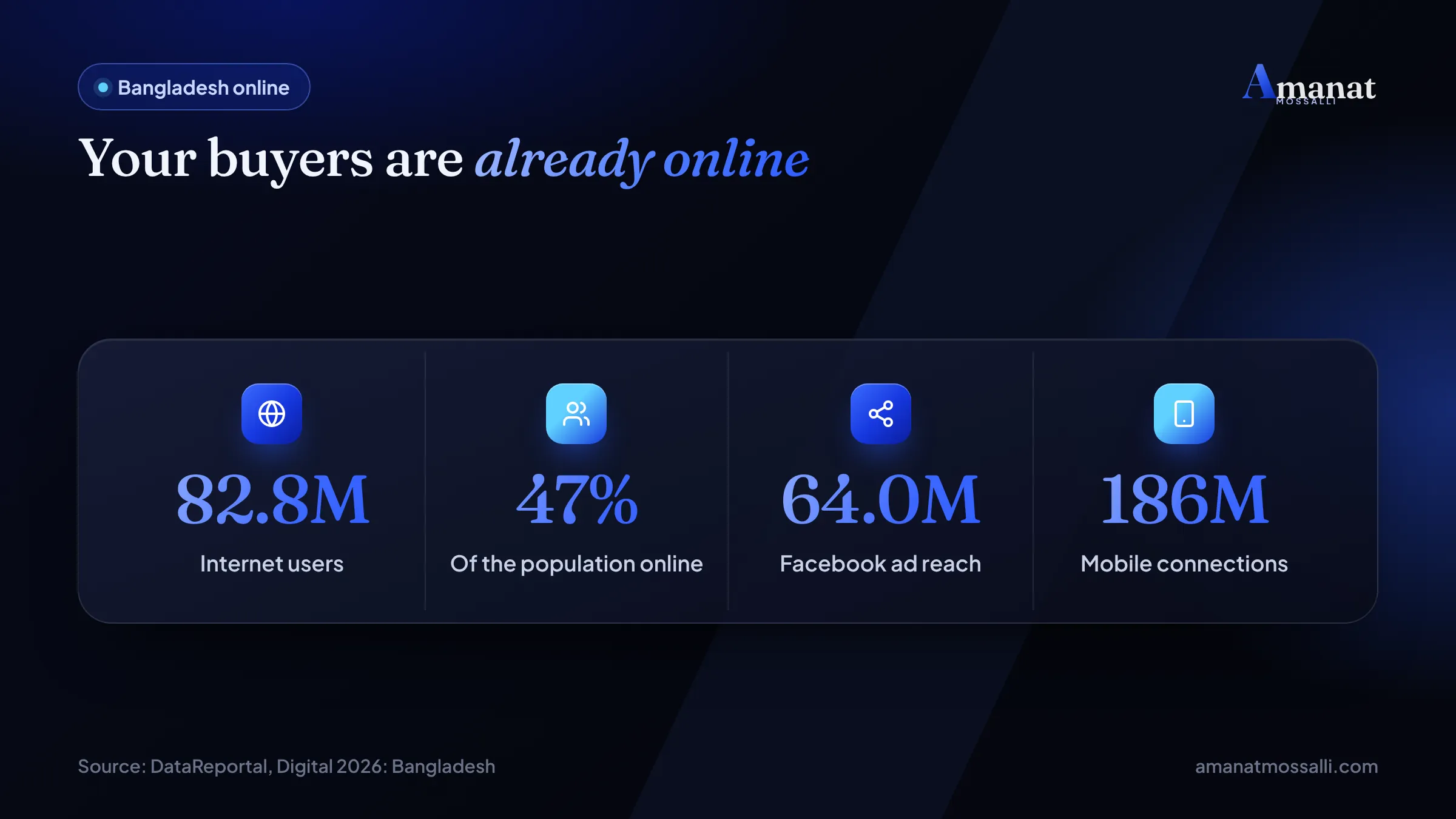
DataReportal published its newer Digital 2027 report on 5 November 2026. It counts 95.3 million internet users in October 2026 and a Facebook ad reach of 64.1 million. The publisher warns against comparing one year’s report with another, so read both as a rough size, not a trend.
One line in that report matters for sellers. Facebook’s reach grew by only 0.2% in a year. The audience is no longer expanding to rescue weak pages.
Why most f-commerce pages lose money
F-commerce means selling through Facebook pages and groups. It’s cheap to start, so thousands of people sell the same dresses at the same prices. The Rampura seller had at least forty direct copies of her best design within a month.
- Cash on delivery orders refused at the door.
- Ad costs that jump every Eid season.
- No website, so no Google traffic and less trust.
- Copying a competitor’s product and fighting on price.
- No tracking, so you never learn which ad made the sale.
The shops that do well own a niche. Their own product, a clear brand, a real website. More in best online business ideas in Bangladesh.
Food, agro and the offline bets
Offline businesses can pay very well. Everyone eats, so food demand never stops. They also need more cash and carry more risk than a laptop business.
Export is a big field here. Export Promotion Bureau figures put goods exports at $48.0 billion in FY2025-26, as The Financial Express reported in July 2026. Ready-made garments brought in $38.7 billion of that, which is just over 80%.
That tells you how concentrated exports are. The same report shows where the smaller doors are. Leather and leather goods earned $1.23 billion, up about 7%. Jute and jute goods earned about $884 million, up nearly 8%.
Small exporters of non-garment goods face less crowding. They do have to learn compliance and find buyers abroad, which is slow.
For food, reread Model 3 before you sign a kitchen lease. The margin lives or dies on two numbers: food cost and the share of orders that pay a commission. Push your own WhatsApp and phone orders from day one.
What can sink a small business here?
Cash flow, rising costs, copycats. Most small businesses I see don’t die from one big blow. They bleed slowly.
- Cash flow: stock, salaries and rent are due before customers pay you. COD money also sits with the courier for days.
- Price changes: dollar rates, fuel and raw material costs move fast. With inflation above 8%, last year’s price list is already wrong.
- Load-shedding and internet cuts: food, cold storage and online work all suffer.
- Copycats: a good product on Facebook gets copied within weeks.
- Legal gaps: no trade licence, no TIN, no BIN. That can block bank accounts and payment gateways.
- Partner fights: no written agreement between friends or family partners.
- One wallet for everything: personal and business money in the same bKash account hides every loss.
Revenue makes you feel rich. Net profit tells you the truth.
Watch for scams as well. Anyone selling a “guaranteed profit” franchise, a dropshipping course with income promises, or a Ponzi-style investment. If it sounds too good, walk away.
How much money do you need to start?
Very little for a service business if you already own a laptop. A product business needs money for stock, packaging, ads and a buffer.
I won’t give you fake taka ranges for each idea. Costs swing too much with location, size and quality. Use the rule I give clients instead.
Total bigger than what you have? Start smaller. Sell online before opening a shop. Rent equipment before buying it. Sort the paperwork with my guide on how to start a business in Bangladesh.
If a website is part of the plan, price it properly first. My breakdown of website development cost in Bangladesh covers the real ranges.
How do you choose the right one for you?
Pick the business where your skill, your money and real demand overlap. Not the one a YouTuber called hot last week.
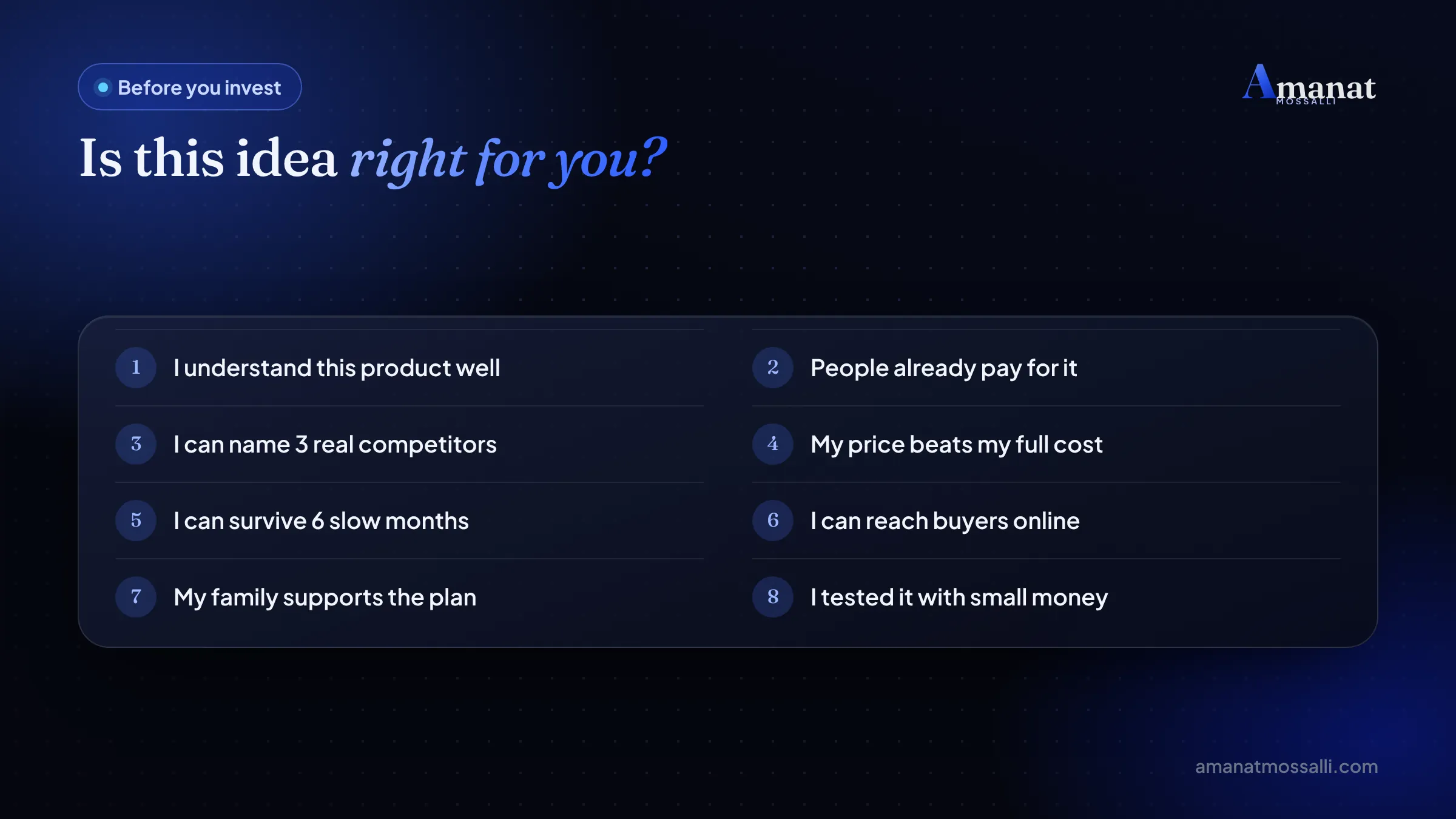
The last box matters most. Test first. Run a small Facebook ad, list five products, or offer your service to three paying clients. Real sales tell you more than any business plan ever will.
I’ve watched plenty of people do it the other way round. Savings into a shop fit-out and stock, then the first customer. The ones who start with a small online test almost always lose less and learn faster.
A good test has a number attached. Take your break-even from the sum above. Give yourself 30 days and a fixed budget to reach half of it. Half in the first month is a business worth a second month.
Marketing decides who keeps the profit
Two shops, same product, very different profits. The difference is usually marketing: how cheaply they find buyers, and how many come back. Model 2 showed it. One ad number moved the margin from 37% to 23%.
If every sale depends on a paid ad, your profit belongs to Facebook. If buyers find you on Google, or return on their own, your cost per order drops.
- A fast website you own, not just a Facebook page.
- SEO so people find you on Google and in AI answers for free.
- Ads with proper tracking, so you stop paying for useless clicks.
- Repeat buyers through WhatsApp, SMS and email offers.
That’s the work I do every day. You can read more in my complete SEO guide for Bangladeshi businesses. If your visitors come but don’t buy, start with website traffic but no sales.
Can you squeeze more profit from the business you already have?
Usually, yes, and it’s cheaper than starting again. Small changes to price, costs and repeat sales add up fast.
- 1Know your numbers. Write down net profit per product every month, not just sales.
- 2Raise prices on your best sellers. Many owners underprice out of fear. Test a small rise on one item first.
- 3Cut refused orders. Call to confirm cash on delivery orders. Ask for a small advance on big ones.
- 4Sell more to the same buyers. Bundles, refills and Eid offers to past customers cost far less than new ads.
- 5Drop the losers. If a product or service loses money three months running, stop it.
- 6Get free traffic. A proper website and Google ranking bring buyers without paying for every click.
The price rise is the one people skip, so look at the sum. On the Tk 1,200 dress with Tk 150 net profit, a Tk 100 rise lifts profit per dress by two thirds. You can lose a fair number of buyers and still come out ahead.
When I audit a client’s business, I first check where orders come from and what each one costs. Usually one channel makes money and another quietly loses it. Moving budget between the two can lift profit without one extra sale.
The Rampura seller didn’t switch businesses. She went home and opened a second page in the cat notebook. She wrote every cost down, including the Tk 80 per order she was losing to refusals.
The next week she started calling each COD buyer before dispatch, usually between 4 and 6 pm when people answer. She stopped selling the design everyone had copied. She raised the price on her one dress nobody else made, by an amount she was almost too nervous to post.
Some buyers grumbled in the comments. Most still ordered.
Two months later she sent me a photo of the newest notebook page. Refused parcels had fallen from about one in five to about one in ten. Net profit per dress was close to Tk 250, up from Tk 150. Not a fortune. Enough that she stopped asking me which business to switch to.
If your shop still lives only on Facebook, a fast site is often the next move. My WordPress website service builds sites that load fast on mobile data and are ready for SEO. For Google visibility, my SEO, GEO and AEO service is built for exactly that.
Open a separate bank or bKash account for the business this week. You can’t see real profit while personal and business money share one wallet.
Your homework: one page, nine lines
So, which business is most profitable in Bangladesh? For most people starting today, a skill-based service or a focused online brand. Both can grow without a big loan.
That’s my opinion. Your notebook is the evidence. Before you choose, switch or invest, fill in this page for one product or one service. It takes twenty minutes.
| Line | Write your number |
|---|---|
| 1. Price the customer pays | Tk ____ |
| 2. Product or delivery cost of the work | Tk ____ |
| 3. Ad or sales cost per order | Tk ____ |
| 4. Courier, packaging and payment fees | Tk ____ |
| 5. Share of refused or refunded orders | Tk ____ |
| 6. What one order leaves (1 minus 2 to 5) | Tk ____ |
| 7. Fixed monthly costs, including your wage | Tk ____ |
| 8. Break-even orders (7 ÷ 6) | ____ a month |
| 9. Orders you really got last month | ____ |
If line 9 beats line 8, you already own a profitable business, whatever it sells. If it doesn’t, you now know which line to attack first.
One caveat about me. My view of margins comes from other people’s ad accounts and order sheets, not from running a kitchen or a farm. Weigh the food and agro sections with that in mind.
FAQ: Which business is most profitable in Bangladesh?
What is the most profitable business with low investment in Bangladesh?
What is the most profitable online business in Bangladesh?
Is agro business profitable in Bangladesh?
Is food business profitable in Bangladesh?
How much money do I need to start a business in Bangladesh?
Which business can make the most money in Bangladesh?
Is this financial advice?
Still stuck between two ideas after doing the sums? Send me both pages on the contact form. Buy a notebook first if you have to. A cat on the cover is optional.

Amanat Mossalli Taju
Senior Digital Marketer & SEO Expert, Dhaka, BangladeshI have grown 175+ brands since 2020 with SEO, Google and Meta Ads, server-side tracking, WordPress and AI automation. Half of my clients are in the UK, USA, Australia and Canada. Everything I write here comes from real client work.
Want this done for your business?
Book a free 15-minute call. I look at your site and ads before we talk, so you leave with clear next steps.