Why SEO Is Important for E-commerce Business in Bangladesh in 2026
Your Facebook ad bill climbs before every festival. Google orders don't. Seven reasons online shops in Bangladesh need SEO, and the product page fixes that bring orders.

“My shop runs on Facebook, so SEO isn’t for me.” I hear that line in almost every first call with an online seller here. It sounds sensible, and it’s costing those sellers money.
Let me show you with one shop I worked with. A woman in Narayanganj was selling cotton three-pieces from a Facebook page. Good fabric, loyal buyers, about 30 orders a day in a normal week.
She called me the week before Eid last year, upset. Her boosted posts were suddenly costing almost double per message, because every clothing page in Dhaka was bidding at the same time. She had no website. Nobody could find her on Google. When the ads got expensive, her whole shop got expensive.
That’s why SEO is important for e-commerce business in Bangladesh, in one picture. Buyers search Google before they buy, and those visits cost nothing per click once you rank. Ads stop the day your budget stops. A product page that ranks for “price in Bangladesh” keeps bringing orders through every Eid, every sale and every slow month.
I’m Amanat Mossalli Taju. I run both ads and SEO for online stores, here and abroad, so this isn’t an anti-ads post. It’s about balance, and about owning something. She comes back near the end.
The short version
- Google holds 98.46% of search in Bangladesh (StatCounter, October 2026). If buyers search, they search there.
- Card-based e-commerce reached Tk 23.60 billion in June 2026. Cash on delivery and wallets come on top.
- SEO makes your blended cost per order worse for a few months, then better for years. Plan for both halves.
- Category pages win most shop searches. Fix your ten best sellers first.
- Never delete a sold-out product page. Mark it out of stock and keep the ranking.
- Google Merchant Center does not list Bangladesh as a supported country, so on-page product data carries the load here.
How Big Is E-commerce in Bangladesh in 2026?
Big, and still growing. According to Bangladesh Bank data reported by The Financial Express, card-based e-commerce spending reached Tk 23.60 billion in June 2026. In February it was Tk 18.15 billion.
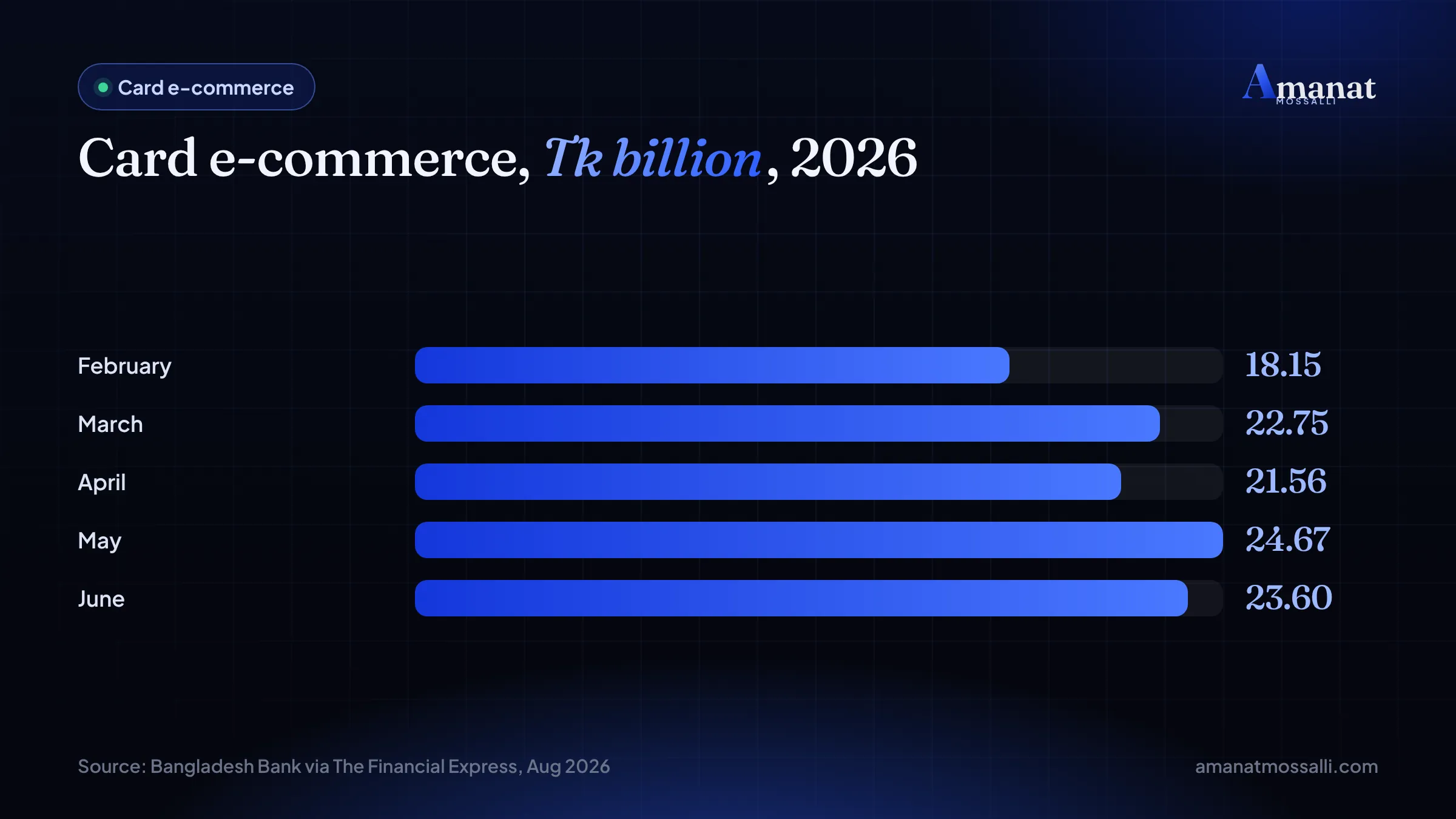
Those figures cover card payments only. Cash on delivery and mobile wallets like bKash and Nagad sit outside them, so the real market is larger.
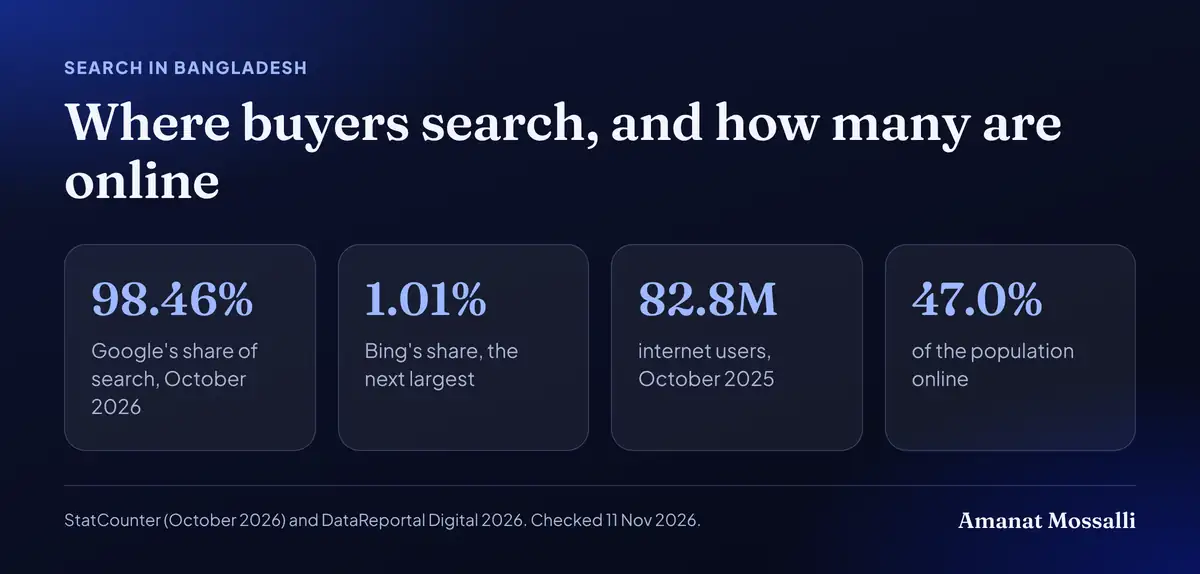
And when people look for products, they go to Google. StatCounter gives Google 98.46% of the search market in Bangladesh for October 2026. Bing is next at 1.01%. I checked the page on 11 November 2026.
The audience is still growing as well. DataReportal’s Digital 2026 report counts 82.8 million internet users in Bangladesh in October 2025. That’s 47.0% of the population, up 5.3 million in a year. Half the country hasn’t come online yet.
Put the numbers and the Narayanganj seller together and you have the whole case. Money is moving online, buyers start on Google, and a Facebook-only shop can’t be found there.
Why SEO Is Important for E-commerce Business in Bangladesh: 7 Reasons
Because it brings buyers who are already looking, at a cost that falls over time. These are the seven reasons I walk every shop owner through.
1. Search buyers are ready to order
Someone typing “Xiaomi Redmi price in Bangladesh” or “winter jacket for men BD” already wants to buy. A Facebook ad interrupts someone watching videos. A search result answers someone who asked.
2. Your cost per order drops over time
With ads, every order costs roughly the same, month after month. With SEO, the page you paid for last year still sends orders this year. Your cost per order from search keeps falling for as long as it ranks.
3. You stop renting your whole business
A Facebook page can be hacked, restricted or buried by a feed change. Your website and its Google rankings belong to you.
4. You catch Eid and sale demand without the ad war
Ad costs climb before every Eid sale, because every shop bids at once. A page that already ranks for “Eid panjabi collection” takes that traffic without joining the auction.
5. A real website builds trust
Fake sellers and advance-payment scams have made buyers wary. A proper website with clear prices, delivery charges, a return policy and reviews tells a buyer you’re a real business.
6. AI shopping answers need a source
Someone asks ChatGPT or Google AI Mode for “best place to buy original perfume in Dhaka”. The answer quotes websites. A Facebook page with no website is hard to cite.
7. You own your customer data
A website with proper tracking shows what people search, view and buy. That data sharpens your ads, your stock planning and your pricing too.
How Does SEO Lower Your Cost per Order?
The work keeps paying after you stop doing it. Ads charge you again for every new buyer.
Here’s an example with round numbers, so the maths stays easy.
Say a shop spends Tk 100,000 a month, and each ad order costs Tk 500. It moves Tk 30,000 of that into SEO and keeps the total the same.
| Month | Ad orders (Tk 70,000) | Search orders (example) | All orders | Blended cost per order |
|---|---|---|---|---|
| Before, ads only | 200 on Tk 100,000 | 0 | 200 | Tk 500 |
| Month 1 | 140 | 0 | 140 | Tk 714 |
| Month 4 | 140 | 20 | 160 | Tk 625 |
| Month 8 | 140 | 60 | 200 | Tk 500 |
| Month 12 | 140 | 100 | 240 | Tk 417 |
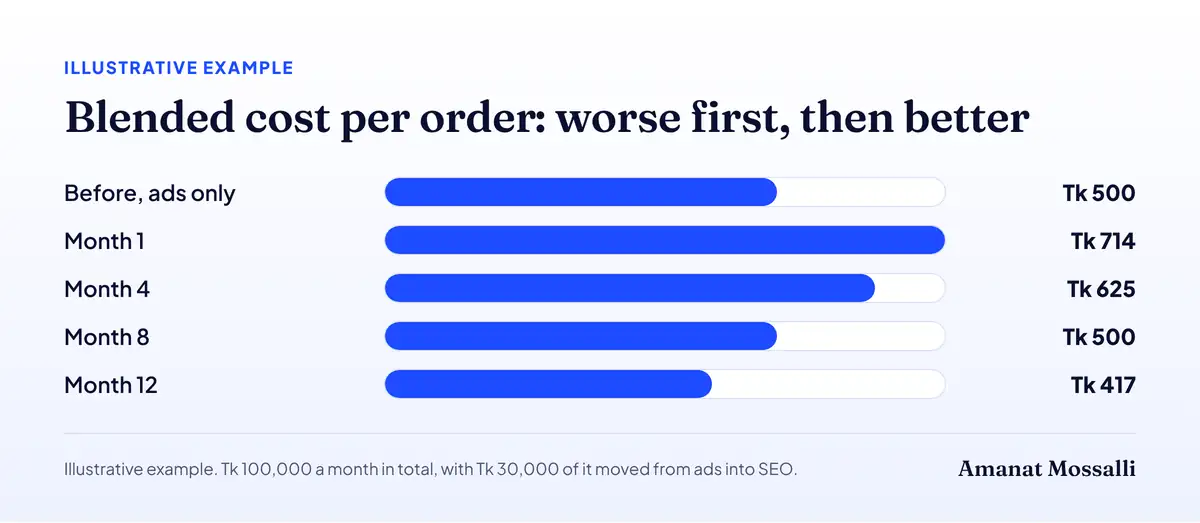
Look at month 1. The cost per order goes up, not down. This is the part nobody selling SEO likes to say out loud. You’ve moved money from a channel that pays today to one that pays later.
In this example the shop breaks even at 60 search orders a month. Everything after that is gain. Your own break-even will sit somewhere else, but the shape is always this shape: worse, level, better.
Two lessons follow. Don’t start SEO two months before you need the cash. And don’t cut ads to zero to pay for it.
SEO won’t save a shop with weak products, bad delivery or prices far above the market. It brings more buyers to your door. It can’t make them stay.
Is a Facebook Page Enough to Sell Online in Bangladesh?
Enough to start. Not enough to grow safely. That’s the short version of why SEO is important for e-commerce business in Bangladesh. F-commerce, selling through Facebook pages and groups, is how most Bangladeshi shops begin, and it works well for reaching people.
The reach is real. DataReportal’s Digital 2026 report put Facebook’s ad reach in Bangladesh at 64 million in late 2025, and TikTok’s at 56.2 million adults. But reach isn’t the same as owning the sale.
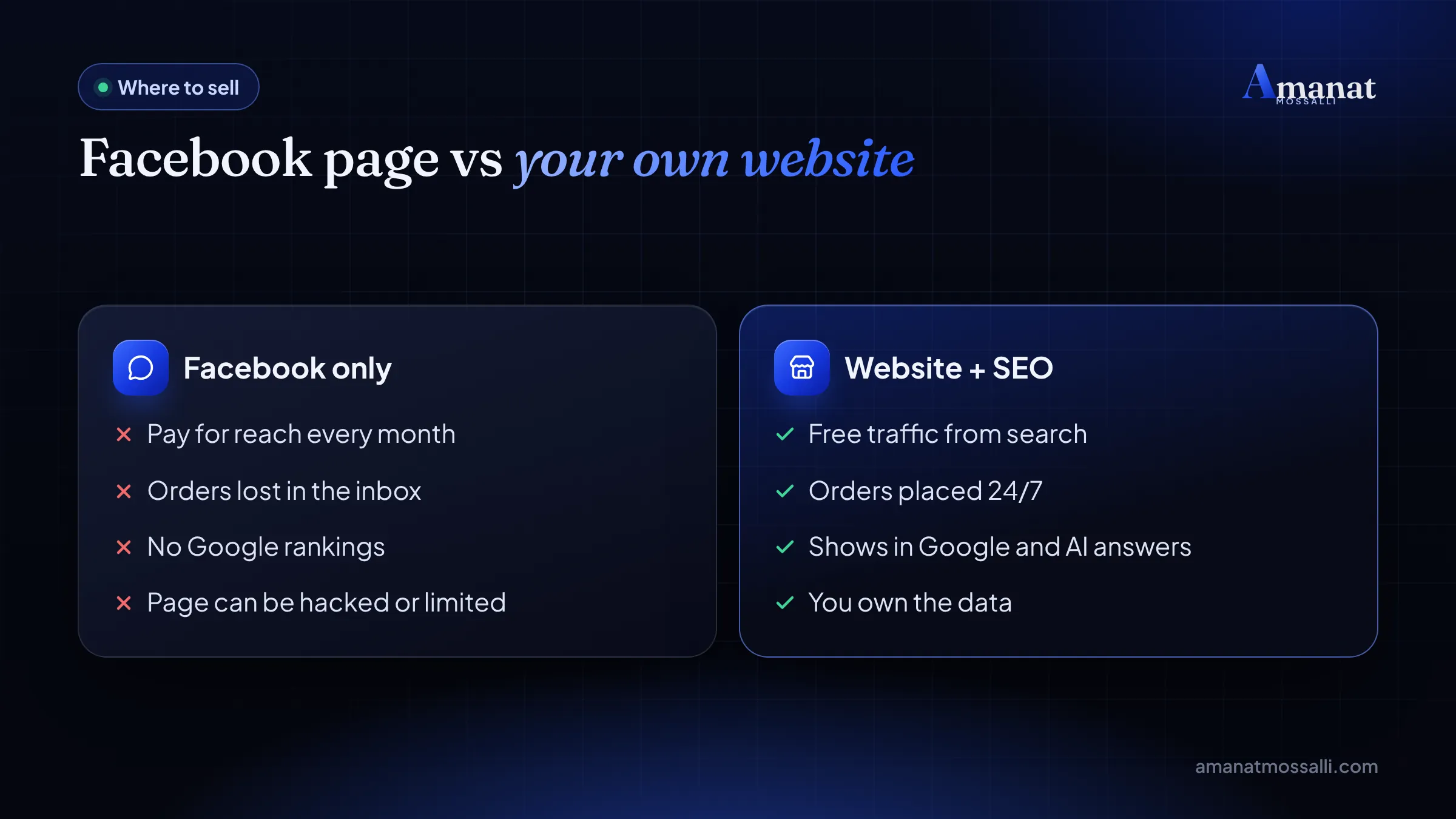
The best setup uses both. Facebook and TikTok create demand. The website captures it, including the people who search your brand name a week later.
That last group is easy to miss. Someone sees your Reel on Tuesday and searches your shop name on Friday. If Google shows nothing, or shows a reseller, that sale is gone and you never knew it existed.
Which Pages Bring the Most Sales From Google?
Category pages, usually. Strong product pages come next. Blog posts help, but they sit further from the sale.
| Page type | Example search it can win | What it needs |
|---|---|---|
| Category page | ladies sandals price in Bangladesh | A short intro, filters, real prices, FAQs at the bottom |
| Product page | Redmi Note price in BD | Unique description, your own photos, price, stock, reviews |
| Brand page | original Cosrx products in Dhaka | Authenticity proof, full range, delivery info |
| Buying guide | best air cooler for small room | Honest comparison table linking to products |
| Policy pages | your shop name plus return policy | Clear delivery charges, return and COD rules |
What a strong product page looks like
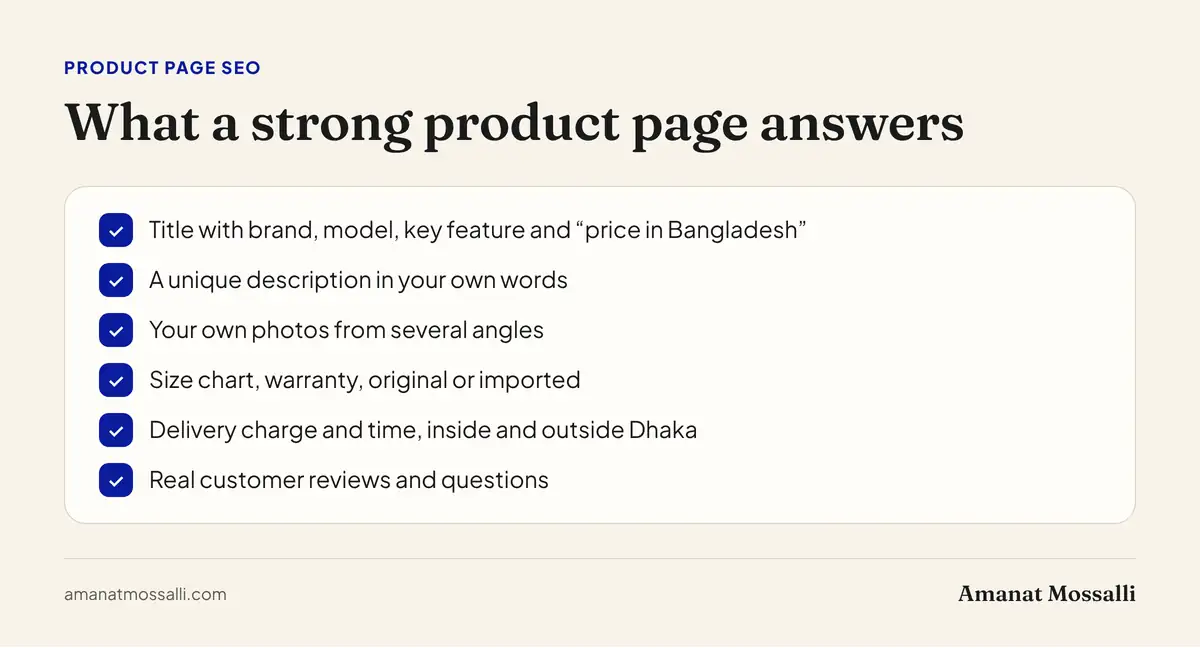
Good product page SEO is mostly about answering every question a buyer would ask in a physical shop. If they still have to inbox you, the page isn’t finished.
- A clear title: brand, model, key feature, and “price in Bangladesh”.
- A unique description in your own words, with real use cases.
- Your own photos from several angles, plus a short video if you can.
- Size chart, warranty and whether the product is original or imported.
- Delivery charge and time for inside and outside Dhaka.
- Real customer reviews and questions on the page.
Start with your ten best-selling categories. Make each one the best page on Google for that product type in Bangladesh. Then move on to product pages.
Write the price and “in Bangladesh” naturally into category titles. Buyers here add “price in BD” to almost every product search.
Addresses Google can read
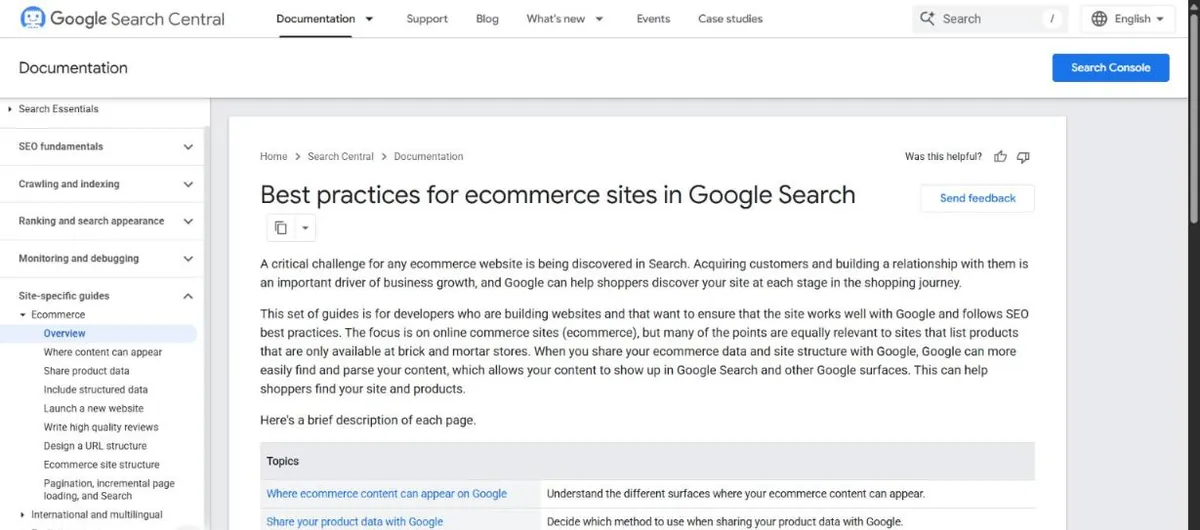
Google publishes a set of eight guides for e-commerce sites. One covers URL structure, and it’s short enough to hand to your developer. I reread both on 11 November 2026. The main points:
- Put descriptive words in the address. Google’s own example prefers /product/black-t-shirt-with-a-white-collar over /product/3243.
- Give each colour or size variant its own URL, and point its canonical tag at the main product.
- Write parameters as key=value, like ?color=green, not a bare ?green.
- Don’t link internally to addresses carrying session IDs or tracking codes.
- Use one form of each URL everywhere: in menus, in the sitemap and in canonical tags.
The SEO Mistakes I See in Almost Every Shop Audit
Most shop sites I audit share the same handful of problems. None are hard to fix. Together, they keep a shop off page one for years.
| Mistake | Why it hurts | The fix |
|---|---|---|
| Copying supplier descriptions | Hundreds of shops use the same text, so Google sees duplicate content and picks one | Rewrite your top 20 products in your own words first |
| Deleting out-of-stock products | The page and its rankings vanish | Keep it, mark it out of stock, link to similar items |
| Filters Google can crawl endlessly | Colour, size and price filters create thousands of near-copies | Block filter parameters in robots.txt |
| Huge product photos | Pages crawl on mobile data | Compress and resize before upload |
| “Inbox for price” | No price means no ranking for price searches | Show the taka price on the page |
| English-only product names | Buyers also search in Bangla and Banglish | Add the words buyers type, naturally, in the description and FAQs |
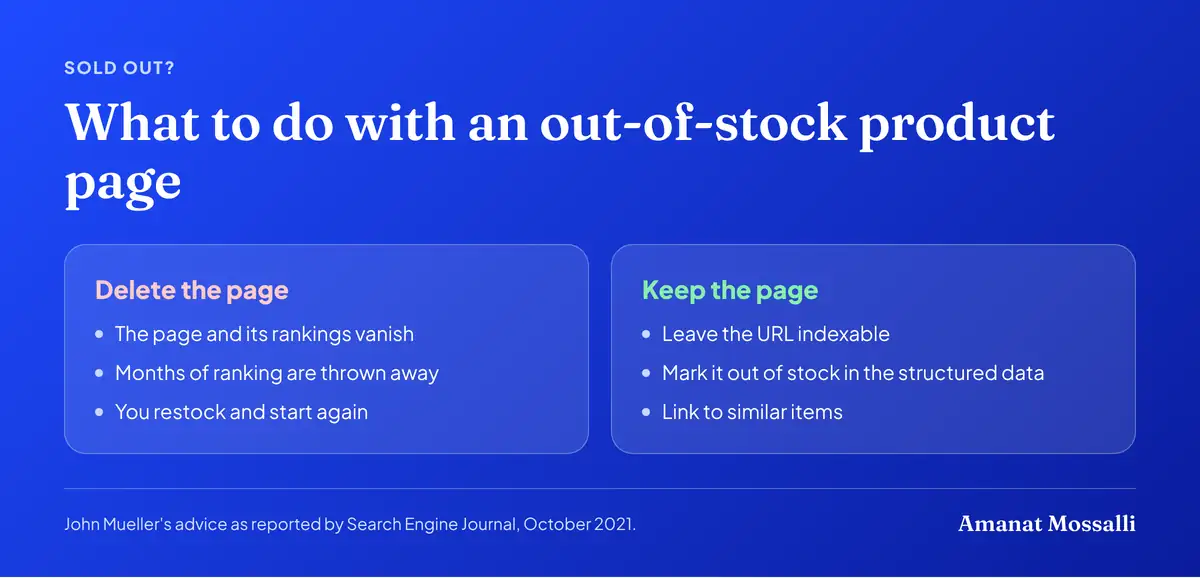
The second one annoys me most. Deleting a sold-out page throws away months of ranking for a product you’ll restock in three weeks.
Google’s John Mueller addressed this in an office-hours session, reported by Search Engine Journal in October 2021. Keep the URL indexable and use structured data to say the product is currently unavailable. Google can then keep the page and recheck it. It’s old advice, and I haven’t seen Google withdraw it.
On filters, Google’s guide to faceted navigation is blunt. Filter URLs cause overcrawling, and they slow the discovery of your new products. If you don’t need those pages in search, it says to disallow the filter parameters in robots.txt. It rates canonical tags and nofollow as weaker tools for this job.
Many of the same habits show up in general marketing too. My list of digital marketing mistakes Bangladeshi businesses make covers the rest.
If your site is slow, or the theme fights you at every step, a rebuild can cost less than endless patching. My website cost guide has the taka ranges.
Showing Prices, Stock and Reviews in Google Results
Product schema does this. It’s a small piece of code that tells Google the price, stock and rating of each product. Google can then show those details right in the results.
Google’s merchant listing documentation names three required properties: the product name, an image and an offer. The offer holds the price, the currency and the availability. Shipping details and a return policy are optional extras, and worth adding.
Most good WooCommerce and Shopify setups add basic product schema for you. Check it with Google’s Rich Results Test, and make sure the price in the code matches the price on the page.
A caveat about Google Merchant Center
Most international guides tell you to upload a product feed to Google Merchant Center. Google’s guide to AI features in Search says the same: Merchant Center feeds and Business Profiles help products appear.
Here’s the catch for local shops. When I checked Google’s supported countries and currencies page on 11 November 2026, Bangladesh wasn’t in the table. So a shop selling only inside Bangladesh can’t lean on a feed today.
That makes the on-page work matter more here, not less. Your product schema and your Google Business Profile are the product data Google gets from you. If you export to a listed country, Merchant Center is open to you for that market.
- Show the price in taka on every product page.
- Mark stock clearly: in stock, out of stock, pre-order.
- Collect real reviews on the product page itself.
- Use your own product photos with clear alt text.
How Do AI Shopping Answers Pick Which Store to Mention?
They pick stores that clearly answer the buyer’s question and that other sites trust. A clear page with prices, policies and reviews is far easier for an AI to quote than an inbox.
Google says its AI Overviews and AI Mode use the same ranking systems as normal Search. So the shops that win in AI answers are mostly the ones already doing solid SEO.
That matches what I see. Some of my clients’ pages are cited in Google’s AI Overviews, and the work behind them was ordinary SEO.
The same Google guide clears away some myths. No special schema is needed for AI features. Google Search ignores llms.txt files. You don’t need to chop your content into small chunks. A page only has to be indexed and able to show a snippet.
Ask ChatGPT and Gemini to recommend shops in your category once a month. If competitors get named and you don’t, study their pages. Usually they just answer more of the buyer’s questions.
For the longer version, see my notes on generative engine optimization.
How Should You Plan SEO Around Eid and Sale Seasons?
Plan six to eight weeks ahead. Google needs time to find and rank a page, so a page published three days before Eid is almost always too late.

The last step on that calendar matters most. Use one URL, like /eid-collection/, and update it each year. A new URL every season throws away the ranking you built.
The same plan works for Puja, Pohela Boishakh, winter wear and back-to-school demand.
Back to the Narayanganj three-piece seller
She agreed to a small website in the quiet months after Eid. We put her ten best categories on it and wrote the descriptions in her own words. She dictated them on WhatsApp voice notes, late at night.
One /eid-collection/ page went up two months early. This Eid, her ads still cost more than usual. That part didn’t change. But in the Eid month, about four of her thirty-odd daily orders came from Google searches like “cotton three piece price in bd”. Those cost her nothing per click. Her average cost per order for the month came in roughly 15% lower than the Eid before.
Not a miracle. Still, the ad bill is no longer the whole story for her. That was the entire goal.
How Do You Measure Sales From SEO?
Set up GA4 e-commerce tracking, then look at revenue by channel. Without it, you see traffic, not money.
- Track purchases, add-to-cart and checkout steps in GA4.
- Count cash on delivery orders as purchases when the order is placed.
- Track WhatsApp and phone clicks as leads.
- Compare cost per order from SEO and from ads each month.
Proper conversion tracking fixes your ads too, because Meta and Google then learn from real purchases instead of guesses.
Add Search Console next to GA4. It shows the exact searches that brought people in, which GA4 can’t. Sort the queries by impressions and look for product names you never wrote a page for.
WooCommerce, Shopify or Custom: Which Is Best for SEO?
All three can rank well. Speed, clean URLs and full control of titles, content and schema matter more than the platform name.
| Platform | SEO strengths | Watch out for |
|---|---|---|
| WooCommerce on WordPress | Full control, strong SEO plugins, easy local payment add-ons | Needs good hosting and few plugins |
| Shopify | Fast to launch, stable hosting | Monthly fees, less control over some URLs |
| Custom build | Can be very fast | SEO basics are often forgotten, harder to edit |
For most Bangladeshi shops, I suggest WooCommerce on good hosting. It works with local gateways and couriers, and you control everything. I’d skip the custom build unless you have a developer on staff.
FAQ: SEO for Online Shops in Bangladesh
Why is SEO important for an online shop?
Is a Facebook page enough for e-commerce in Bangladesh?
How long does e-commerce SEO take in Bangladesh?
What is the most important page for e-commerce SEO?
Should I write product descriptions in Bangla?
Does SEO help with cash on delivery orders?
Can a small online shop compete with Daraz on Google?
What Should You Fix First This Week?
Your ten best-selling category pages. That’s where why SEO is important for e-commerce business in Bangladesh turns from theory into orders.
- 1Pick your ten best-selling categories and improve those pages first.
- 2Replace supplier text on your top 20 products.
- 3Stop deleting out-of-stock pages.
- 4Put the taka price on every page that says “inbox for price”.
- 5Set up GA4 e-commerce tracking and Search Console.
For a step-by-step growth plan, read how to increase organic traffic in Bangladesh. For the bigger picture, see the future of e-commerce in Bangladesh.
Not sure which of the five to start with? Run your best category page through my free SEO audit tool. It takes under a minute, and the report usually makes the choice for you.

Amanat Mossalli Taju
Senior Digital Marketer & SEO Expert, Dhaka, BangladeshI have grown 235+ brands over more than seven years with SEO, Google and Meta Ads, server-side tracking, WordPress and AI automation. Half of my clients are in the UK, USA, Australia and Canada. Everything I write here comes from real client work.
Want this done for your business?
Book a free 15-minute call. I look at your site and ads before we talk, so you leave with clear next steps.