How to Start a Business in Bangladesh in 2026: The Papers, in the Right Order
Trade licence, RJSC, e-TIN, BIN, bank account and DBID in plain words and in the right order. The 2026 steps, plus the paperwork gaps that block ad accounts and payment gateways.

Somebody will say “just get a trade licence” the moment you ask how to start a business in Bangladesh. That’s one paper out of four or five, and not even the first one. Order matters here, because each office asks for the paper the last office gave you.
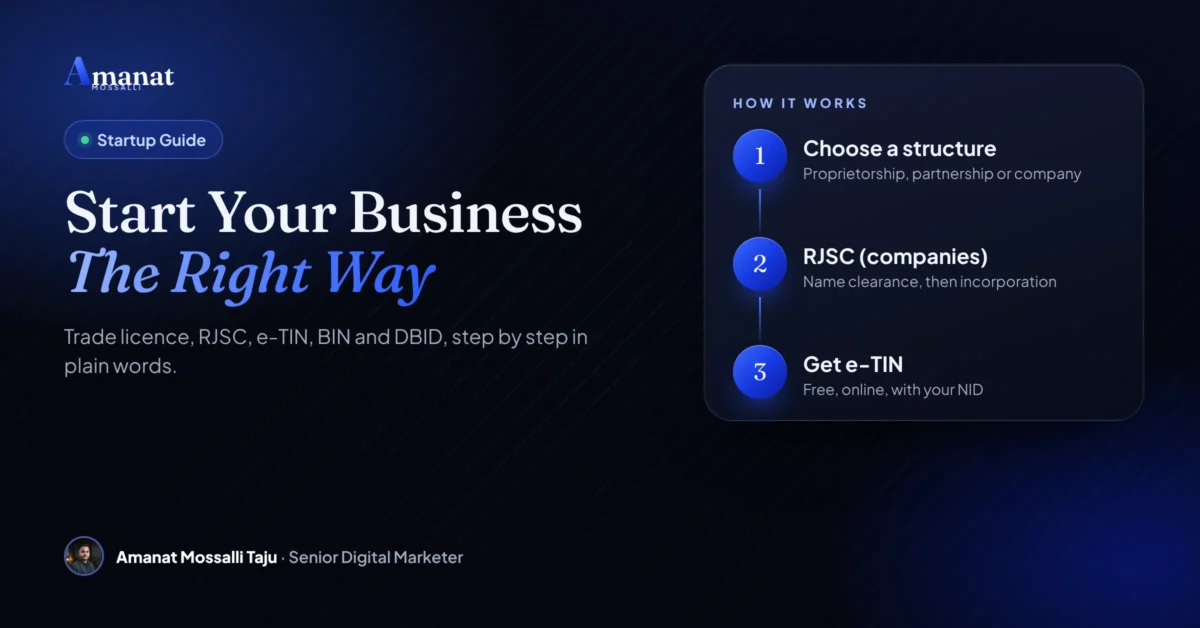
The sequence: choose your business type, get an e-TIN, and take a trade licence from your city corporation or local council. Then register for VAT (BIN) and open a bank account. Companies register with RJSC before all that. Online sellers also need a DBID.
Two things changed this year, and most older guides miss both. Since 1 July 2026 a BIN is needed for jobs that never used to involve the VAT office. And BIDA’s BanglaBiz portal now bundles five approvals into one application. I cover both below, with the fees I could verify and the dates I checked them.
I’m Amanat Mossalli Taju, a digital marketer, not a lawyer. I meet these papers from the other side, when an ad account, a payment gateway or a Google profile asks for them. So read this as general guidance, not legal advice. Rules and fees change often, sometimes twice a year. Check the official website of each office before you pay anyone anything.
How to Start a Business in Bangladesh: The Quick Answer
Four papers cover almost any business: an e-TIN, a trade licence, a VAT registration (BIN) and a business bank account. Some sectors need extra licences on top.
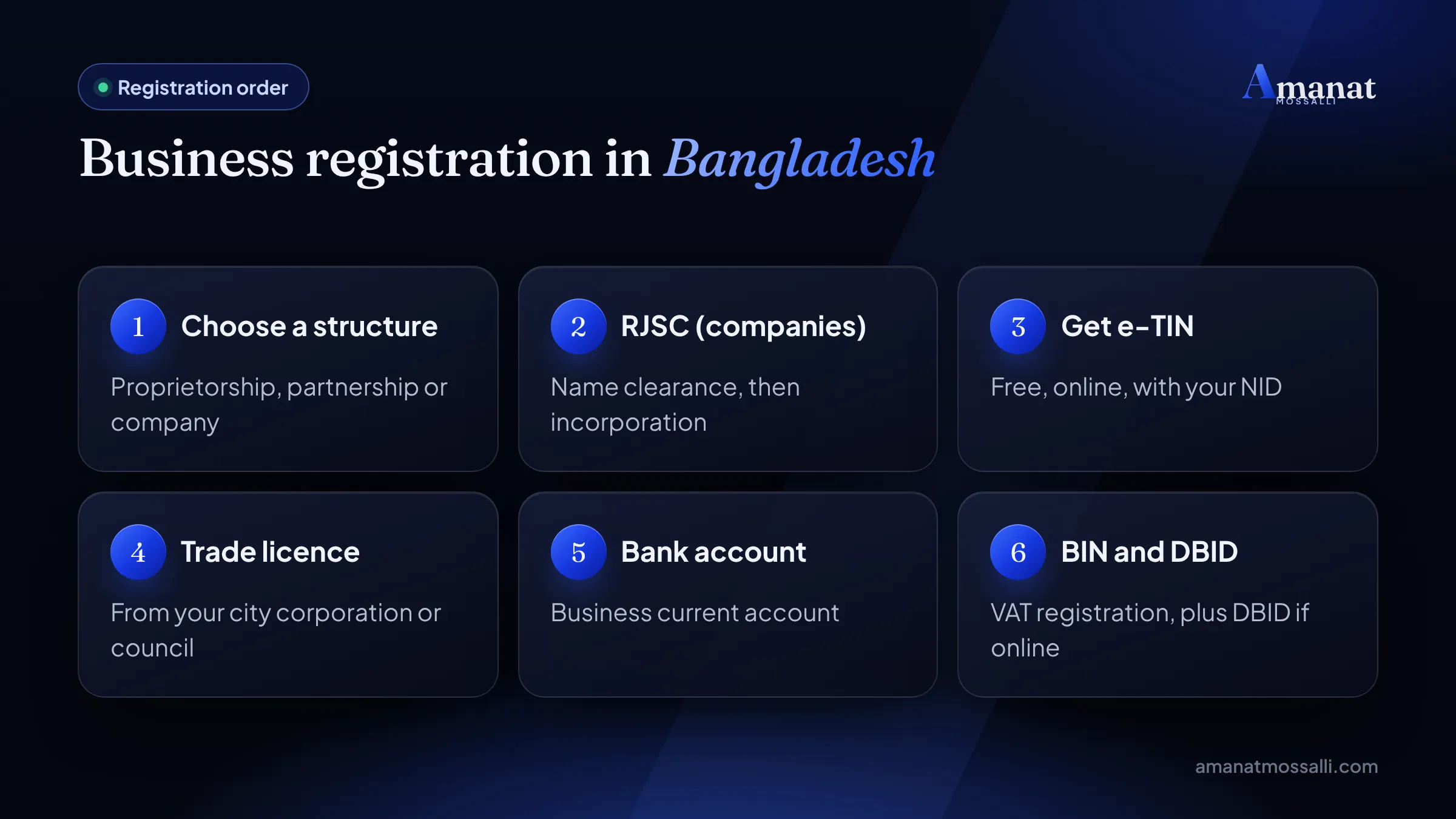
If you see the bank listed before the BIN anywhere, older charts included, swap them. Since 1 July 2026 the bank asks for the BIN first.
Which papers you need depends on what you’re opening. Find your row first. Then read only the sections that apply to you.
| You are opening | Your papers, in order | Skip |
|---|---|---|
| A shop, clinic, cafe or service as one owner | 1. e-TIN. 2. Trade licence. 3. BIN or turnover tax enlistment. 4. Business current account. 5. Sector licence if needed. | RJSC |
| An online-only shop on Facebook or a website | 1. e-TIN. 2. DBID. 3. BIN or enlistment. 4. Bank and bKash or Nagad merchant account. A trade licence helps with banks and gateways. | RJSC |
| A partnership | 1. Written partnership deed. 2. e-TIN for the firm. 3. Trade licence. 4. BIN. 5. Bank account. | RJSC, unless you choose to register the firm |
| A private limited company or OPC | 1. Name clearance. 2. RJSC incorporation. 3. Company e-TIN. 4. Trade licence. 5. BIN. 6. Bank account. | Nothing. This is the long route |
The one-application route: BanglaBiz
Good news: more of this is moving online. BIDA and JICA launched the second version of the BanglaBiz portal at BIDA’s Agargaon office. BSS reported it on 1 February 2026.
Its Business Starter Package takes five approvals in one application: name clearance, a temporary bank account, company incorporation, e-TIN and trade licence. The same report says the portal covers more than 20 recurring approvals too, VAT registration and fire licences among them.
The target is three working days. The Financial Express described the package in March 2026 as “designed to conclude within three working days”. That’s a design goal, not a promise. Notice also that the package is built around company incorporation. A one-owner shop still deals with the city corporation directly.
BIDA also runs a one stop service (OSS) for investors, and more city corporations are joining it. BSS reported that BIDA signed agreements with seven city corporations and four banks in January 2026. The plan is to bring trade licence services online through this system in phases.
So if you’d rather not run between offices, check BanglaBiz and the BIDA one stop service first. If your area isn’t connected yet, the steps below are the manual route.
Which Business Structure Should You Choose?
Most small businesses here start as a sole proprietorship. It’s the simplest and cheapest. Pick a company if you want investors, limited liability or big corporate clients.
| Structure | Best for | Register with | Key point |
|---|---|---|---|
| Sole proprietorship | One owner, small shop or service | City corporation (trade licence) | Cheapest. You are personally liable for debts. |
| Partnership | 2 or more owners | Trade licence; RJSC registration optional | Always sign a written partnership deed. |
| Private limited company | Growth, investors, corporate clients | RJSC, then trade licence | Limited liability. More paperwork and yearly filings. |
| One person company (OPC) | Solo founder who wants a company | RJSC, then trade licence | Minimum paid-up capital of Tk 25 lakh. |
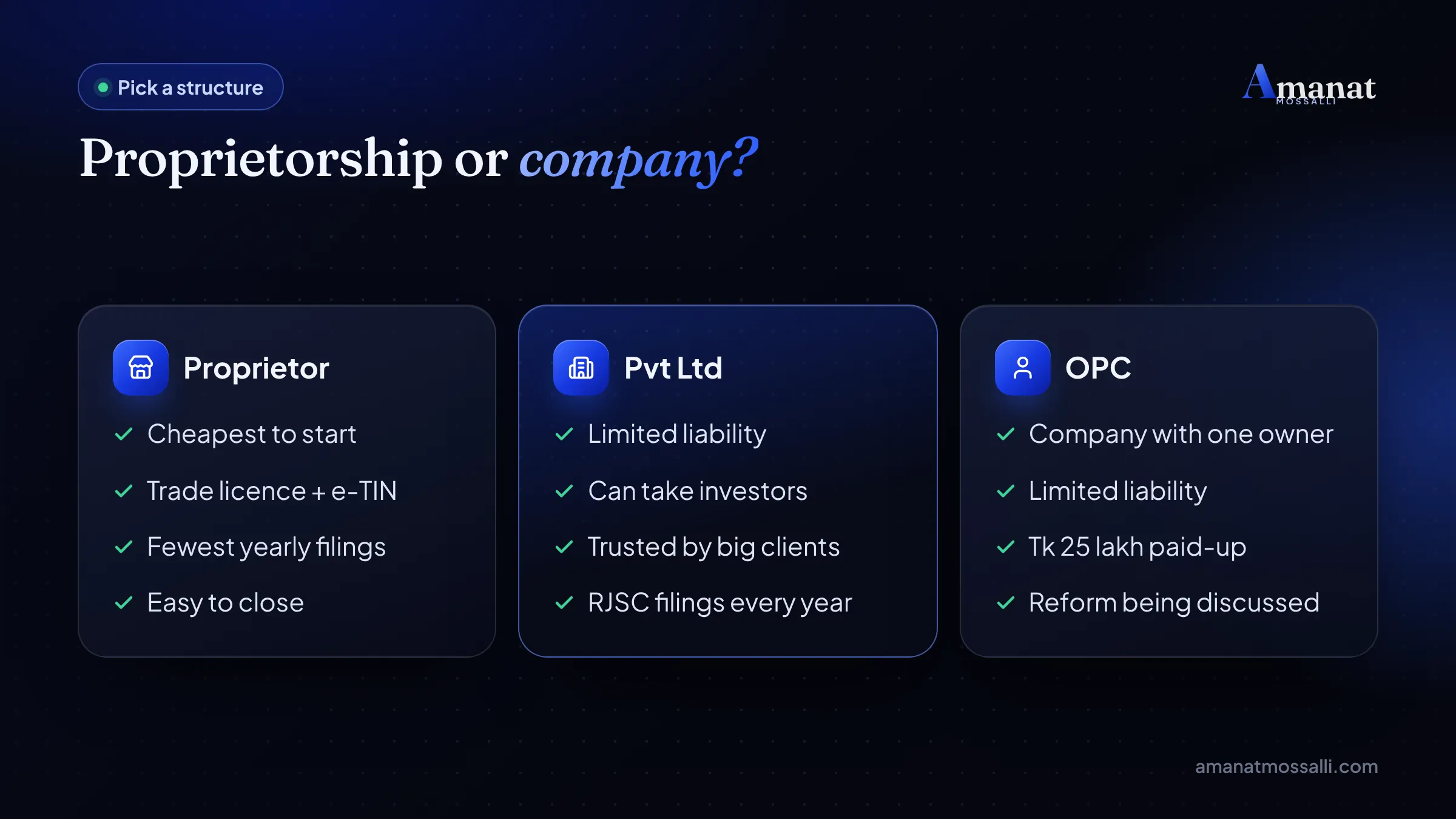
The OPC rule matters. The Financial Express wrote in October 2026 that an OPC still needs Tk 2.5 million paid-up capital. A normal private limited company has no legal minimum. The ministry and RJSC are working on a change, so check before you decide.
How the tax differs
A sole proprietor’s profit is taxed as personal income, at individual rates. A company pays corporate tax on its profit, whatever the owner draws.
PwC’s summary of the Finance Act 2026 puts the rate for an ordinary private company at 27.5%. It drops to 25% if every transaction goes through bank transfer. I read that summary on 11 November 2026.
The same summary says companies with turnover above Tk 1 crore, or capital above Tk 50 lakh, must file audited accounts with the return. That means an auditor’s fee every year. A proprietor selling the same amount has a lighter load.
If you are testing an idea, start as a sole proprietor. You can turn it into a private limited company later, when you have sales and a reason to.
Test the Idea Before You Register Anything
Before you pay a single fee, make sure people will buy. Paperwork for a business nobody wants is money down the drain.
Sell to ten real customers first, even informally. Run a small Facebook test. Ask a few shops or clients if they’d order. Still choosing an idea? Read which business is most profitable in Bangladesh.
Decide your business name now too. Check that the name, the .com or .com.bd domain and the Facebook page name are all free. Renaming after you’ve printed signboards and papers is painful, and I’ve watched people do it.
RJSC Name Clearance and Company Registration
Forming a company? You register with the Registrar of Joint Stock Companies and Firms (RJSC). Sole proprietors skip this and go straight to the e-TIN and trade licence.
Name clearance
Apply online at the RJSC website. The government’s Bangladesh Trade Portal guide lists a fee of Tk 600 per proposed name. The clearance stays valid for 180 days, and an extension costs Tk 100. Fees move, so confirm on RJSC’s site.
RJSC company registration
After name clearance, you file to incorporate. You’ll need:
- Memorandum and Articles of Association (MoA and AoA).
- The RJSC forms for directors, office address and shares.
- NID or passport and TIN of every director and shareholder.
- Proof of stamp duty and registration fee payment.
Fees depend on your authorised capital. Bigger capital means higher stamp duty and filing fees. RJSC has a fee calculator on its website. Use it before you pick a number.
A worked example: Tk 10 lakh authorised capital
The Trade Portal guide prints the fee slabs, so you can do the sum by hand. I worked this one through on 11 November 2026. The guide carries no publication date, so treat the result as a budget figure and confirm it on RJSC’s calculator.
| Item | How the guide counts it | Amount |
|---|---|---|
| Name clearance | One name | Tk 600 |
| Capital fee, first Tk 20,000 | Flat | Tk 360 |
| Capital fee, Tk 20,001 to 50,000 | 3 slabs of Tk 10,000 at Tk 180 | Tk 540 |
| Capital fee, Tk 50,001 to 10 lakh | 95 slabs of Tk 10,000 at Tk 45 | Tk 4,275 |
| Filing fee | 6 documents at Tk 200 | Tk 1,200 |
| Stamp duty on MoA and AoA | Stated as Tk 4,000 for capital up to Tk 10 lakh | Tk 4,000 |
| Total government fees | About Tk 10,975 |
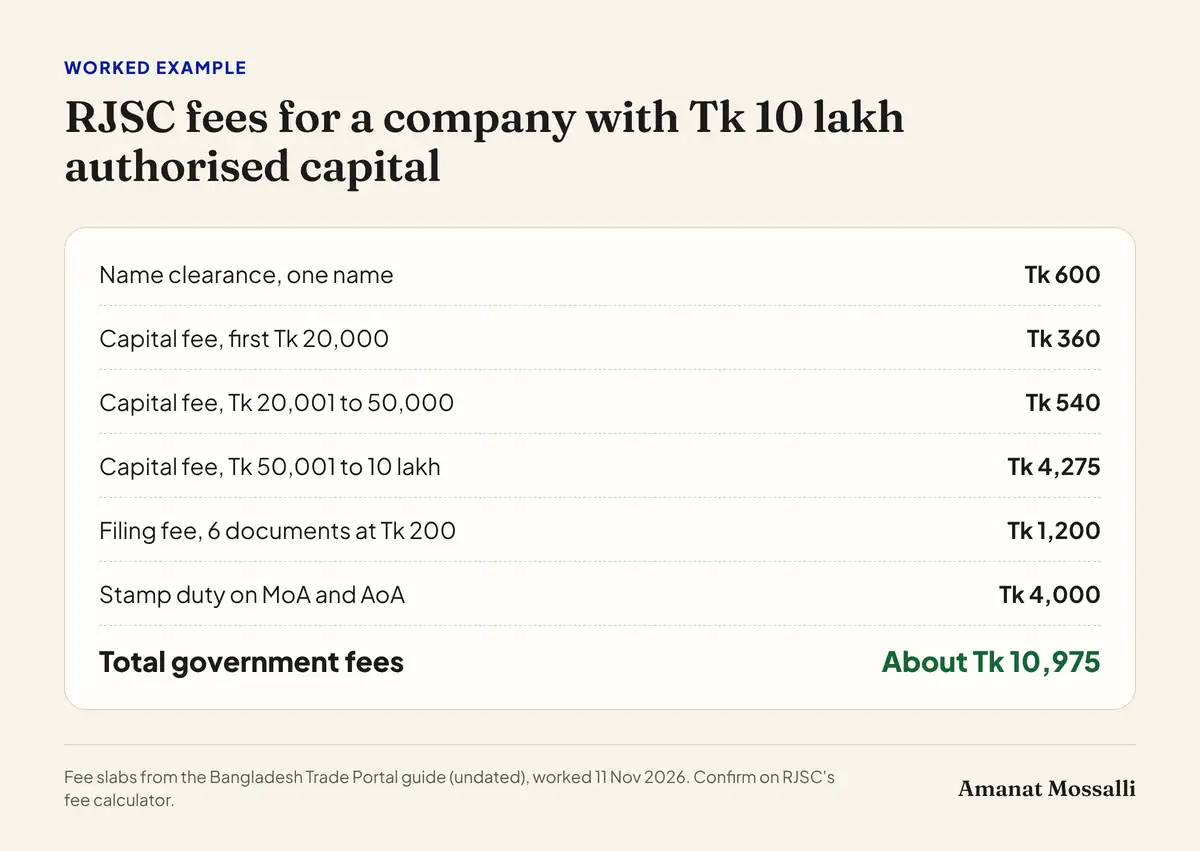
One wrinkle. Elsewhere the same guide lists the stamps as Tk 500 and Tk 2,000, which adds up to less. I’ve used the higher figure so you aren’t caught short. A company seal adds Tk 100 to 200. A lawyer or consultant, if you use one, is on top of all this.
A bigger capital figure keeps adding to the bill. The guide charges Tk 24 for each further Tk 10,000 up to Tk 50 lakh, then Tk 45 for each further Tk 1 lakh. Its fee table also lifts the stamp on the Articles above Tk 10 lakh. Above Tk 3 crore that stamp reaches Tk 10,000.
There’s a second cost. Capital above Tk 50 lakh brings the audited accounts rule from the tax section into play, every year.
Do not pick a huge authorised capital to look big. It raises your fees for no benefit. Pick what you really plan to raise in the next few years.
When it’s done, you get a Certificate of Incorporation. Keep certified copies. Banks, the city corporation and the VAT office will all ask to see them.
Get Your e-TIN From the NBR
An e-TIN is your tax identification number from the National Board of Revenue (NBR). It’s free and takes a few minutes online.
For yourself, you need your NID and a mobile number registered in your name. A company gets its own TIN after incorporation.
A TIN means you must file an income tax return every year, even when you owe little or nothing. Offices and banks now ask for proof of return submission (PSR), so don’t skip it.
The FY2026-27 budget brought some relief. Future Startup’s reading of the budget says income from turnover up to Tk 50 lakh is tax-exempt for general entrepreneurs. For women entrepreneurs the figure is Tk 70 lakh.
The Daily Star’s budget coverage gave the same two figures. PwC’s summary of the final Act adds that the SME exemption now carries an extra registration condition. So don’t assume you qualify. Confirm the conditions with a tax adviser.
Take a Trade Licence From Your City Corporation
A trade licence is the basic permission to run a business from a specific address. In Dhaka it comes from Dhaka North (DNCC) or Dhaka South (DSCC) City Corporation, depending on where your office sits.
Outside city corporations, you apply to the local pourashava or union parishad. Either way, each business address needs its own licence.
Documents usually asked for
- Completed application form and passport-size photos.
- NID of the owner, and TIN certificate.
- Rent agreement or ownership papers for the office or shop.
- Holding tax receipt of the premises.
- For companies: Certificate of Incorporation, MoA and AoA.
- For partnerships: the partnership deed.
What it costs
The fee depends on your type of business. The Bangladesh Trade Portal guide lists licence fees from about Tk 1,000 to Tk 20,000, with company fees linked to paid-up capital. It allows about seven days for the process.
Don’t expect one flat number. DSCC alone sorts its licences into 294 business categories, the Dhaka Tribune reported in August 2026. A law firm guide from Jural Acuity, dated January 2026, gives a wider range, from Tk 100 to over Tk 40,000. It adds that signboard tax and VAT come on top.
So ask the counter for the full demand note before you pay, not the licence fee alone.
Renewal, and the new BIN rule
A trade licence runs with the fiscal year, 1 July to 30 June, and is renewed every year. The Jural Acuity guide puts the renewal deadline at 30 June, with surcharges after that.
From 1 July 2026, renewal needs a BIN or turnover tax enlistment. That comes from the Finance Act 2026. Plan your VAT registration early, because the BIN section below now affects almost everything else.
What Is a BIN, and Why Does It Matter More in 2026?
BIN means Business Identification Number. You get it by registering with the NBR’s online VAT system, and you can download the certificate once approved. Registration itself carries no government fee. The Trade Portal guide allows one to two working days.
What changed on 1 July 2026
The Finance Act 2026 was gazetted on 30 June 2026 as Act No. 96. Lookuptax’s note on the change says it adds a new sub-section to Section 4 of the VAT and Supplementary Duty Act 2012. The rule took effect on 1 July 2026. A BIN or enlistment certificate is now a precondition for:
- Opening or operating a current or STD account with a bank or NBFI.
- Taking a bank or NBFI loan.
- Renewing a trade licence.
- Opening a mobile financial services merchant account, such as bKash or Nagad.
- Joining or renewing a trade body membership.
- Getting an electricity or gas connection for the business.
- Registering a vehicle with the BRTA in a business name.
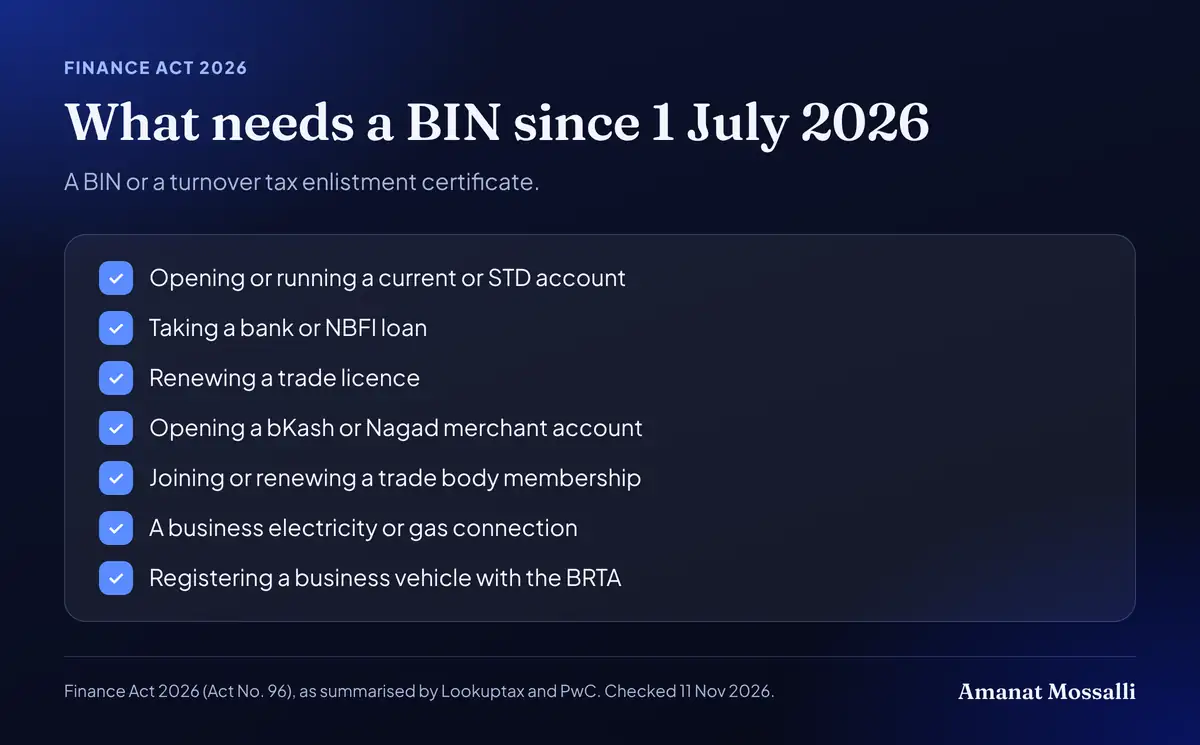
PwC’s summary reads the same way. It notes the rule will pull in businesses that only make VAT-exempt supplies too. I checked both pages on 11 November 2026.
Full VAT or turnover tax?
Small businesses under the VAT registration limit can take turnover tax enlistment instead. PwC’s summary says the Tk 30 lakh enlistment threshold stays, and so does the 4% turnover tax. A budget proposal to remove the threshold was not enacted.
The registration limit above that has moved in recent budgets, and I couldn’t confirm the final FY2026-27 figure from an official page. Check it on the NBR website or with a VAT consultant before you choose.
One filing change is worth knowing. According to PwC, quarterly VAT returns are now the default, due by the 15th day after the quarter ends. Monthly filing stays as an option.
Startups get a new benefit too. Future Startup’s budget analysis says eligible startups are exempt from 15% VAT on local services, imported services and premises rent until June 2035. PwC puts it more broadly. All supplies by a startup, as the Income-tax Act 2023 defines one, are VAT-exempt from 1 July 2026.
Open a Business Bank Account
Open a separate current account in your business name. Never run business money through your personal account or personal bKash. That habit causes more trouble than any missing form.
Last year a woman in Dhanmondi who sold home decor from a Facebook page messaged me on a Thursday afternoon. Her ad account had been restricted, her payment gateway application had bounced, and she had an Eid stock order sitting in a Keraniganj warehouse. Every taka of her business had moved through her personal bKash for two years. No trade licence, no business account, no BIN, no DBID. I’ve helped grow 235+ brands, and a surprising number arrived exactly like her: good product, missing papers. We stopped talking about ads that day and made a list of offices instead. It took her about six weeks to get everything in order. Her DBID came through on the second try. The gateway approved her about ten days after the business account opened. Her ad account came back on the second appeal, in time for the next Eid. Only then did the marketing conversation restart.
Banks usually ask for your trade licence, NID, TIN and photos. Companies add their incorporation papers and a board resolution.
Here’s the catch, and it’s why I’ve put this step after the BIN. Under the Finance Act 2026, opening or running a business current account needs a BIN or enlistment. Some banks may accept proof that you’ve applied. Ask your bank which order it wants before you visit.
A proper bank account also opens the way to a payment gateway (SSLCommerz or bKash merchant, for example) and makes loans easier later. The decor seller found that out the hard way. If you plan to take payments on a website, my guide to bKash payment gateway integration covers what the merchant team asks for.
Do I Need a DBID or Other Licences?
Yes, if you sell online, including on Facebook, you need a DBID (Digital Business Identification). Food, medicine, import and a few other sectors need special licences as well.
DBID for e-commerce and f-commerce
The Ministry of Commerce started DBID in 2022 after the e-commerce scams. RJSC handles it. Under the guidelines, online businesses can’t operate without one.
Many people fail on small details. The Financial Express reported RJSC data showing only 1,458 of 10,218 applications succeeded. Of the applications decided, 8,367 were rejected for lacking proper documents.
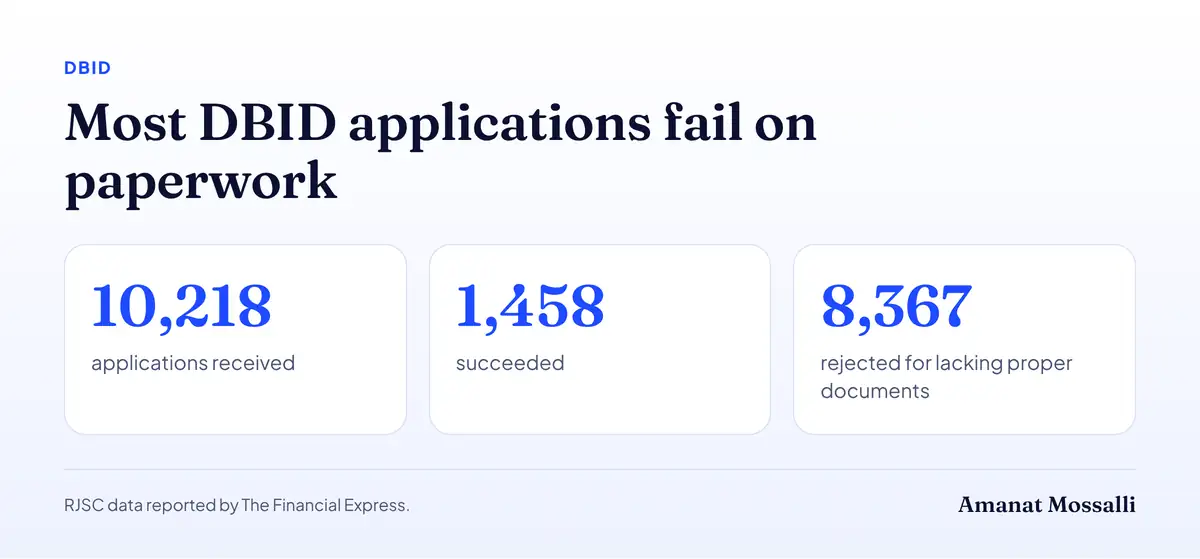
A common reason: no terms and conditions in Bangla on the website or page. The decor seller’s first application failed for exactly that. RJSC also told the paper that many firms applied without reading the guidelines.
The same report has two points in your favour. A DBID can be had without a trade licence if you have an official website or social media page. And the owner’s NID is enough to apply.
- Write your terms, refund and delivery policy in Bangla on your website or page.
- Display your DBID number on the website or page once you get it.
- Read the guideline fully before you apply.
Other common licences
Not sure what applies to you? BIDA’s BanglaBiz portal has a Know Your Approvals tool that lists required approvals by sector.
How Much Does It Cost to Register a Business in Bangladesh?
A sole proprietorship can be registered for a few thousand taka in government fees. A private limited company costs more, because RJSC fees and stamp duty rise with authorised capital. Registration is the small part of your startup cost. Stock, rent and marketing usually cost far more.
| Item | Government fee | Notes |
|---|---|---|
| e-TIN | Free | Online with NID |
| VAT registration (BIN) | No fee | Online on the NBR VAT system |
| Trade licence | About Tk 1,000 to Tk 20,000 | Depends on business type; signboard tax and VAT may be added; yearly renewal |
| RJSC name clearance | Tk 600 per name | Companies only; valid 180 days |
| RJSC registration and stamp duty | About Tk 10,400 at Tk 10 lakh capital | See the worked example above; rises with capital |
| Company seal | Tk 100 to 200 | Companies only |
| DBID | Check the current guideline | Online sellers |
| Lawyer or consultant | Varies widely | Optional, but helpful for companies |
Fees in this table come from the Bangladesh Trade Portal guide and NBR practice, checked on 11 November 2026. They can change at any time. Confirm on the official site before paying, and get a receipt for every payment.
Where does the money leak? Rarely in the official fees. It goes to the middleman who promises a licence “in one hour”, and to cash paid with no receipt. It goes to an inflated authorised capital too. Pay at the counter or online, in your own name, and keep the slip.
The Dates That Come Back Every Year
Registration is a one-time job. Staying registered is a yearly one, and this is where new owners slip. I’d put every line below into your phone calendar the day you get the paper.
| What | When | Source and caveat |
|---|---|---|
| Trade licence renewal | By 30 June each year | Jural Acuity guide, January 2026. Your city corporation may extend the date, so check |
| VAT return | Quarterly, by the 15th day after the quarter ends | PwC’s Finance Act 2026 summary. Monthly filing is optional |
| Income tax return | Every year once you hold a TIN | Confirm the due date for your category on the NBR site |
| Audited accounts | With the return, if turnover passes Tk 1 crore or capital passes Tk 50 lakh | PwC’s summary; applies to companies and firms |
| RJSC annual filings | Every year for companies | Ask your company secretary or lawyer for the dates |
| Sector licences | On each licence’s own cycle | Food, drug, fire, import and export papers all expire separately |
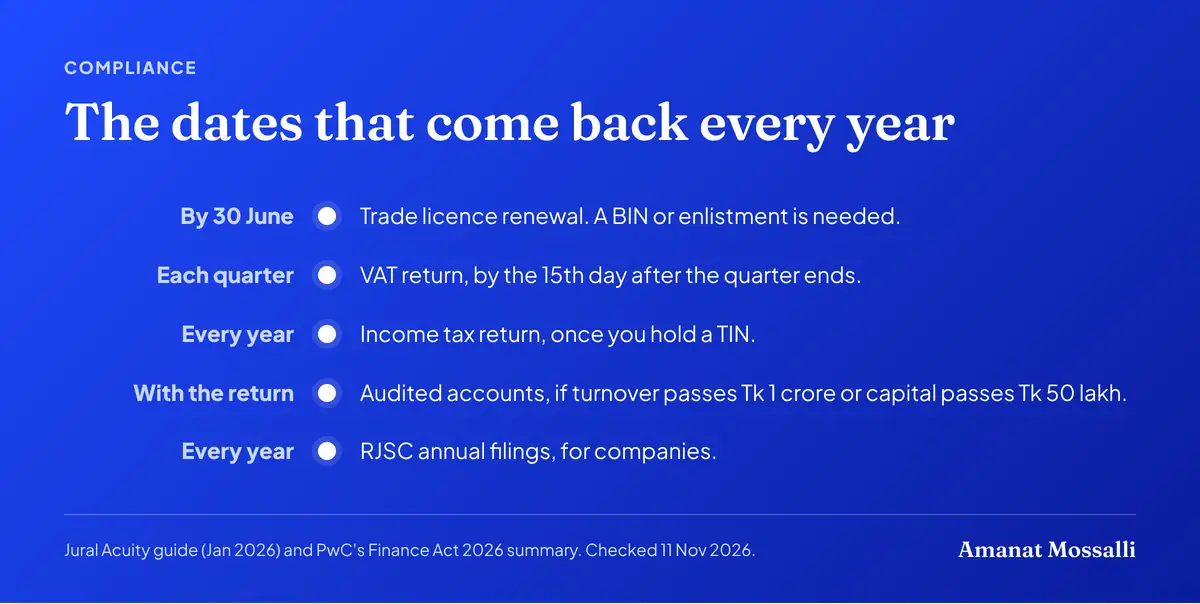
A missed renewal hurts more now than it did a year ago. No valid BIN means no licence renewal. No licence means trouble at the bank. The papers lean on each other.
Set Up Your Online Presence and First Marketing
Once the papers are done, customers need to find and trust you. In Bangladesh, people check Google and Facebook before they buy or call. Both will ask for the address on your trade licence sooner or later.
- 1Get a domain and a fast, mobile-friendly website with your trade licence address.
- 2Create a Google Business Profile so you show up on Google Maps.
- 3Set up a Facebook page with the same name, phone and address.
- 4Install tracking before you spend on any ads.
- 5Write a few helpful pages that answer what your customers ask.
My WordPress website service builds sites that load fast on mobile data. Budgeting for one? See website development cost in Bangladesh. For a local shop, read why local SEO matters for Bangladeshi businesses and my Google Business Profile guide. If you plan to build a name people remember, see my guide on brand building in Bangladesh.

FAQ: Starting a Business in Bangladesh
What documents do I need to start a business in Bangladesh?
How long does business registration take in Bangladesh?
Can I start a business in Bangladesh without a trade licence?
Is a TIN required for a small business in Bangladesh?
What is the difference between TIN and BIN?
Do Facebook page sellers need a DBID?
Can a foreigner start a business in Bangladesh?
Is this legal advice?
Papers in Order, Then Growth
That’s how to start a business in Bangladesh without the six-week scramble the decor seller went through. Do it in order, and keep every receipt.
If you do one thing tonight, make it the e-TIN. It’s free, it takes minutes, and every other office on this page will ask for it. Tomorrow, phone your city corporation and ask for the fee for your business category.
The marketing can wait a few weeks. It works far better on a business that’s allowed to have a bank account. When you reach that stage, the free marketing tools on this site are a sensible place to begin.

Amanat Mossalli Taju
Senior Digital Marketer & SEO Expert, Dhaka, BangladeshI have grown 235+ brands over more than seven years with SEO, Google and Meta Ads, server-side tracking, WordPress and AI automation. Half of my clients are in the UK, USA, Australia and Canada. Everything I write here comes from real client work.
Want this done for your business?
Book a free 15-minute call. I look at your site and ads before we talk, so you leave with clear next steps.