Generative Engine Optimization: How to Get Cited by ChatGPT, Gemini and AI Overviews
A source-backed GEO playbook: how AI search tools choose what to cite, what actually helps, what's hype, and how to measure your AI search visibility.

You typed your own category into ChatGPT last week, something like “best travel agency in Dhaka for Umrah”, and it named three companies. None of them was yours. You rank on page one of Google for that phrase. You’ve paid for the website, the content, the links. And the AI still quoted someone else.
Generative engine optimization (GEO) is the work of fixing that. It means making your pages easy for ChatGPT, Gemini, Perplexity and Google AI Overviews to find, trust and cite. In practice it’s good SEO plus three extras. Answers written to be quoted. A clear brand identity across the web. And tracking of where AI tools mention you.
I’ll stick to what the platforms themselves say, plus one peer-reviewed study. Where something is only an opinion or a proposal, I’ll say so. By the end you’ll have a four-week plan, and most of it costs nothing but time.
Generative engine optimization, defined without the hype
GEO means shaping your content so AI answer engines use it as a source. The goal isn’t only a blue link any more. It’s a mention, a quote or a citation inside the AI answer itself.
The owner of a travel agency in Banani showed me his phone in a cafe one Saturday morning. Google: his site at position one for his main keyword. ChatGPT, same question: three competitors named, with their prices, and his agency nowhere. He asked whether ChatGPT was broken. It wasn’t. His homepage opened with four paragraphs about the company’s founding. The competitors’ pages opened with a package price and a departure date. I’ve been doing SEO since 2020, and some of my clients’ pages now get cited in AI Overviews in the UK and the US. The ones that get cited all share that habit: the answer comes first.
The term comes from a research paper. GEO: Generative Engine Optimization was written by researchers including Pranjal Aggarwal and Karthik Narasimhan. It was published at KDD 2024, one of the main data science conferences.
Today people use the word for four kinds of AI answers. Each works a little differently.
You’ll also hear answer engine optimization (AEO). It’s an older, close cousin that grew up around featured snippets and voice answers. GEO is about AI-written answers. The foundation under both is the same as in my guide to SEO for Bangladeshi businesses.
How do ChatGPT, Gemini and AI Overviews pick what to cite?
They search an index of the web, pick a few pages that answer the question well, then write a summary that links to them. If your page isn’t in that index, it can’t be cited. Simple as that.
Google is clear on this. Its AI features guide for site owners says a page “must be indexed and eligible to be shown in Google Search with a snippet”. It adds that “there are no additional requirements” and no “special optimizations necessary”.
Google also describes a step called query fan-out. The AI runs many related searches across subtopics and then builds one answer. That’s why a single AI Overview can cite pages that rank for slightly different questions.
| AI tool | Where it gets pages | What you control |
|---|---|---|
| Google AI Overviews and AI Mode | Google’s normal search index, crawled by Googlebot | Indexing, snippets (nosnippet, max-snippet), content quality |
| ChatGPT search | OpenAI’s search crawler, OAI-SearchBot, plus search partners | Allow OAI-SearchBot in robots.txt |
| Perplexity | Its own crawler, PerplexityBot | Allow PerplexityBot in robots.txt |
| Microsoft Copilot | Bing’s index | Bing indexing and Bing Webmaster Tools |
For ChatGPT, OpenAI’s crawler documentation is blunt. “Sites that are opted out of OAI-SearchBot will not be shown in ChatGPT search answers.” That’s a direct quote. OpenAI also notes it can take about 24 hours for its systems to react to a robots.txt change.
So how to get cited by ChatGPT starts with a boring check: is the crawler allowed in? After that, the same quality signals apply as on Google.
GEO versus SEO: mostly the same job
Most of the work is normal SEO done well. The rest is about being easy to quote and being known beyond your own site. Anyone selling you GEO as a separate discipline with its own secret rules is selling the word, not the work.
The useful new evidence is the GEO paper. The researchers tested nine ways of rewriting web pages and measured how visible each page became in AI answers.
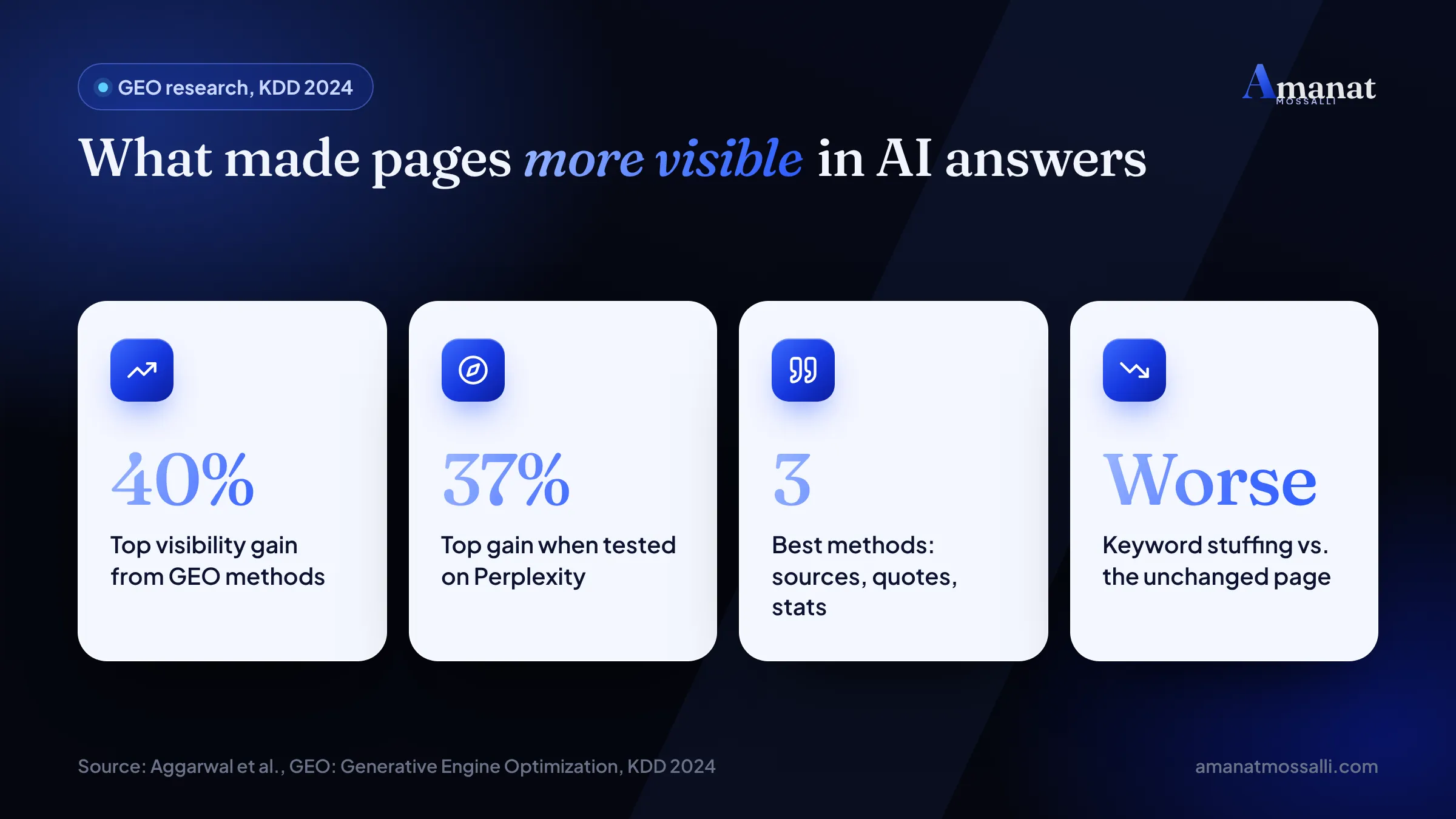
In the paper’s words, “including citations, quotations from relevant sources, and statistics can significantly boost source visibility.” Keyword stuffing scored below the unchanged page. Google has been saying that about keyword tricks for years.
The study used its own test engine and its own set of test questions. It shows what tends to help. It does not promise any result on ChatGPT or Google for your site, whatever the sales deck says.
So treat GEO as an extra layer on top of SEO, not a replacement. If your pages aren’t indexed, crawl at a snail’s pace on mobile data, or say nothing new, no GEO trick saves them.
Step 1Step 1: let the crawlers in
Check this first. A blocked crawler means zero citations, and plenty of sites block AI bots without knowing it, through a security plugin or a CDN switch.
- 1Open yoursite.com/robots.txt in a browser.
- 2Look for lines that disallow Googlebot, Bingbot, OAI-SearchBot or PerplexityBot.
- 3Check your CDN or firewall. Some hosting panels have a one-click “block AI bots” switch.
- 4In Google Search Console, run URL Inspection on your key pages. Confirm they’re indexed.
- 5Add your site to Bing Webmaster Tools too. Copilot draws on Bing’s index.
You might want to block AI training but still appear in AI search. That’s possible. OpenAI separates GPTBot, which collects training data, from OAI-SearchBot, which powers search. Google offers a token called Google-Extended to limit use in its other AI systems, while normal Googlebot rules control Search.
On cheap shared hosting, check speed as well. A page that times out for a crawler is as good as missing.
Step 2Step 2: write the sentence an AI would lift
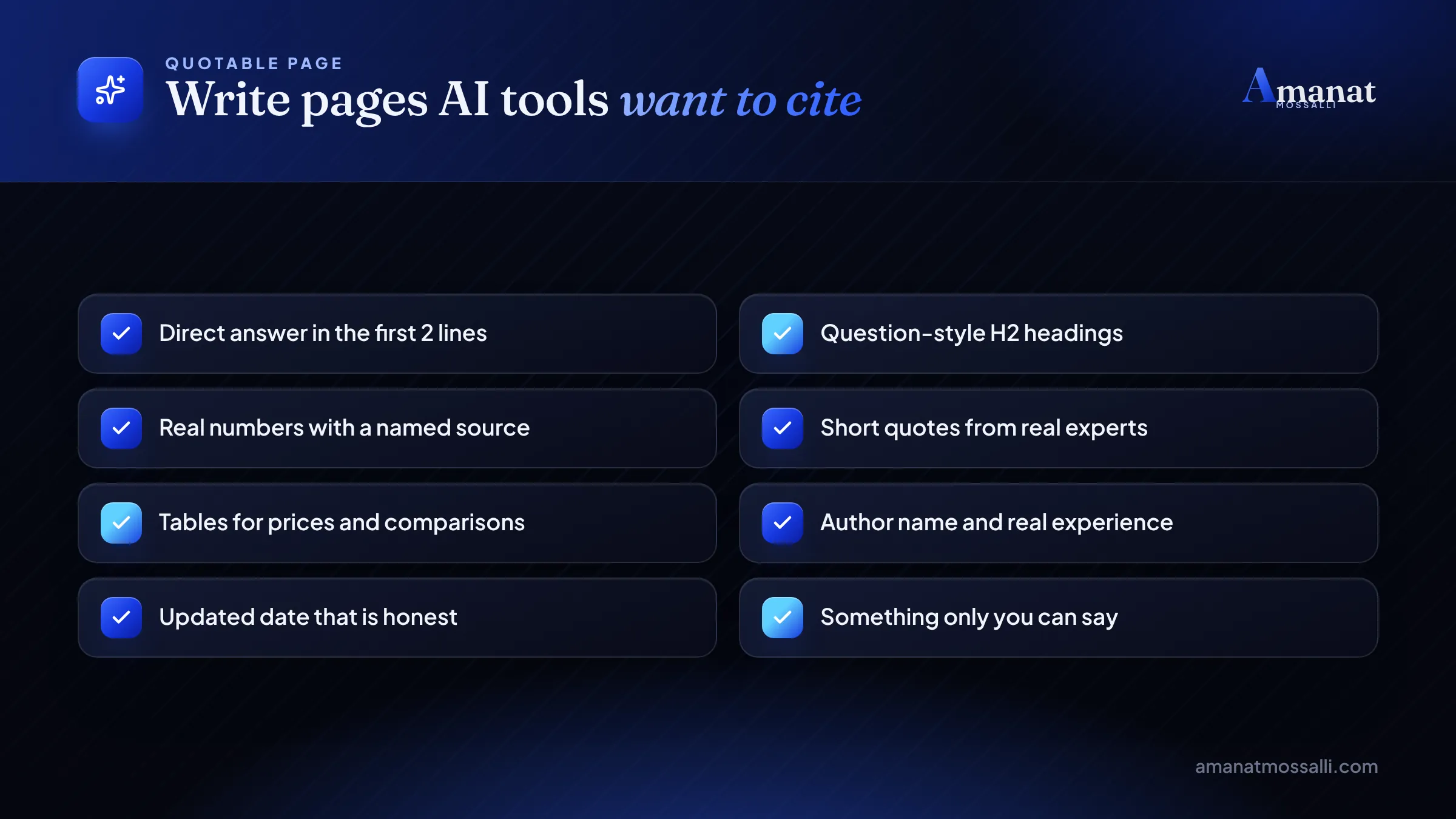
Short, direct answer at the top of each section. Facts and sources underneath. AI tools pull clean, self-contained passages. A rambling page gives them nothing neat to lift, which is exactly what happened to the Banani agency.
This is the core of AI Overviews optimization. It’s also what Google’s helpful content guidance has always asked for: original information, clear expertise, content made for people first.
Write the answer a stranger would quote
A reader asks how much a trade licence costs in Dhaka. Your first sentence should answer that, with the source. The detail can follow. If your answer starts with history, the AI quotes someone else.
Add what nobody else has
AI answers summarise the common view. The pages they cite usually add something extra: a price list, a local test, a photo, a clear table. A furniture shop in Mirpur that lists real delivery times by area has more to offer than a generic buying guide.
Cover the follow-up questions
Because of query fan-out, the AI looks at related questions too. Add a short FAQ with the next questions your customers ask. Use their words, including Bangla and Banglish phrasing where it fits.
Step 3Step 3: schema and your entity
Schema helps Google understand who you are. Google also says no special schema is needed for AI features. So use it to make your identity clear, not as a magic switch.
This is where entity SEO comes in. An entity is a thing Google can identify: your business, your founder, your product. The clearer the entity, the easier it is for AI tools to connect mentions back to you.
- Organization markup. Google’s Organization structured data guide says it helps Google understand your administrative details. Use the sameAs property to link your Facebook, LinkedIn and YouTube profiles.
- Match the page. Google’s AI features guide asks that structured data match the visible text. Don’t mark up reviews or prices you don’t show.
- One name, one address, one phone. Same business details on your site, Google Business Profile and directories.
- Author pages. A real person with a real bio is easier to trust than “Admin”.
The honest answer on schema markup for AI, then: it’s good hygiene that helps search engines read your site. It doesn’t force any AI tool to cite you.
Step 4Step 4: brand mentions, the digital word of mouth
Being mentioned on other trusted sites helps. AI tools build answers from many sources. If ten reviews and two news stories name your clinic, an AI has more reasons to include it.
Google says for local results that prominence, meaning how well known a business is, affects ranking. It makes sense that AI answers built on the same index reward the same thing. I can’t prove the exact weight, and nobody outside Google can.
Don’t buy links or fake mentions. Google’s spam policies treat links bought to manipulate rankings as link spam. Paid placements must be marked as sponsored or nofollow.
Do you need an llms.txt file?
No. Not for Google, and there’s no public proof that any major AI tool relies on it. It’s cheap to add, so add it only if you’ve got time left over.
llms.txt is a proposal by Jeremy Howard, first published in September 2024. It suggests a Markdown file at /llms.txt that summarises your site and links to key pages for AI agents.
Google’s AI features guide says you don’t need “new machine readable files, AI text files, or markup” to appear. Google’s John Mueller compared llms.txt to the old keywords meta tag in April 2025, as reported by Search Engine Journal.
My view: spend your first hours on content and mentions. An llms.txt file won’t fix a weak page, and I’ve never seen it fix anything else either.
Perplexity, ChatGPT, Copilot, Gemini: the small differences
The basics are shared. Be crawlable, be clear, be cited by others. What differs is which crawler and which index each tool uses.
- Perplexity SEO. Perplexity says it respects robots.txt for PerplexityBot. It shows numbered sources in every answer, so pages with clean facts and tables do well.
- ChatGPT. Allow OAI-SearchBot. ChatGPT may also visit a page live when a user asks, through ChatGPT-User.
- Copilot. Make sure Bing has indexed you. Many Bangladeshi sites never submit to Bing at all.
- Gemini. It draws on Google Search, so Google SEO covers most of it.
Language matters too. Google’s help centre lists Bangladesh and Bengali among the places and languages where AI Overviews work. A Bangla page that answers a local question clearly can be cited in a Bangla AI Overview.
How do you measure AI search visibility?
Use the free reports from Google and Bing first, then add manual checks. You can’t improve what you never look at.
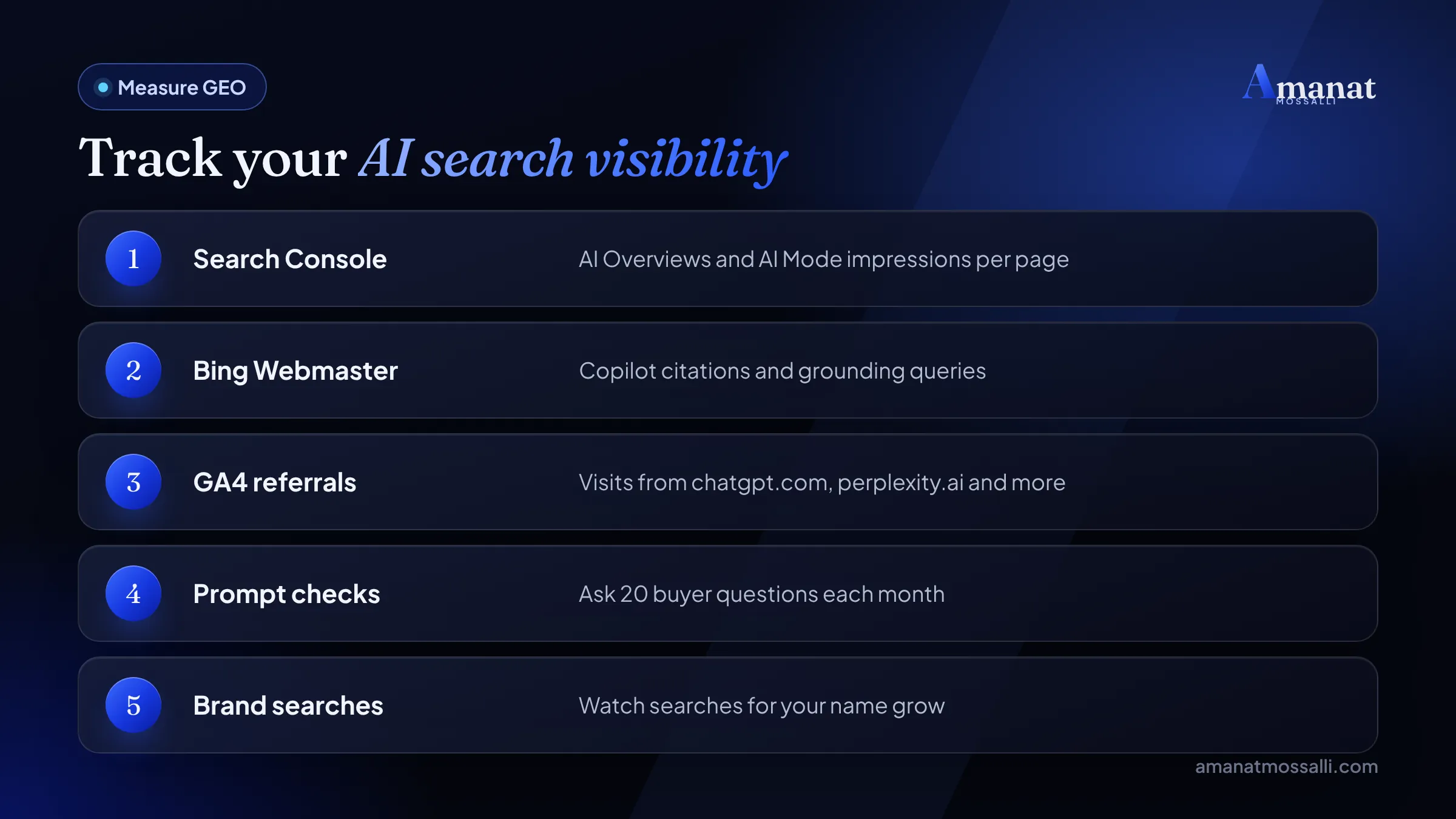
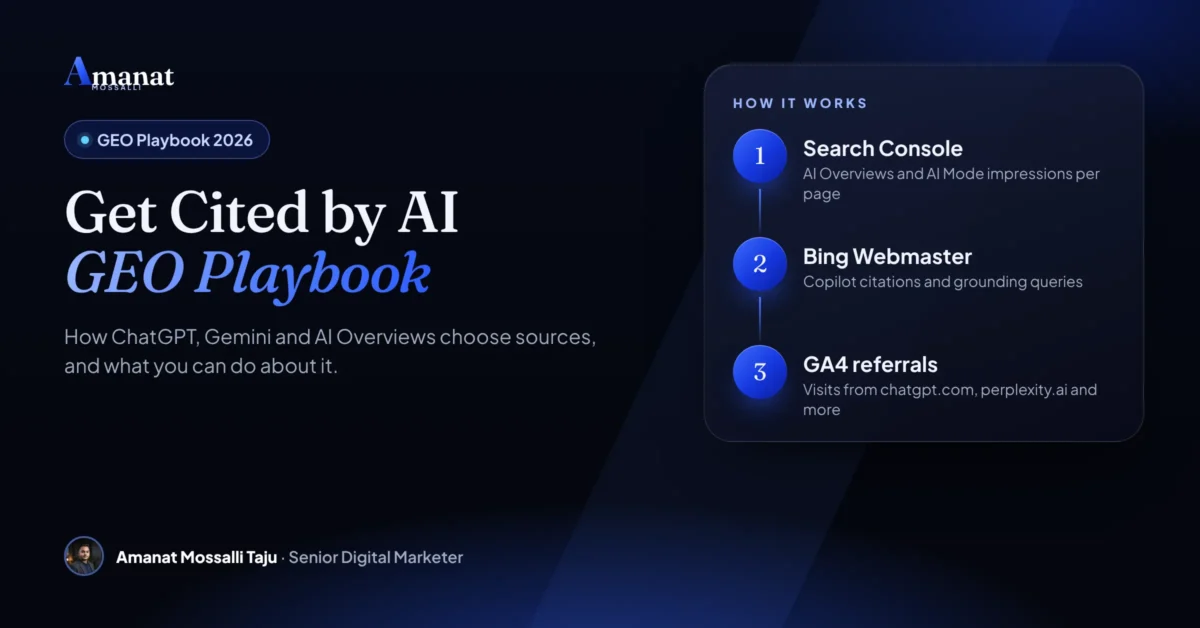
In June 2026 Google introduced Search generative AI performance reports in Search Console. They show how often your pages appear as sources in AI Overviews and AI Mode. At launch they showed impressions, not clicks or queries. Industry coverage reported the rollout reached all sites by the end of August 2026.
Clicks from AI Overviews and AI Mode are already counted inside your normal Performance report, under the Web search type. Google says these visitors tend to be “higher quality”, meaning they spend more time on the site.
Microsoft added an AI Performance report to Bing Webmaster Tools in February 2026 as a public preview. It shows citations in Copilot and Bing AI answers, which pages were cited, and the grounding queries behind them.
For manual checks, write 20 questions a buyer might ask, like “best dental clinic in Dhanmondi for braces”. Ask them in ChatGPT, Gemini and Perplexity once a month. Note who gets named. For deeper tracking, see my tracking and analytics service.
Generative engine optimization mistakes I keep finding
Most GEO failures come from shortcuts. Here are the ones that turn up most.
- Blocking AI crawlers by accident. A firewall rule can remove you from ChatGPT search overnight.
- Mass-producing AI articles. Google calls many pages made mainly to manipulate rankings “scaled content abuse”.
- Stuffing keywords. The GEO study found it did worse than doing nothing.
- Faking stats or reviews. AI tools cross-check sources. Fake numbers destroy trust when found.
- Chasing tools before basics. No dashboard fixes an unindexed page.
- Ignoring Bing. Copilot and some partners rely on it.
- Pages with no reason to click. If the AI answer says everything, give a calculator, price list or booking link.
A coaching centre near Farmgate had strong Google rankings for its IELTS courses and never once appeared in a ChatGPT answer. I checked on a Thursday evening while the owner watched. The hosting firewall had a “block unknown bots” toggle switched on, which quietly dropped OAI-SearchBot. The centre also had almost no mentions outside its own site. We opened the crawler, tightened the first two lines of each course page, and started asking students for reviews. The fix was never one trick. It was a few basics done together, which is the whole lesson of this article in one paragraph.
FAQ: Generative Engine Optimization
What is generative engine optimization in simple words?
How do I get cited by ChatGPT?
Is GEO replacing SEO?
Do I need special schema markup for AI Overviews?
Does llms.txt help with AI search?
How long does GEO take to work?
Can a small Bangladeshi business appear in AI Overviews?
How do I know if AI tools mention my business?
Before you go
- Google says there are no special requirements for AI Overviews. A page must be indexed and eligible to show a snippet. That’s it.
- ChatGPT search relies on OpenAI’s OAI-SearchBot. Block it and your site won’t appear in ChatGPT search answers.
- A KDD 2024 study found adding sources, quotes and statistics raised visibility in AI answers by up to 40%. Keyword stuffing made things worse.
- Third-party mentions and a consistent business identity help AI tools decide you’re a real, trusted source.
- Search Console now reports AI Overviews and AI Mode impressions, and Bing Webmaster Tools reports Copilot citations. Look at them monthly.
Four weeks, four jobs
Access first, then answers, then reputation. This is the order I’d follow, and the order the Banani agency followed once the owner stopped blaming ChatGPT.
- 1Week 1: check robots.txt, firewall and indexing. Add Bing Webmaster Tools.
- 2Week 2: rewrite the top of your five most important pages with a direct answer.
- 3Week 3: add Organization markup with sameAs links, and fix your business details everywhere.
- 4Week 4: write your 20 test questions and record who AI tools cite today.
AI is changing how people in Bangladesh find businesses. I wrote more on that in how AI is changing digital marketing in Bangladesh. Want someone to run the four checks above on your site? I’m Amanat Mossalli Taju, and that takes me about 15 minutes.

Amanat Mossalli Taju
Senior Digital Marketer & SEO Expert, Dhaka, BangladeshI have grown 175+ brands since 2020 with SEO, Google and Meta Ads, server-side tracking, WordPress and AI automation. Half of my clients are in the UK, USA, Australia and Canada. Everything I write here comes from real client work.
Want this done for your business?
Book a free 15-minute call. I look at your site and ads before we talk, so you leave with clear next steps.