AI Overviews Traffic Drop: A Zero-Click SEO Plan That Still Brings Customers
Lost clicks to Google's AI Overviews? Here's how to confirm the cause in Search Console, and the four-move plan I use to keep leads coming anyway.

You opened Search Console this morning, probably before your first tea, and the two lines have split. Impressions climbing, clicks sliding, month after month. Your rankings haven’t moved. Your site hasn’t changed. And yet the phone rings less than it did in spring. That is what an AI Overviews traffic drop looks like from the inside.
It happens when Google answers a question with an AI summary at the top of the page. Fewer people scroll down and click your link. The classic sign is exactly what you saw: impressions holding steady or rising while clicks fall, with position roughly unchanged.
The good news is that not every keyword is hit the same way. Searches that lead to a sale, a booking or a visit still get clicked. I’ll show you how to check what really happened to your traffic. Then the plan I use to turn the drop into a smaller, better-paying stream of visitors.
Why did my traffic drop after AI Overviews appeared?
Because many searchers now get their answer from the AI summary and never click. The drop is biggest on simple information questions where the summary is “good enough”.
A woman runs a baking-supplies shop in Banani, with a blog full of “how to” posts. She sent me a Search Console screenshot at 7:04 on a Sunday morning. Impressions up year on year. Clicks down hard. Her message said only: “Did Google penalise me?” It hadn’t. Her top ten losing queries were things like “how to make buttercream without a mixer”. Every one of them now opened with an AI Overview. Her shop pages, the ones with prices for whipping cream and cake boards, had lost almost nothing. I’ve been doing SEO since 2020. About half my clients are in the UK, USA, Australia, Canada and Europe, where AI Overviews arrived earlier. I’d seen this exact chart dozens of times before it reached Dhaka.
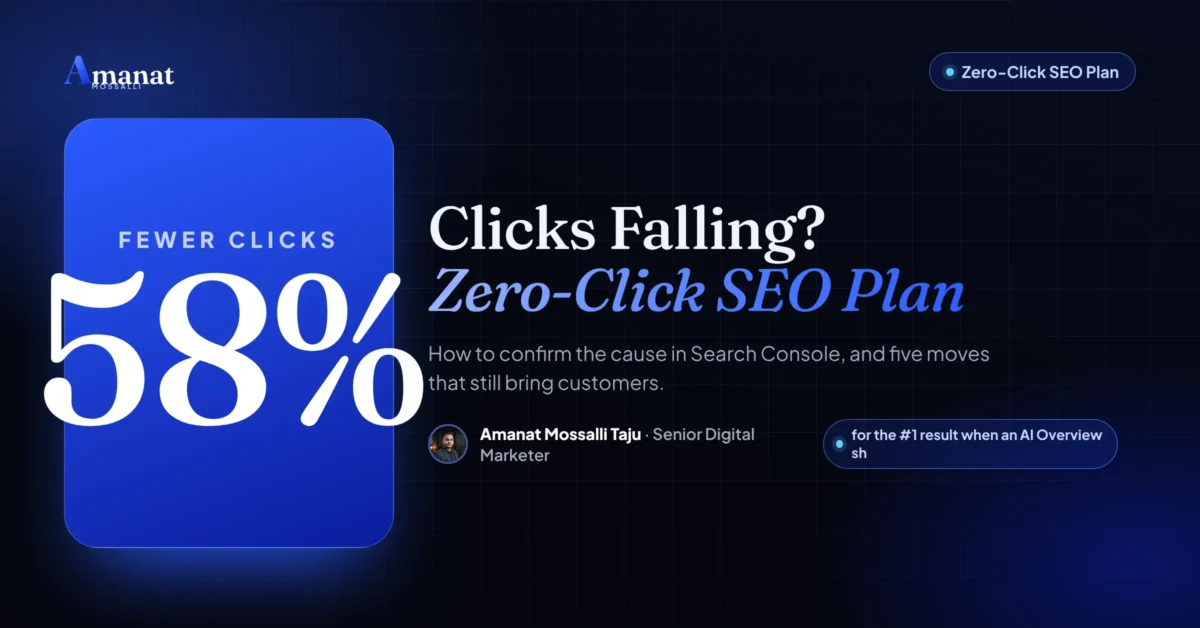
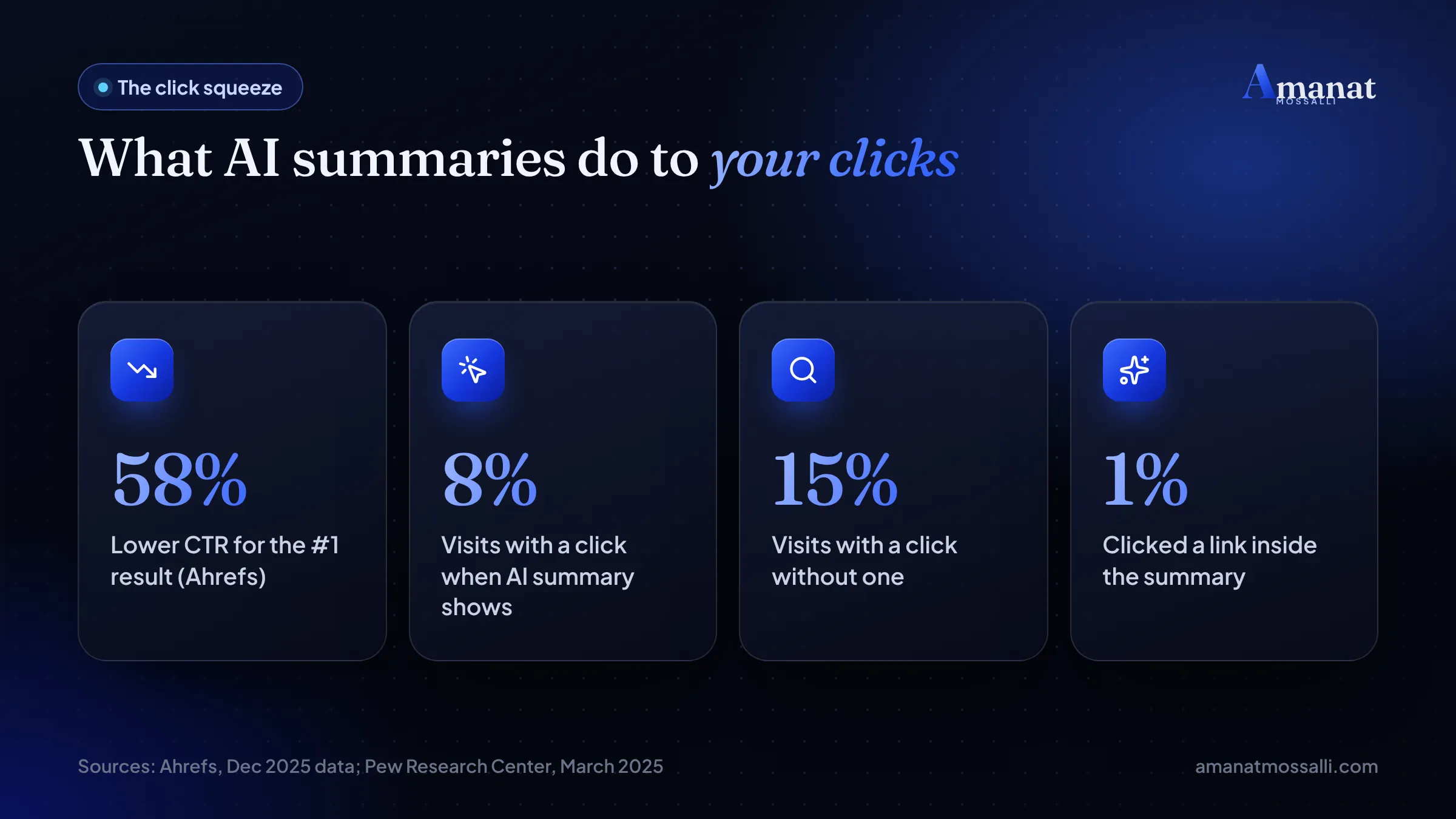
Two independent studies show the size of it. Ahrefs compared 300,000 keywords in December 2023 and December 2025. When an AI Overview showed, the top result had about 58% lower click-through rate than expected.
Pew Research Center tracked the real browsing of 900 US adults in March 2025. As Search Engine Roundtable summarised, people clicked a normal result in 8% of visits when an AI summary showed. Without one, they clicked in 15% of visits.
This matters in Bangladesh too. Google’s AI Overviews help page names both Bangladesh and Bengali on its supported list. A student in Rajshahi asking a question in Bangla can see an AI answer first.
Google sees it differently. Its AI features guide calls clicks from pages with AI Overviews “higher quality”. Those visitors tend to spend more time on the site. Both things can be true. Fewer clicks, but more serious ones.
How do you confirm it in Search Console?
Look for impressions up, clicks down, on question-style queries, with your position roughly unchanged. If your position fell too, the cause is probably something else, and I’d look there first.
| What Search Console shows | Most likely cause | First action |
|---|---|---|
| Impressions up, clicks down, position stable | AI Overview or other SERP feature taking clicks | Improve the reason to click and target money queries |
| Impressions down, position down | Ranking loss from an update or a stronger competitor | Content and quality review |
| Clicks down on all pages at once | Technical issue or tracking break | Check indexing, robots.txt and GA4 setup |
| Clicks down only in some months | Seasonal demand | Compare year on year, not month on month |
Google says traffic from AI Overviews and AI Mode is counted in the normal Performance report, under the Web search type. Since mid-2026, Search Console also has generative AI reports that show how often your pages appear as sources in AI Overviews and AI Mode.
Look at 3 months against the same 3 months last year. One bad month is often Eid, a tracking gap or plain noise. The Banani shop’s first “drop” in April turned out to be the Eid holiday.
Zero-click searches, featured snippets and AI Overviews
A zero-click search ends without a click to any website. These existed long before AI Overviews, thanks to featured snippets, maps, weather boxes and knowledge panels.
The best-known estimate comes from SparkToro and Datos. Their 2024 study found 58.5% of Google searches in the US and 59.7% in the EU ended with no click. Only 360 of every 1,000 US searches sent a click to the open web.
So nearly 60% zero-click isn’t new. What’s new is that AI answers now cover longer, more complex questions that used to need a click.
| Featured snippet | AI Overview | |
|---|---|---|
| What it shows | A quoted passage from one page | An AI-written summary from several pages |
| Sources linked | Usually one | Several, often in a side panel or inline |
| Question types | Short, factual questions | Short and long, including how-to and comparisons |
| Can you mark up for it? | No. Google says “You can’t.” | No. Google says no special markup is needed |
| Opt-out control | nosnippet or max-snippet | nosnippet, data-nosnippet, max-snippet or noindex |
The control column comes straight from Google’s featured snippets documentation and its AI features guide. Both features are chosen by Google’s systems. You can’t request either one.
Which keywords still bring clicks in 2026?
Searches where people want to buy, book, compare prices or visit a place. Simple definitions and quick facts lose the most.
This is the split between informational vs commercial keywords. An informational keyword asks to learn. A commercial one shows the person is close to spending money.
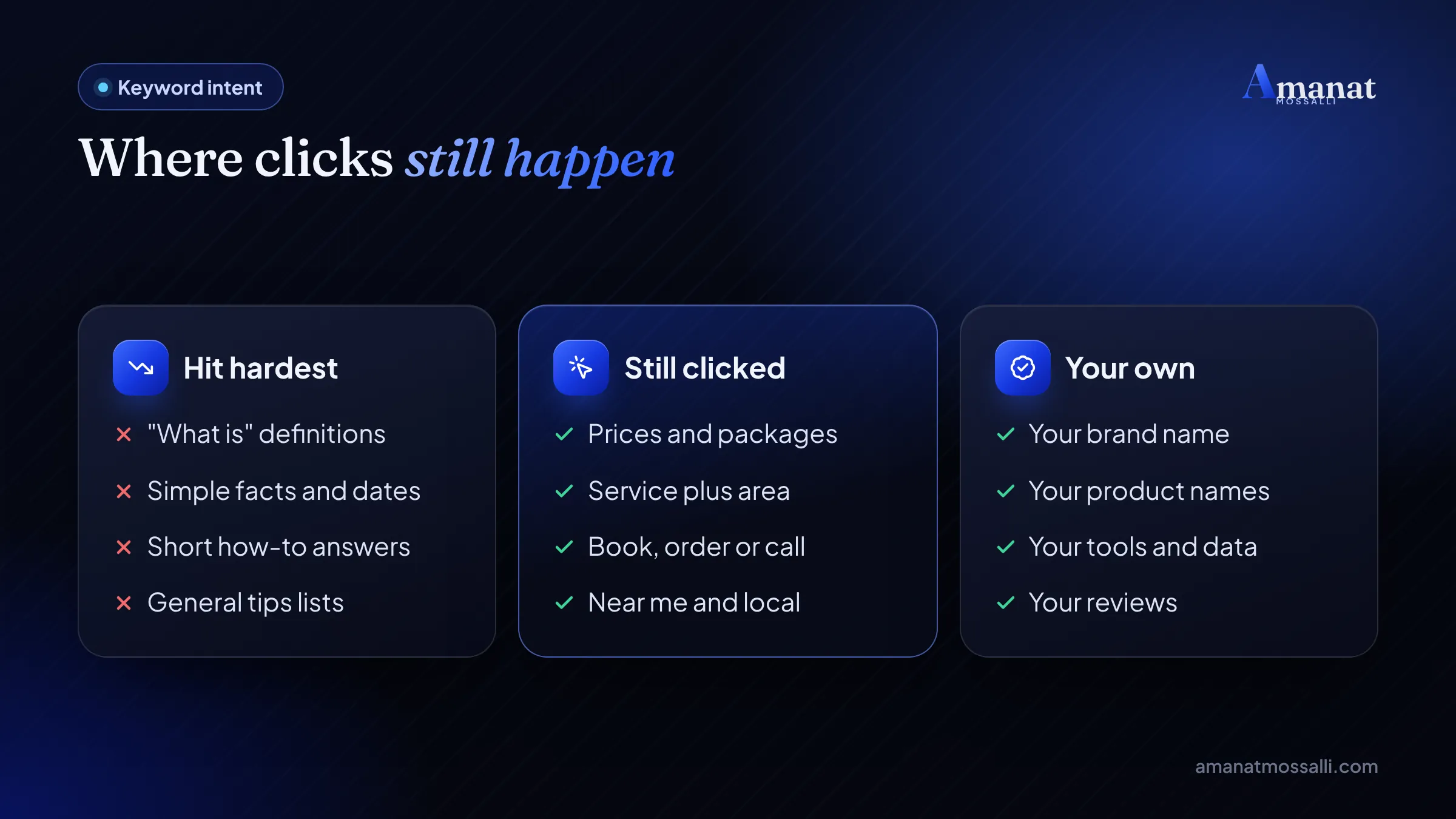
Not every search shows an AI summary. In Pew’s data, only 18% of the searches tracked produced one. So check your own keywords one by one instead of assuming the worst.
A travel agency in Dhaka loses clicks on “best time to visit Cox’s Bazar”. It keeps them on “Cox’s Bazar 3 day package price from Dhaka”, because that searcher wants a real offer, not an essay.
Who feels an AI Overviews traffic drop the most?
Sites that earn most of their traffic from general questions. Sites that sell a local service or a product usually feel it least.
| Type of site | Typical exposure | Why |
|---|---|---|
| Blogs and news explainers | High | Most of their traffic is “what is” and “how to” questions |
| Affiliate review sites | High | AI answers summarise “best X” lists directly |
| E-commerce shops | Medium | Product and price searches still get clicked, buying guides less so |
| Local services (clinics, salons, repair) | Lower | People need to call, book or visit |
| B2B and software | Mixed | Learning content loses clicks, pricing and demo pages keep them |
These are rough patterns from my own audits, not measured numbers. Your own Search Console data is the only real answer for your site.
Take two Dhaka businesses. A recipe blog loses a pile of clicks on “how to make borhani”, because the AI answer lists the steps. A catering company in Bashundhara barely notices. People searching “wedding catering package Dhaka” still want menus, prices and photos.
If you run an online shop, read my notes on why SEO matters for e-commerce in Bangladesh. Category and product pages are your safest ground.
Step 1Move 1: chase the searches with money in them
Put your next three months of SEO effort into pages that match buying searches. They lose fewer clicks and they convert better. That’s the whole strategy in one sentence.
- Service pages for each service. “AC servicing in Gulshan” deserves its own page, not one line on a services list.
- Price and package pages. Show real BDT prices or ranges. People click to see the number.
- Comparison pages. “Bridal makeup packages compared” pulls people who are choosing.
- Area pages. Only where you truly serve the area, like Chattogram or Sylhet.
- Google Business Profile. Map results drive calls and direction requests for local businesses.
Keep the useful informational posts, but link each one to a money page. The post builds trust. The money page takes the lead. My guide to increasing organic traffic in Bangladesh explains how to find these keywords in your own data.
Step 2Move 2: make people search for your name
When people search your name, you get the click, AI Overview or not. Brand search growth is one of the safest SEO goals left in 2026.
You grow brand searches outside Google. Facebook and Instagram content, YouTube videos, a memorable name, reviews, and the sign above your door all make people search for you later.
Track it in Search Console. Filter queries that contain your brand name and watch the trend each month. If it’s flat, your marketing isn’t leaving a memory.
Brand building is a full topic of its own. I cover it in how to build a brand in Bangladesh.
Step 3Move 3: become a source instead of a casualty
If you can’t stop the AI answer, aim to be one of its sources. Google says a page must be indexed and eligible to show a snippet, with no extra special requirements.
So how to appear in AI Overviews comes down to clear, well-sourced content that Google already trusts. Here’s what I check on every page, and what I did with the Banani shop’s buttercream post.
- 1Answer the main question in the first two sentences.
- 2Use question-style headings that match real searches.
- 3Add facts, prices and tables with named sources.
- 4Show who wrote it and why they know the subject.
- 5Keep the page indexed and fast on mobile data.
- 6Add something the AI can’t summarise away, like a calculator or a local price list.
Being cited doesn’t guarantee clicks. Pew found only 1% of visits included a click on a link inside the AI summary. Treat a citation as brand exposure, then win the click with Move 4.
Step 4Move 4: give people a reason to click, and a reason to stay
The AI can summarise facts. It can’t book a slot, calculate a quote or send a discount. Build those things into your pages.
Build lists you own
Every visitor you turn into an email subscriber or WhatsApp contact is one you can reach again for free. No Google update can take that list away.
In Bangladesh, WhatsApp often works better than email for shops and services. Ask for permission first and make leaving easy. I set this up for clients through my email marketing and automation service. The baking shop now sends a Thursday recipe to its WhatsApp list. Most of those subscribers came from the very posts that lost their Google clicks.
Should you block AI Overviews from using your content?
For most businesses, no. The controls that keep you out of AI Overviews also shrink your normal search snippet, which can cost even more clicks.
Google’s AI features guide says you limit what’s shown with nosnippet, data-nosnippet, max-snippet or noindex. These rules apply to Search as a whole. There’s no switch that removes you from AI Overviews only.
The Google-Extended token is different. It controls use in some of Google’s other AI systems, not Google Search. Read the official guide before you touch anything.
Blocking makes sense mainly for publishers who sell the content itself. A dental clinic or a clothing brand usually gains more from being seen.
What should you measure now that clicks are falling?
Leads and sales from organic search, not only sessions. A smaller number of better visitors can be worth more money, and you’ll never know unless you count it.
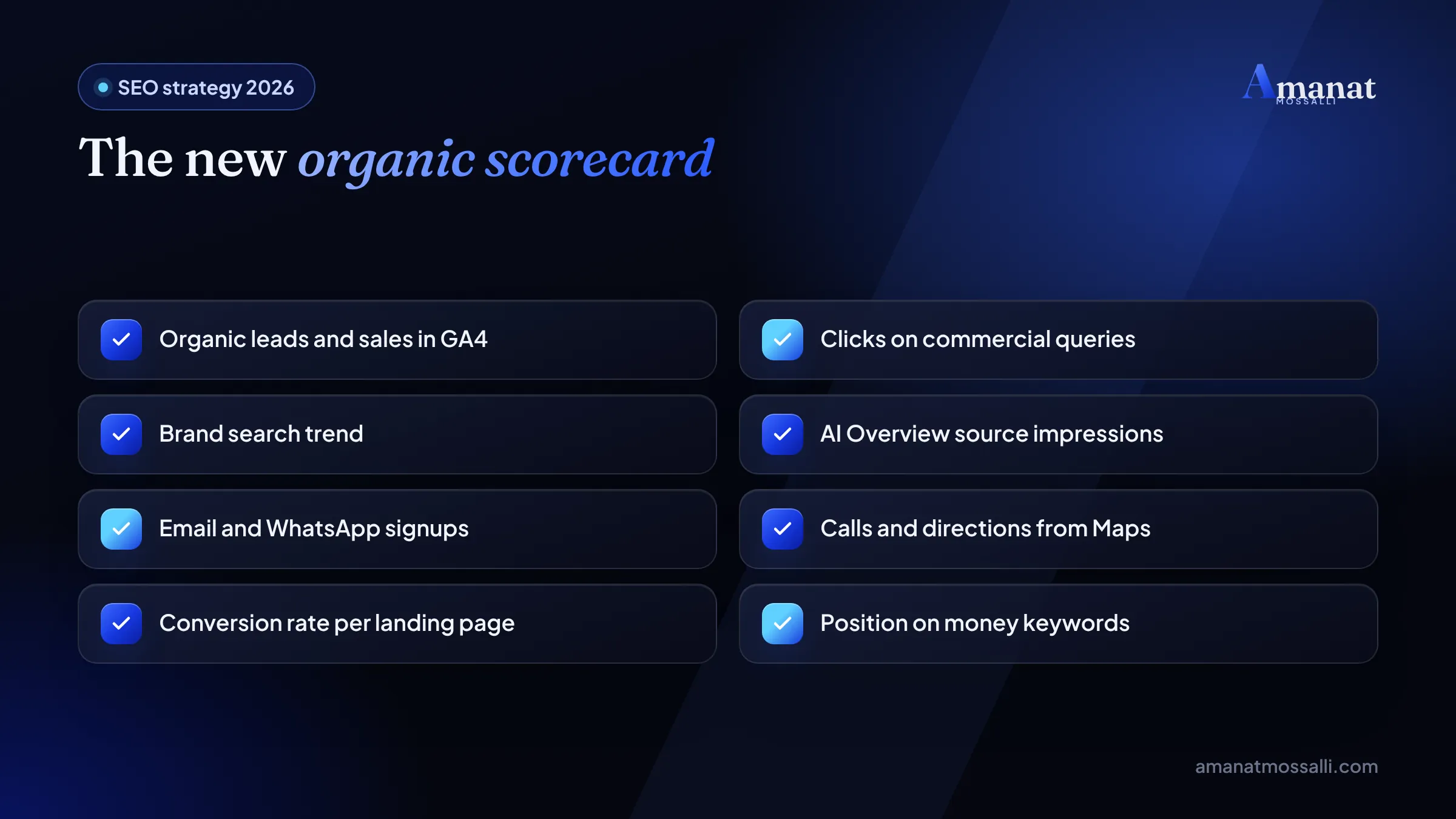
Set up conversions in GA4 for form fills, calls and WhatsApp clicks. Without them you can’t tell a harmless drop from a costly one. If your tracking is shaky, my tracking and analytics service fixes that first.
FAQ: AI Overviews Traffic Drop
Do AI Overviews really reduce website traffic?
How do I know if AI Overviews caused my traffic drop?
What is the AI Overviews click through rate?
Are zero-click searches new?
Can I opt out of AI Overviews only?
Is SEO still worth it in 2026?
Does this affect Bangla searches in Bangladesh?
What makes the drop worse?
Reacting fast without checking the data. Nearly all the damage I see comes from one of these.
- Deleting old posts that lost clicks. They may still earn citations, links and brand searches.
- Publishing more “what is” posts. That’s the content AI answers replace first.
- Using nosnippet in a panic. You can lose your normal snippet too.
- Judging SEO by sessions only. Leads and sales tell the real story.
- Blaming AI for every drop. Updates, tracking breaks and seasons cause drops too.
- Having no owned list. One algorithm change shouldn’t cut you off from customers.
The Banani shop owner’s first instinct was to delete the buttercream post. I asked her to wait a week. That post still earns the shop a citation in the AI Overview. The brand name in that box is worth more than the clicks it lost. I can’t prove the exact value of a citation yet. Nobody can. But deleting it would have been free money thrown away.
Quick recap
- Ahrefs found the top result gets about 58% fewer clicks on average when an AI Overview shows.
- Pew found users clicked a normal result in 8% of visits with an AI summary, against 15% without one.
- Impressions up, clicks down in Search Console is the classic sign. Rule out updates, tracking and season first.
- Commercial, local and brand searches lose fewer clicks than simple “what is” questions. Move your effort there.
- Build email and WhatsApp lists so a change in Google never cuts you off from your customers again.
Thirty days to move your SEO closer to the money
Treat an AI Overviews traffic drop as a signal, not a verdict. This is the order I follow.
- 1Week 1: compare 3 months year on year in Search Console and list the 20 queries with the biggest click loss.
- 2Week 2: check each one for an AI Overview and rule out other causes.
- 3Week 3: improve your top 5 service or product pages and add a clear call to action.
- 4Week 4: add an email or WhatsApp signup and set up conversion tracking in GA4.
Search will keep changing. I wrote about where it’s heading in the future of digital marketing in Bangladesh. Want me to read your chart the way I read the Banani one? I’m Amanat Mossalli Taju, and a screenshot is all I need.

Amanat Mossalli Taju
Senior Digital Marketer & SEO Expert, Dhaka, BangladeshI have grown 175+ brands since 2020 with SEO, Google and Meta Ads, server-side tracking, WordPress and AI automation. Half of my clients are in the UK, USA, Australia and Canada. Everything I write here comes from real client work.
Want this done for your business?
Book a free 15-minute call. I look at your site and ads before we talk, so you leave with clear next steps.