How AI Is Changing Digital Marketing in Bangladesh (What I See in 2026)
AI now writes the ad, picks who sees it and answers the 2am Messenger question. Here's what has really changed for Bangladeshi businesses, and what to do first.

The moment someone asks me how AI is changing digital marketing in Bangladesh, I ask them to open their phone. The Facebook post they boosted last week? AI picked who saw it. The answer box on top of their last Google search? AI wrote it. It’s already here, and it didn’t ask permission.
Three things have changed. Customers get answers from AI search before they ever reach your site. Meta and Google now choose your audience for you. And AI agents can reply to a “price koto?” message in Bangla at 2am and take the order.
This piece covers what’s real, what’s hype, and what I’d do about it. I checked every rule and number below on 11 November 2026. Where I couldn’t find a firm fact, I say so.
AI in Marketing, in Plain Words
AI in digital marketing means software that learns from data to write, predict, decide or reply for you. It does jobs that used to need a person sitting at a laptop.
You already use it, whether or not you call it that. Facebook deciding who sees your boosted post is AI. Google showing a short answer at the top of search is AI too.
I’ve worked in digital marketing from Dhaka for over seven years, across 235+ brands and more than $8M of Google and Meta ad spend. These days I use AI tools in nearly every account. In my work, AI does four kinds of jobs.
The big shift isn’t any one tool. It’s that all four now happen at once, on the same phone your customer is holding.
How AI Is Changing Digital Marketing in Bangladesh Right Now
Bangladeshi people already use AI daily and spend hours on platforms run by it. The audience is ready. Most businesses aren’t.
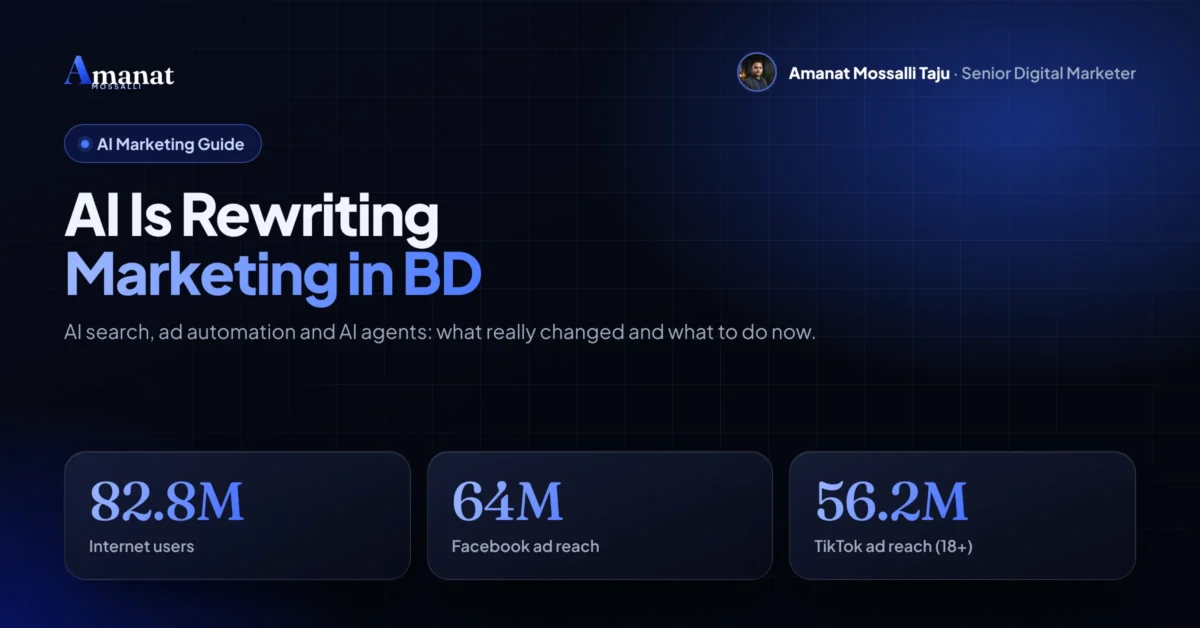
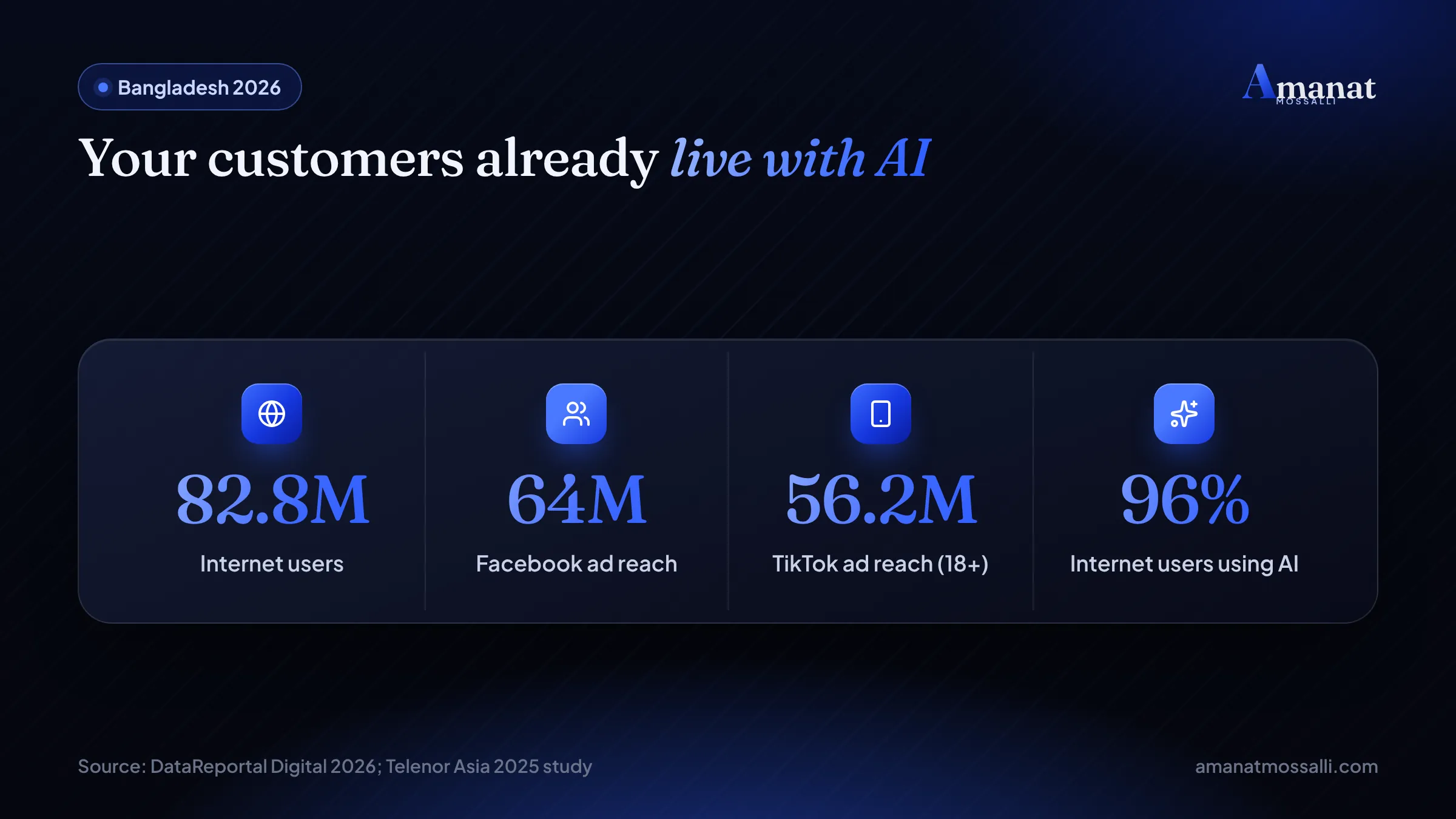
DataReportal’s Digital 2026 Bangladesh report counted 82.8 million internet users here in late 2025. Facebook ads could reach 64 million people. TikTok ads reached 56.2 million adults aged 18 and above.
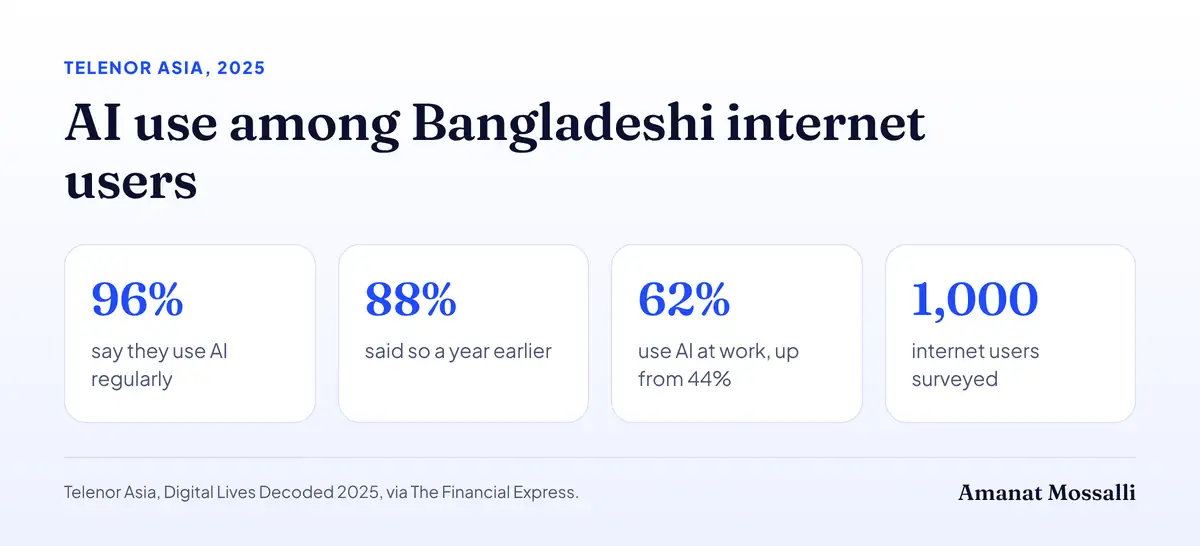
AI use is high as well. In Telenor Asia’s Digital Lives Decoded 2025 study, about 96% of Bangladeshi internet users said they use AI regularly. That was up from 88% a year earlier. Almost six in ten use it every day.
One caveat on that figure. It comes from a survey of 1,000 internet users, so it describes people already online, not the whole country. It still tells you who your online buyers are.
What changed in the last 12 months?
- Search: Google says AI Overviews run in more than 200 countries and territories, and AI Mode has read Bengali since October 2025. In July 2026 Google published its own guide to optimising for these features.
- Ads: Meta Advantage+ and Google Performance Max now pick audiences, placements and even ad versions without you.
- Messages: In June 2026 Meta began rolling out its own AI Business Agent inside WhatsApp, Messenger and Instagram.
- Rules: Since 15 January 2026, WhatsApp bars general-purpose chatbots from its business platform. Customer-service bots are still allowed.
- Content: AI content creation tools make a week of captions and product photos in an hour.
So that’s how AI is changing digital marketing in Bangladesh, in short. The marketer’s job has moved. Less button pressing. More strategy, offers, tracking and trust.
How Is AI Changing SEO in Bangladesh?
Many searches now end with an AI answer, not a click. You need to rank on Google and also be the source AI tools quote.
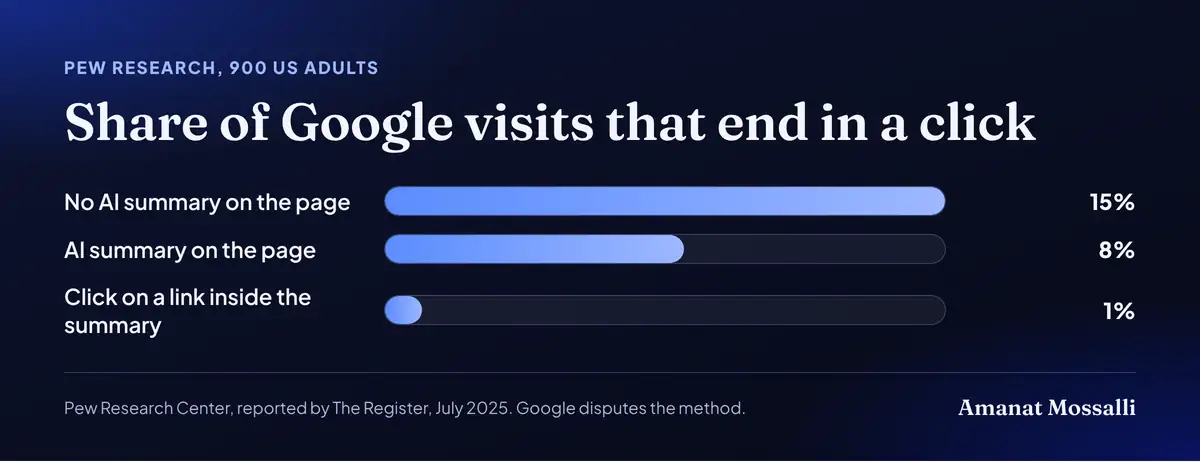
How many clicks disappear? The clearest study is from the US. Pew Research tracked 900 adults and found they clicked a result in 8% of visits with an AI summary. Without one, it was 15%. Only 1% clicked a link inside the summary itself, The Register reported in July 2025. Google disputed the method.
Nobody has published the same test for Bangladesh. I assume the direction is the same and plan for it.
Google AI Overviews is the summary box at the top of results. ChatGPT, Gemini and Perplexity do the same inside a chat. They read pages, then name a few brands. A site that isn’t clear, fast and trusted doesn’t get named.
Two terms describe this work. Answer engine optimization (AEO) means shaping pages so AI can lift a clear answer. Generative engine optimization (GEO) means making your brand the one AI tools mention and recommend.
| Classic SEO | AEO | GEO | |
|---|---|---|---|
| Goal | Rank in the blue links | Be the quoted answer | Be the brand AI recommends |
| Where | Google results page | AI Overviews, voice, featured snippets | ChatGPT, Gemini, Perplexity, AI Mode |
| Main work | Keywords, links, speed | Question headings, short direct answers, FAQ | Mentions on trusted sites, clear facts about you, reviews |
| Bangladesh tip | Target Bangla and English searches | Answer the question in the first 2 sentences | Get listed and reviewed on local news and directories |
What Google itself says you can skip
Here’s the part most “AI SEO” sellers won’t tell you. Google’s guide to generative AI features in Search, last updated in July 2026, says this is still SEO. It calls AEO and GEO names for the same work.
The guide also lists things Google Search doesn’t need from you.
- An llms.txt file. Google says Search doesn’t use it. Other AI services might, so it does no harm. I explain it in what is llms.txt.
- Chopping pages into tiny “chunks”. Google says there’s no need, and no ideal page length.
- Special AI markup. No new schema is required to appear in AI answers.
- Manufactured mentions. Google says chasing inauthentic mentions across the web isn’t as helpful as it seems.
What it does ask for is harder. Write “non-commodity” content, meaning things you know first-hand that a chatbot couldn’t have written. Keep your Google Business Profile complete. Then watch the Generative AI performance report in Search Console.
The first of those is a local business’s honest edge. An AI can’t invent your real prices, your delivery photos or your customer’s review. You can publish them.
Open your top 5 pages. Turn each main heading into a real question your customer types. Answer it in the first two sentences below. This one change helps both Google and AI tools.
When I audit a site now, two checks come first. Can Google crawl it easily? And can an AI read a page and find a clear, quotable answer in the opening lines? For the first check, my free SEO audit tool gives you a quick pass on your own site.
This is the core of my SEO, GEO and AEO service. My longer notes are in generative engine optimization.
Are Facebook and Google Ads Now Run by AI?
Mostly, yes. Meta Advantage+ and Google Performance Max decide who sees your ad, where it shows and which version wins. Your job is to feed them good signals.
Five years ago a good media buyer won with clever interest targets. That trick is fading. In most accounts I manage, the AI now finds buyers better than I can by hand. (That took some swallowing of pride.)
But the AI only learns from what you tell it. If your pixel counts a fake order as a sale, the AI goes hunting for more fake orders. I see this constantly with cash on delivery shops.
What the AI needs from you
- 1Clean tracking. Meta Pixel plus Conversions API, and real purchase events, not just “add to cart”.
- 2Many creatives. Give it 5 to 10 ad versions. Different hooks, faces, offers and video lengths.
- 3A clear offer. AI cannot fix a weak price or slow delivery.
- 4Enough signal. Aim for about 50 conversions a week in each ad set.
- 5Patience. Let a campaign learn for about a week before you judge it.
That fourth point now comes from Meta itself. In a post dated 21 October 2026, Meta said ad sets under roughly 50 weekly conversions cost about 28% more per purchase. PPC Land covered it, and noted Meta showed no method.
Meta’s sum is easy to run. Divide your weekly budget by your cost per result times 50. Say you spend Tk 42,000 a week and a purchase costs Tk 280. Fifty purchases cost Tk 14,000, so the budget feeds three ad sets. Most small accounts I open run far more than that.
Facebook shops often come to me saying “the algorithm stopped working”. The problem is almost always tracking.
A phone-accessories shop in Sylhet sent me exactly that message last winter. Ads Manager showed a cost per purchase of about Tk 210, which looked great. His courier sheet told another story. We placed one test order together on a video call. The Purchase event fired twice: once from the thank-you page, once from a plugin he’d forgotten. Returned COD parcels were counted as sales too.
So Meta’s AI had spent months finding people who looked like buyers on paper. We removed the duplicate, added the Conversions API, and sent only confirmed orders as purchases. The dashboard cost jumped to about Tk 340 overnight, and he hated that. But within six weeks his real cost per delivered order fell from roughly Tk 450 to about Tk 330. Same campaigns, honest data.
Fix the data before you touch the campaign. A proper tracking and analytics setup is the cheapest ad upgrade most shops can buy. To do it yourself, follow my Conversions API guide.
What Is an AI Agent, and How Can a Bangladeshi Business Use One?
An AI agent is software that understands a message, decides what to do and then does it using your tools. A normal chatbot only follows a fixed script.
Think of an Eid sale. Hundreds of messages land at night. “Vai, size L ache?” “Delivery charge koto?” A simple chatbot replies with a menu. An agent reads the real question, checks your stock sheet and books the order.

A woman who cooks and sells homemade food from her Facebook page in Lalmatia showed me her phone one evening during Ramadan 2025. 140 unread Messenger threads. Most asked the same four things: menu, price, delivery area and the iftar cut-off time.
She was answering between frying and packing, and losing the ones she answered late. We wrote her menu and rules into one document. Then we set up a simple agent on Messenger for those four questions, with anything odd passed to her. It took a weekend.
Her average first reply went from a few hours to under two minutes. By the second week she said she was sleeping before 1am again. Orders rose from about 25 a day to about 32. I can’t honestly separate the agent from Ramadan demand, and I told her so.
Where AI agents help most
- Facebook Messenger and Instagram DMs for online shops.
- WhatsApp for clinics, salons and real estate leads.
- Website chat for B2B and export businesses.
- Lead follow-up, so no inquiry waits until next morning.
Meta’s built-in agent or a custom one?
Until this year, an agent meant a custom build. That changed in June 2026, when Meta began rolling out its Business Agent worldwide, WABetaInfo reported. You switch it on inside the WhatsApp Business app.
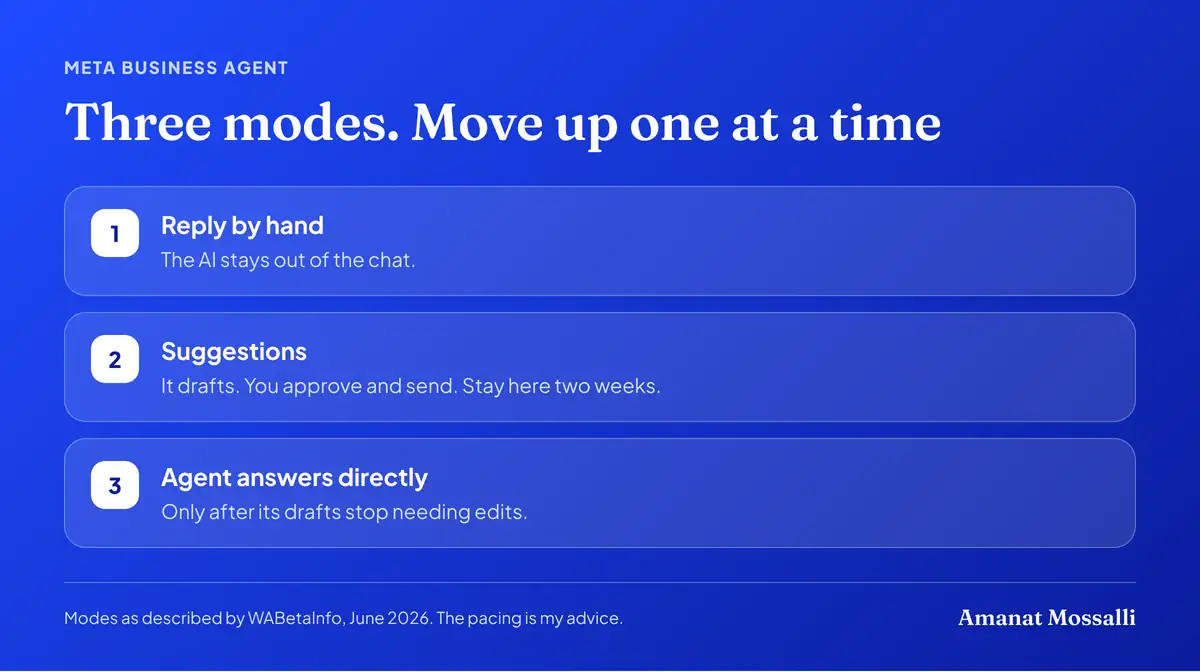
It has three modes. You can reply by hand. You can let it suggest replies that you approve. Or you can let it answer customers directly. I’d run “Suggestions” for two weeks before trusting the third, and switch only when its drafts stop needing my edits.
| Meta Business Agent | Custom-built agent | |
|---|---|---|
| Where it lives | WhatsApp Business app, Messenger, Instagram | WhatsApp Business Platform, Messenger, your website |
| Setup | A settings page. No developer | Built and tested for your business |
| What it knows | Your catalogue and, if you allow, past chats | Whatever you connect: stock sheet, courier, CRM |
| Best for | A shop answering the same ten questions | Order booking, stock checks, lead scoring |
| My worry | How it handles Banglish. Test it hard | Cost and upkeep. Start with one task |
Two rules matter if you go custom on WhatsApp. First, cost. Meta’s WhatsApp pricing page changed its rules on 1 October 2026. Replies to a customer who wrote first are no longer free without limit. Each business number gets 1,000 free a month, and Meta charges from the 1,001st.
Marketing templates you send first are always charged. There’s still a bonus for advertisers. Reply within 24 hours to someone who came from a Click to WhatsApp ad, and a free messaging window opens. Meta’s pricing page gives 72 hours; some partners report up to 7 days for ad clicks.
Second, the ban. WhatsApp changed its business terms to bar general-purpose AI assistants from 15 January 2026, TechCrunch reported. Meta told TechCrunch that businesses using AI to serve their own customers aren’t affected. So a shop’s order bot is fine. A “chat with any AI” service isn’t.
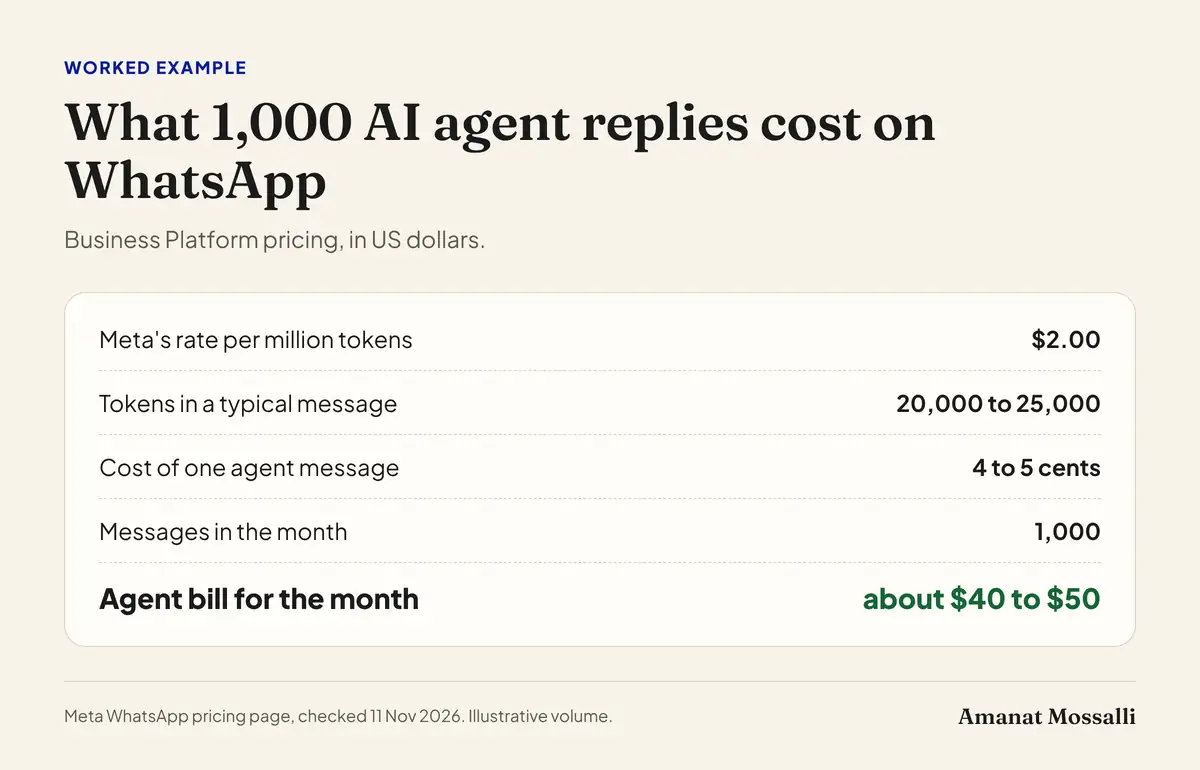
What does Meta’s own agent cost? On the Business Platform, the same pricing page lists $2.00 per million tokens. Meta says a typical message uses 20,000 to 25,000 tokens, which is about 4 to 5 US cents. It charges that even inside the free window.
So 1,000 agent replies a month is roughly $40 to $50. Compare that with what one lost midnight order costs you. For the agent inside the free app, I found no published price. Check your own app before you rely on it.
One honest warning. An agent is only as good as the data it can see. If your price list lives in your head, fix that first. When clients ask me about AI agent development, that’s always step one.
AI Agent or Agentic AI: Which Fits Your Business?
An AI agent does one job well, such as replying to messages. Agentic AI is a team of agents that plan and finish a longer, multi-step goal together. Most small businesses should start with one agent.
Simple example. One agent answers customers. An agentic system could also check which ads brought those customers, write a weekly report and suggest where to move the budget.
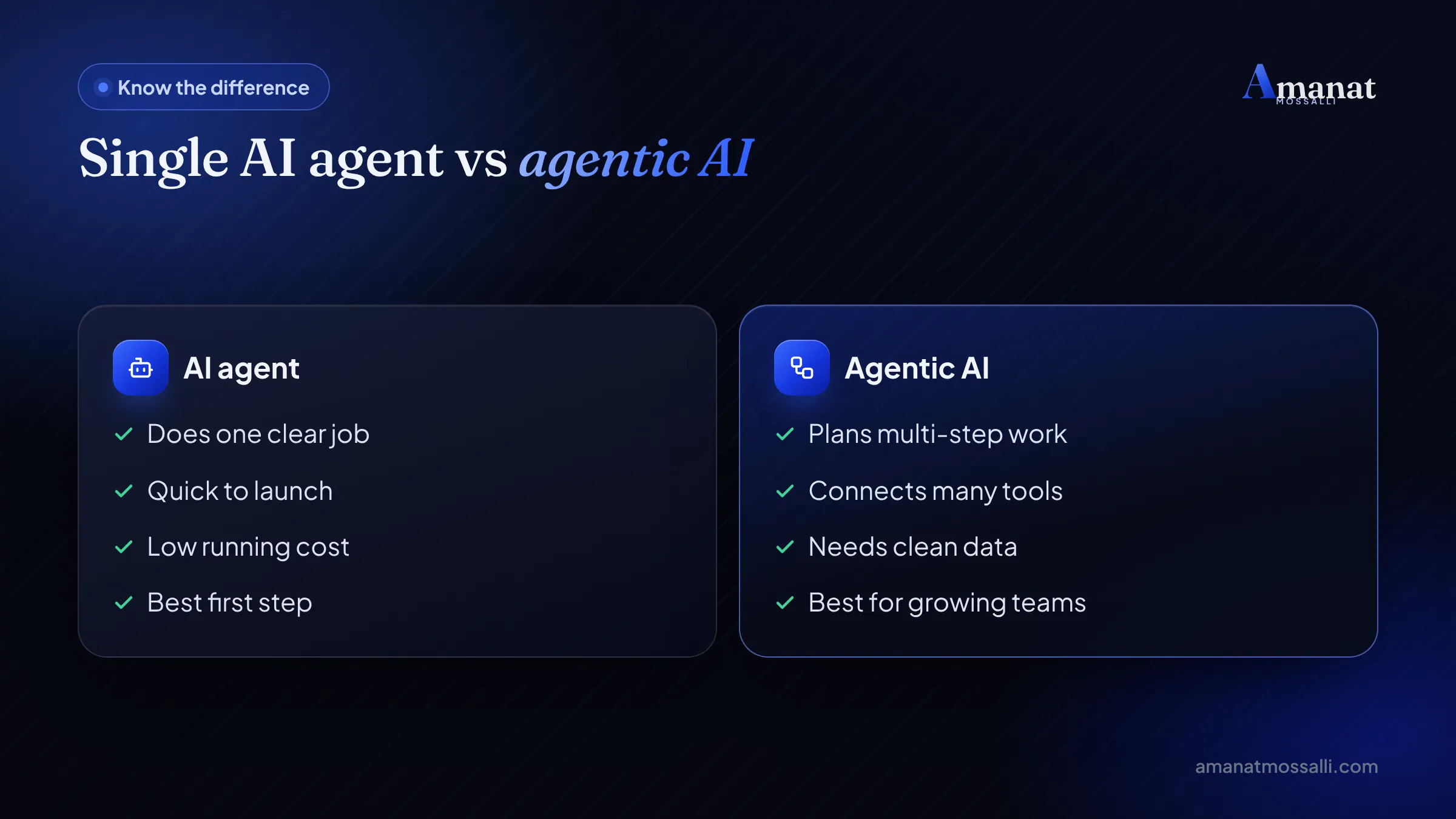
A single agent is quicker and cheaper to launch. Bigger systems take longer, and I’ll say so up front and not after the invoice.
Agentic AI makes sense when you repeat the same multi-step process every week. Lead scoring, order follow-up and reporting are the usual cases. It’s the next stage of marketing automation, and it’s what I build in agentic AI development projects.
My rule: no second agent until the first has paid for itself in taka you can point to.
The AI Tools Bangladeshi Marketers Actually Use
Most marketers here use a small set of general AI tools plus the AI built into Meta, Google and TikTok. You don’t need 20 tools. You need three or four you know well.
| Task | Tools I see used most | What to watch |
|---|---|---|
| Writing captions and ads | ChatGPT, Gemini, Claude | Edit for your voice. Raw AI text sounds the same as everyone else. |
| Images and design | Canva AI features, Meta AI image tools | Check hands, text and product details. |
| Short video | CapCut, TikTok and Meta creative tools | Real faces and real products still win trust. |
| Ads | Meta Advantage+, Google Performance Max | Only as good as your tracking. |
| Research and SEO | ChatGPT, Gemini, Google Search Console | Verify every number before you publish it. |
| Customer replies | Meta Business Agent, custom agents on Messenger and WhatsApp | Test hard in Banglish before going live. |
Most have a free plan. Paid plans are usually billed in US dollars. OpenAI’s cheaper ChatGPT Go plan reached Bangladesh in October 2025 at about $5 a month, TechCrunch reported. Prices move, so read the checkout page.
Check that your card works for international payments before you get attached to a tool.
One prompt, done properly
Most bad AI copy comes from a lazy prompt. “Write a Facebook ad for my panjabi shop” gives you the same ad as everyone else. Give it facts instead.
You write Facebook ad hooks for a Dhaka panjabi shop. Buyer: men aged 22 to 35 shopping for Eid. Product: cotton panjabi, Tk 1,450, six colours, sizes M to XXL. Delivery: Tk 70 in Dhaka, Tk 130 outside, cash on delivery. Proof: 300+ reviews on our page. Write 10 opening lines in everyday Bangla, under 12 words each. No exclamation marks. No claim I haven’t given you.
Look at what that prompt contains. A buyer. A price. A delivery rule. Proof. A limit on what it may claim. Every detail is one you’d otherwise have to fix by hand.
Then edit. Pick three lines, rewrite them in your own voice, and test them as separate creatives. The AI gives you range. You supply the judgement.
AI-powered personalization, made simple
Personalization means each customer sees a message that fits them. A returning buyer gets a reorder reminder. A new visitor gets a first-order offer.
You don’t need a data team for this. Meta’s catalogue ads already do a version of it, picking which of your products each person sees. Add two simple email or Messenger flows, one for new buyers and one for returning ones. That’s enough for the first year.
What Are the Risks and Limits of AI in Marketing?
AI is fast, but it makes confident mistakes, struggles with Banglish and breaks trust if you hide it. Keep a human in the loop.
- Made-up facts. AI tools sometimes invent prices, laws or statistics. Never publish a number you have not checked.
- Weak Banglish. Customers write “vai, kobe pabo?” Test your agent on real messages before launch.
- Same-same content. If everyone uses the same prompt, every brand sounds the same. People scroll past.
- Fake reviews and fake people. AI-generated testimonials are dishonest and can get your page restricted.
- Customer data. Do not paste phone numbers or addresses into public AI tools.
Google is plain about the first risk. Google’s guidance on generative AI content, updated in October 2026, warns that AI outputs “may contain inaccuracies”. It tells site owners to fact-check everything before publishing, titles and descriptions included.
The same page covers bulk content. Generating many pages with AI and adding no value for readers may break Google’s spam policy on scaled content abuse. So 200 AI-written area pages are a risk to your site, not a growth plan.
On customer data, the Personal Data Protection Ordinance 2025 already requires explicit consent to use personal data, as The Daily Star explained. Pasting a customer list into a chatbot is hard to square with that.
More rules are on the way. The Business Standard reported in July 2026 that the government was still drafting a human-centric National AI Policy. What the final rules will say, I don’t know yet.
AI can write your post in ten seconds. It can’t earn your customer’s trust for you.
Should Bangladeshi Marketers Worry About Their Jobs?
No. It will replace marketers who only press buttons. People who understand strategy, data and customers are worth more now, not less.
Telenor Asia’s study found AI use at work rose from 44% to 62% in a year. Only half of those users said their employer has a formal AI strategy. So most offices are using AI with no plan. Someone who brings one stands out.
The freelance market says the same. Upwork’s In-Demand Skills 2026 report found that demand for skills applying AI inside existing roles grew 109% in a year. Clients aren’t hiring “AI people”. They’re hiring marketers who use it well.
If you’re a student or a freelancer, this is where I’d put my hours:
- Tracking and analytics, because AI ads need clean data.
- Writing good prompts, and editing AI output into a real brand voice.
- SEO for AI search: GEO and AEO.
- Building simple AI agents and automations.
- Creative strategy: hooks, offers and short video.
My guide to the best digital skills in Bangladesh goes deeper on each one.
FAQ: AI and Digital Marketing in Bangladesh
How is AI used in digital marketing in Bangladesh?
Will AI replace digital marketers?
What is GEO in digital marketing?
Is AI marketing expensive for small businesses?
Can an AI chatbot reply in Bangla?
Do Google AI Overviews show in Bangladesh?
What AI skills should a marketer learn first?
A 30-Day Plan to Start Using AI in Your Marketing
Pick one problem that costs you money every week. Fix it with one AI tool. Measure the result in taka before you add anything else.
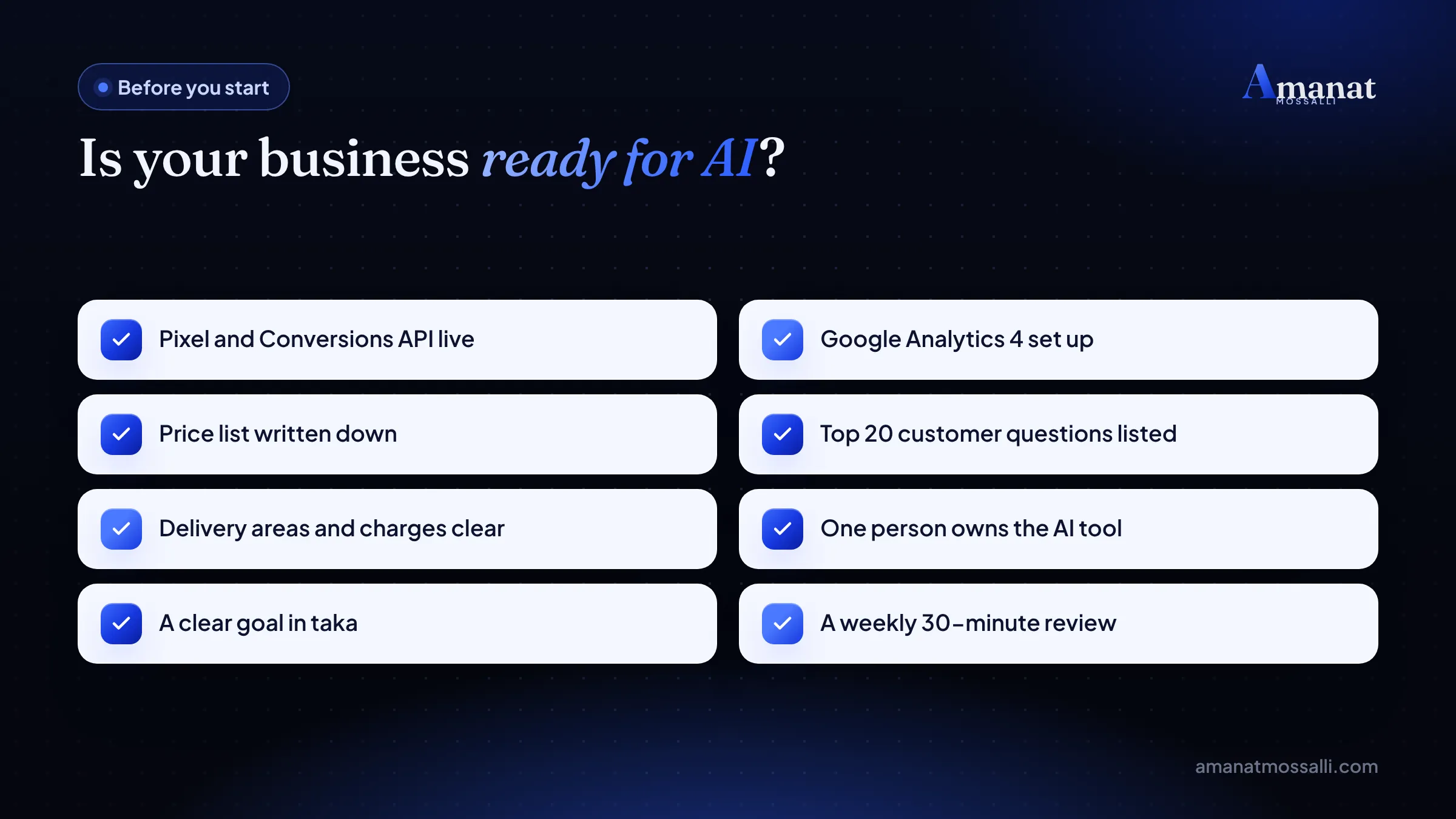
The food seller’s whole project fits inside this plan. Week one was the document. Week two was the agent. Weeks three and four were watching real chats and fixing wrong answers.
Write down three numbers before you start: average reply time, cost per delivered order, and orders per week. Without a “before”, you’ll never know if the AI helped.
Want the bigger picture? My post on the future of digital marketing in Bangladesh looks further ahead.
Use AI for Speed, Stay Human for Trust
That’s how AI is changing digital marketing in Bangladesh. Search gives answers, ads pick audiences and agents answer customers. The businesses that win will use AI for speed and keep people for trust.
After more than seven years of this, my advice is short. Fix your tracking. Pick one problem. Add one AI tool, measure it in taka, and grow from there. The food seller started with four questions, not a transformation project.
Here’s a test you can run tonight, and it costs nothing. Ask a friend to message your page at 11pm with “price koto?” for your best seller. Time the reply.
Then ask ChatGPT or Gemini to recommend a business like yours in your area. See if your name comes up.
Those two results tell you where AI is already costing you. Slow reply? Start with an agent. Missing name? Start with your pages and your Google profile. Both fine? Then your next taka belongs in creative, not software.
Some fixes are bigger builds than you can do alone. Then compare the top AI companies in Bangladesh before you sign with anyone, me included.

Amanat Mossalli Taju
Senior Digital Marketer & SEO Expert, Dhaka, BangladeshI have grown 235+ brands over more than seven years with SEO, Google and Meta Ads, server-side tracking, WordPress and AI automation. Half of my clients are in the UK, USA, Australia and Canada. Everything I write here comes from real client work.
Want this done for your business?
Book a free 15-minute call. I look at your site and ads before we talk, so you leave with clear next steps.