How to Increase Organic Traffic in Bangladesh in 2026: What Actually Moves the Needle
A Chattogram shop owner with 40,000 impressions and almost no clicks, and the order of work that fixes it. Search Console, Bangla keywords, AI answers, Maps and speed.

Forty thousand impressions in a month. Three hundred clicks. That is a click rate of 0.75%, and it was the whole problem.
The laptop sat open on a glass counter in an IPS and battery shop in Agrabad, Chattogram. It was a humid afternoon last year. The owner kept scrolling the same Search Console screen while I watched. “Google shows us to everyone,” he said. “Nobody comes,” he added. That gap between seen and clicked holds most of the answer to how to increase organic traffic in Bangladesh in 2026.
This guide is built the way I work. First you diagnose which traffic problem you have. Then you fix it in order, across seven steps. A 90-day plan closes the page. Skip to the step your diagnosis points to if you’re short on time.
Where does organic traffic come from in 2026?
From four places now, not one. Organic traffic is free traffic from search. You earn it with useful pages instead of ad money, and a page that ranks can bring visitors every day for years.
These are the sources I check for every client, in the order I check them.
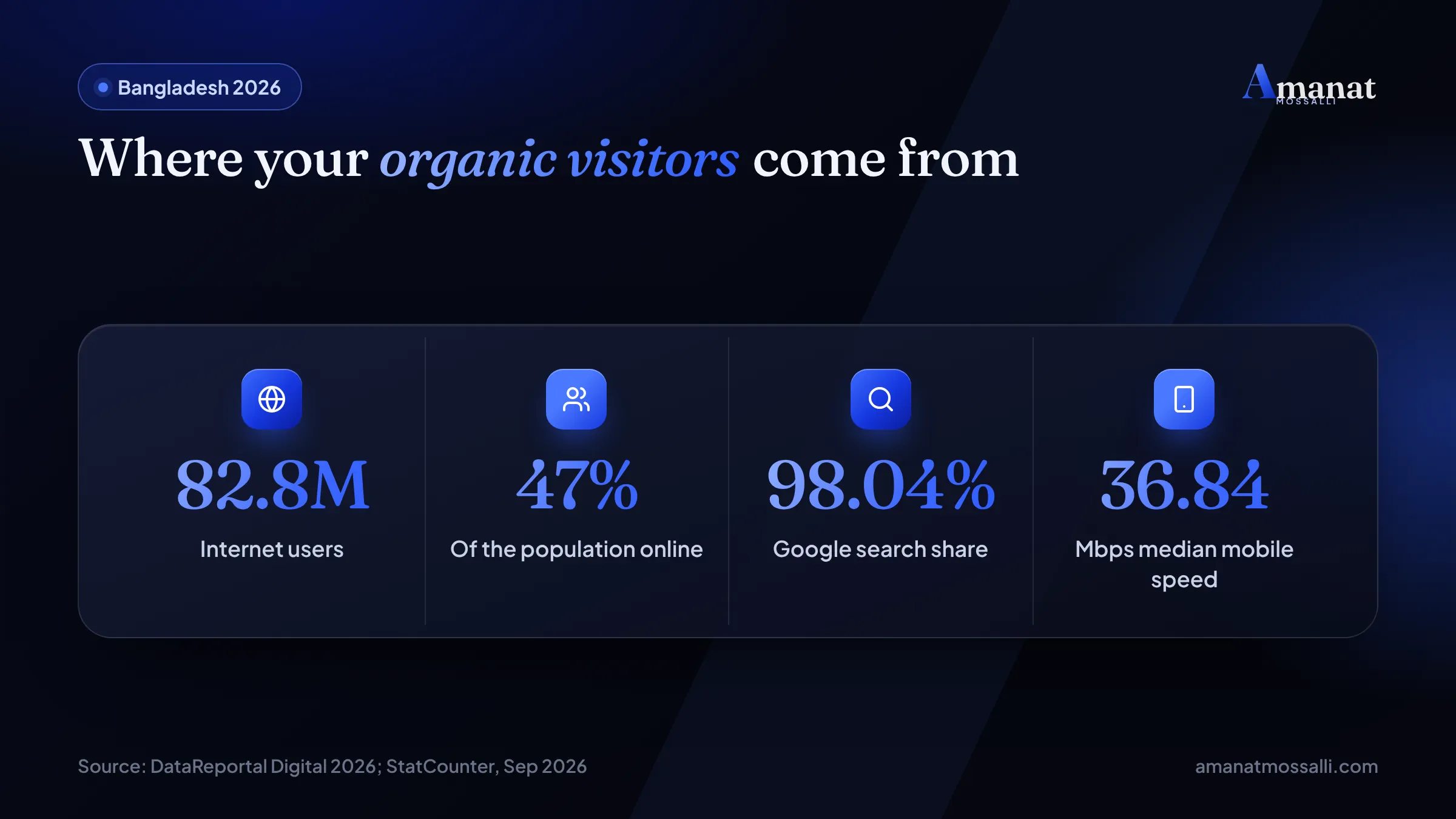
The audience keeps growing. DataReportal’s Digital 2026 Bangladesh report counts 82.8 million internet users at the end of 2025. That’s 47% of the population.
Its newer Digital 2027 report, published on 5 November 2026, puts the figure at 95.3 million for October 2026. DataReportal warns against comparing its yearly reports directly. Either way, close to half the country still hasn’t arrived.
When they search, they use Google. StatCounter gave Google 98.46% of the search market in Bangladesh in October 2026. Bing had 1.01%. I checked on 11 November 2026. I’ve never once optimised for Bing here, and I don’t plan to.
Why is it harder to win in 2026?
Because Google answers many questions itself now. AI Overviews sit above the normal results. Fewer people scroll, fewer people click.
This isn’t a foreign problem. Google’s AI Overviews help page lists Bangladesh as a supported country and Bengali as a supported language. A shopper in Khulna searching in Bangla can see an AI summary before any website.
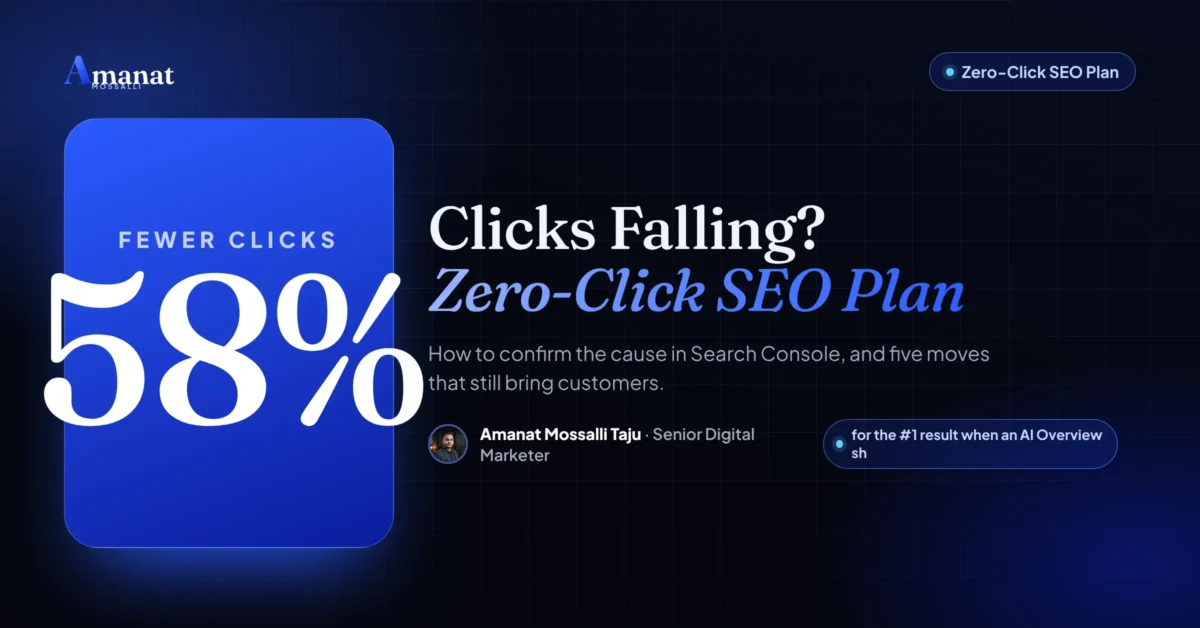
The cost is measurable. An Ahrefs study published in February 2026 looked at 300,000 keywords. When an AI Overview appeared, the top result got about 58% fewer clicks than expected. The loss shrinks as you go down the page.
| Position on Google | Estimated click loss when an AI Overview shows |
|---|---|
| 1 | 58.0% |
| 2 | 50.8% |
| 3 | 46.4% |
| 5 | 32.6% |
| 10 | 19.4% |
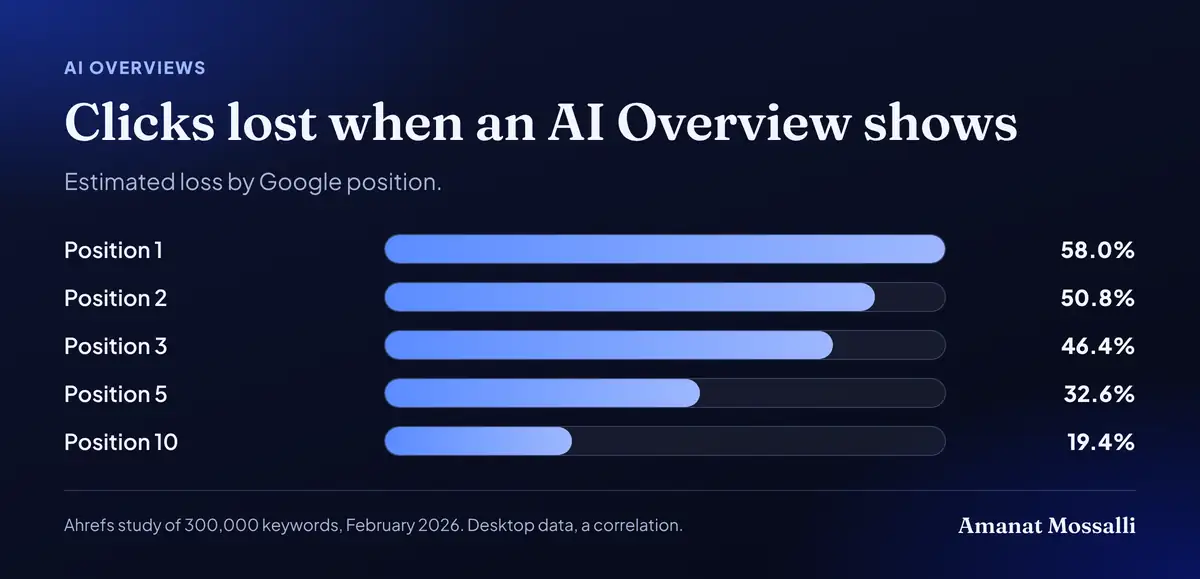
Two cautions from the study itself. It used desktop data, and Ahrefs calls the link a correlation. Still, it matched what I saw in Chattogram. That shop ranked well for “what is” questions. The AI was answering them.
Ranking #1 on a simple “what is” question is worth less than it was. Pages that sell, compare, show prices or solve a local problem still get the click.
So the plan shifts a little. You still need to rank. You also need to be the page the AI quotes, and you need to leave people a reason to click through. I go deeper on this in my notes on the AI Overviews traffic drop.
Diagnose first: four traffic problems, one screen
“Low traffic” is not one problem. It is four different ones, and each needs a different fix. You can tell them apart in ten minutes with Search Console.
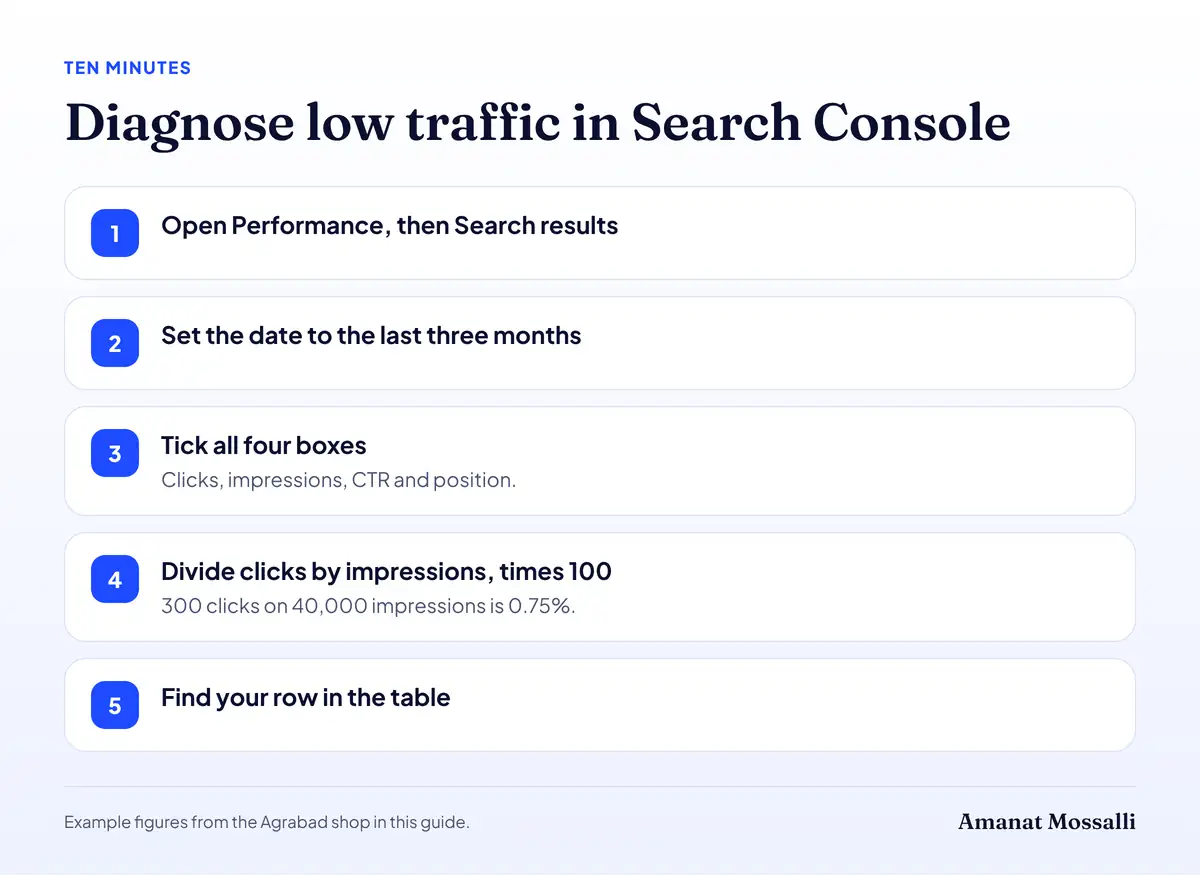
Open Search Console. Go to Performance, then Search results. Set the date to the last three months. Tick all four boxes at the top: clicks, impressions, CTR and position. Then compare your site with this table.
| What the screen shows | Your real problem | Go to |
|---|---|---|
| Almost no impressions at all | Google hasn’t indexed you, or nobody searches your words | Step 6, then Step 2 |
| Impressions, but average position past 20 | Pages are too thin or too generic to rank | Steps 3 and 7 |
| Good positions, CTR under 1% | Seen but skipped, often behind an AI Overview | Steps 1 and 4 |
| Healthy clicks, no calls or orders | Not a traffic problem. The page doesn’t sell. | The measuring section |
The Agrabad shop was row three. Forty thousand impressions meant Google already trusted the pages. Three hundred clicks meant searchers didn’t. More blog posts would have fixed nothing.
Do the same division for your own site. Clicks divided by impressions, times 100. Write the number down. You’ll want it again in 90 days.
If you’re in row four, the fix lives on the page, not in search. I cover that in website traffic but no sales.
Step 1Start in Search Console, not with a new blog post
Begin with the traffic you almost have. Google Search Console is free, and it shows every search where your pages appear, even the ones nobody clicks.
The diagnosis looked at the whole site. This step goes page by page.
On a new site I open the Performance report first. I sort by impressions and look for two groups of pages.
| What you see | What it means | What to do this week |
|---|---|---|
| Position 8 to 20, many impressions | Google likes the page, but not enough | Add depth, a clear answer, an FAQ and internal links |
| Top 5 position, low click-through rate | People see you but skip you | Rewrite the title and meta description |
| Pages with zero impressions | Not indexed or no demand | Check indexing, or merge into a stronger page |
| Old page that lost clicks | Content is outdated | Do a content refresh with 2026 prices and facts |
This one table finds more traffic than ten new blog posts. Page-two rankings are the cheapest wins in SEO. A small push moves them to page one, where nearly all the clicks live.
Find your page-two list in five clicks
- 1In the Performance report, click the Pages tab.
- 2Click one page. The report now shows only that page.
- 3Switch to the Queries tab to see every search it appears for.
- 4Sort by impressions. Note queries sitting between position 8 and 20.
- 5Check whether the page truly answers each query. Usually it mentions it once, in passing.
Then give each of those queries its own heading and a straight answer on the page. That’s the “small push”. No new URL, no new post.
Rewrite a weak title in ten minutes
For the seen-but-skipped pages, the title is your only advert. Google’s own title link guidance asks for titles that are descriptive, concise and distinct for each page. It warns against keyword stuffing and vague labels like “Home”.
Here’s how that looks on a real kind of page.
| Before | After | Why it earns the click |
|---|---|---|
| Services | ABC Cooling | AC Servicing in Chattogram: Price List and Same-Day Booking | Says what, where, and promises a price |
| Best Gaming Chair Best Price BD Gaming Chair Shop | Gaming Chair Price in Bangladesh (12 Models Compared) | One clear phrase, plus a reason to open |
| Blog Post 14 | Trade Licence Renewal in Dhaka: Fees, Papers and Steps | Matches the question the searcher typed |
The rule behind all three is simple. Promise the thing an AI summary can’t give in two lines: a full price list, a comparison, a booking.
The same Google page says title changes can take days to weeks to show. So change five titles, note the date, and compare CTR after a month.
No Search Console yet? Set it up today. Without it you’re guessing, and guessing is expensive.
Step 2Which words do Bangladeshis actually type?
Think about intent first and volume second. Search intent is the reason behind the search: to learn, to compare, to buy, or to visit.
- Learn: “trade license fee Dhaka”. Answer with a clear guide.
- Compare: “Walton vs Samsung fridge”. Answer with a comparison table.
- Buy: “gaming chair price in Bangladesh”. Answer with a product or category page.
- Visit: “dental clinic near Banani”. Answer with your Maps profile and an area page.
After the Ahrefs numbers above, I’d weight these differently than I did two years ago. “Learn” searches lose the most clicks to AI summaries. “Buy” and “visit” searches still send people to a website or a shop. Build those pages first.
Don't skip Bangla keywords and Banglish
People here search three ways. English, Bangla script, and Banglish, which is Bangla typed in English letters. “ঢাকায় বাসা ভাড়া” and “dhaka te basa vara” are both real searches with real buyers behind them.
Bangla keywords are usually less crowded. The big national sites write in English. A clear Bangla page from a small business can rank faster than you’d expect.
One rule keeps this tidy. Give each language its own page, and write the title in the same language and script as the page. Google’s title guidance says a mismatch between the two is one reason it rewrites titles.
Free keyword research that works
- 1Type your topic into Google and note the autocomplete ideas.
- 2Open “People also ask” and copy every question.
- 3Check Search Console for searches you already appear for.
- 4Read your Facebook page comments and inbox. Customers repeat the same questions.
- 5Ask whoever answers your phone what callers ask before they buy.
Eid, Puja, winter, admission season and the monsoon all change what people search. Publish or update seasonal pages four to six weeks early.
Step 3Content Google and AI tools want to quote
Content that says something the other nine results don’t. Google calls the copy-of-everyone pages “commodity content”, and its own AI guide says they rest on common knowledge anyone could write.
Google’s guide on AI features in Search asks for a unique point of view, such as a first-hand review. That’s good news for a small business. You know your customers better than any portal does.
What a page that earns traffic includes
- A direct answer in the first two sentences.
- Local detail: prices in taka, delivery areas, bKash or Nagad steps, cash on delivery rules.
- Your own photos instead of stock images.
- Question headings, like “How much does it cost in Chattogram?”
- A short FAQ built from real customer questions.
- Links to your related pages.
Two summers ago I took on an AC servicing company with an office above a tyre shop in Mohakhali. Their blog had forty articles with titles like “5 Benefits of Regular HVAC Maintenance”. They were clearly written from foreign templates. Nobody in Dhaka types HVAC. Traffic had been flat for a year.
We stopped the blog for a month and rewrote the six main service pages instead. Real prices in taka. The areas they cover. Photos of their own technicians on a Dhanmondi rooftop. A question heading for every job.
Nothing happened for about seven weeks. The owner phoned me twice in that stretch to ask if we should go back to blogging. Then the pages started showing for searches like “AC servicing cost Dhaka”. By the fourth month, bookings that came from Google had gone from about three a week to about ten. The phone got busier before the dashboard looked impressive.
Publish less, but better. Two strong pages a month beat twenty thin ones. Don’t worry about length either. Google’s SEO Starter Guide says content length alone doesn’t matter for ranking.
A refresh routine for pages that slipped
An old page that once ranked is easier to revive than a new page is to rank. This is the routine I use.
- 1In Search Console, compare the last three months with the same months a year ago.
- 2List the pages that lost the most clicks.
- 3Search the main query yourself. Read the top three results. What do they answer that you don’t?
- 4Update every price, date, rule and screenshot. Delete anything no longer true.
- 5Add the missing answers under clear headings. Keep the same URL.
- 6Use URL Inspection to request indexing, then note the date.
Changing only the year in the title isn’t a refresh. Google’s title guidance lists outdated years as a reason it rewrites titles. Readers spot the trick too.
Step 4How do you show up in AI Overviews and ChatGPT?
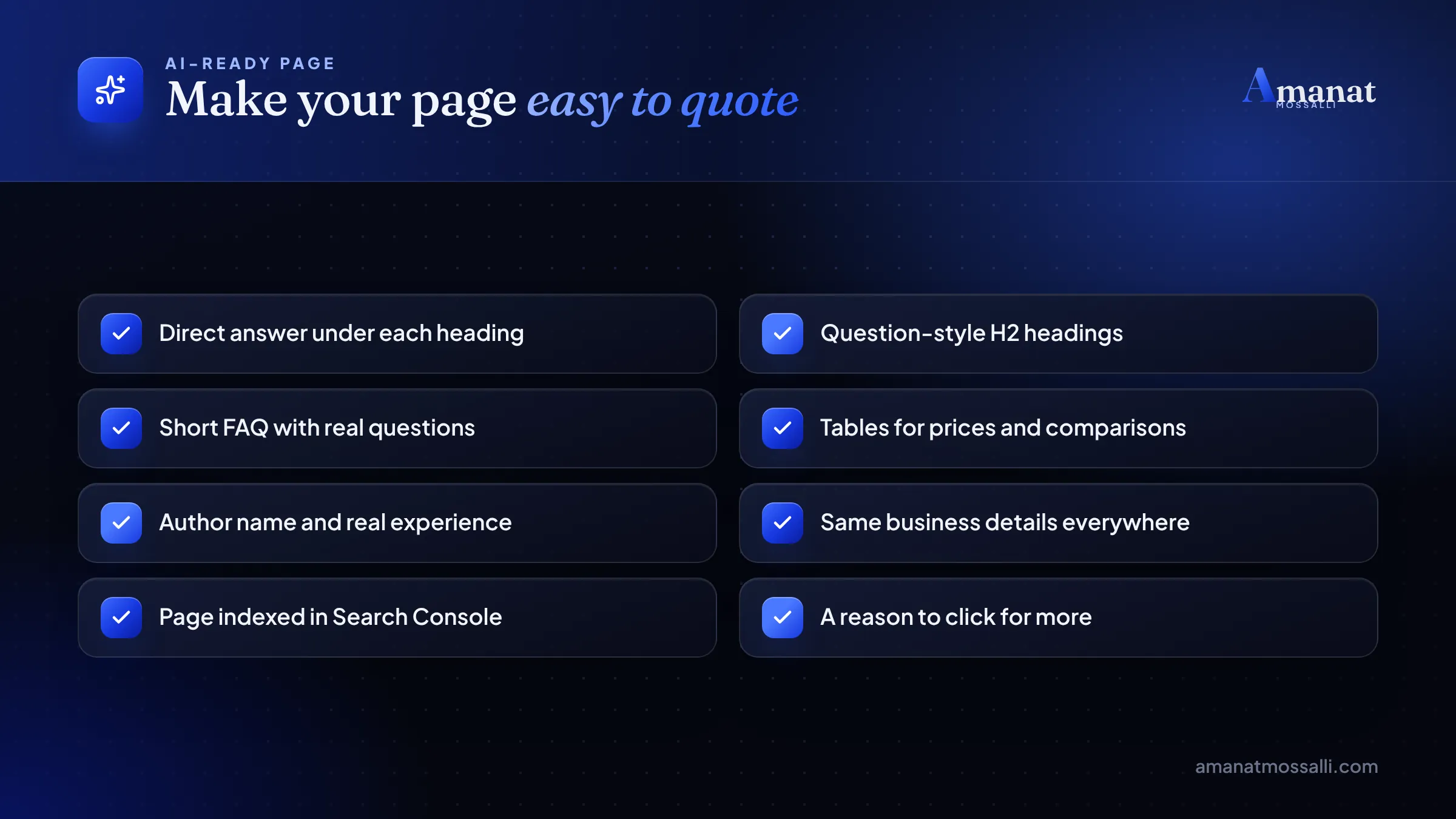
Make your page easy to quote and your brand easy to trust. AI tools lift short, clear answers from pages that already rank and that other sites mention.
Google’s guide says AI Overviews and AI Mode are rooted in its core Search ranking systems. Good SEO is still the floor. I reread the guide on 11 November 2026, and four of its points save people money.
- No special files. You don’t need llms.txt or AI text files for Google Search. Google says it doesn’t use them.
- No special markup. There is no AI-only schema. Normal structured data is still worth having for rich results.
- No chopping. You don’t have to split content into tiny chunks. Google says there is no ideal page length.
- No fake buzz. Chasing inauthentic mentions across the web “isn’t as helpful as it might seem”.
The first point applies to Google only. Other AI services may treat such files differently, and I explain that in what is llms.txt. One requirement does matter: the page must be indexed and allowed to show a snippet.
Check where you stand in AI answers
Write down ten questions a buyer might ask, like “best catering service in Sylhet”. Ask them in ChatGPT, Gemini, Perplexity and Google AI Mode. Note which brands and websites get named.
Then study the cited pages. What do they answer that yours doesn’t?
Repeat it monthly in a plain spreadsheet. One hour, and you see exactly where you’re invisible. Back in Chattogram, the owner’s brand wasn’t named once in ten questions. His competitor was named in four.
This is the work I do most for clients now. Some of them rank #1 on Google here at home, others in the UK, USA, Australia and Canada. A few are cited in Google’s AI Overviews. The ten-question check above is where I start with each of them.
My SEO, AEO and GEO service covers Google rankings and getting brands named inside AI answers. The method is laid out in my guide to generative engine optimization.
Step 5Free local traffic from Google Business Profile
If you serve customers in a specific area, your Google Business Profile is the fastest free traffic you’ll get. It puts you on Maps and in the local box above the normal results.
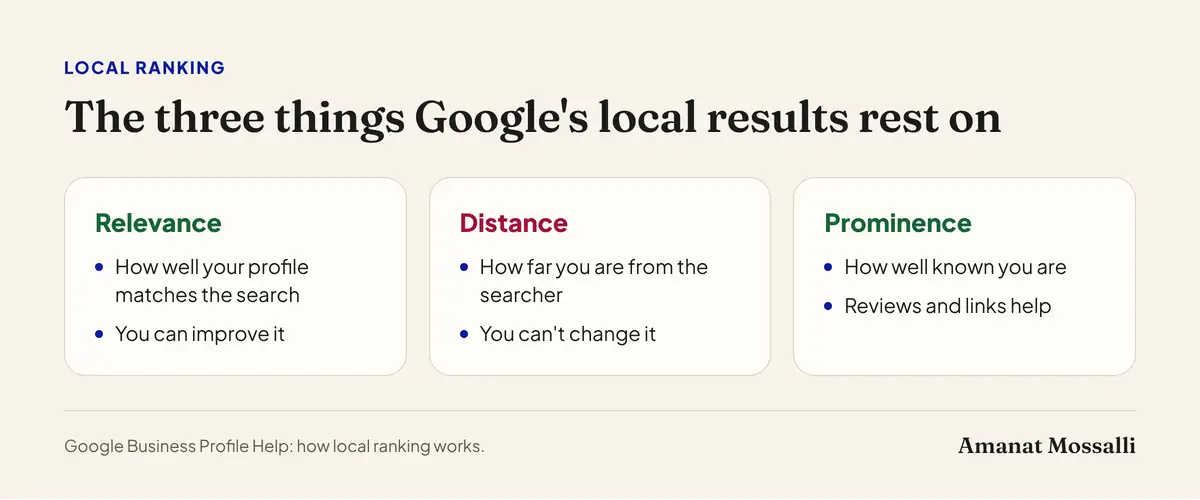
Google explains how local ranking works in plain words. It rests on three things. Relevance is how well your profile matches the search. Distance is how far you are from the searcher. Prominence is how well known you are, helped by reviews and links.
You can’t move your shop closer to the searcher. You can fix the other two. The same page states that nobody can pay Google for a better local position.
- 1Claim and verify the profile.
- 2Choose the most accurate main category.
- 3Add real photos of your shop, team and products.
- 4Ask happy customers for reviews, and reply to every one.
- 5Update your hours for Eid, Puja and other holidays.
Use your real business name, exactly as on the signboard. Stuffing keywords into the name gets profiles suspended. Write a plain description of what you do and which areas you serve, like Mirpur, Dhanmondi or Agrabad.
The setup itself is in my Google Business Profile guide for Bangladesh. The wider strategy is in my guide to local SEO for Bangladeshi businesses.
Step 6What's blocking Google from your pages?
Usually two things: pages Google can’t index, and pages that load too slowly. If Google can’t store a page, no amount of writing brings it traffic.
| Problem | Why it hurts | Quick fix |
|---|---|---|
| Pages not indexed | Google cannot show them at all | Check the Pages report in Search Console |
| Slow mobile page speed | Visitors on mobile data leave | Compress images to WebP, use better hosting |
| Heavy theme, many plugins | Slow and fragile site | Remove unused plugins, use a light theme |
| Duplicate pages | Google splits trust between copies | Merge them or add canonical tags |
| No HTTPS | Browsers warn visitors away | Install an SSL certificate |
The three speed numbers Google names
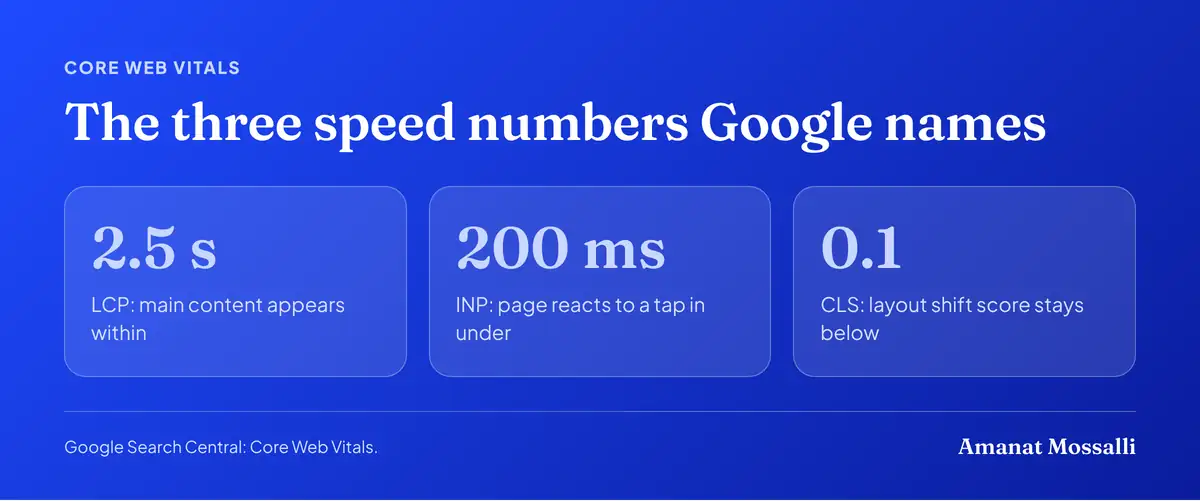
Google measures page experience with three Core Web Vitals. A page is in good shape when it meets all three.
- Loading (LCP): the main content appears within 2.5 seconds.
- Response (INP): the page reacts to a tap in under 200 milliseconds.
- Stability (CLS): the layout shift score stays below 0.1.
Google doesn’t call these a ranking trick. It says they align with what its ranking systems seek to reward. You’ll find your own scores in Search Console, under Core Web Vitals.
Speed matters more here than in many countries. DataReportal’s 2027 report puts the median mobile download speed at 38.67 Mbps. Plenty of people still use budget phones on patchy signal. Load-shedding pushes everyone off Wi-Fi and onto mobile data at the worst moments.
Open your site on a cheap Android phone using mobile data, not office Wi-Fi. If you get bored waiting, so will your customers.
Want a wider check than speed? My walkthrough on how to do an SEO audit covers the full list. The free SEO audit tool tests a page in under a minute.
Sometimes the theme itself is the problem. Then a clean rebuild helps more than months of patching, and I say that as someone who has tried the patching.
Step 7Backlinks without the Facebook-group packages
Earn them by being worth mentioning. Backlinks are links from other websites to yours. Google treats good ones like votes of trust.
The cheap link packages sold in Facebook groups are a gamble. Google’s spam policies name paid links, automated link services and low-quality directory links as link spam. These work better:
- Share real data or tips with Bangladeshi news sites and blogs.
- Get listed by your suppliers, partners and trade bodies.
- Speak at or sponsor a local event and get a link on the event page.
- Make a free price guide or tool that other sites want to reference.
- Put your website in every social bio and YouTube description.
Honest mentions pay twice. They lift your Google ranking, and they teach AI tools that your brand is real.
The links you control: your own
Before chasing anyone else’s links, fix yours. Internal links cost nothing and most small sites barely use them. The Starter Guide notes that Google finds most new pages through links.
- Link from your five most visited pages to your five most valuable ones.
- Use words that describe the target, like “AC servicing prices”, not “click here”.
- Make sure every important page can be reached in three clicks from the homepage.
- When you publish a new page, add links to it from two older, related pages.
I’ve seen page-two pages move on internal links alone. It’s the least glamorous job in SEO and one of the most reliable.
How do you measure what's working?
Search Console for what happens before the click, GA4 for what happens after it. Once a month. Not every hour, however tempting.
A word on that new report, so you don’t expect too much. Google announced it in June 2026. According to PPC Land’s report, the first version shows impressions, pages, countries and devices. It doesn’t show clicks, and it began with a subset of sites. If you don’t see it yet, that’s normal.
Impressions up but clicks flat? An AI Overview is probably answering the question. Rewrite the title to promise what the summary can’t give, like a full price list or a free checklist.
Keep a simple monthly sheet with five rows. Clicks, impressions, CTR, enquiries from organic visitors, and the date of each change you made. The last row is the one people skip. Without it you can’t tell which change worked.
Traffic is half the story. You need to know which visits turn into orders and calls. If GA4 isn’t set up, start with how to set up GA4 and the Facebook Pixel.
FAQ: How to Increase Organic Traffic in Bangladesh
How can I increase organic traffic to my website quickly?
Is organic traffic free?
Do AI Overviews reduce website traffic in Bangladesh?
Should I write content in Bangla or English?
How do I check my website's organic traffic?
How to increase organic traffic in Bangladesh for a local shop?
Can I grow organic traffic without a blog?
How long until the traffic moves?
Three to six months for the first clear movement on most sites. Search Console quick wins can show in weeks. Competitive keywords can take a year.
Google’s Starter Guide is honest about this too. It says some changes take effect in a few hours and others take several months.
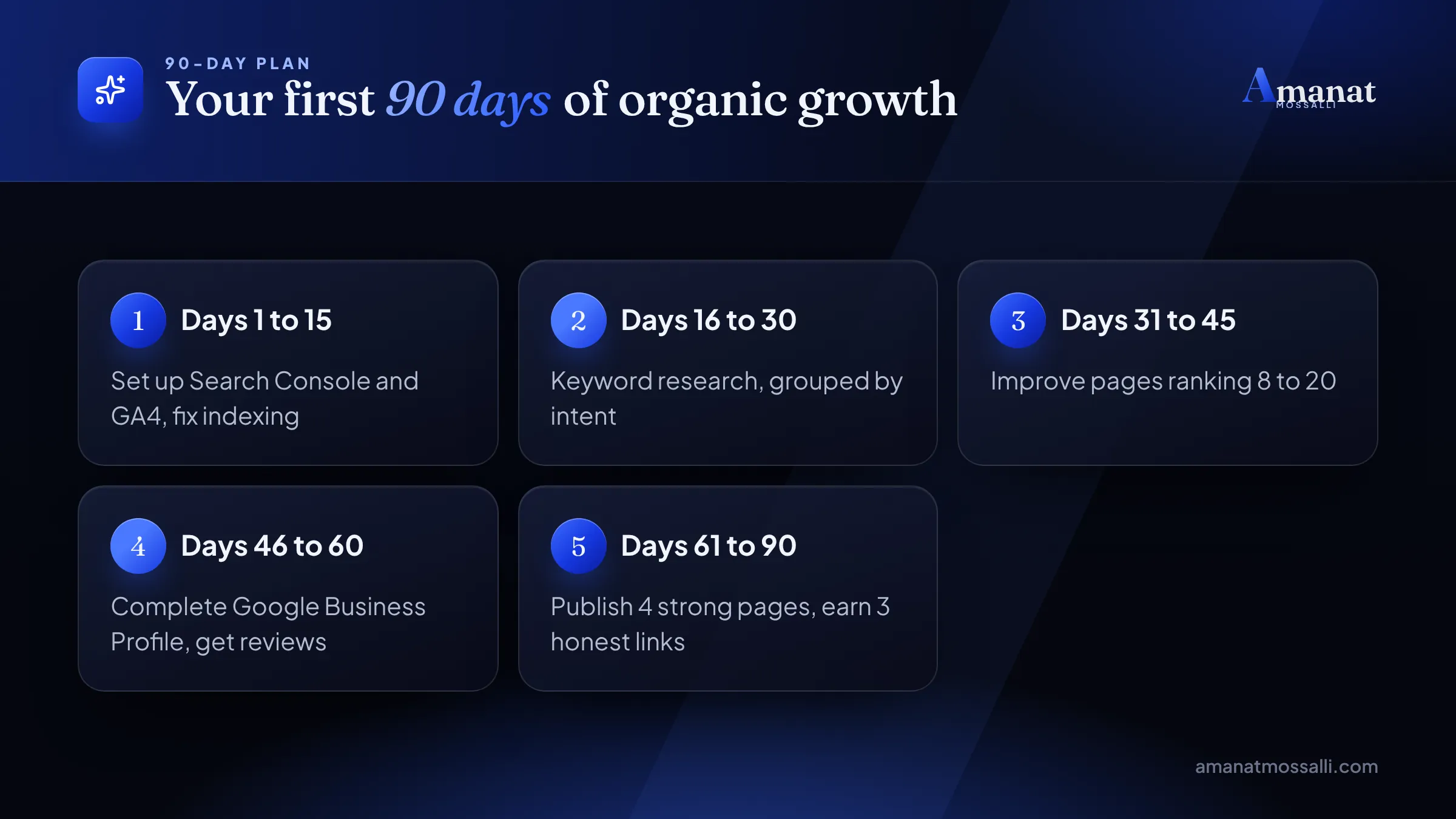
This is the 90-day order I use for small and mid-sized businesses. Each step makes the next one work better.
| When | What to do | What you should see |
|---|---|---|
| Week 1 | Set up Search Console and GA4. Run the diagnosis. Write down your CTR. | A baseline you can trust |
| Weeks 2 to 3 | Fix indexing and speed. Rewrite five weak titles. | Fewer errors in the Pages report |
| Weeks 4 to 6 | Improve five page-two pages. Complete your Google Business Profile. | First position gains, more Maps views |
| Weeks 7 to 10 | Publish four strong pages from your customer question list, in English and Bangla. | New queries appearing in Search Console |
| Weeks 11 to 13 | Add internal links. Ask for five real links. Run the AI answer check. | CTR and clicks above your baseline |
Don’t judge SEO in month one. It builds slowly, then grows faster once Google trusts the site. The Chattogram owner nearly quit in week five. I’m glad he didn’t.
If you’d rather learn the wider basics first, read my complete guide to SEO for Bangladeshi businesses. Online shops face extra problems, covered in why SEO matters for e-commerce in Bangladesh.
The shop in Agrabad still gets about forty thousand impressions a month. By the fifth month, clicks had climbed from about 300 to roughly 900. That’s a click rate a little over 2%, and the owner says most new IPS enquiries now mention Google. Nothing clever happened. Better titles, sharper service pages, one Maps profile, and patience.
If you’re stuck on the diagnosis, send me your Search Console screenshot. I’m Amanat Mossalli Taju, and I read these myself. I’ll tell you which row of the table you’re in.

Amanat Mossalli Taju
Senior Digital Marketer & SEO Expert, Dhaka, BangladeshI have grown 175+ brands since 2020 with SEO, Google and Meta Ads, server-side tracking, WordPress and AI automation. Half of my clients are in the UK, USA, Australia and Canada. Everything I write here comes from real client work.
Want this done for your business?
Book a free 15-minute call. I look at your site and ads before we talk, so you leave with clear next steps.