Website Traffic but No Sales? 12 Reasons and How to Fix Each One
Visitors arrive, orders don't. Here are 12 causes of website traffic but no sales, a quick test for each one, and the fix I'd make first.

More visitors won’t fix a website that doesn’t sell. That’s the myth I hear every week. When you have website traffic but no sales, one of two things is nearly always true. The wrong people are arriving. Or the right people hit something that pushes them away.
The second group is the big one. A page that crawls on mobile data. A price hidden behind “inbox us”. No cash on delivery. A checkout that demands an account. Each one looks small on its own, but they add up fast.
Below are the 12 causes I check first. Each comes with a five-minute test and a first fix. Start with the table, find the rows that sound like your site, and jump to those parts.
What you need to know
- Traffic quality matters more than traffic size. Check sources and search intent first.
- Test your own site on a phone, on mobile data, and place a real order.
- Show the price, the delivery charge and the return policy before checkout.
- In Bangladesh, offer cash on delivery, bKash or Nagad, and a WhatsApp button. A BBS survey found 86.8% of online shoppers paid cash on delivery.
- Fix tracking early, or you’ll make every other decision on bad numbers.
Why Do You Get Website Traffic but No Sales?
Short answer: people arrive, and something stops them before they pay. Website traffic but no sales is a leak, not a shortage of visitors. Your job is to find that something. Guessing costs money, so test before you change anything.
How I know this, in a few lines. My name is Amanat Mossalli Taju, and I fix leaky websites from Dhaka. I’ve been doing this for over seven years, with over $8M of Google and Meta budgets passing through my hands for 235+ brands. Paid clicks are honest in a harsh way. You see what each visitor cost, so a page that doesn’t sell hurts from day one.
The list below is ordered roughly by how often I find each cause on small business sites. That order comes from my own audits. It isn’t a study, so treat it as a starting point.
| # | Cause | 5-minute check | First fix |
|---|---|---|---|
| 1 | Wrong search intent | Search Console queries | Build pages for buying searches |
| 2 | Junk or wrong-country visits | GA4 source and country reports | Cut bad sources, fix ad locations |
| 3 | Slow on mobile | PageSpeed Insights, mobile tab | Compress images, remove heavy add-ons |
| 4 | Unclear message | Five-second test with a friend | Rewrite the headline |
| 5 | Weak offer or hidden price | Read the page as a stranger | Show price, delivery and returns |
| 6 | Low trust | Look for reviews, phone, address | Put proof next to the button |
| 7 | Checkout friction | Test order on your phone | Cut fields, allow guest checkout |
| 8 | Missing payment options | Compare with how buyers pay | Add COD, bKash or Nagad |
| 9 | No fast human contact | Message yourself at 10 pm | Add WhatsApp and reply hours |
| 10 | Broken tracking | GA4 key events plus a test order | Fix purchase and lead events |
| 11 | Ad and page mismatch | Click your own ad | Match headline, offer and product |
| 12 | No follow-up | Check retargeting and email | Retarget viewers, recover carts |
People phrase the problem in many ways. Website not converting. High traffic low conversion. Why my website is not getting sales. It’s the same question, and the same 12 places to look.
Find the Step Where Visitors Vanish
Before you touch any of the twelve, draw your funnel. It takes ten minutes in GA4, and it tells you which half of the list to read first.
Here’s an example with round numbers. Say you spend Tk 32,000 on ads in a month, at about Tk 8 a click. That buys 4,000 visits. Then you count how many people reach each next step.
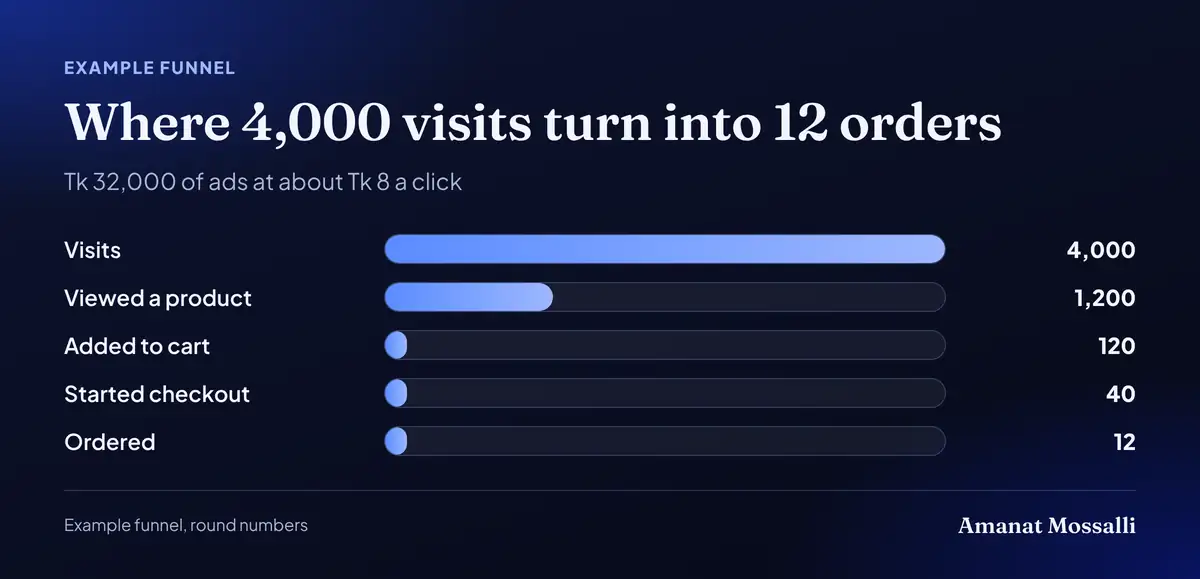
| Step | People | Kept from the step before | Causes to check |
|---|---|---|---|
| Visits | 4,000 | – | 1, 2, 11 |
| Viewed a product | 1,200 | 30% | 3, 4 |
| Added to cart | 120 | 10% | 5, 6, 9 |
| Started checkout | 40 | 33% | 5, 7 |
| Ordered | 12 | 30% | 7, 8, 10 |
That’s a 0.3% conversion rate and Tk 2,667 per order. Now look at the last row. Of 40 people who started checkout, 28 left. Those people already wanted to buy.
Say a checkout fix doubles the last step, from 12 orders to 24. Same ad spend, same traffic. Cost per order falls to about Tk 1,333. No extra visitor was needed.
In GA4, the Explore section has a funnel exploration that builds this view for you. If your events are broken, count by hand for a week instead. Rough numbers still beat guesses.
Are the Wrong People Visiting Your Site?
Often, yes. Not all traffic can buy. A blog post on “how to clean a sofa” brings readers. A page for “sofa price in Dhaka” brings buyers.
1. Your visitors came to learn, not to buy
Open Google Search Console. Go to Performance, then the Queries tab, and sort by clicks. Mark each of your top 20 queries as learning, comparing or buying.
If most are learning queries, you don’t have a sales problem. You have a traffic-mix problem. Those readers were never going to order today.
The fix is to build pages for buying searches: product pages, price pages, area pages and comparison pages. Then link your guides to them. I cover the search side in how to grow organic traffic in Bangladesh.
2. The visits are junk, or from the wrong country
In GA4, open Reports, then Acquisition, then Traffic acquisition. Read the source column. Then check the country report under user attributes.
Red flags look like this. A spike from a country you don’t ship to. Sessions with almost no engagement. A referral site you’ve never heard of. Cheap “traffic packages” sold online often produce exactly this pattern.
Ads can do it too. A broad Meta campaign can send lots of quick taps from people who clicked by accident. In accounts I audit, Audience Network placements are a common source of these empty clicks.
Filter GA4 to one source at a time. If a source has plenty of sessions but zero add-to-carts or form starts, stop paying for it before you touch the website.
How Slow Is Your Website on a Real Phone?
Slower than it feels at your desk, probably. Most buyers in Bangladesh shop on phones. A page that loads fine on office Wi-Fi can crawl on a bus in Mirpur.
Test your main product or service page in PageSpeed Insights and read the mobile tab, not desktop. Google’s Core Web Vitals guide sets three targets for a good page. LCP should be 2.5 seconds or less. INP should be 200 milliseconds or less, and CLS 0.1 or less. Google Search Central gives the same targets (checked 12 November 2026).
In plain words, LCP is how long the main content takes to appear. INP is how fast the page reacts when you tap. CLS is how much things jump around while loading. Google judges these at the 75th percentile of visits, so your slow visits count.
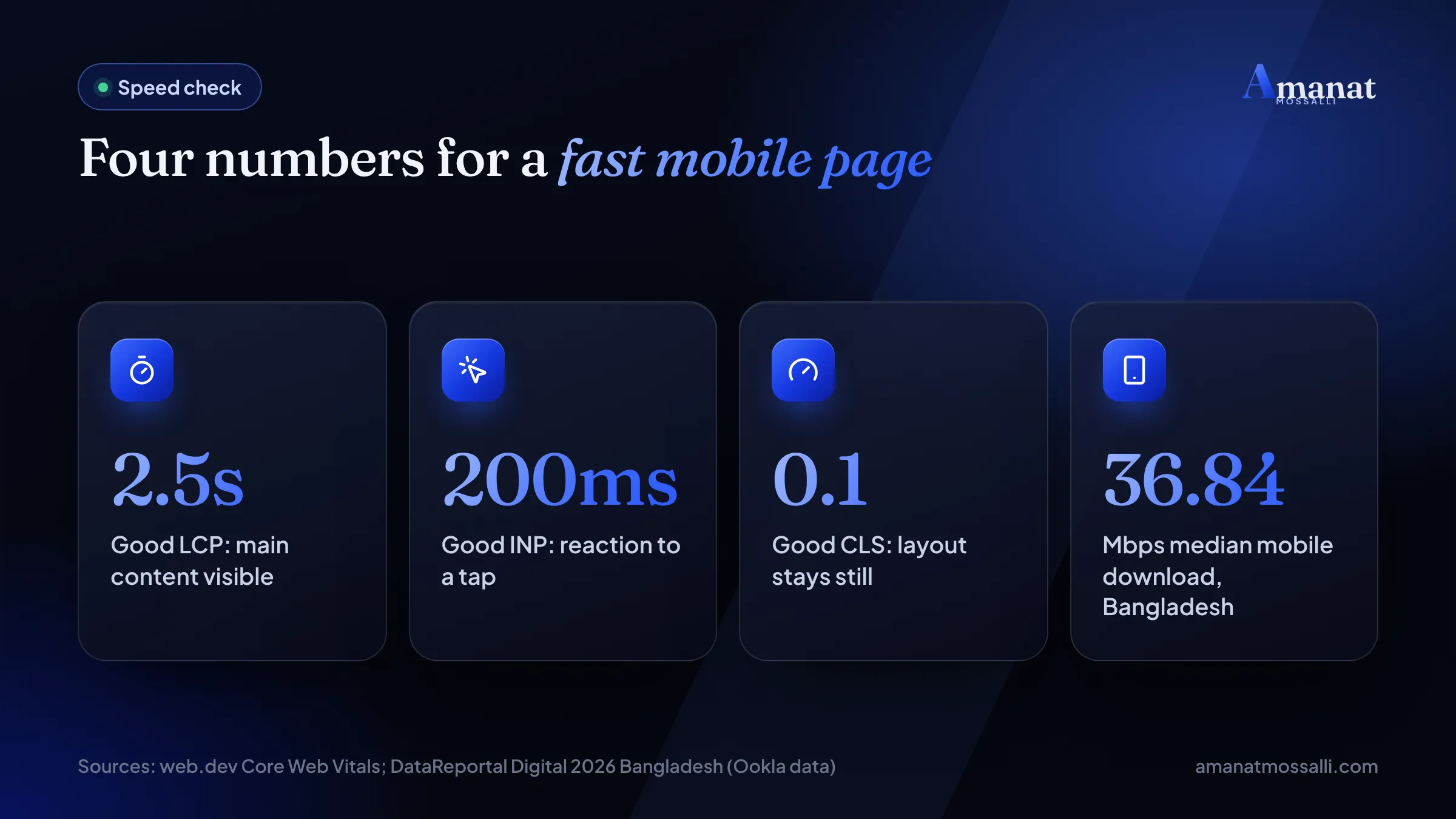
DataReportal’s Digital 2026 Bangladesh report puts the median mobile download speed at 36.84 Mbps at the end of 2025, using Ookla data. That’s decent. Still, signal drops fast outside the big cities, and a heavy page loses people in Rangpur long before it loses them in Gulshan.
3. The fixes that usually help most
- Convert product photos to WebP and keep each one small, ideally a few hundred KB at most.
- Remove sliders, pop-ups and chat widgets nobody uses.
- Pick hosting with servers near your buyers, or add a CDN.
- On WordPress, delete plugins you haven’t touched in months.
- Lazy-load images that sit below the first screen.
Speed work is fiddly on WordPress. If you’d rather hand it over, it’s part of my WordPress development service.
Does Your Page Explain Itself in Five Seconds?
Most pages don’t. Owners know their business so well that they forget a stranger knows nothing.
4. The message is unclear
Show your page to a friend for five seconds, then hide it. Ask three things. What do we sell? Who is it for? What should you do next? If they pause, your visitors pause too.
Compare two headlines. “Welcome to Pure Living” says nothing. “Water purifiers for Dhaka tap water, installed at home the same week” says everything a buyer needs to keep reading.
Write the way your buyer talks. Plenty of shoppers here search in Banglish or Bangla. One warm Bangla line near the order button can feel more honest than polished English.
5. The offer is weak, or the price is hidden
“Price in inbox” works on Facebook because people expect to chat. On a website it reads like a trap. Most visitors leave rather than ask.
Show the price. Show the delivery charge inside and outside Dhaka. Put the return rule in one short line. If your price really varies, show a starting price and what changes it.
This isn’t only good practice. The government’s Digital Commerce Operation Guidelines 2021 ask online sellers to show the price, delivery charges and return conditions. That summary is from The Daily Star. They also ask for real images or video of the product.
Then give an honest reason to act now. Limited stock you really have, a same-day dispatch cut-off, a bundle that saves money. Fake countdown timers backfire once people see them reset.
Why Should a Stranger Trust Your Online Shop?
They shouldn’t, until you give them reasons. That’s cause six. Many people in Bangladesh have had a bad online order, so the doubt starts high.
There’s data on this now. The Bangladesh Bureau of Statistics surveyed households for its ICT Access and Use survey 2024-25. The Daily Ittefaq reported that 11.4% of online shoppers had a problem. Of those, 50.7% got something that didn’t match the order. Poor quality came next at 44.8%, then late delivery at 19.3%.
So the buyer’s fear is specific. Will the thing in the photo be the thing in the box? Answer that on the page: real photos, a short video, exact sizes and an easy return line.
Go through the checklist below on your best-selling page. Every missing item is a cheap fix.
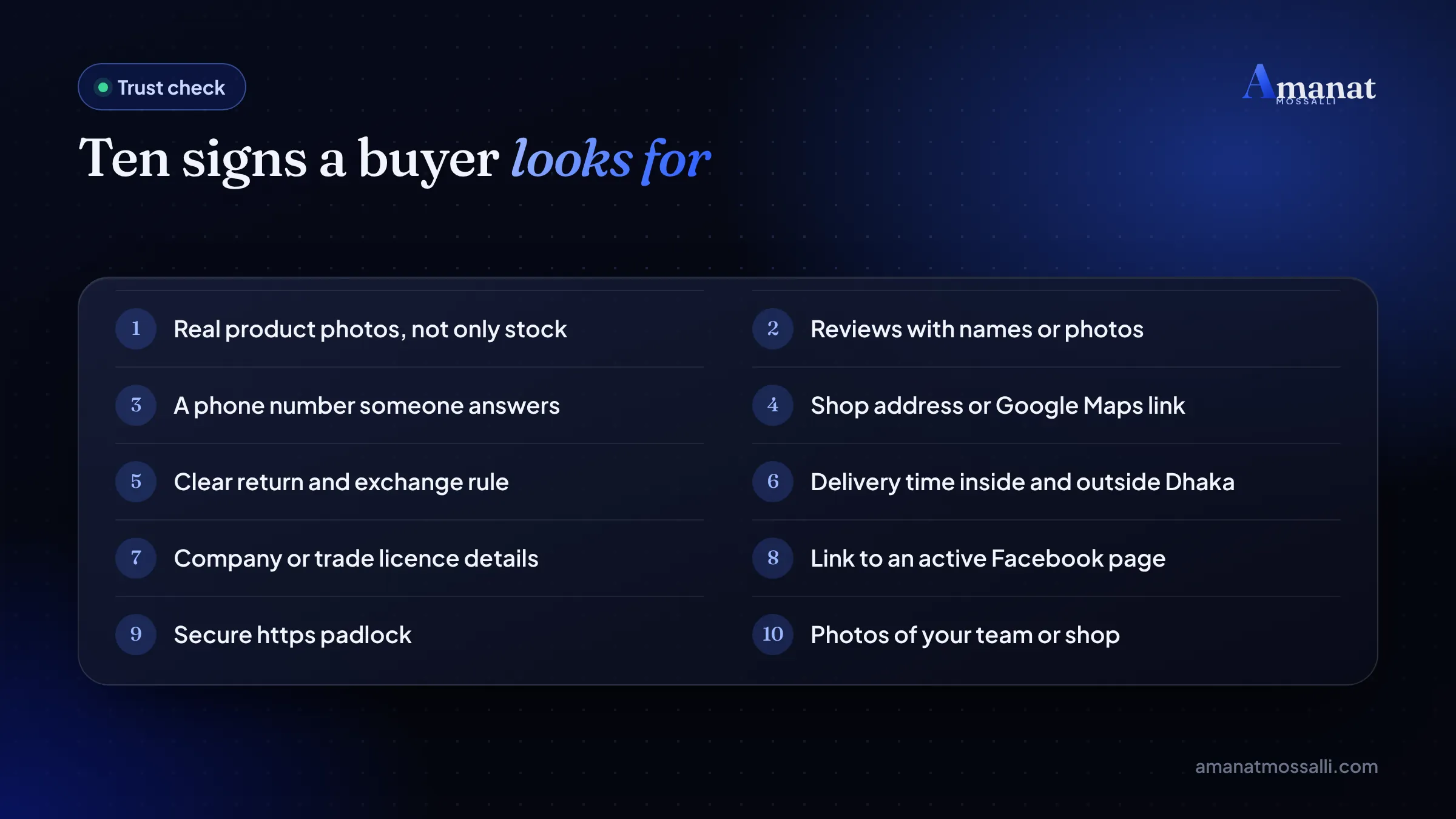
Place proof close to the decision. One review right beside the Order button does more than twenty reviews on a page nobody opens.
Delivery promises build trust too, if you keep them. The same 2021 guidelines set delivery within 5 days of payment in the same city and 10 days for another city. They also ask sellers to settle complaints within 72 hours. If you deliver faster, say so near the button.
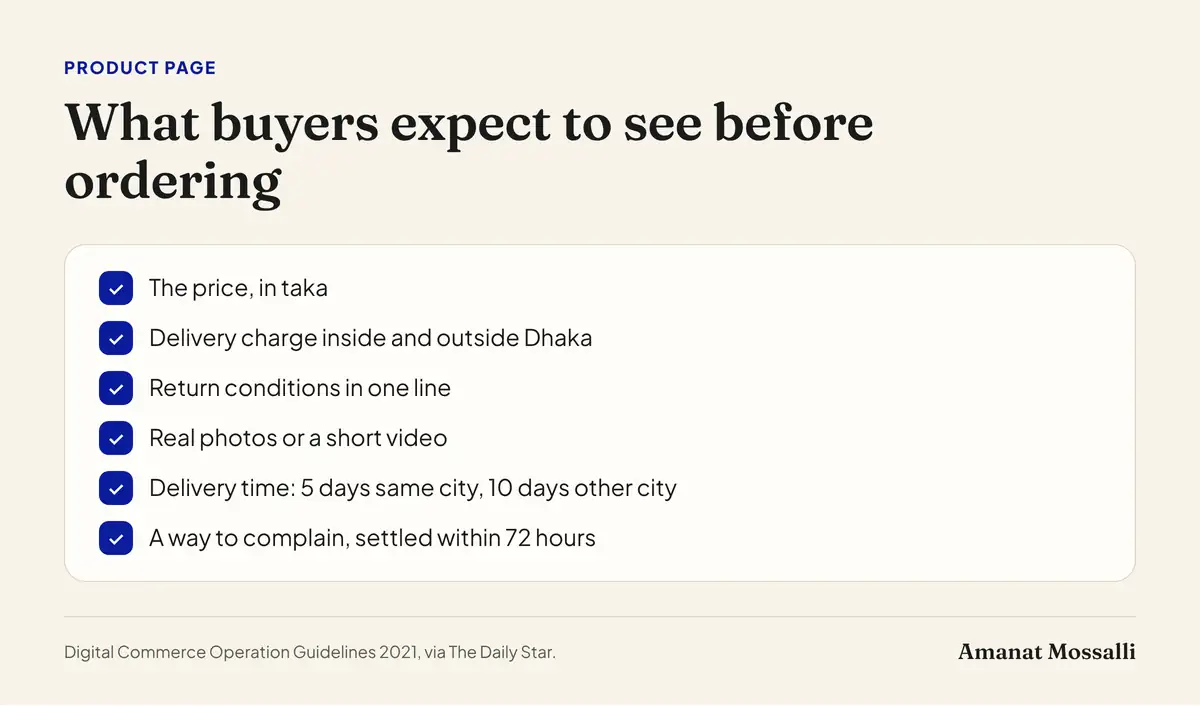
Local buyers also check Google before paying someone new. A Google Business Profile with real reviews and photos quietly backs up everything your site claims.
Where Do Buyers Quit During Checkout?
Usually at a step that asks for more than they expected. Money, effort or information. Find that step and you’ve found most of your lost sales.
7. Too many steps and fields
Place a test order on your own phone, on mobile data. Time it. Count the fields. Write down each moment you feel annoyed.
The usual suspects are easy to spot. Forced account creation. A postcode field nobody knows. A coupon box that sends people off hunting for codes. A delivery charge that only appears on the last screen.
For most small shops, name, phone, address and area are enough. Make email optional. Show the full total, delivery included, before the final button.
8. Buyers can't pay the way they want
This one is huge in Bangladesh. The same BBS survey found 86.8% of online shoppers paid cash on delivery. Mobile money such as bKash and Nagad came to 13.9%. Cards were 3.1%, and internet banking 1.1%. People could name more than one method.
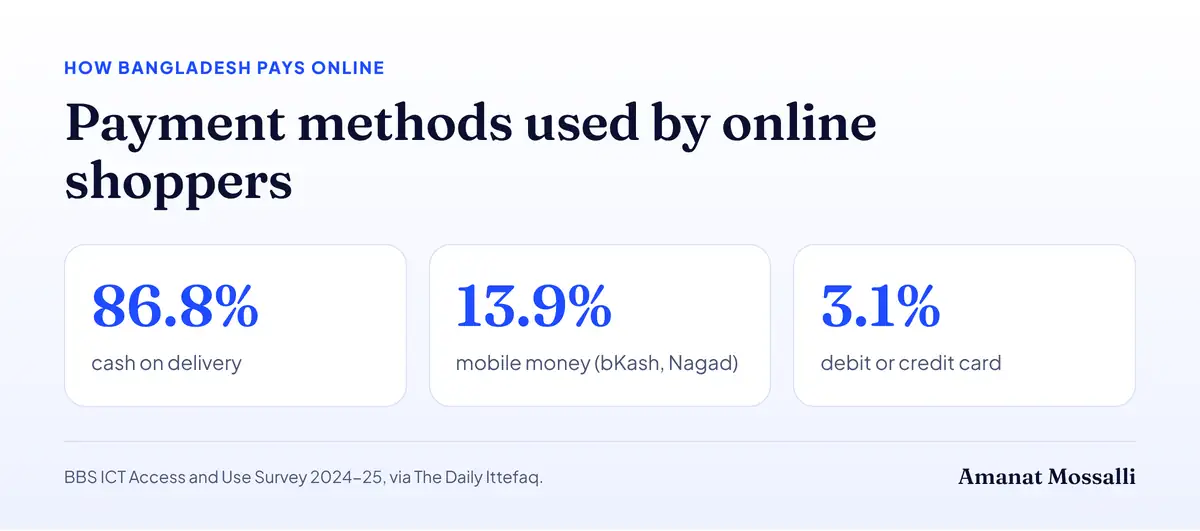
Read that again if your site only takes cards. You are asking almost everyone to pay in a way they rarely use.
| Payment option | Works well for | Watch out for |
|---|---|---|
| Cash on delivery | First-time buyers, low trust | Fake orders, returns, cash handling |
| bKash or Nagad | Repeat buyers, advance payments | Manual checking unless a gateway is linked |
| Card through a gateway | Higher-value orders, gift buyers abroad | Gateway fees and setup time |
| Small advance, rest on delivery | Big orders, areas with many returns | Must be explained before checkout |
Worried about fake orders? Confirm each COD order by phone or WhatsApp before dispatch. Ask for a small advance only where returns hurt you most. Say so plainly on the product page, not after the order.
Can a Buyer Reach a Real Person Fast?
If they can’t, many won’t buy. That’s cause nine. Bangladeshi shoppers often want to ask one thing first. Is it original? Will it fit? Can it arrive by Friday?
With no WhatsApp button, no phone number and no reply promise, the question goes nowhere. The buyer then orders from a Facebook page that answers in minutes.
Try this tonight. Send a message through your own site at 10 pm. Note how long the reply takes, and whether one comes at all.
- Add a WhatsApp click-to-chat button on product and contact pages.
- Show your reply hours right next to it.
- Save quick replies for your five most common questions.
- Put a tap-to-call number in the mobile header.
Track those chats as well. Set the WhatsApp button click as an event, so you can see which pages start conversations that end in orders.
Is Your Tracking Hiding Real Sales?
Sometimes it is. Cause ten is sneaky because it can go both ways. Real sales go uncounted, or fake ones get counted.
In GA4, open Admin, then Events. Google’s help page on key events (checked 12 November 2026) shows how to star the events that matter. A standard property can mark up to 30 of them. Standard reports can take up to 24 hours to show new key events. Realtime shows them within minutes.
Then place a real test order and watch the Realtime report. Did one purchase or lead event fire, with the right value? Did it fire twice? Or not at all?
Here’s what I find most often. The purchase event fires on the checkout page instead of the thank-you page. Phone and WhatsApp orders never get counted. Cancelled COD orders still sit in the report as sales.
A pet food shop in Khulna asked me to look at their site last spring. The owner had a GA4 screenshot ready: nine purchases in two weeks, from about 2,600 visits. He’d decided the website was a waste and wanted to move everything back to Facebook. I asked him to do one boring thing first. For two weeks, his staff wrote down every order and where the buyer came from. The sheet came back with 31 orders. Nine went through the website checkout. The other 22 started on a product page, then tapped the WhatsApp button to ask about a brand or a bag size. GA4 had counted none of them. We added a WhatsApp click event and a simple “order placed” note in the chat replies. He kept the site. His ad money didn’t change, but now he could see which pages actually started orders.
If WhatsApp brings a big share of your orders, your site may be doing better than GA4 shows. Count those orders by hand for two weeks before you judge the website.
Do Your Ads Promise Something the Page Doesn't?
Cause eleven. An ad says “30% off winter jackets”. The click lands on the homepage, which shows summer shirts. The visitor is gone in three seconds.
Click your own ads once a week. The headline, image, product and price on the page should match the ad. Same words, same item, same number.
That’s why a landing page not converting is often an ad problem in disguise. One campaign, one promise, one page. If you run Facebook campaigns, my piece on boosting versus Ads Manager shows why the setup behind the click matters too.
A focused page for each main offer usually costs less than buying more clicks. That’s the whole point of my landing page design work.
What Brings Back Visitors Who Didn't Buy?
A follow-up system. Without one, cause twelve quietly eats your budget. Most people don’t buy on the first visit. They compare, ask family, or wait for salary day.
- Retarget product viewers on Facebook and Instagram for a week or two.
- Send cart reminders by SMS or email when someone leaves a phone number.
- Offer a small first-order reward in exchange for a WhatsApp opt-in.
- Use remarketing lists in Google search campaigns.
Retargeting tends to be cheap because the audience is small and warm. It only works when tracking works, though, so sort out cause ten first.
Here’s one of my favourite conversion rate optimization tips for small shops: thank every buyer by WhatsApp after delivery. Ask for a photo review. That review then feeds cause six, and the loop starts paying for itself.
FAQ: Website Traffic but No Sales
Why is my website getting traffic but no sales?
What is a good conversion rate for a small online shop?
How long do conversion fixes take to work?
Does cash on delivery increase sales in Bangladesh?
Should I redesign my website if it doesn't sell?
Can SEO traffic convert as well as ad traffic?
Is low traffic or low conversion my bigger problem?
Which free tools help find conversion problems?
A 30-Minute Diagnosis to Run Today
This is the order I check things in. It moves from the cheapest fix to the hardest. Do it in one sitting, with a cup of tea.
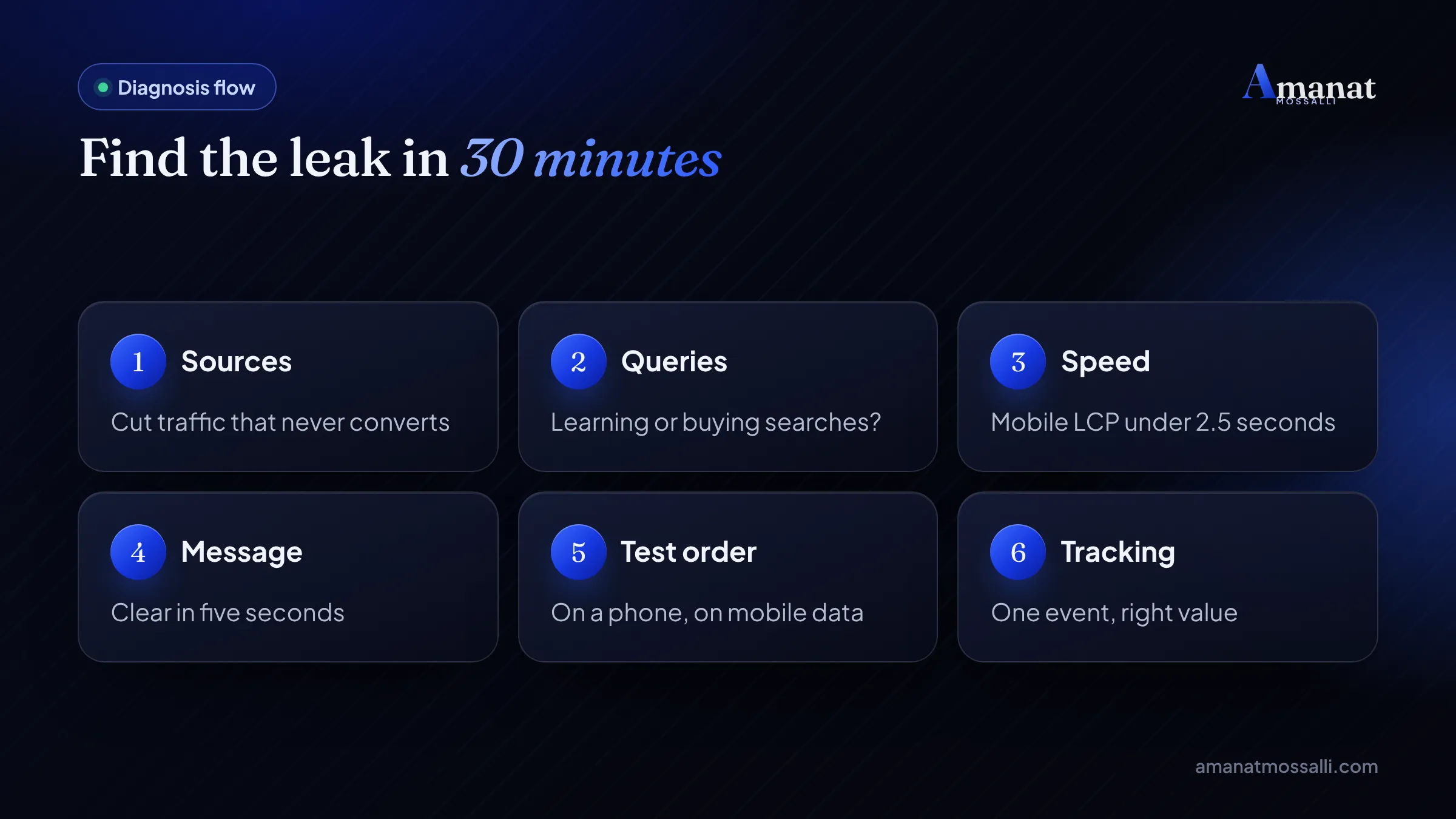
You’ll probably find two or three problems. Start with the one nearest the money. Checkout, payment and tracking come before headline tweaks.
Want to watch real visitors? Microsoft Clarity is free and records sessions and heatmaps, including rage clicks. Ten recordings of people leaving your checkout will teach you more than a month of guessing.
For the technical side, run your site through my free SEO audit tool. It flags speed and page issues in a few minutes.
Mistakes That Make Website Traffic but No Sales Worse
When sales are flat, owners panic and change everything at once. Then nobody knows what worked. A real low conversion rate fix is slow and a bit boring.
- Buying more traffic first. More visitors to a leaky page just make a bigger leak.
- Redesigning the whole site. A new look rarely fixes a checkout or payment gap.
- Changing five things in one week. Change one thing, wait, then measure.
- Copying a marketplace layout. It suits a site with ten thousand products, not a shop with forty.
- Judging on one week of data. Eid, salary day and rain all swing sales.
- Ignoring WhatsApp and phone orders. They are sales too, so count them.
A water purifier dealer in Tangail messaged me on a Thursday, just before midnight. His Google Ads were bringing steady clicks, and his order sheet was almost empty. He wanted a brand-new website. We shared screens instead.
I tapped his ad on my phone and landed on a purifier with no price, only “Call for price”. The call button rang the shop landline, which nobody picked up after 9 pm. Most of his clicks came in the evening, when families were home and talking about it.
We changed three things and nothing else. Prices on every model, a WhatsApp button with reply hours, and a delivery and installation note for outside Tangail. Over the next month, orders went from about four a week to about seven. His cost per sale dropped from roughly Tk 2,900 to about Tk 1,700, on the same budget and the same traffic.
Remember the five-second test from earlier? His page failed it on the first question a buyer asks: what does this cost?
More of these traps are in my list of digital marketing mistakes Bangladeshi businesses make.
Your Seven-Day Fix Plan
Website traffic but no sales feels urgent. Still, don’t attack all twelve causes at once. Do this instead, one small job a day.
- 1Day 1: run the 30-minute diagnosis, draw your funnel and write down every problem.
- 2Day 2: fix tracking, so you can trust what you see next.
- 3Day 3: show price, delivery charge and return rule on key pages.
- 4Day 4: add COD, bKash or Nagad, and a WhatsApp button.
- 5Day 5: cut checkout down to the fields you really need.
- 6Days 6 and 7: watch the numbers and change nothing else.
Then compare your funnel with the one you drew on day 1. If the biggest drop has moved to a different step, you fixed something real. Go after the new biggest drop next.
And if a week of clean data shows people reach checkout, see the full price and still leave? Then the leak may not be the website. It may be the price, the product or the competition. That’s a harder conversation, but at least now you’re having it with real numbers. If you want a second pair of eyes on those numbers, my conversion work starts exactly there.

Amanat Mossalli Taju
Senior Digital Marketer & SEO Expert, Dhaka, BangladeshI have grown 235+ brands over more than seven years with SEO, Google and Meta Ads, server-side tracking, WordPress and AI automation. Half of my clients are in the UK, USA, Australia and Canada. Everything I write here comes from real client work.
Want this done for your business?
Book a free 15-minute call. I look at your site and ads before we talk, so you leave with clear next steps.