Digital Marketing for Doctors in Bangladesh: Clinics, Hospitals and the BMDC Rules
What the BMDC code really says about publicity, and how a doctor, clinic or diagnostic centre can still get found online without crossing it.

Read the rules before you touch the ads. Healthcare work taught me that in my first month with a clinic. Digital marketing for doctors in Bangladesh is the one field where a clever campaign can end in a complaint to the council. So the order matters: rules first, Google Maps second, website third, ads last, if at all.
Most clinics I look at have it backwards. A “Best Clinic in Dhaka” banner on the homepage. A Facebook page full of patient thank-you posts. A Google profile with a phone number nobody answers. All three are fixable. Two of them are also problems under the BM&DC code. Below I quote what that code says and what the High Court and DGHS have added. I also cover what a new data law means for your booking form. Then I show what doctors, clinics and diagnostic centres can do safely, with two cases from my own work.
What Does Digital Marketing for Doctors in Bangladesh Actually Involve?
It involves being found, being understood and being easy to book. That’s it. Good digital marketing for doctors in Bangladesh looks quieter than marketing for a clothing shop, and it should.
A word on who’s writing. I’m Amanat Mossalli Taju. I’ve worked in digital marketing for over seven years and have led it with agencies in Bangladesh and abroad. I hold 20+ certificates, including Digital Marketing Strategy from Harvard Business School Online. None of that makes me a lawyer. So where this page summarises a law or the code, I link the source. Confirm anything serious with BM&DC or a legal adviser.
Patients search before they call. DataReportal counted 82.8 million internet users in Bangladesh in October 2025, and most of them use a phone. The searches I see in clinic accounts late at night are short and practical: a specialty, an area, “near me”. The person typing wants a name, a chamber address, hours and a number that works. Give them exactly that.
Ads, if you run them at all, sit on top of these four. And every one of them has to fit the rules in the next section.
The BMDC Code, in Plain English
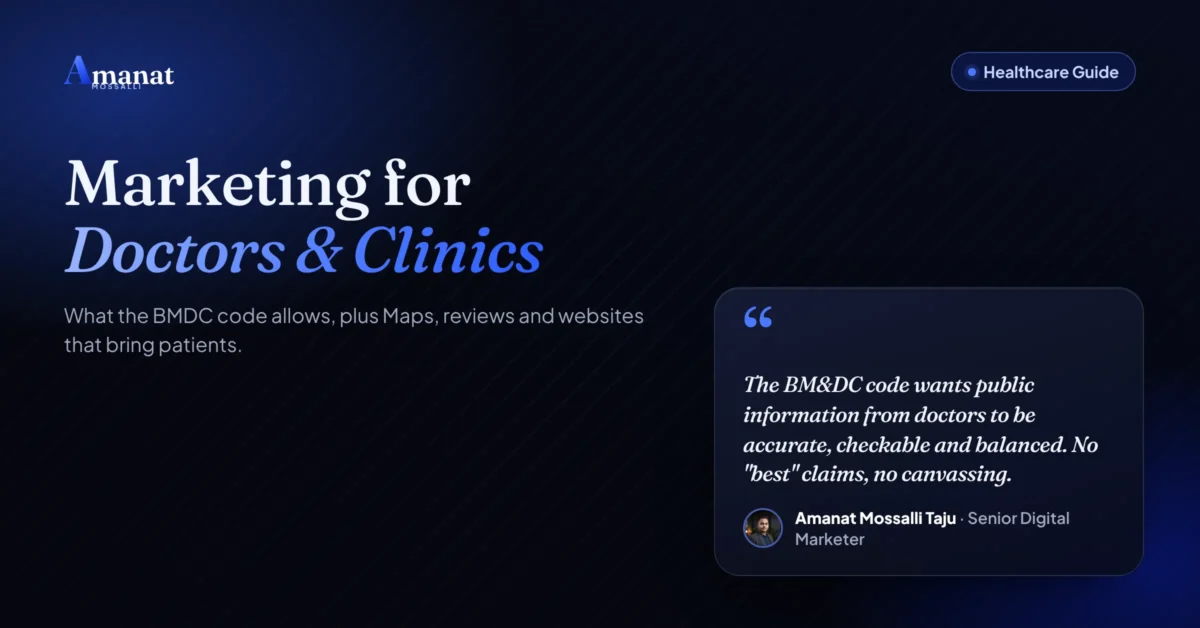
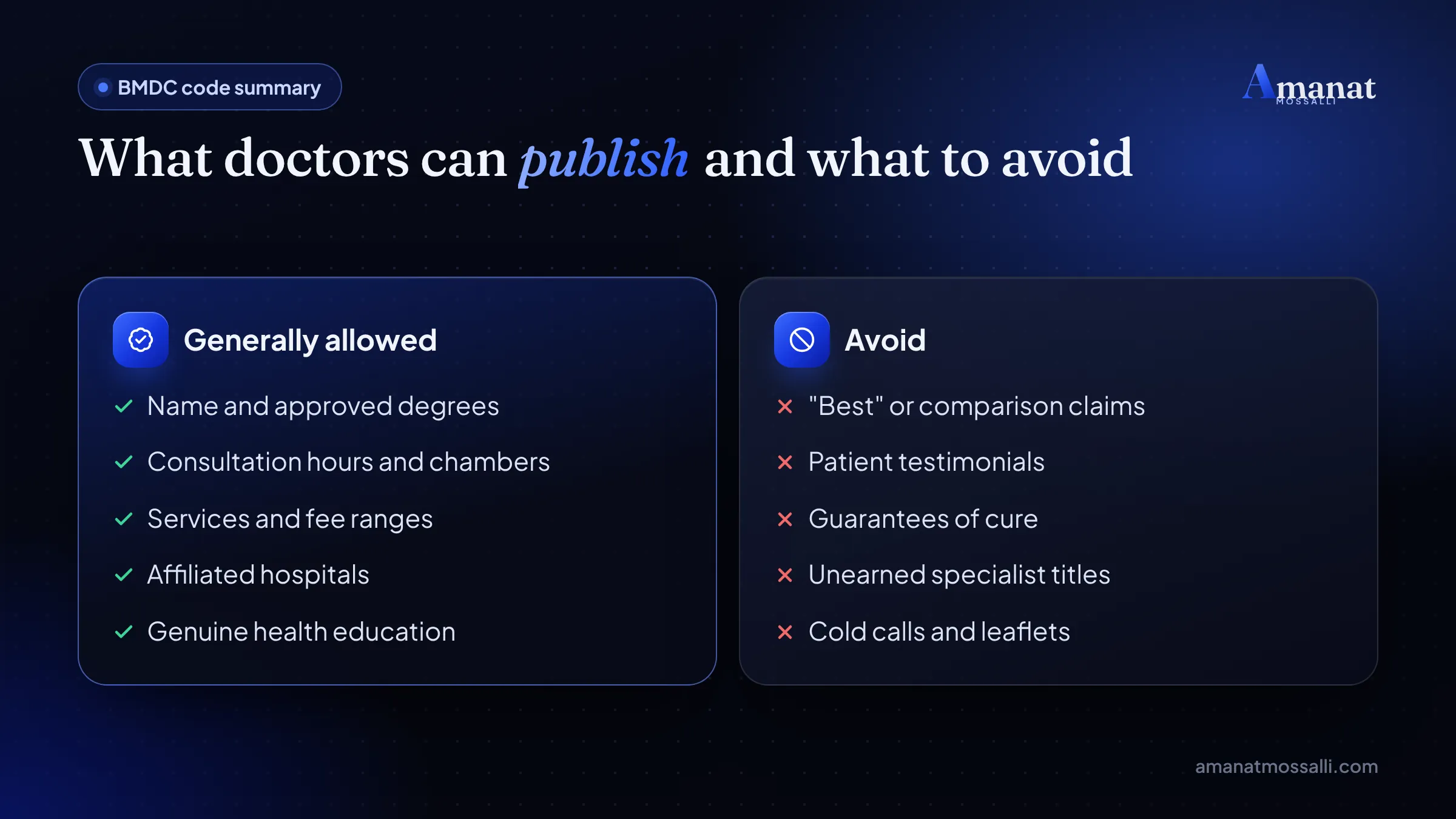
The BM&DC Code of Professional Conduct, Etiquette and Ethics is strict about publicity. Factual service information is fine. Promotion, comparison, testimonials and canvassing are not.
The code is published by the Bangladesh Medical and Dental Council under the BM&DC Act 2010. I re-read the publicity sections on 12 November 2026 for this update. Section numbers below are from the code itself.
- 3.1 Accurate and balanced: anything a doctor tells the public must be accurate and factual. When it discusses a treatment, it must show advantages and disadvantages fairly.
- 3.2 No hype: nothing exaggerated or misleading, and no claims of being better than other doctors. No soliciting patients, no sensational claims, no unrealistic hopes, no running down colleagues.
- 3.3 Promotion is broad: publicity by the doctor or anyone acting for him counts as practice promotion. It counts whether or not the doctor gains.
- 3.4.3 Testimonials: letters of gratitude or appreciation from patients should not be published or made available to the public. Doctors should take practical steps to discourage them.
- 3.4.3 Announcements: a new or changed practice may be announced only in newspapers, within two weeks of the change. The notice may not exceed 12 square inches, and photographs are not allowed. The same announcement by printing, mailing, broadcasting or electronic means is not permitted.
- 3.4.5 Websites: a practice website may carry only the service information permitted in doctors’ directories.
- 3.5.2 No guarantees: no offering guarantees to cure a particular condition.
- 3.5.3 No cold contact: no promoting services through unsolicited visits, calls, faxes, emails or leaflets.
- 3.6 Health education: genuine lectures and publications are welcome. They must not be used to promote a practice or canvass for patients.
- 3.7 Titles: only doctors with a recognised postgraduate degree listed in the BM&DC register may call themselves a specialist. The title covers only that specialty.
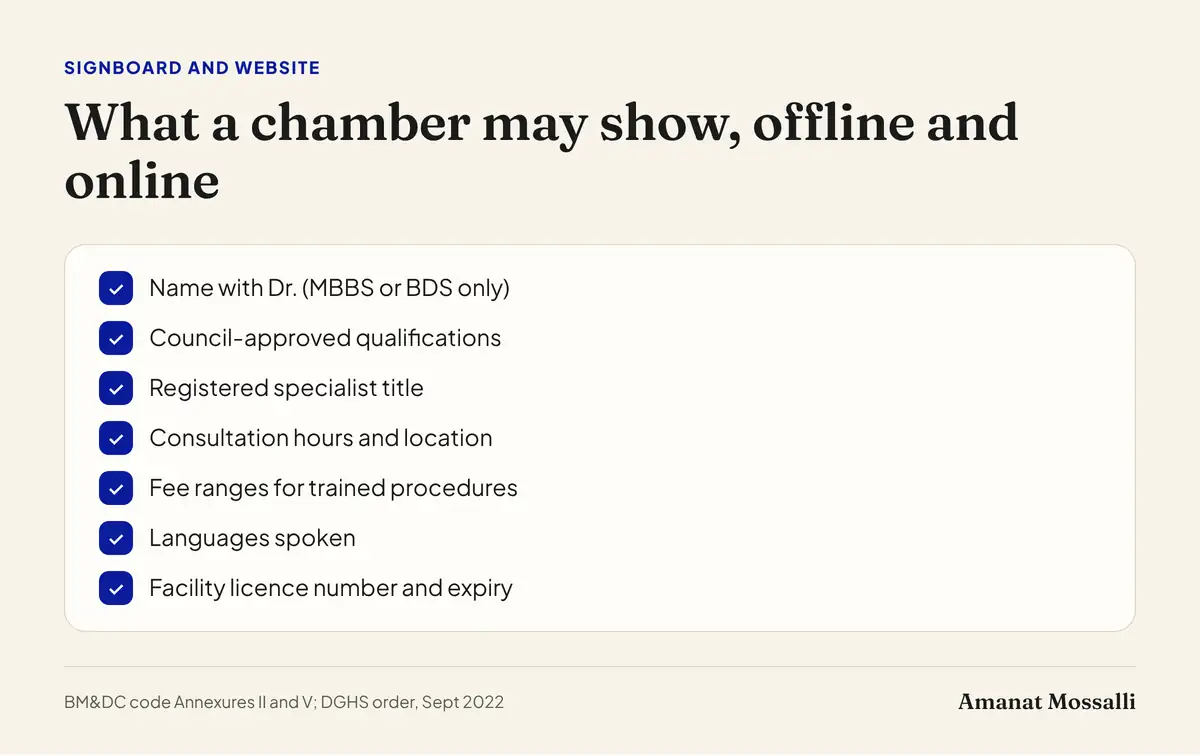
The directory rules in Annexure V spell out what a listing, and so a website, may carry. The office’s district, a passport-type photo, gender and languages spoken. Affiliated hospitals and emergency contact details. Services and fee ranges, but only for procedures the doctor is properly trained in. Printed directories may not make one entry stand out with borders or highlighting. I use that list as the template for every doctor appointment website I touch.
Who can use the title "Dr"?
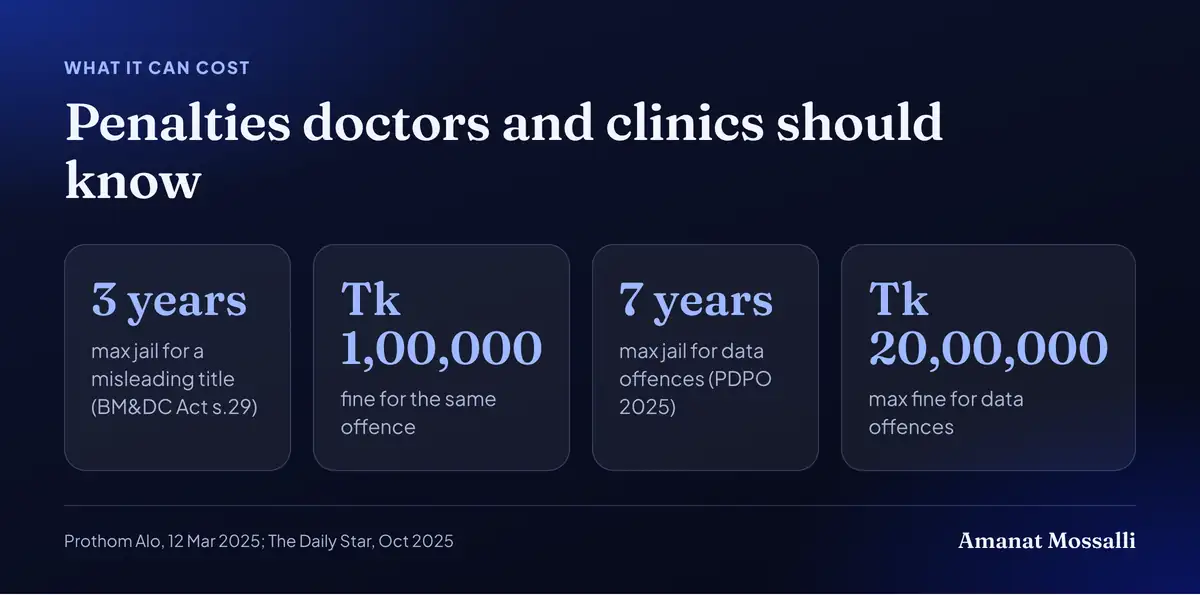
On 12 March 2025, Prothom Alo reported a High Court order on the title. Nobody without an MBBS or BDS degree may use “Doctor” before their name. The report explains section 29 of the BM&DC Act. A violation can mean up to three years in prison, a fine of Tk 1,00,000, or both. If the offence continues, each repeat adds a fine of at least Tk 50,000. Check every title on your signboard, website, Google profile and ads this week.
Read literally, the code is stricter than the way many practices market themselves today. One example: it limits practice announcements to newspapers, yet clinics post “new chamber” notices on Facebook every day. My advice is to build on what the code clearly allows: facts, Maps, education and easy booking. For anything grey, such as a paid ad featuring a named doctor, ask BM&DC or a lawyer first. This article is not legal advice.
Signboards, Licence Numbers and the Offline Half
Your signboard ends up online. Patients photograph it and upload it to Google Maps. So the offline rules shape what people see on your profile, and the two should match.
Annexure II of the code covers signboards. A door sign may be up to 10 square feet. A sign above the first floor may be up to 20 square feet. Blinking lights are banned, and lighting may only make the text readable. The sign may carry the doctor’s name with “Dr.”, approved qualifications and specialist title. It may also show the practice name, consultation hours and where the chamber sits in the building.
DGHS adds a rule for facilities, The Financial Express reported in September 2022. Private hospitals, clinics, diagnostic centres and blood banks must show their licence number and its expiry date on their signboards. A QR code may be added. A separate DGHS notice, reported by The Daily Star, said doctors may practise privately only at registered facilities.
I add the licence number to the clinic’s website footer too. It costs nothing, it matches the signboard, and it answers a question careful patients already ask.
Maps, Reviews, Website: The Three That Carry a Clinic
Three free or cheap assets bring most clinics their steadiest patient flow. A strong Google Business Profile. Honest Google reviews. A factual website. None of them needs hype, and all three sit comfortably inside the code.

Google Business Profile for doctors and clinics
Google’s local ranking help page says ranking depends on relevance, distance and prominence. So use your real clinic name, the most specific category, exact chamber hours and photos of the building entrance. Finding the right floor in a medical complex is a small nightmare. Show the lift, the sign and the reception desk.
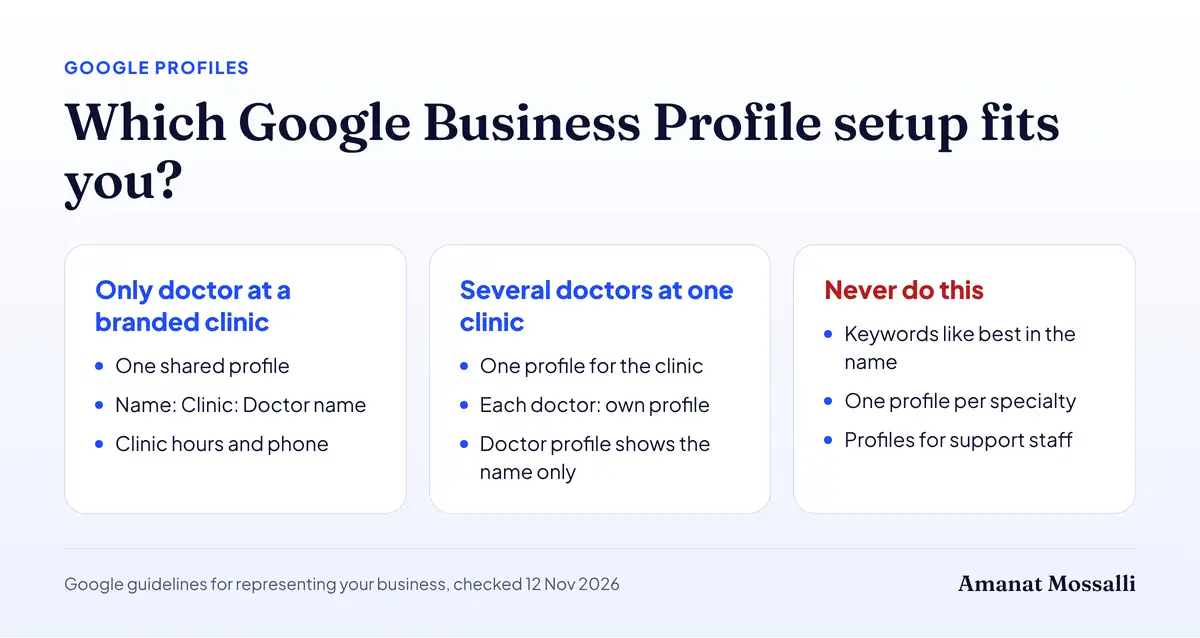
Google’s guidelines for representing your business have a section on practitioners such as doctors. A doctor who sees the public at a verified location during stated hours may have a profile of their own. One doctor shouldn’t create several profiles for several specialties. If you’re the only doctor at a branded clinic, Google prefers one shared profile, named in the form “Clinic: Doctor name”. Where many doctors work at one clinic, the clinic gets its own profile and each doctor’s profile carries only the doctor’s name. Keywords in the name, like “best” or “specialist in [area]”, are not allowed.
An ENT specialist in Netrokona asked me to look at his “Google problem” in January. His profile was named “Best ENT Doctor Netrokona”. The map pin sat on a pharmacy two buildings away. The phone number was his old assistant’s, and that phone went off at 8 pm, right when evening patients called.
We renamed the profile to his real name, as it appears on his signboard. We moved the pin, added the chamber’s own number and photographed the narrow stair beside the sweet shop that leads up to it. None of it took more than an afternoon. Over the next three months, calls from the profile went from about 20 a month to about 55. He told me the bigger change was quieter: fewer patients arriving late and lost.
Clinic Google reviews, done carefully
Google’s contributed content policy is clear. You may not offer payment, discounts or free services for reviews. You may not discourage negative reviews or ask only happy patients. Reviews from people with a conflict of interest, including current or former staff, aren’t allowed. The BM&DC code adds a layer: no pressure on patients, and no publishing their praise yourself. So ask gently, ask everyone, and don’t paste reviews into your ads or website.
When you reply, never confirm that someone is your patient. Never mention a medical detail. Google’s own reply tips say not to share a reviewer’s private information. A safe reply is: “Thank you for your feedback. Please call our front desk on [number] so we can help.”
What Belongs on a Doctor Appointment Website?
Only the facts a patient needs to book, and nothing that reads like an advert. The BM&DC directory list is your checklist, so I built the table below around it.
| Section | Include | Avoid |
|---|---|---|
| Doctor profile | Name, approved degrees, registered specialist title, passport-type photo, languages | “Best”, “top”, “No. 1”, unearned titles |
| Chambers | Each address, hours, days, phone, map, facility licence number | Old chamber details |
| Services | Procedures you are trained in, short plain explanations | Guaranteed results, before-and-after hype |
| Fees | Consultation and procedure fee ranges | Hidden charges |
| Booking | Phone, WhatsApp and a short form | Long forms asking for medical history |
| Education | Articles answering common patient questions | Content that pushes people to book you |

Keep the booking form short: name, phone, preferred date, chamber. Don’t ask for symptoms in a web form. The data law in the tracking section below is one reason; a phone call handles the rest anyway. If you need a fast, plain site, my WordPress development service builds exactly this kind.
Can Healthcare SEO Work Without Breaking the Code?
Yes, because healthcare SEO is mostly honest patient education, and the code allows that. The line it draws is clear: educate, but don’t use the article to canvass patients.
Google draws a similar line from the other side. Its guide to creating helpful, reliable content covers topics that could affect people’s health. For those, it says, its systems give more weight to experience, expertise, authority and trust. Trust counts most. The same guide asks whether a page makes clear who wrote it and what their background is. A named, registered doctor as reviewer answers that question.
A paediatrician with a chamber in Jessore showed me his laptop between patients one evening in February. His homepage said “Jessore’s Most Trusted Child Specialist”. Below it sat a gallery of thank-you messages from parents, screenshotted from WhatsApp. He was proud of them, and the parents meant every word.
I asked what parents type into Google before they find him. He didn’t know. We opened Search Console together. The top queries were Bangla questions about fever in babies, a child who won’t eat, and how often to use a nebuliser. His site answered none of them. That week the banner and the screenshots came down. He began writing one plain answer page a month in Bangla, and he checked every line himself.
Nothing dramatic happened in the first months. By the eighth month, more parents mentioned the website when they called. It went from about 3 calls a month to about 14. The pages break no rule, and they’ll keep working for years.
Write what patients actually search, in English and Bangla. “When to see a doctor for fever in children”. “ডায়াবেটিস হলে কী খাবেন”. “Tonsil surgery recovery time”. Give benefits and risks in balance, as section 3.1 asks. Let the doctor sign off every article before it goes live.
This is where digital marketing for doctors in Bangladesh pays off over time. One clear article on a common question can bring patients for years. An ad stops the day you stop paying. The article also shows patients how you explain things before they ever sit across your desk.
- One topic per page, with the answer in the first two lines.
- A named medical reviewer with registered qualifications and a short bio.
- No “book now with the best doctor” lines inside education articles. A plain contact link in the footer is enough.
- Update old pages when guidelines change, and show the date.
- A local page for each chamber with its own address and hours.
Pages like these also get picked up by AI answers. Google AI Overviews and ChatGPT lean on clear, well-sourced, factual pages. The basics are in my guide to SEO for Bangladeshi businesses.
Are Facebook Ads for Clinics Worth the Risk?
Sometimes. Two rulebooks apply at once: Meta’s ad policies and the BM&DC code. So the only ads I’m comfortable with are factual ones about a clinic’s services. Not a named doctor’s brilliance.
Meta’s privacy violations and personal attributes policy bans ads that assert or imply a person’s health condition. A line like “Do you have diabetes?” talks to the viewer about their body, so it fails. “Our clinic offers diabetes check-ups” talks about the service. Write about the service, never about the viewer.
| Rejected style | Safer style |
|---|---|
| “Is your child’s fever not going down? Come to us!” | “Paediatric consultation in Jessore. Sat to Thu, 5 pm to 9 pm.” |
| “Dhaka’s best heart specialist” | “Cardiology clinic at [hospital], consultation hours and fees on our website.” |
| “Guaranteed cure for your sinus problem” | “ENT outpatient service, fee ranges listed on our website.” |
| Patient testimonial video | Short video explaining what happens during a check-up |
Keep targeting broad and location-based. Don’t try to reach people by health condition. And remember section 3.3: publicity done on a doctor’s behalf is still practice promotion. A clinic ad that spotlights one doctor falls under the code. When in doubt, ask BM&DC before you spend.
FAQ: Digital Marketing for Doctors in Bangladesh
Can doctors advertise in Bangladesh?
Is a Google Business Profile allowed for doctors?
Can a clinic post patient reviews on its website?
Are Facebook ads allowed for clinics?
Who can use the title "Dr" in Bangladesh?
What is the best online channel for a new chamber?
How long does healthcare SEO take?
Dental Clinics and Diagnostic Centres Play a Different Game
Both are local and both get compared on price. So Maps, clear information and plain education matter even more than for a solo chamber. Patients pick on location, hours, price clarity and trust, in roughly that order. Hospitals and multi-doctor clinics have a third problem: many names under one roof.
Dental clinic marketing
Give each treatment its own page, with a plain explanation and a fee range. Put photos of the chair, the equipment and the sterilisation area on the site. Answer the questions patients are nervous about, such as whether scaling hurts, honestly. Skip the smile-makeover hype and any before-and-after gallery that promises results.
Diagnostic center marketing
People choosing a diagnostic centre want test availability, preparation steps, report times, home sample collection and prices. Give each common test its own page with preparation instructions in Bangla and English. Show opening hours per branch on Google Maps. If you offer online report download, make the link impossible to miss.
Hospitals and multi-doctor clinics
Follow Google’s practitioner rule here. The hospital or clinic gets one profile per location. Each consultant who sees patients there during set hours can have a profile with only their own name. Keep a single page per doctor on the website too, with chamber days at each branch. When a doctor leaves, update both on the same day.
How Do You Track Appointments Without Touching Patient Data?
Track the source and the count, nothing else. Where a booking came from is enough to make good marketing decisions. What is wrong with the patient is none of your ad tool’s business.
Keep health information out of pixels and analytics. Don’t put symptoms or test names into page URLs that tracking tools record (this one gets missed a lot). My tracking and analytics setup keeps the numbers useful without collecting more than you need.
The data law that now covers your booking form
Bangladesh now has a Personal Data Protection Ordinance. The government issued its gazette in November 2025, Prothom Alo reported. The Daily Star’s summary lists health information as sensitive personal data. Handling it needs explicit, informed consent and stronger security. Offences can bring up to seven years in prison, a fine of up to Tk 20,00,000, or both. Some sections take effect 18 months after the gazette, so the time to tidy up is now.
For a clinic website that means three things. Don’t collect symptoms online unless you truly need them. If you do, say why in plain words next to the form and get a clear yes. And never let a marketing tool see what a patient wrote.
Mistakes I See in Clinic Marketing Every Month
Almost all of them come from copying retail marketing. In healthcare they cost trust, and several break the code outright.
- “Best doctor” or “No. 1 hospital” claims. The code bans superiority and comparison claims.
- Posting patient thank-you letters or videos. The code says testimonials should not be made public.
- Promising cures or showing only perfect results.
- Using a specialist title you are not registered for.
- Cold calling or leaflet drops to promote a practice.
- Ads that name the viewer’s condition, which Meta rejects anyway.
- Replying to reviews with medical details or confirming someone is your patient.
- Fake reviews from staff or relatives, which Google bans as a conflict of interest.
- Keywords in the Google profile name, like the ENT chamber above had.
A healthcare brand takes years to build and one bad post to dent. My guide on brand building in Bangladesh covers the slow, steady version.
If You Only Do One Thing This Month
Fix your Google Business Profile for every chamber. Your real name, the right pin, a number someone answers after 8 pm, a photo of the entrance. It’s free, it sits inside the code, and it’s how the Netrokona chamber nearly tripled its calls without a single ad.
- 1Read the publicity sections of the BM&DC code once, start to finish.
- 2Fix your Google Business Profile for every chamber this week.
- 3Strip “best” claims and testimonials from your website and pages.
- 4Add your facility licence number to the website footer.
- 5Publish one doctor-reviewed patient guide each month.
For the wider picture, see how local SEO works for any local practice.

Amanat Mossalli Taju
Senior Digital Marketer & SEO Expert, Dhaka, BangladeshI have grown 235+ brands over more than seven years with SEO, Google and Meta Ads, server-side tracking, WordPress and AI automation. Half of my clients are in the UK, USA, Australia and Canada. Everything I write here comes from real client work.
Want this done for your business?
Book a free 15-minute call. I look at your site and ads before we talk, so you leave with clear next steps.