Restaurant Marketing in Bangladesh: Google Maps, foodpanda and Facebook Playbook for 2026
A 90-day plan for restaurants and cafes in Bangladesh. Get found on Google Maps, list on delivery apps without losing your margin, and run food ads that bring real diners.
You’ve probably boosted a post this month. Tk 500, maybe Tk 1,000, on a photo of your best dish. A few hundred likes came back, mostly from people in districts you will never deliver to.
Restaurant marketing in Bangladesh goes wrong at exactly that point. The likes feel like progress. The empty tables on a Tuesday say otherwise.
I saw it clearly with a client last year. A husband and wife had opened a 24-seat Bengali restaurant in Shantinagar. She messaged me on a Sunday night with a screenshot: 1,400 likes, 60 shares, and a comment from Patuakhali asking if they delivered there. Lunch that day had served nine people. They had never opened Google Maps.
I’m Amanat Mossalli Taju. I’ve worked with 235+ brands, and food is the most local category of all of them. Likes in Patuakhali don’t pay rent in Shantinagar. So we spent the first week on Maps and a review card. Only then did we run ads, and only to people a short rickshaw ride away.
This guide is that order of work, written out. Maps first, then delivery apps without giving away your margin, then food photos and local ads, then a 90-day plan with a sample budget. Most of it needs a phone and a free afternoon, not an agency.
Three channels, three jobs
Strong local search, a sensible delivery app setup and steady social content. That’s the whole list. Most restaurants only do the third, then wonder why the dining room is quiet on weekdays.
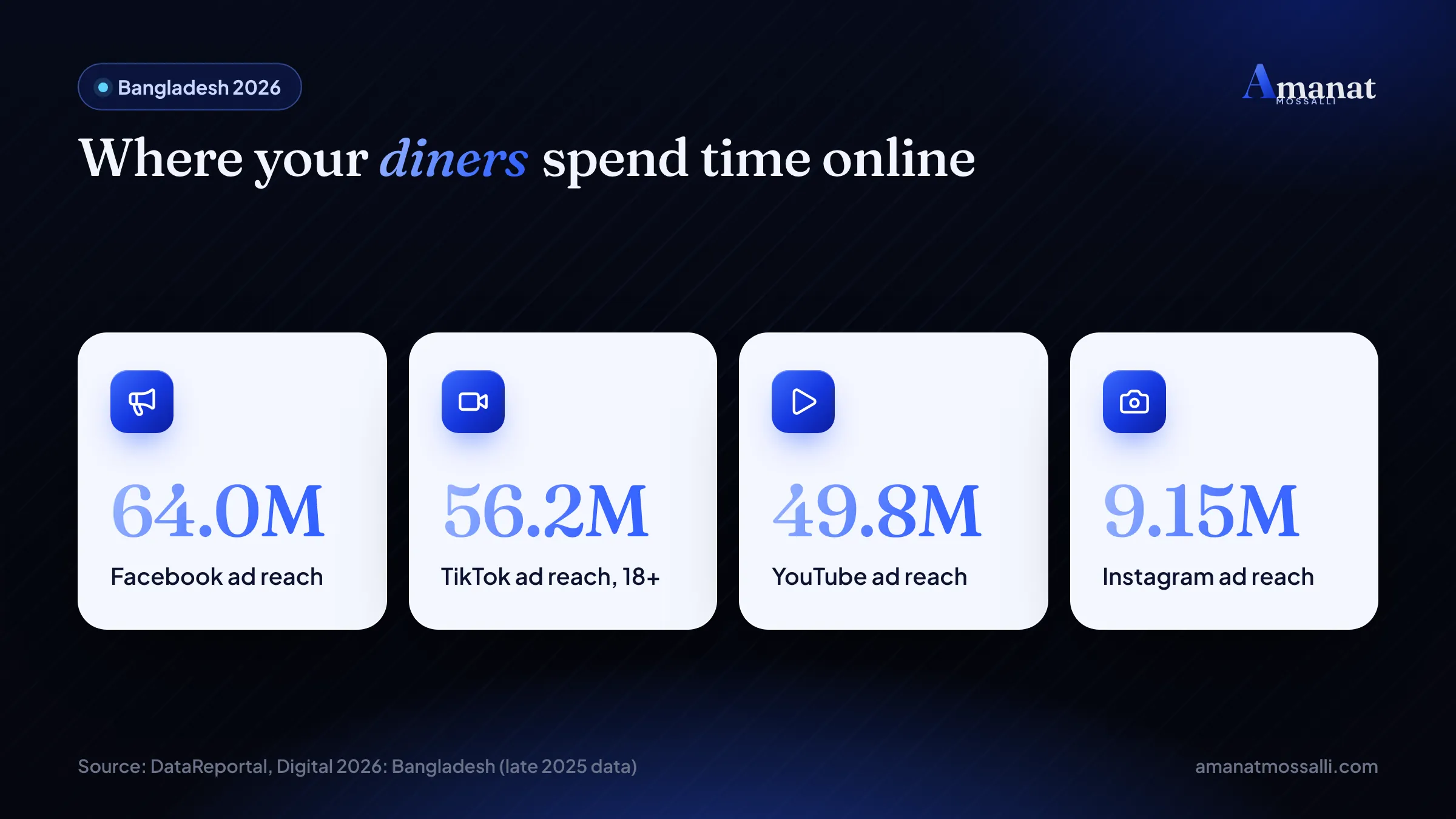
Your diners are online, mostly on social apps. DataReportal’s Digital 2026 Bangladesh report counts 82.8 million internet users, 47.0% of the population, in late 2025. Facebook’s ad reach was 64.0 million. TikTok reached 56.2 million adults and YouTube 49.8 million. Instagram was far smaller at 9.15 million, but that group is young, urban and hungry for photos.
Give each channel one job, and don’t ask one of them to do all four.
Is Google Maps really the cheapest table-filler?
Yes, and it isn’t close. People who find you on Maps are usually hungry and already nearby. Every restaurant plan I write starts here, before a single ad.
Google says local results depend on relevance, distance and prominence. Its local ranking help page adds that more reviews and positive ratings can help. It also says plainly that there’s no way to pay for a better local ranking. For a restaurant that means correct details, honest photos and a steady flow of real reviews.
Google’s posts help page says offers get a View offer button automatically. Posts older than six months get archived unless you set a date range. A weekly lunch-deal post keeps your profile looking alive for someone deciding where to eat at 12:40.
One detail from the same page catches restaurants out. A post with a phone number in the text may be rejected if Google can’t link that number to your business. Put the booking number in the profile itself, not in the post.
Many places in Gulshan, Banani and Dhanmondi sit on the fourth or ninth floor of a food tower. Photograph the building, the lift and the stairs. Diners give up when they can’t find the entrance, and some leave a two-star review about it.
The Shantinagar couple’s profile took one afternoon. Correct category, real hours, twenty photos shot at lunch, and the menu with prices. Within the first month, Google showed direction requests in their profile for the first time. It was a small number, but every one was a person on the way.
The full setup is in my guide to Google Business Profile in Bangladesh. The wider picture is in local SEO for Bangladeshi businesses.
How do you get more Google reviews without breaking the rules?
Ask every table, every day, with a QR card in the bill folder. Never trade a free dessert for a review. Google bans it, and it can restrict your profile.
The review policy bans discounts or free goods for posting, changing or removing reviews. It also bans asking only your happy guests. So the safest system is boring on purpose: everyone gets the same polite request.
Restaurants should know one newer rule too. In April 2026 Google added two lines to its review policy, reported by Search Engine Roundtable on 17 April. Owners must not ask staff to collect a certain number of reviews. They must not ask staff to collect reviews with specific content, including a staff member’s name. So no waiter quotas, and no “please mention Sohel” on the card.
- QR card in the bill folder: “Tell us how we did. Scan to review on Google.”
- Delivery bags: a small sticker with the QR code for direct orders.
- WhatsApp after a booking: a thank-you message with your review link the same evening.
- Reply to every review within a day or two, especially complaints about wait times or taste.
Bad food reviews nearly always mention one of three things: slow service, cold food or a rude waiter. Fix the real cause first. Then reply politely and invite the guest back. Future diners read your replies as closely as the reviews themselves.
Should you list your restaurant on foodpanda?
For most restaurants, yes, as long as every app order still makes money. The apps bring reach you can’t build alone. They also take a slice of each order, and that slice is where many owners lose the plot.
How a foodpanda restaurant listing works
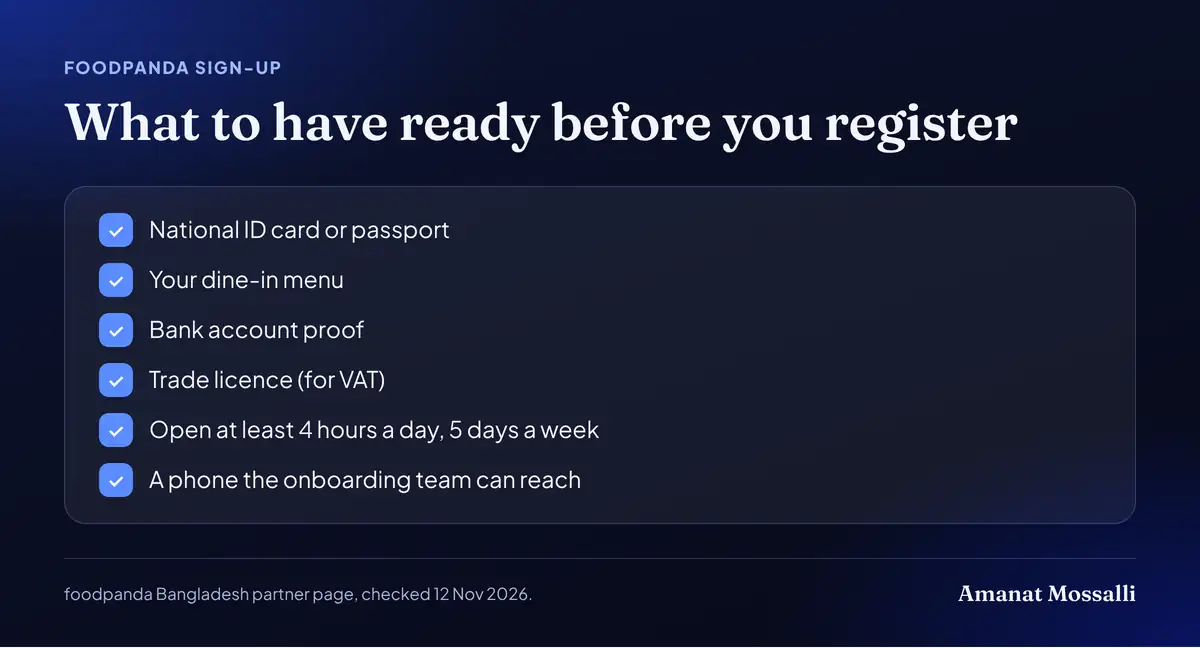
You register through foodpanda’s partner sign-up page. When I checked it on 12 November 2026, it listed the basics. Your shop must be inside its operating area and open at least 4 hours a day, 5 days a week. You need a fixed location, though home chefs and cloud kitchens can join without a storefront.
Have four documents ready: your National ID or passport, your dine-in menu, bank account proof and a trade licence for VAT. foodpanda says approval typically takes 2 to 5 working days, and someone may call you, so keep your phone close.
On commission, the page says foodpanda offers several packages that may change over time. You see your exact rate during registration. Its partner FAQ from February 2025 says the same thing: a percentage of each order that varies by location and cuisine.
What commission should you expect?
There’s no public rate card, so get your rate in writing. The public reference points are old. A TBS feature from December 2021 quoted foodpanda’s then managing director using a 25% example. It said aggregators need roughly 25 to 35% to survive.
A TBS opinion piece from October 2023 said commissions sometimes reach 35% to 40% per order. It quoted the restaurant owners’ association with one case: Tk 300,000 in app sales left about Tk 90,000 in commission. That is 30%. Treat all of these as rough markers from three to five years ago, nothing more.
| Example order | At 25% commission | At 35% commission |
|---|---|---|
| Menu price Tk 500 | Tk 125 to the app | Tk 175 to the app |
| You receive | Tk 375 | Tk 325 |
| Food and packaging cost Tk 250 | Tk 125 left | Tk 75 left |
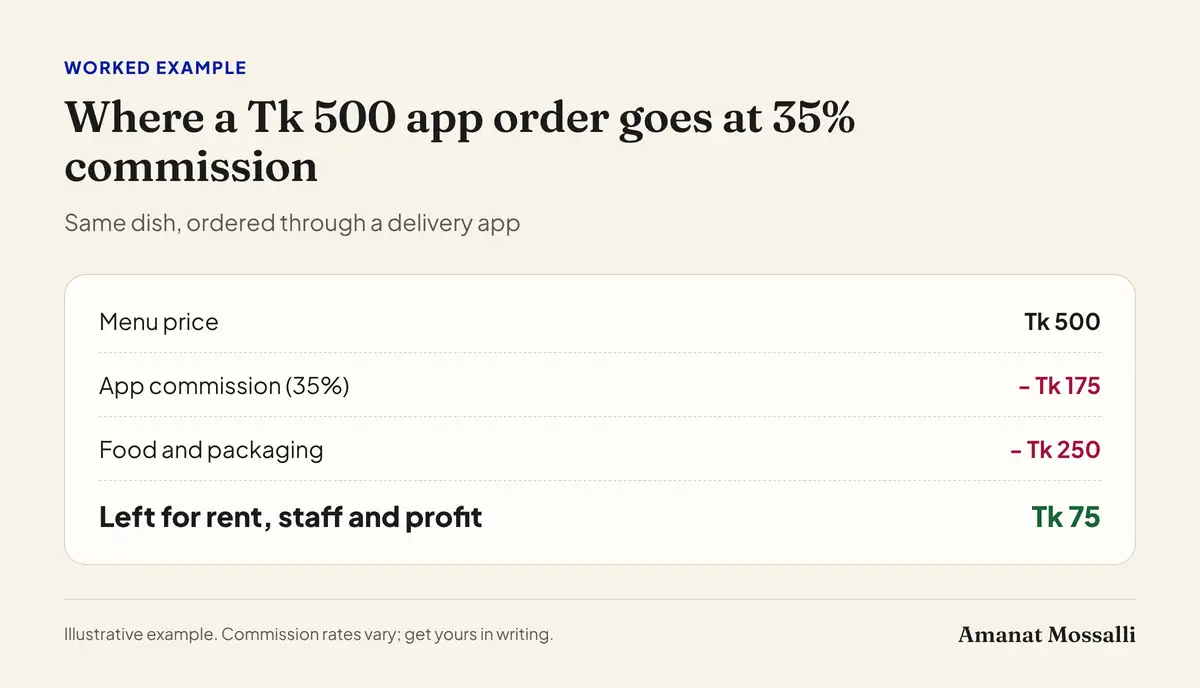
That is a worked example, not a real rate. The lesson is simple. Check your margin per dish before you list anything. Then decide which dishes belong on the app at all.
In February a kacchi house near Lalbagh Fort asked me why its busiest month felt so poor. App orders were up. The bank balance wasn’t. The owner’s son had the partner app open on his phone, and we went through it line by line.
Their half-plate kacchi was the most-ordered item and the thinnest margin after commission. We made three changes. The app menu got its own prices, a little higher than the dine-in menu. The half-plate came off the app. And every delivery bag got a card with their WhatsApp number and a direct-order deal.
App orders dipped slightly for a few weeks, then settled. Direct WhatsApp orders went from roughly one in ten deliveries to about one in four by May. Nobody got rich. But the busiest month stopped being the most stressful one.

Food photos that make people hungry
Real dishes, daylight, close up, one hero item. A modern phone is enough. Food photos for Facebook are about appetite, not perfection. I’d rather see a slightly messy plate of real kacchi than a glossy render.
- 1Shoot near a window between late morning and mid afternoon. Switch off the yellow ceiling lights.
- 2Get close. Fill the frame with the dish, not the table.
- 3Show texture: cheese pull, steam off the biryani, sauce being poured.
- 4Add hands. A hand tearing naan or lifting a burger feels real.
- 5Shoot 10 to 15 second vertical videos for Reels and TikTok.
- 6Clean plates, simple backgrounds. One prop is plenty.
- 7Keep the same style for every dish so your page looks like one restaurant.
Skip heavy filters and stock photos. When the dish arrives looking different from the photo, the review writes itself. The photo is a promise.
How should a restaurant run Facebook ads?
Target people near you, show one dish with one clear offer, and ask for one simple action: message you or get directions. Facebook ads for restaurants die when they try to show the whole menu in one image.
Who to target
Draw a circle around the restaurant. For a cafe in Dhanmondi that might be Dhanmondi, Lalmatia and the streets around them, not the whole city. For delivery, match the area your riders or the app actually cover. Let Meta find the right people inside that circle instead of stacking ten interests.
The Shantinagar couple’s first local-only ad reached a fraction of the people the boost had. But the Messenger enquiries came from Malibagh, Kakrail and Shantinagar itself, people who could walk over. Reach was never the problem. Distance was.
Ad creatives that work for food
What objective to choose
Messages campaigns to Messenger or WhatsApp work well for bookings and party orders. People ask questions before they commit. For a new opening, start with reach or video views in a small area. For delivery, send people to your app listing or your own order page.
Promotion ideas tied to real Bangladeshi moments
Follow the calendar people already live by: lunch breaks, iftar, Eid, birthdays and exam results. You don’t need to invent an occasion. You need to show up for the ones that exist.
- Weekday lunch combo for offices in Motijheel, Gulshan or Agrabad.
- Iftar boxes in Ramadan, with pre-orders on WhatsApp.
- Eid family platters booked a week ahead.
- Birthday packages with a cake and a reserved table.
- Student deals near universities on weekday afternoons.
- Live music or cricket screening nights to fill slow evenings.
- Local food creators visiting on a quiet day, with honest content and clear disclosure.
Food creators can bring a rush of new faces. My guide on influencer marketing in Bangladesh explains how to pick ones whose followers actually live near you. For pre-orders, set up quick replies and a catalogue first; my WhatsApp Business guide shows how.
What’s different about cafe marketing in Dhaka?
A cafe sells a place to sit as much as it sells coffee. Cafe marketing in Dhaka lives on Instagram, Google Maps and word of mouth among students and young office workers.
- Show the space: seating, lights, Wi-Fi and power sockets. Many people pick a cafe to work or study.
- Fill the Google Maps attributes like Wi-Fi and seating options where they’re offered.
- Post the menu with prices, and say whether VAT is included.
- Create one signature drink that photographs well and becomes your name.
- Run small Instagram ads to people within walking distance.
Say plainly whether prices include VAT. The Dhaka Tribune reported in June 2026 that dine-in restaurants pay 5% VAT and catering 15%. The Daily Observer noted in May 2026 that dine-in VAT came down from 15% to 5% after talks with the NBR. A surprise line on the bill is still one of the most common reasons for an angry review.
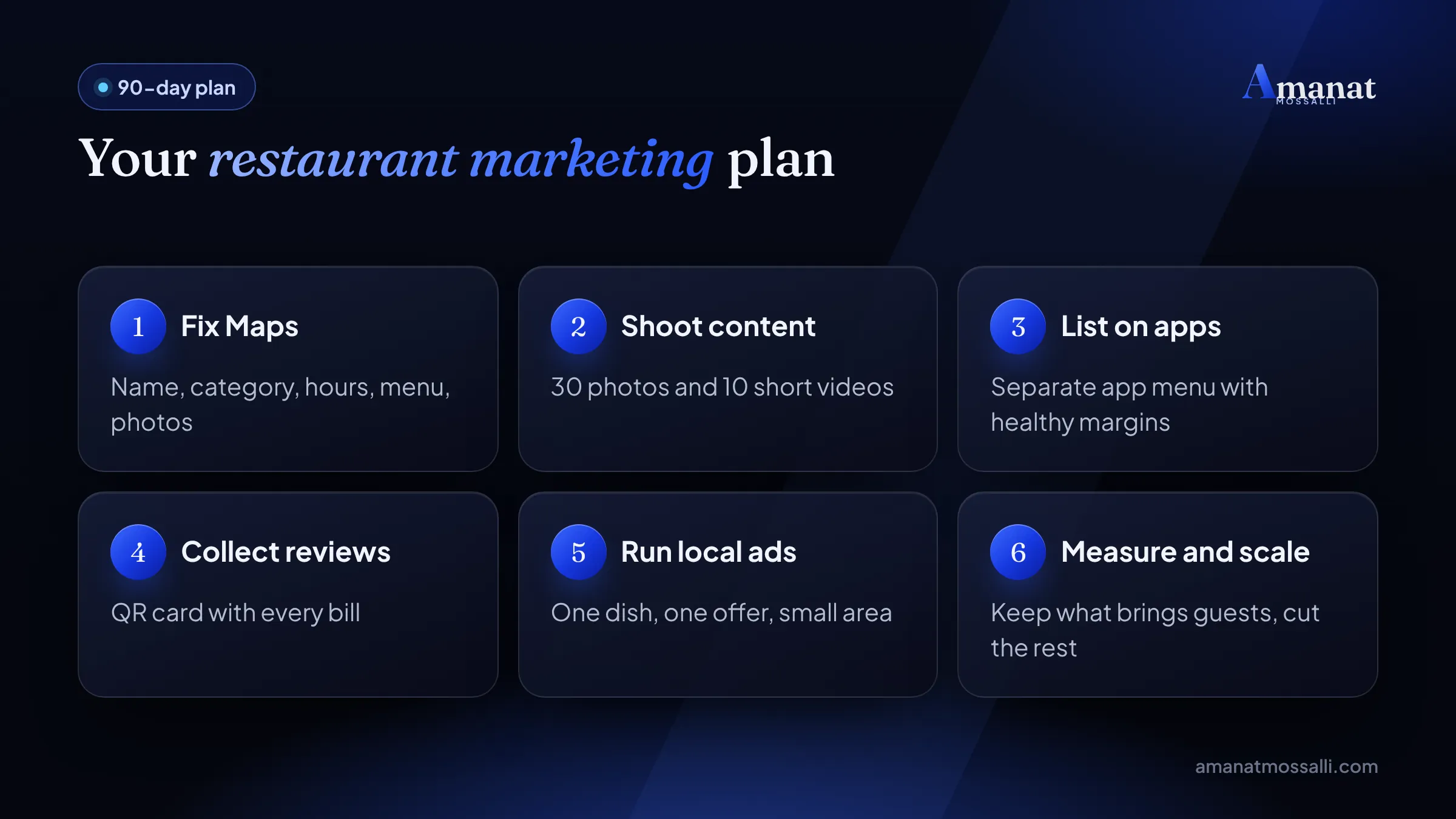
A 90-day plan for restaurant marketing in Bangladesh, with budget
Month one is foundations. Month two is growth. Month three is doubling down on whatever worked. Here’s a sample plan for a small restaurant or cafe.
| Month | Focus | Key tasks | Example ad budget |
|---|---|---|---|
| Month 1 | Foundations | Fix Google profile, shoot 30 photos and 10 videos, list on a delivery app, print review QR cards | Tk 10,000 to 15,000 for local reach and video views |
| Month 2 | Growth | Weekly Maps posts, 3 Reels a week, message ads for bookings, first food creator visit | Tk 15,000 to 25,000, mostly message ads |
| Month 3 | Double down | Keep the best ad, cut the rest, launch a direct WhatsApp order offer, review all numbers | Tk 20,000 to 30,000 on proven ads |
These budgets are examples for a small place, not a quote. An 80-seat restaurant in Gulshan needs more. A quiet-street cafe can start with less. Start small, find the one ad that brings real guests, then put next month’s money on that one.
Where restaurant ad money leaks
Most of the money goes on reach, while the basics that turn interest into a visit sit untouched. The Shantinagar couple had made four of these mistakes before we met. Honestly, so had I with my first food client years ago.
- Posting designed posters instead of real food. People eat with their eyes.
- Wrong hours on Google during Ramadan and Eid.
- Listing on apps without checking margins, so the busiest months still lose money.
- Free food for reviews. Google bans incentives and can restrict your profile.
- Boosting posts to the whole country when only nearby people can visit.
- Leaving messages unanswered for hours. The family books somewhere else.
- No way to track which channel brought the guest.
For more on choosing channels, read my guide to social media marketing for Bangladeshi businesses.
Which channel actually filled the tables?
Give each channel its own code, number or question. Without that, every busy night looks like luck and every slow night looks like bad weather.
This is the part owners skip most. It takes ten minutes a week, and it tells you where next month’s money should go.
- Google Maps: check calls, direction requests and website clicks in your profile each month.
- Facebook and Instagram: a separate offer code, such as “FB20”, on every ad offer.
- Delivery apps: orders, average order value and commission paid, month by month.
- Direct WhatsApp orders: a simple sheet with date, area and order value.
- Ask at the table: “How did you hear about us?” Train staff to write the answer down.
Want calls, messages and website orders tracked properly? My tracking and analytics service sets it up so you can see the cost of each booking.
Quick recap
- Hungry people search Google Maps first. Fix your profile before you spend a taka on ads.
- Delivery apps bring reach and take a cut. Price the app menu so every order still pays you.
- Bright, real food photos and ten-second videos beat designed posters every time.
- Run Facebook and Instagram ads only to people who can reach you, with one dish and one offer.
- Give each channel its own code or question, so you know what filled the tables.
FAQ: Restaurant Marketing in Bangladesh
How do I promote my new restaurant in Dhaka?
How much commission does foodpanda take in Bangladesh?
How much should a restaurant spend on Facebook ads?
Do Google reviews matter for restaurants?
What kind of food content works best on Facebook?
Is a website necessary for a restaurant?
How do I market a cafe to students?
Tuesday lunch, six months later
Good restaurant marketing in Bangladesh isn’t about going viral. It’s about being easy to find on Maps, easy to order from on apps and WhatsApp, and tempting on Facebook once a week.
The Shantinagar couple still run one local ad, rotated each month with a new dish. They stopped boosting to the whole country. Weekday lunch now runs at roughly 25 to 30 covers instead of nine. It isn’t a queue down the street. It is enough to pay the cook on time, and that was the goal.
If you do one thing this week, open your Google profile and check your hours. Then walk outside and photograph your own entrance from the road, the way a hungry stranger would see it.
Amanat Mossalli Taju
Senior Digital Marketer & SEO Expert, Dhaka, BangladeshI have grown 235+ brands over more than seven years with SEO, Google and Meta Ads, server-side tracking, WordPress and AI automation. Half of my clients are in the UK, USA, Australia and Canada. Everything I write here comes from real client work.
Want this done for your business?
Book a free 15-minute call. I look at your site and ads before we talk, so you leave with clear next steps.