Digital Marketing Strategy for Small Business: One Plan for SEO, Google Ads and Meta Ads
One plan instead of three separate channels: how SEO, Google Ads, Meta, email and tracking feed each other, with a 90-day roadmap and sample budgets.

“Bhai, I have Tk 40,000 a month. SEO, Google Ads or Facebook?” A caterer in Kushtia sent me that on WhatsApp one Friday, with a photo of a wedding buffet attached. I get some version of the question every week.
My answer surprised him. Pick a system, not a channel.
A digital marketing strategy for small business works when each channel has one job and hands people to the next. Search catches people who already want you. Meta finds people who don’t know you yet. Retargeting, email and WhatsApp bring both groups back until they buy.
Below is that system in plain steps. You’ll see how the channels feed each other and what to track. There are budget splits in BDT and USD and a 90-day roadmap. I’ll tell you what happened to the caterer at the end.
Key takeaways
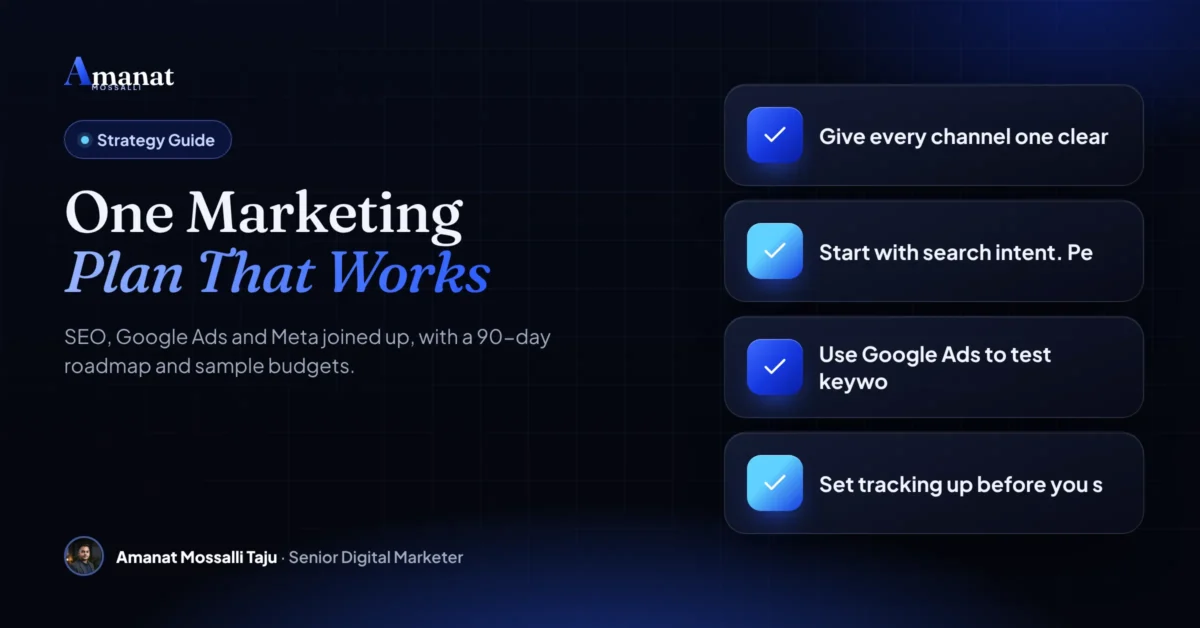
- Give every channel one clear job, and connect them with retargeting and follow-up.
- Start with search intent. People who search are closer to buying than people who scroll.
- Use Google Ads to test keywords fast, then build SEO pages for the winners.
- Set tracking up before you spend, or you can’t tell which channel works.
- Run the plan for 90 days, then move money toward what brought customers.
What Does a Digital Marketing Strategy for Small Business Need?
Five parts, and they must connect. Search catches demand and social creates it. Content answers questions. Follow-up brings people back, and tracking tells you what’s working.
People call this an integrated marketing strategy. The name doesn’t matter much. What matters is that no channel works alone.
One of my 20+ certificates is Digital Marketing Strategy from Harvard Business School Online. The framework there is sound. But the ad accounts taught me more than the course did, and this article leans on the accounts.
Why Do Channels Work Better Together?
Because each one is weak alone. SEO is slow. Google Ads gets costly when every click comes cold. Meta ads reach many people who aren’t ready yet.
Joined up, they cover each other’s gaps. Here’s how the hand-offs work in practice.
| Channel | Its one job | What it hands to the next channel |
|---|---|---|
| Google Ads | Catch buyers searching today | Keyword data for SEO, visitors for retargeting |
| SEO | Win the same searches for free, over time | Steady visitors and trust for the brand |
| Meta ads | Reach people who haven’t searched yet | Video viewers and visitors for retargeting |
| Retargeting | Bring back people who looked but didn’t buy | Leads and sales the first visit missed |
| Email and WhatsApp | Turn buyers into repeat buyers | Reviews, referrals and repeat orders |
| Tracking | Show which hand-off produced the sale | Facts for the next budget decision |
Read the last column again. That’s the whole idea of full funnel marketing. Every channel feeds another one, so no visit is wasted.
Start With Search Intent, Not With a Platform
Most owners start with the platform they use themselves, usually Facebook. I start with what buyers type.
Search shows intent. Someone typing “wedding catering Kushtia” wants a quote this month. Someone scrolling past a biryani video might want one next year, or never.
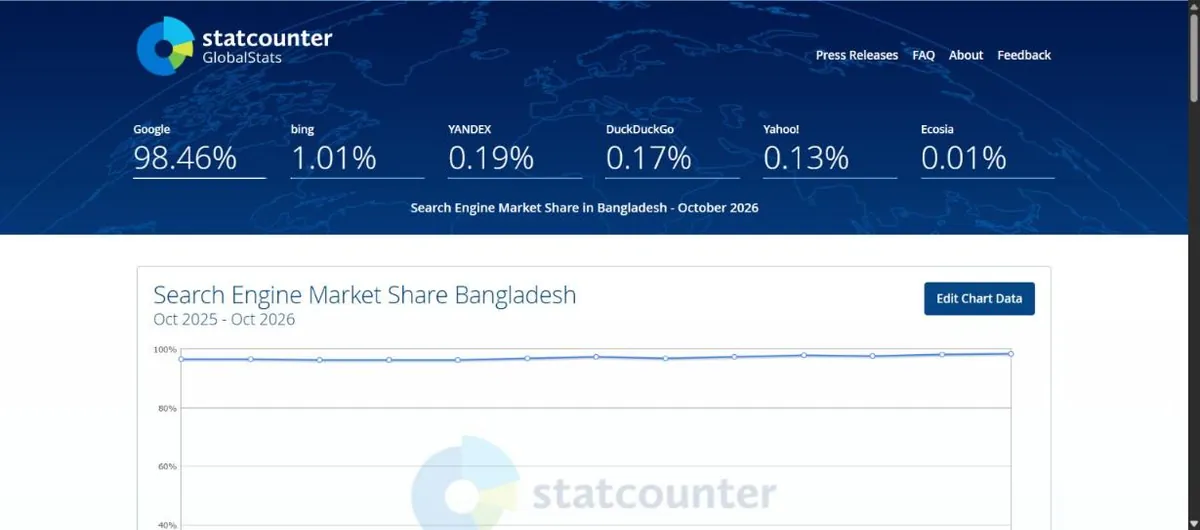
In Bangladesh, search means Google. StatCounter gave Google 98.46% of search in Bangladesh for October 2026, with Bing second at 1.01% (checked 12 November 2026). So your keyword plan is really a Google plan.
Build a short buying-keyword list first
- 1Write down what you sell, in the words your buyers use, in English, Bangla and Banglish.
- 2Add the place: your city, your area, or “near me”.
- 3Add buying words: price, cost, order, best, delivery, booking.
- 4Check each phrase in Google Keyword Planner for rough search volume.
- 5Keep the 20 to 30 phrases that a buyer, not a student, would type.
That list becomes the backbone of your small business marketing plan. Google Ads bids on it. SEO pages target it. Even your Meta ad copy borrows its words.
A caution on volumes. Keyword tools are rough for Bangla and Banglish phrases. If a phrase shows “0” but your customers say it in your inbox every week, keep it.
How Do SEO and Google Ads Work Together?
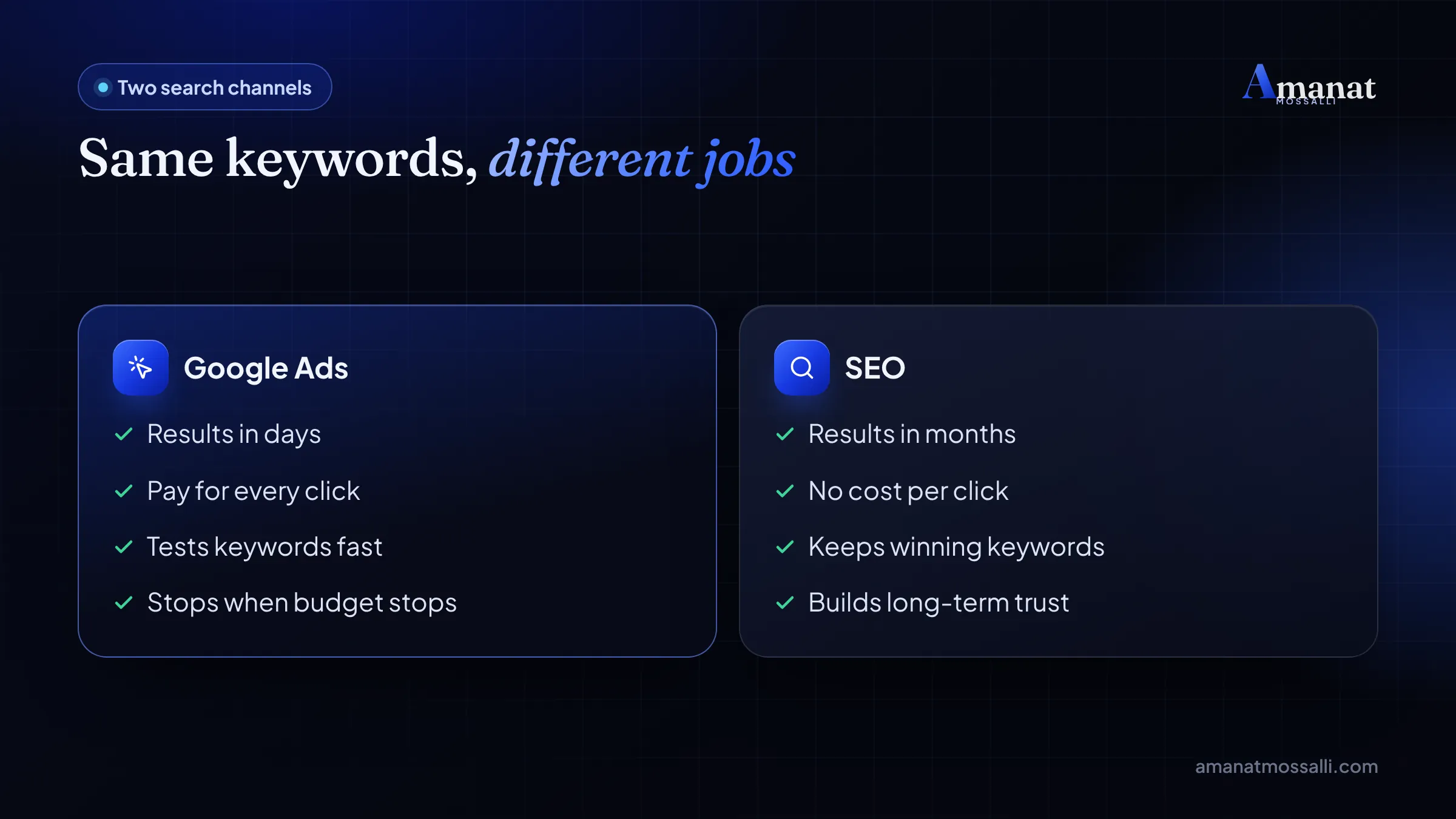
Ads give you answers fast, and SEO keeps the winners for free. Running both together is the cheapest way I know to find keywords that really sell.
Here’s the loop. Run search ads on your 20 to 30 phrases for four to six weeks. Note which ones bring calls, forms or orders, not just clicks. Then build or improve an SEO page for each winner.
Months later, when that page ranks, you can cut the ad bid on that keyword. The budget moves to new tests. Over time your paid list shrinks and your free traffic grows. That loop is the core of my Google Ads management.
Want the cost side? I’ve broken down click prices and budgets in Google Ads cost in Bangladesh. For the organic side, start with my SEO guide for Bangladeshi businesses.
If people visit you in person, set up and fill out your Google Business Profile before anything else. Map results often show above normal results for local searches, and the listing is free. My Google Business Profile guide walks through it.
Where Does Meta Fit in a Small Business Marketing Plan?
Meta creates demand that search can’t. Nobody searches for a product they haven’t heard of. A good video ad makes them want it, and then they search.
The reach is big. DataReportal’s Digital 2026 Bangladesh report counts 82.8 million internet users in late 2025. It puts Facebook’s ad reach at 64.0 million people and Messenger’s at 35.0 million. For most small shops, that’s where new customers first meet the brand.
Split Meta into two jobs. First, prospecting: short videos and offers shown to new people. Second, retargeting: reminders shown only to people who watched, visited or messaged.
Keep prospecting broad and let the creative do the targeting. Keep retargeting tight and specific. The costs are in Facebook ads cost in Bangladesh. If boosting has stopped working, look at a managed Meta ads setup.
What Does a Marketing Funnel Look Like for a Small Shop?
Four stages, each with its own channel and its own number to watch. A marketing funnel is only a map of where people are in their decision.
| Stage | What the buyer thinks | Main channel | Number to watch |
|---|---|---|---|
| See | “I didn’t know this existed” | Meta video ads, short posts | Cost per 1,000 people reached |
| Think | “Is this right for me?” | Search, SEO pages, reviews | Engaged visits, time on page |
| Do | “I’ll order now” | Google Ads, retargeting | Cost per lead or per sale |
| Care | “I’d buy again” | Email, WhatsApp, SMS | Repeat orders, reviews |
Last winter the owner of a driving school in Moghbazar opened his laptop across my desk. He had boosted the same poster for seven weeks: a smiling learner, a car, “Admission Going On”. Likes came in. Calls barely did. He was spending about Tk 12,000 a month and getting six or seven enquiries.
We looked at the funnel together and found the gap in a minute. Every ad was a “see” ad. Nothing caught the people who later searched “driving school near me” or “driving licence training Dhaka”. Nothing reminded the ones who had visited his page and left.
We moved about a third of the money to a small search campaign on those phrases. A little more went into a retargeting ad showing the course fee and batch times. He kept a smaller poster boost for awareness. Over the next two months enquiries roughly doubled at the same total spend. Most of the new ones came from search.
His mistake is the most common one I see. Lots of “see”, no “do”. A full funnel doesn’t need a big budget. It needs every stage covered, even thinly.
How Much Should a Small Business Spend on Marketing?
There’s no fixed rule, and anyone who gives you one exact percentage is guessing. A common starting point is a share of revenue, adjusted for your stage and your margins.
The US Small Business Administration’s post on marketing budgets, published in July 2019, also says there’s no hard and fast answer. It quotes Web Strategies figures: average marketing spend of 7.9% of revenue, from 6.3% for B2B product firms to 11.8% for B2C service firms. The same post notes that startups usually spend more than established firms.
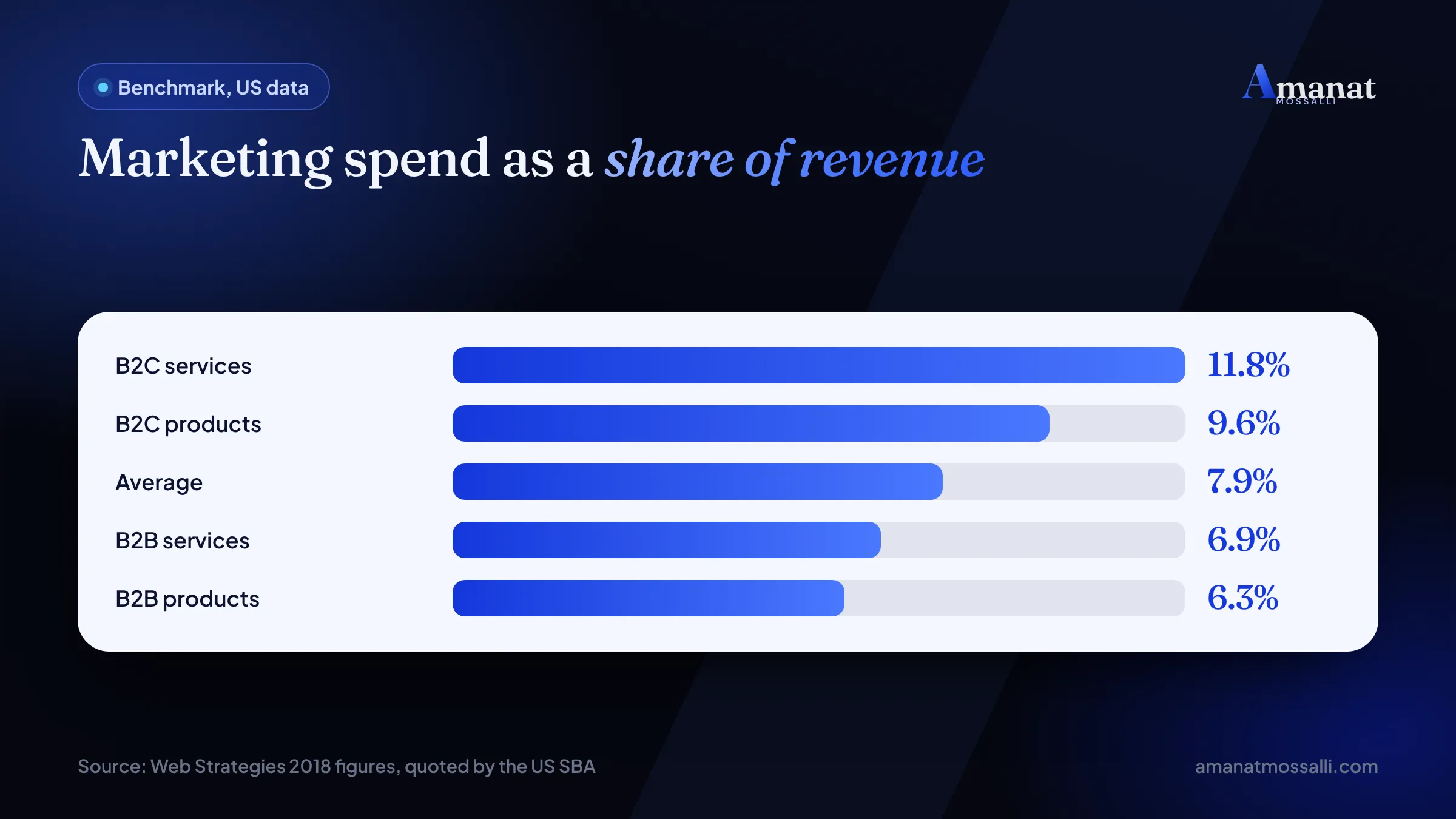
Those are old US figures, so treat them as a sanity check, not a target. A new business usually needs to spend more than the average just to get known.
Three example budget splits
These are examples I’d start from, not statistics. USD figures use Tk 124 to the dollar, the rate on the last working day of October 2026 according to The Financial Express. Adjust the splits to your margins and season.
| Monthly budget | Google Search | Meta prospecting | Retargeting | SEO and content | Tracking and tools |
|---|---|---|---|---|---|
| BDT 30,000 (about $242) | 12,000 | 9,000 | 4,000 | Your own time | 5,000 |
| BDT 80,000 (about $645) | 30,000 | 22,000 | 8,000 | 15,000 | 5,000 |
| BDT 200,000 (about $1,613) | 70,000 | 55,000 | 20,000 | 45,000 | 10,000 |
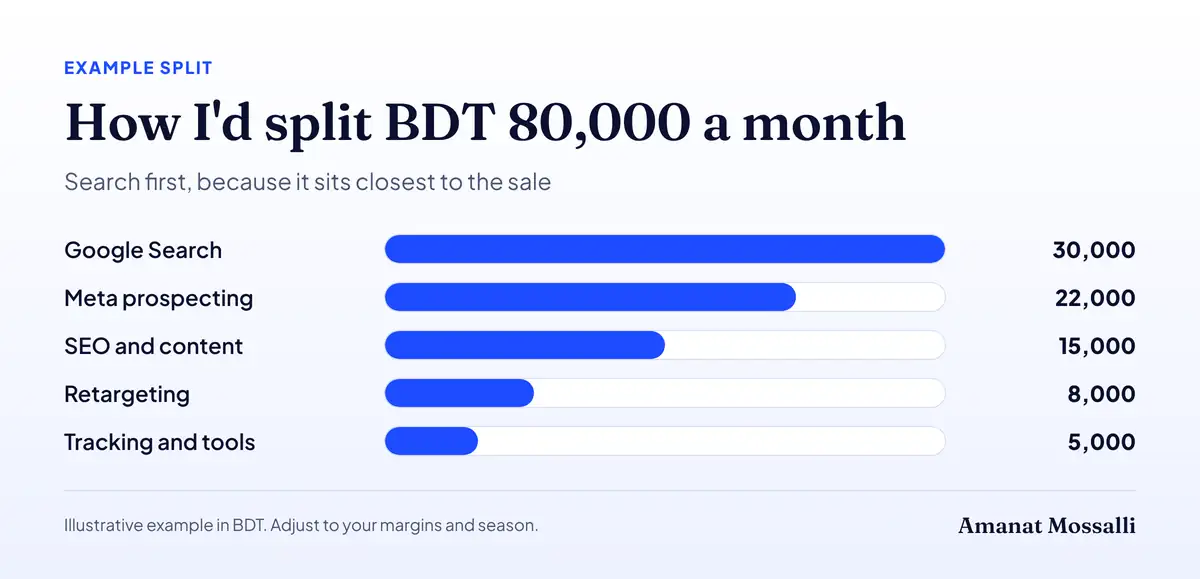
Notice two things. Search gets the biggest share because it’s closest to the sale. And retargeting stays small, because the audience is small. If you sell something buyers never search for, flip the first two columns.
Leave room for tax as well. PwC’s summary of the Finance Act 2026 says online advertisement is now its own VAT service code, at 5%. Ask your accountant how that applies to your ad bills before you set the final number.
One honest caveat. I don’t know your margins. A shop selling BDT 500 items lives on different numbers from a clinic selling BDT 20,000 treatments. Work out what a customer is worth first.
A quick way to size your own budget
Work backwards from customers, not from a percentage. It takes ten minutes with a calculator.
- 1Decide how many new customers you need each month.
- 2Estimate what one customer is worth to you over a year, after costs.
- 3Choose the most you’d pay to win one customer. Many owners start at a third of that value.
- 4Multiply customers needed by that cost. That’s your ad budget.
- 5Add tools and tracking on top, then test for one month and redo the sum with real numbers.
Say an online clothing shop wants 60 new customers a month and can pay up to BDT 400 to win each one. That’s BDT 24,000 in ads. Add BDT 5,000 for tracking and tools and the first test month costs BDT 29,000.
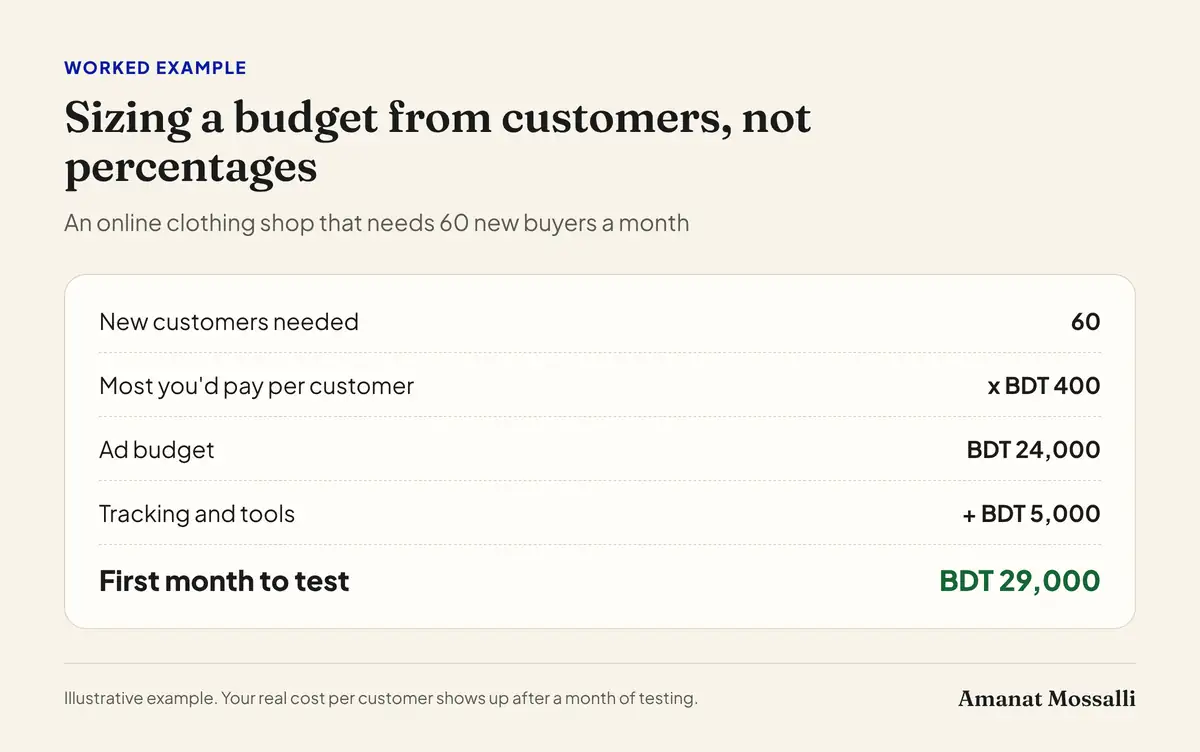
It’s an example, not a promise. Your real cost per customer only shows up after a month of testing.
Is Content Still Worth It for a Small Business?
Yes, if it answers buying questions. Content that only fills a blog calendar is a waste of your evenings.
Good small business content is boring in the best way. Price pages. “How to choose” guides. Delivery and return details. Phone clips of someone actually using the thing. Answers to the ten questions customers ask in your inbox.
Each piece should do double duty. A product video becomes a Meta ad. A price page becomes a Google Ads landing page. A buyer’s FAQ becomes a set of WhatsApp quick replies.
Write some of it in Bangla. Plenty of buyers search in Bangla or Banglish, and fewer competitors bother to answer them there. A clear Bangla price page can be easier to rank than its English twin.
Keep a rhythm you can sustain. Two useful pages a month beat ten rushed posts in week one and silence after.
Don't skip email and WhatsApp
These are the only channels you own. Ad prices change and reach drops, but your customer list stays yours.
- Ask every buyer for permission to message them about new stock or offers.
- Send a thank-you message after delivery, and ask for a review.
- Keep a simple monthly message for past buyers, nothing more.
- Tag messages by product, so you can send the right offer to the right group.
My WhatsApp Business marketing guide covers the setup. Social posts still matter for trust, even if they rarely sell on their own. My piece on social media marketing for Bangladeshi businesses covers what to post.
Which Numbers Should You Check Every Week?
Five numbers are enough. More than that and you’ll stop looking.
| Number | Where to find it | Why it matters |
|---|---|---|
| Leads or sales by channel | GA4 key events, ad platforms | Shows which channel actually sells |
| Cost per lead or sale | Google Ads, Meta Ads Manager | Tells you if a channel is worth the money |
| Organic clicks on buying keywords | Search Console | Shows SEO progress before sales follow |
| Retargeting audience size | Meta and Google audience lists | Too small and the ads won’t run well |
| Repeat customers | Your order sheet or shop system | The cheapest sales you’ll ever make |
Audience size matters on Google. Google’s help page on data segments (checked 12 November 2026) sets the floor. A list needs at least 100 active users in the last 30 days to serve on Display, Search or YouTube. Membership on Display and Search can last up to 540 days.
For a small site that floor matters. If only 60 people visited your price page last month, a retargeting list built on that page won’t run yet. Build the list on all visitors instead, and narrow it later.
None of this works if tracking is broken. Make sure one sale shows up once in GA4, once in Meta and once in Google Ads, with the right value. My guide to setting up GA4 and the Facebook Pixel shows how to test it.
After managing more than $8M in Google and Meta ad spend, the pattern I trust most is boring. The accounts that grew were the ones where the owner could name last week’s cost per sale without opening a laptop.
FAQ: Digital Marketing Strategy for Small Business
What is the best digital marketing strategy for small business?
Should a small business do SEO or Google Ads first?
How much should a small business spend on digital marketing?
Is Facebook enough for a small business in Bangladesh?
What is full funnel marketing?
How long does a digital marketing strategy take to work?
Can I run this plan myself?
A 90-Day Roadmap You Can Copy
Ninety days is long enough to learn and short enough to stay focused. Here’s how I’d split it for a small business starting from close to zero.
| Weeks | Focus | What you do | What you should have at the end |
|---|---|---|---|
| 1 to 2 | Foundations | Tracking, Google Business Profile, keyword list, one landing page | Every lead and sale is counted |
| 3 to 6 | Test search | Google Search ads on buying keywords, Meta video ads to new people | A list of keywords and ads that convert |
| 5 to 8 | Add retargeting | Retarget visitors and video viewers, start an email or WhatsApp list | Second-chance sales from warm people |
| 7 to 10 | Build SEO pages | Pages for the winning keywords, plus buyer FAQs | Organic pages that can rank over time |
| 11 to 13 | Review and shift | Compare cost per sale, cut losers, move budget to winners | A plan for the next 90 days |
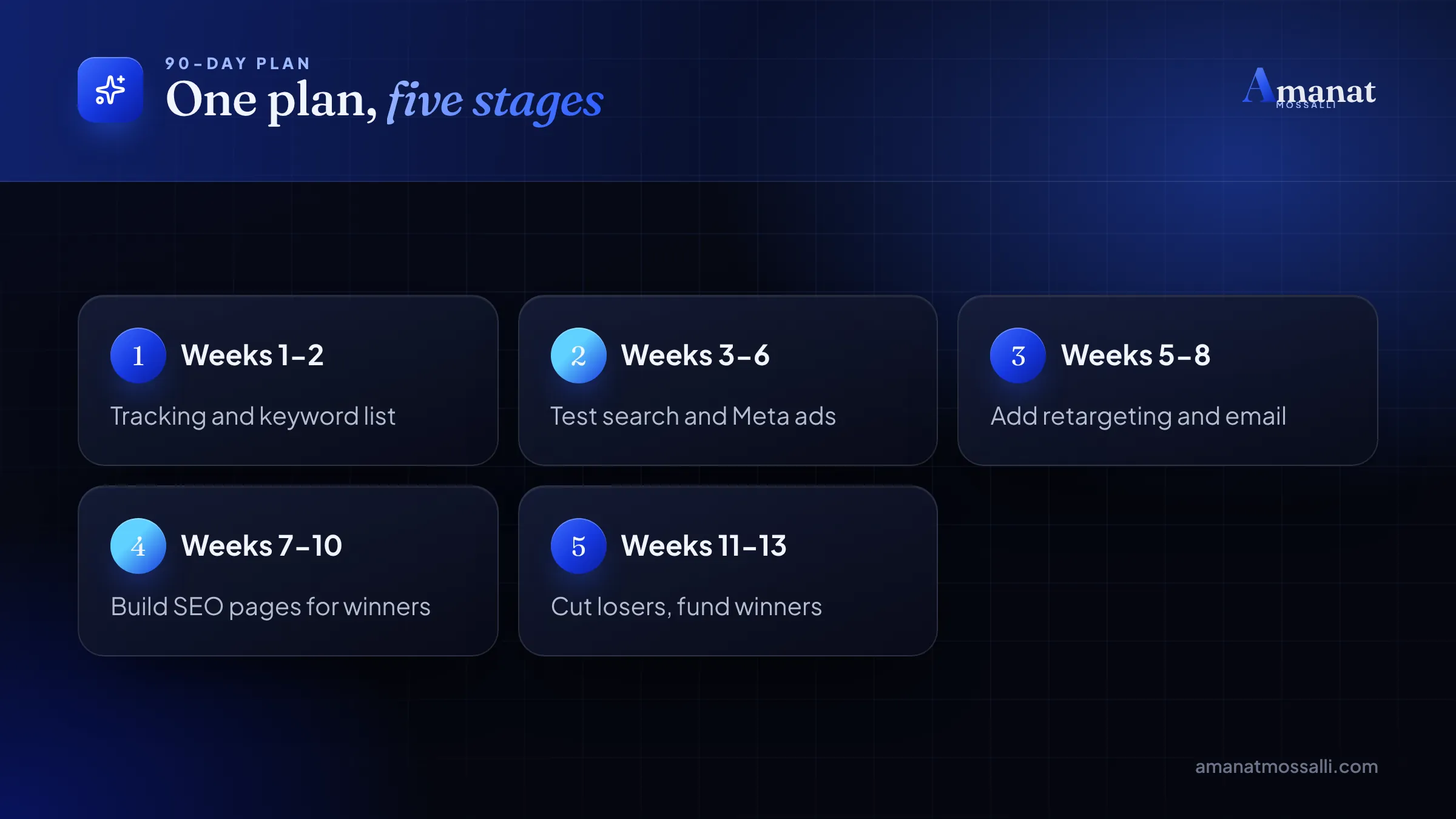
The stages overlap on purpose. You can’t retarget visitors you don’t have yet, and you can’t pick SEO pages before ads show you what sells.
Check your site’s technical health in week one too. My free SEO audit tool flags the basics in a few minutes.
Your Strategy on One Page
Most small businesses don’t need a thirty-slide strategy deck. They need one page they actually look at. Copy this table into a notebook or a sheet and fill in each row tonight.
| Line | What to write | Example: Kushtia caterer |
|---|---|---|
| Goal | One number for the next 90 days | 12 booked events |
| Customer | Who buys, in one sentence | Families planning weddings and aqiqah within 40 km |
| Offer | Why they pick you over the next option | Free tasting for bookings over 150 guests |
| Catch demand | Search terms you will bid on and build pages for | “catering service Kushtia”, “biye catering price” |
| Create demand | The one video or post that shows your work | A 20-second clip of a real buffet being set up |
| Follow up | How you bring back people who asked but didn’t book | WhatsApp message with a sample menu after 3 days |
| Measure | Where each booking is written down | One sheet: date, source, guests, value |
If a row stays empty, that is the gap in your plan. Fix the empty row before you add a new channel.
Mistakes That Waste a Small Marketing Budget
Most wasted budgets I audit fail in the same few ways. None of them are about talent. They’re about order and focus.
- Starting with the platform you like. Start with what buyers search and where they spend time.
- Spreading thin across six channels. Two connected channels beat six lonely ones.
- Only running “see” ads. Remember the driving school. Awareness without a “do” step leaks money.
- Spending before tracking. Without it you’ll fund the wrong channel with confidence.
- Judging SEO after one month. It usually needs several months to show steady results.
- Never moving money. A plan that never shifts budget toward winners isn’t a plan.
For a longer list from the Bangladeshi market, see my common digital marketing mistakes piece. If you want a second pair of eyes on your own plan, here is who I am and how I work.
If You Pick Just One Move This Month
Make it tracking plus one search campaign. Tracking tells you the truth. A small search campaign on buying keywords tells you what people want badly enough to type. Everything else in this plan builds on those two answers.
That’s what I told the caterer in Kushtia. He put Tk 15,000 into search for “catering” phrases around Kushtia and Kumarkhali. Tk 10,000 went into one buffet video on Facebook, and he kept the rest back. Every enquiry went into a single sheet with a “how did you find us” column.
By the end of the third month the sheet had a clear answer. Search brought fewer enquiries than Facebook, but more of them booked. He moved money toward search, and the video kept running at a lower spend. He booked a few more events than the season before. Modest, but now he knows why, and he knows where the next taka goes.

Amanat Mossalli Taju
Senior Digital Marketer & SEO Expert, Dhaka, BangladeshI have grown 235+ brands over more than seven years with SEO, Google and Meta Ads, server-side tracking, WordPress and AI automation. Half of my clients are in the UK, USA, Australia and Canada. Everything I write here comes from real client work.
Want this done for your business?
Book a free 15-minute call. I look at your site and ads before we talk, so you leave with clear next steps.