10 Digital Marketing Mistakes for Bangladeshi Businesses (and the Fix for Each)
Blind boosting, broken tracking, hidden prices and fake COD orders. The ten mistakes I find most often in Bangladeshi ad accounts, and what to do about each one.

The costliest digital marketing mistakes for Bangladeshi businesses are habits, not tech problems. Boosting without a goal. Trusting likes. Hiding prices. Replying three hours late. Ignoring tracking until the money’s gone.
I’ve spent more than seven years inside other people’s ad accounts. So far that’s meant 235+ brands and more than $8M of Google and Meta spend. When a new client shares access, I usually find most of these ten in the first 15 minutes. Not because I’m clever. Because they’re the same ten, almost every time.
They’re below in the order I’d rank the damage. Each has a fix, and most fixes cost discipline, not money. Where a number matters, I show the source and the sum.
Why Do Smart Owners Keep Making the Same Mistakes?
Because they copy what competitors do without knowing why it works. The shop next door boosts posts, so you boost posts. Nobody checks the numbers. Everyone assumes someone else did.
A pharmacy owner in Mohammadpur asked me to look at his Facebook spend one Thursday morning last year. He shared his screen with some pride. Twelve boosted posts that month, the same as two rival shops nearby, and more page likes than either of them.
Then I asked for his order sheet. There wasn’t one. Orders came by phone, by Messenger and over the counter. Nobody wrote down which ones came from an ad.
He wasn’t careless. Nobody had ever told him the likes weren’t the point. By the end of that call, he had three of the ten mistakes below circled in pen.
The market is big enough to hide this for a while. According to DataReportal’s Digital 2026 report, Facebook ads could reach 64.0 million people in Bangladesh in late 2025. With that many people, even a bad ad gets some orders.

Reach isn’t buying, though. The Bangladesh Bureau of Statistics ran an ICT survey for 2024-25. Only 14.4% of people had bought anything online, The Daily Ittefaq reported in June 2026. Most of them paid cash at the door.
So a message isn’t money yet, and neither is an order. That gap is the root of mistake 5.
The Facebook ads mistakes I find in audits are rarely about the ad itself. They sit around it: no goal, no tracking, no follow-up.
| # | Mistake | What it costs you |
|---|---|---|
| 1 | Boosting posts without a goal | Likes instead of orders |
| 2 | Running the business only from a Facebook page | Everything, on the day the page goes |
| 3 | Targeting “everyone in Bangladesh” | Ads that speak to nobody |
| 4 | Broken or missing tracking | An ad system trained on bad data |
| 5 | Counting likes and messages, not delivered orders | Profit you think you have |
| 6 | One tired ad for months | Rising cost for the same result |
| 7 | Hidden prices and late replies | Buyers who message the next shop |
| 8 | Ignoring reviews, or faking them | Trust, in public |
| 9 | Ignoring Google Search and Business Profile | Buyers who were ready to pay |
| 10 | Bought phone lists and SMS blasts | Your number, your name, maybe a fine |
Mistake 1: Is Boosting Without a Goal Wasting Your Money?
Usually, yes. The blue Boost button is easy, and that’s the trap. It gives you very few choices, and it often aims for likes and comments instead of sales.
A boost is fine for quick reach on an announcement. It’s weak when you want orders. The pharmacy owner was boosting for likes and hoping for sales.
The fix: open Meta Ads Manager. Pick a clear objective, such as Sales or Leads. Then tell Meta what a result is, like a purchase on your website or a WhatsApp conversation.

So when is boosting fine? A shop opening, an event, a big announcement where you only want people to see it. For everything meant to bring money, build a campaign.
I compare the two screens side by side in Facebook Boost vs Ads Manager. If the dollar card is your real blocker, read how to pay for Facebook ads in Bangladesh first.
Mistake 2: What Happens When Your Facebook Page Is the Whole Business?
You lose it all in a day, if you’re unlucky. A page can be hacked, restricted or buried by an algorithm change overnight. I’ve watched businesses lose years of followers between dinner and breakfast.
It’s rented land. You follow the landlord’s rules, and the landlord can change them whenever he likes.
There’s a second cost that owners miss. In that BBS survey, 75.8% of people who don’t shop online said they prefer to see or touch the product first. A page with three photos and “inbox for price” does nothing for that fear. A proper product page can.
The fix: build a simple, fast website with your products, real prices, delivery policy and contact details. It doesn’t need to be fancy. It needs to load quickly on mobile data and take orders, with bKash and cash on delivery at checkout.
- Real prices in taka on every product, with delivery charges shown.
- Several honest photos per product, including size, back and close-up.
- A clear delivery and return policy, written in simple Bangla and English.
- Fast mobile pages. Test on a slow 4G phone, not office Wi-Fi.
- WhatsApp and phone buttons that work with one tap.
Keep your Facebook page too. Just stop treating it as the whole business. The page brings people in. The website is where you keep them, track them and sell to them again.
Worried about the bill? I list real ranges in website development cost in Bangladesh. For checkout, see my notes on bKash payment gateway integration.
Mistake 3: Can You Really Target Everyone in Bangladesh?
No. “Everyone aged 18 to 65 in Bangladesh” isn’t a target. A student in Mirpur and a factory owner in Gazipur don’t buy the same way, and they don’t respond to the same ad.
There’s a quieter problem inside “everyone”. DataReportal’s Digital 2026 report puts Facebook’s adult ad audience here at 63.1% male and 36.9% female. TikTok’s is 70.1% male. Sell sarees or skincare to “everyone” and much of your reach starts in the wrong half.
The fix: before any ad, write one paragraph about your best buyer. Age, city, budget, problem, and why they choose you. Use it to write the ad, pick the photo and set the offer.
A skincare seller who runs her page from Banani came to me in early 2025. She’d spent eight months boosting posts to the whole country. Lots of likes, very few second orders.
We opened her last 200 orders together and wrote down who actually bought. Mostly working women in Dhaka and Chattogram, aged about 25 to 35. Short on time, and tired of products that felt heavy in humid weather.
Then we rebuilt the ads around that woman’s day. Same budget, new hooks, women 24 to 38 in the cities where her buyers lived. Orders dipped for the first month, and she was nervous.
By the third month, her cost per delivered order had fallen from about Tk 520 to about Tk 390. Repeat buyers went from roughly one in ten to about one in five. The product never changed. Only the focus did.
Does targeting still matter when Meta’s AI picks the audience? Yes, in a new way. The AI reads your ad to decide who sees it. A vague ad for everyone teaches it nothing.
A clear ad about one person’s problem gives the system a strong signal. It then finds more people like that buyer, often better than manual interest targeting ever did.
Mistake 4: Tracking That's Broken or Missing
If Meta or Google can’t see who bought, their AI can’t find more people like them. It aims at the wrong crowd, and your cost per sale creeps up month after month.
In 2026 this matters more than ever. Meta’s Advantage+ and Google’s Performance Max do the targeting themselves. They only learn from the data you send them.
The fix: install the Meta pixel and add server-side tracking through Meta’s Conversions API. Server-side means your website server sends the sale to Meta directly, so ad blockers can’t hide it. Set up GA4 with purchase events too.
Open Events Manager while you place a test order on your own site. If the Purchase event does not appear, or appears twice, your ads are flying blind. Fix this before you spend another taka.
The 50-a-week rule, in taka
Tracking also decides how many ad sets you can afford. Meta published a post on 21 October 2026. It said ad sets with fewer than about 50 conversions a week cost roughly 28% more per purchase. PPC Land covered it, and noted Meta gave no method for the figure. I read it on 11 November 2026.
Meta’s own sum is simple. Take your weekly budget. Divide it by your cost per result times 50. The answer is the most ad sets your budget can feed.
Here’s an example. Say you spend Tk 70,000 a week and a purchase costs you Tk 350. Fifty purchases cost Tk 17,500. So Tk 70,000 feeds four ad sets, not fourteen.
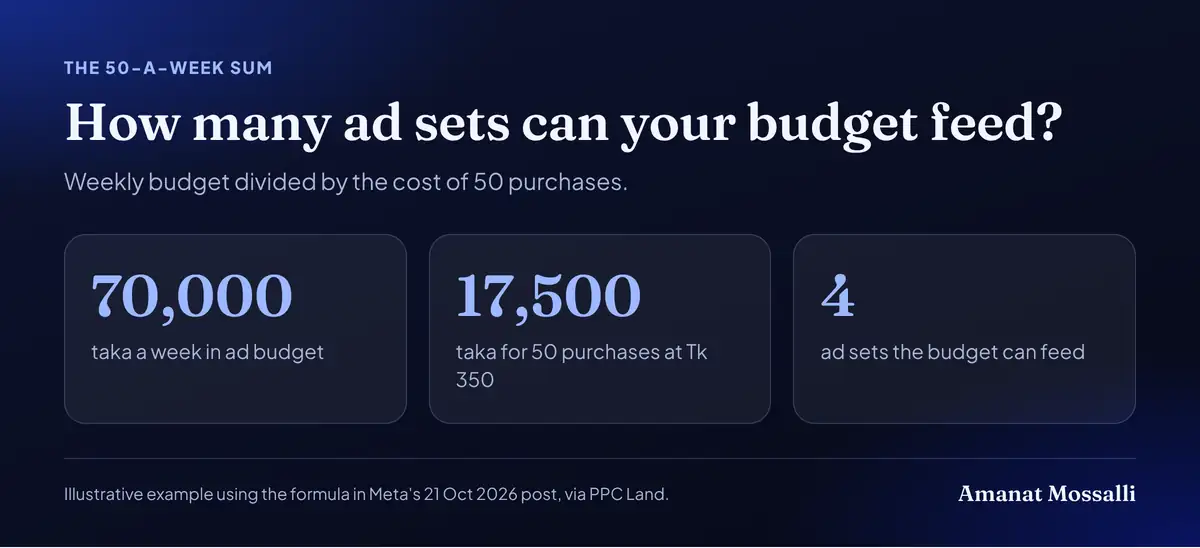
Most small accounts I open run ten ad sets on a budget that can feed two. Each one starves. Merge them, and let one or two learn properly.
My step-by-step setup guides are here: Facebook Conversions API and GA4 with the Facebook pixel.
Mistake 5: Are You Counting Likes Instead of Delivered Orders?
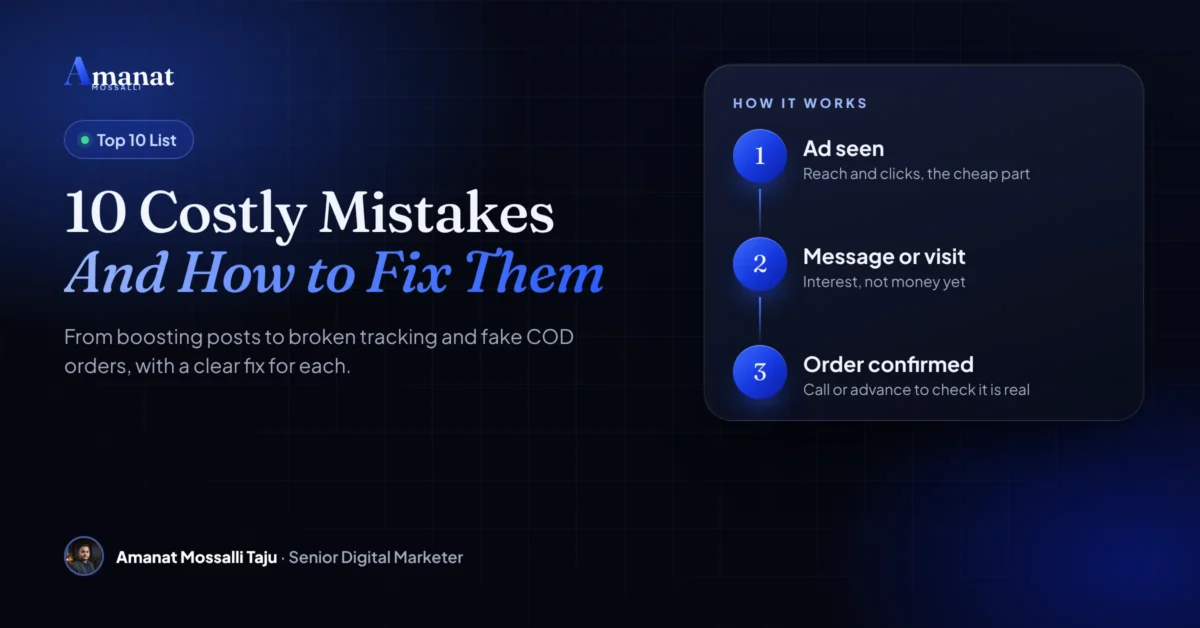
Most businesses here are. In Bangladesh, a message isn’t a sale. An order isn’t a sale either, until the rider brings back the cash.
Cash on delivery still rules. The same BBS survey found 86.8% of online shoppers used cash on delivery, and only 13.9% used mobile money like bKash or Nagad. Every refused parcel costs you the delivery charge, the packing and the time.
What one refused parcel does to your numbers
Let me show the sum. The ad figures below are a round-number example. The courier figures come from a published rate card.
Courier first. Paperfly’s published rate card lists Tk 70 for a parcel up to 1 kg in the same city. For the rest of Bangladesh it’s Tk 130. Cash collection outside the same city adds 1%. A refused parcel is still charged, and a return charge of up to 50% of the delivery charge may apply. I rechecked the page on 12 November 2026.
Other couriers differ a little. Steadfast’s terms say you pay delivery on every parcel handed over, delivered or cancelled. So a refusal is never free.
| Line | Example month |
|---|---|
| Ad spend | Tk 30,000 |
| Orders taken | 100 |
| Cost per order (what the dashboard shows) | Tk 300 |
| Parcels refused or unreachable (example: 1 in 4) | 25 |
| Delivered orders | 75 |
| Courier paid on the 25 failed parcels, at the Tk 130 outside-city rate | Tk 3,250 |
| Real cost per delivered order | (30,000 + 3,250) / 75 = about Tk 443 |
You paid out Tk 33,250 in all, for 75 sales. The dashboard says Tk 300. The bank says Tk 443. That’s a 48% gap, and it’s before packing and staff time. If your margin per order is Tk 400, the dashboard shows a profit and the month shows a loss.
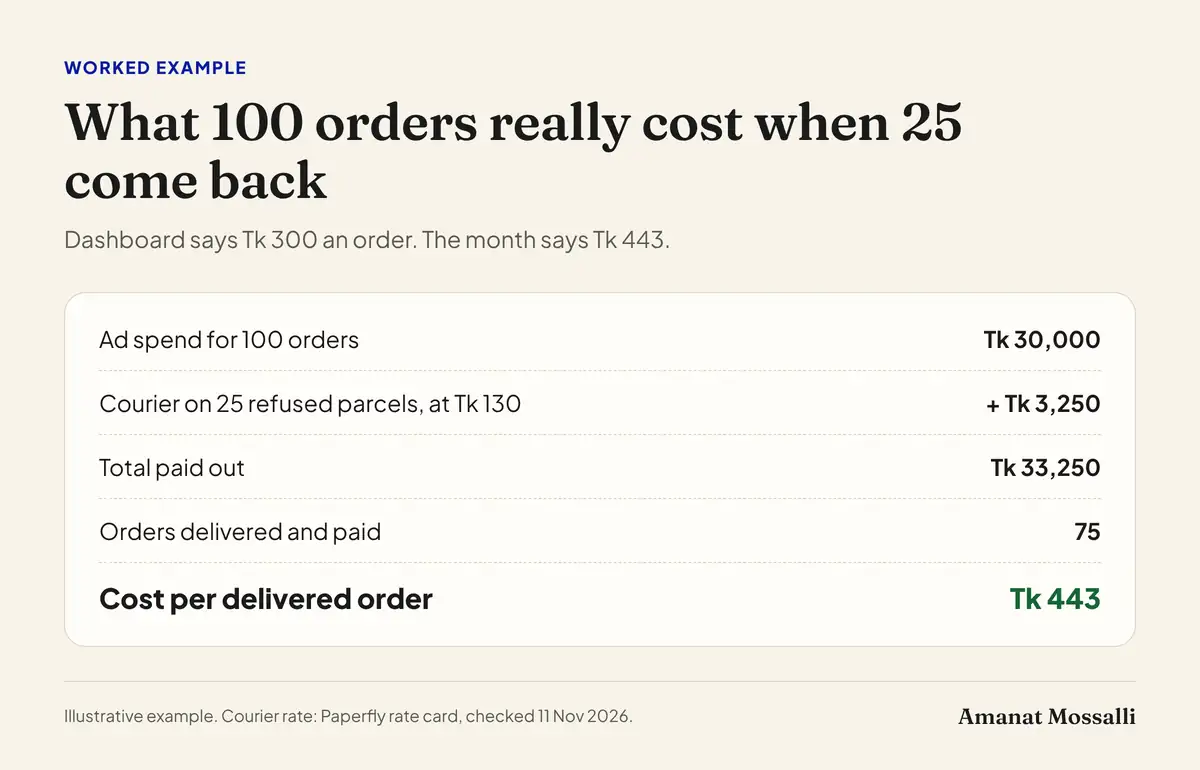
Your refusal rate will differ. Count your own for one month before you trust any benchmark, including mine.
Why do people refuse? The BBS survey gives a hint. Of shoppers who faced a problem, 50.7% said the goods weren’t delivered as ordered. Another 44.8% reported poor quality, and 19.3% reported late delivery. Honest photos and fast dispatch cut refusals more than any ad trick.
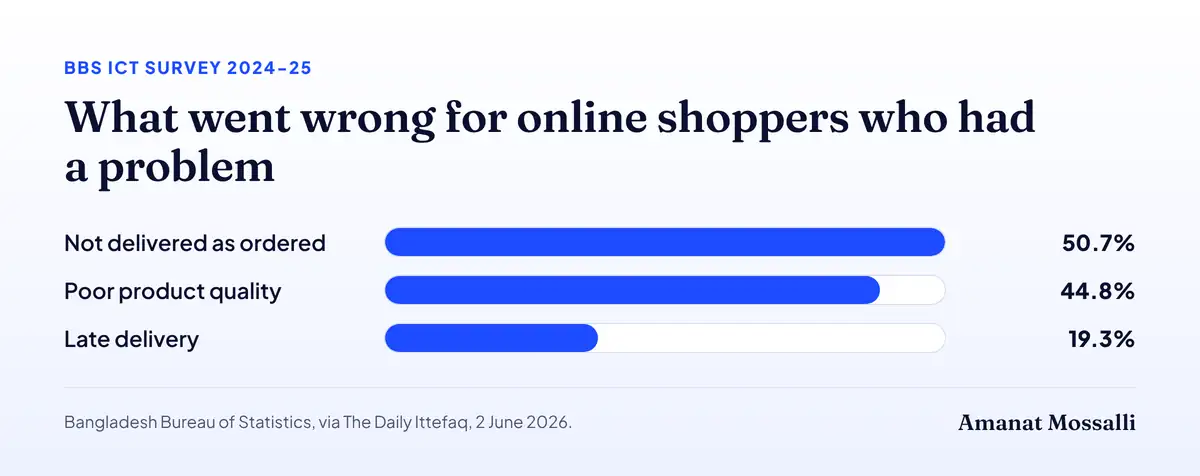
The fix: keep a simple sheet. For each campaign, count orders, delivered orders and returns. Confirm every order by phone before dispatch. Ask first-time buyers in far districts for a small bKash or Nagad advance, which also cuts fake orders. Judge every ad by cost per delivered order.

The pharmacy owner started his sheet the following Saturday. One column per channel. He told me it felt like homework for the first week, and like a map by the third.
If visits are fine but orders aren’t, the leak may be the page itself. I cover that in website traffic but no sales.
Mistake 6: One Tired Ad, Running for Months
Ask yourself how long your best ad has been live. If the answer is months, it’s tired. People see the same video three times, then scroll past it forever. Meta’s AI also needs variety to find different groups of buyers.
The fix: make three to five new ad creatives every week. Change the hook, the face, the format. Mix a customer review video, a product close-up and a simple offer graphic. Let the system pick winners, then make more like them.
Add them inside the ad sets you already have. New creative is good. A new ad set for every new video takes you straight back to the 50-a-week problem.
You don’t need a studio. A phone, daylight from a window and a real customer holding the product beat a polished stock photo most days.
Fresh creatives also protect you during Eid, when every seller shouts at once and old ads get ignored even faster.
Mistake 7: Why Does "Inbox Koren" Lose Sales?
Because buyers don’t wait. Hiding the price and writing “inbox koren” feels clever. In practice, many buyers just leave and message the next seller who shows a price.
The fix: put the price in the post and the ad. Make one person responsible for the inbox in busy hours. A fast, polite reply is often the cheapest sales boost you’ll ever get.
- Use saved replies for price, delivery time, delivery charge and returns.
- Pin a post with your top five questions answered.
- Turn on an away message that says when a human will reply.
- Check slow chats every week and fix the cause.
WhatsApp Business also has a free catalogue. Add your best products with prices, so buyers can browse inside the chat. It saves your team typing the same answer fifty times a day.
Can’t staff the inbox at midnight? Meta began rolling out its AI Business Agent worldwide in June 2026, WABetaInfo reported. It has a “Suggestions” mode that drafts replies for you to send. I’d start there, not on full autopilot.
An agent needs a written price list and delivery rules to read from. If those live in your head, write them down first. That document helps your human staff just as much.
Mistake 8: Ignoring Reviews, or Faking Them
Bangladeshi buyers read comments and reviews before they pay, because many have been cheated before. A page with no reviews looks risky.
A page with fake reviews looks worse, once someone notices. And people do notice. Usually in the comments, in public.
There’s a legal edge too. The Consumer Rights Protection Act 2009 punishes selling through false advertising. The maximum is one year in prison, a fine up to Tk 2 lakh, or both. That’s from Lawyers Club Bangladesh’s explainer, read on 11 November 2026. I’m not a lawyer. A made-up testimonial still looks like false advertising to me.
The fix: after every delivered order, send a short thank-you and ask for a review. Reply to every negative review calmly and in public. Share real customer photos, with permission.
Reviews help on Google as well. Google’s local ranking help page says prominence is partly based on how many reviews a business has. It also says positive reviews and helpful replies help you stand out.
Mistake 9: Leaving Google Out of the Plan
For a lot of owners here, marketing means Facebook, full stop. But when people are ready to buy, they search: “AC servicing in Bashundhara” or “birthday cake delivery Chattogram”.
Google says local results rest mainly on three things: relevance, distance and prominence. You can’t move your shop closer to the searcher. You can fix the other two with a complete profile and real reviews.
The same help page is blunt about shortcuts. It says there’s “no way to request or pay for a better local ranking on Google”. If someone sells you a Maps ranking package, show them that line.
Google now also shows AI answers on top. Its guide to generative AI features, updated July 2026, says Business Profiles help you show up in those answers too. If your business isn’t clear online, the AI quotes a competitor instead.
The fix: claim and complete your Google Business Profile with photos, hours and real reviews. Build website pages that answer real questions in simple words, with prices in taka. For buyers ready right now, run focused Google Ads on the searches that bring sales.
Not sure where your site stands today? Run it through my free SEO audit tool before you pay anyone, me included.
My guide on local SEO for Bangladeshi businesses walks through it step by step, and the Google Business Profile guide covers verification. If you’d rather hand it over, see my SEO, GEO and AEO service or Google Ads management.
Mistake 10: Is Buying Number Lists Still Worth the Risk?
No. Buying 50,000 phone numbers and blasting SMS or WhatsApp used to be common. It annoys people, damages your name and can get your WhatsApp number banned.
It’s a legal risk now, too. Bangladesh’s Personal Data Protection Ordinance 2025 requires explicit consent to collect and use personal data, according to The Daily Star’s summary. People can withdraw consent at any time.
The penalties aren’t small. The same summary lists up to seven years in prison, a fine up to Tk 20 lakh, or both, for unauthorised collection or use. Directors and managers can be personally liable.
Two honest caveats. Some sections only start 18 months after the gazette. And an ordinance can be amended, so confirm today’s position before you rely on my summary.
The fix: build your own opt-in list. Ask buyers at checkout if they want offers by SMS, WhatsApp or email. Give a small reason to join, like early Eid access. Make leaving easy. A small list of willing buyers beats a big list of strangers.
This is general guidance. If you store a lot of customer data, ask a lawyer how the ordinance applies to you.
Which Mistakes Should Bangladeshi Businesses Fix First?
The cheap, high-impact ones. Tracking, prices and inbox speed pay back fastest. A website and SEO take longer, but they keep paying for years.
| Mistake | Effort to fix | Impact | When you see results |
|---|---|---|---|
| Hidden prices | Very low | High | Within days |
| Late inbox replies | Low | High | Within days |
| Counting likes, not delivered orders | Low | High | First month |
| Broken tracking | Medium | Very high | Within weeks |
| Too many starving ad sets | Low | High | Within weeks |
| Tired ads | Medium | High | Within weeks |
| No website | Medium to high | Very high | Two to three months |
| Ignoring Google | Medium | High | Three to six months |
A word on your marketing budget. Don’t cut it to zero while you fix things. Keep a small, steady spend on your best ad so you keep learning.
Then raise it step by step, once cost per delivered order has looked healthy for two or three weeks running. My Facebook ads cost guide has current ranges if you need a starting figure.
A 30-minute self-audit
Sit down with your phone, your ad account and your order sheet. Answer each line honestly. No one’s watching.

Three or more “no” answers? Don’t raise your ad budget yet. More money into a leaking bucket just makes a bigger puddle.
A Five-Day Repair Week You Can Start on Sunday
You don’t need a quarter. You need one working week and about an hour a day. This is the order I’d use.
- 1Sunday: prices. Put the price and delivery charge on your ten best-selling posts and in every live ad.
- 2Monday: the sheet. One row per day. Columns for orders, delivered, returned and ad spend, split by channel.
- 3Tuesday: the test order. Buy from yourself with Events Manager open. Note what fires and what doesn’t.
- 4Wednesday: the inbox. Write five saved replies. Name one person who owns the inbox from 8 pm to midnight.
- 5Thursday: the ad sets. Run the 50-a-week sum. Merge what your budget can’t feed, and add three new creatives.
The pharmacy owner took a slower road and fixed one thing a month. The order sheet came first. Then prices on every post. Then one proper Messenger campaign instead of twelve boosts.
Three months in, his sheet told a plain story. He was spending about a third less on Facebook, and ad orders had held roughly steady at 60 to 70 a month. Not a miracle. Just money he’d been wasting, now back in the till. Both speeds work. Stopping doesn’t.
Stop the leaks before you pour in more water.
None of these digital marketing mistakes for Bangladeshi businesses needs a big budget to fix. They need attention.
For your social channels, my guide to social media marketing for Bangladeshi businesses is the next read. Curious where the platforms go next? Read the future of digital marketing in Bangladesh.
And if you finish the week and the numbers still don’t make sense, send me your sheet. A month of honest rows tells me more than any dashboard screenshot. I reply within 12 hours, weekends included.
FAQ: Digital Marketing Mistakes for Bangladeshi Businesses
What is the biggest digital marketing mistake in Bangladesh?
Is boosting a Facebook post a waste of money?
Why do I get messages but no sales from Facebook ads?
How do I reduce fake orders and COD returns?
Do small businesses in Bangladesh need a website?
Is SMS marketing legal in Bangladesh?
How much should I spend on Facebook ads in Bangladesh?

Amanat Mossalli Taju
Senior Digital Marketer & SEO Expert, Dhaka, BangladeshI have grown 235+ brands over more than seven years with SEO, Google and Meta Ads, server-side tracking, WordPress and AI automation. Half of my clients are in the UK, USA, Australia and Canada. Everything I write here comes from real client work.
Want this done for your business?
Book a free 15-minute call. I look at your site and ads before we talk, so you leave with clear next steps.