Facebook Lead Ads: How to Get Cheap Leads That Actually Pick Up the Phone
Cheap leads are easy. Leads who answer the phone are harder. Here's how to set up Facebook lead ads with the right form, the right questions and fast follow-up.

A hair-restoration clinic in Rupganj sent me its lead sheet one Friday, close to midnight. The manager had spent the evening calling last week’s Facebook lead ads. First number: switched off. Second: no answer. Third: “I never filled any form.” She’d given up after twenty calls.
I hear some version of that every month. Facebook lead ads make leads cheap because the form fills itself in. Cheap often means cold. The fix has two parts: a form that asks a little more, and a follow-up that happens within minutes, not days.
Below you’ll find the form type I’d pick and the setup steps. You’ll also get questions that filter out time-wasters, a follow-up timetable, CRM options and Meta’s conversion leads goal. Then I’ll show you what happened at that clinic once we changed it.
Quick answers
- Lead forms remove friction, so they bring more leads and more weak ones.
- Use the Higher intent form when quality matters more than volume.
- Ask one or two qualifying questions that a casual tapper can’t answer by autofill.
- Call or message every lead within five minutes. Speed beats a clever script.
- Send lead outcomes back to Meta so it learns which leads become customers.
What Are Facebook Lead Ads, and When Do They Work?
Facebook lead ads are ads that open a form inside Facebook or Instagram. Meta calls it an instant form. The person taps and sees their name and phone already filled in. They submit without visiting your website. People often search for it as “instant form facebook”, and it’s the same thing.
They work best when one conversation closes the deal. Think clinics, coaching centres, real estate, study abroad, insurance and B2B services. They work poorly for impulse products, where a shop page converts better.
I’ve run Meta lead form ads for over seven years, inside more than $8M of Google and Meta spend I’ve managed. As lead digital marketer for Software Gaze and for international agencies, I’ve watched forms fail in Dhaka and in London for the same reasons. I’m Amanat Mossalli Taju, and most of this page is what those failures taught me.
| Use an instant form when | Use a landing page when |
|---|---|
| One call or chat closes the sale | People buy online straight away |
| Your site is slow or weak on mobile | Your page converts well already |
| You need volume to test offers fast | You need detailed info before contact |
| Buyers prefer not to leave Facebook | You want visitors for Google retargeting too |
The audience is there. DataReportal’s Digital 2026 Bangladesh report (checked 12 November 2026) says Meta’s ad tools showed 64.0 million Facebook users in Bangladesh in late 2025. Instagram showed 9.15 million, and Messenger ads reached 35.0 million. These are ad reach estimates, not active users, but they show where local buyers are.
Why Are Cheap Leads So Often Bad Leads?
Because the form is too easy. Autofill means someone can submit in two taps, sometimes by accident, often without reading what you offer.
Poor lead quality on Facebook usually comes from four places. The lead quality complaints in my inbox nearly always trace back to them:
- The form asks nothing beyond contact details.
- The ad promises something vague like “free consultation”.
- The audience is far too broad.
- Nobody calls back for a day or two, by which point the person has forgotten.
You can’t fix all four with targeting. Meta’s system finds people likely to submit forms, and it does that very well. If submitting is all you ask for, that’s what you’ll get.
So change what you ask for. Let the form do some filtering, and let your team do the rest by phone within minutes.
Stop judging lead ads by cost per lead. Judge them by cost per booked appointment or cost per sale. A BDT 150 lead that never answers is more expensive than a BDT 600 lead who books.
More Volume or Higher Intent: Which Form Should You Pick?
Pick Higher intent when your team calls every lead. Pick More volume only when you’re testing offers or building a list for later.
In the form settings, Meta offers form types. More volume is the default and the quickest to submit. Higher intent adds a review screen, where the person checks their details and confirms before sending. That extra tap slows down accidental and careless submissions.
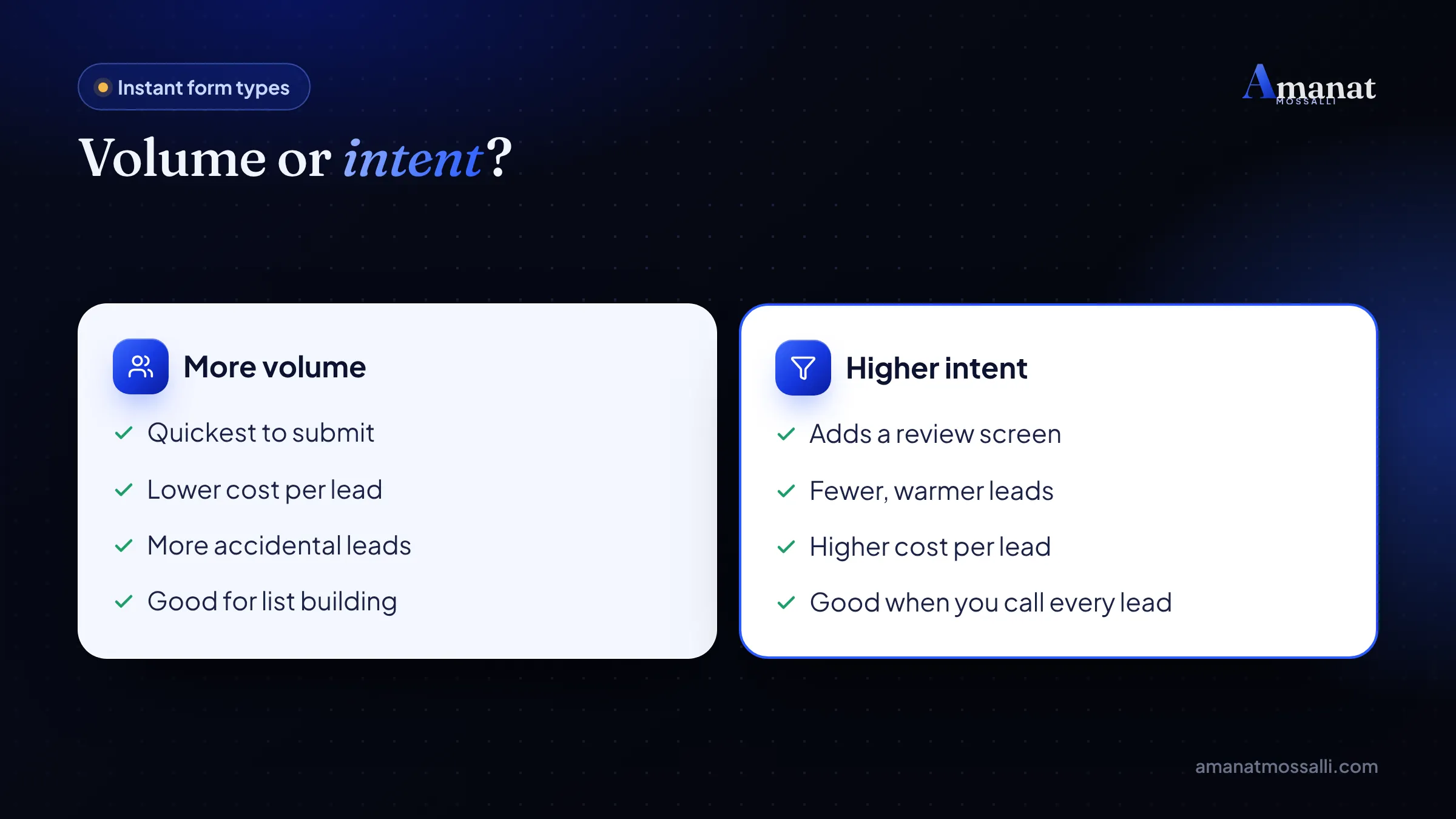
The third type, Rich creative, adds sections such as how it works, products and social proof inside the form. I use it when the offer needs explaining. For a simple booking, it’s usually more than you need.
My default: Higher intent plus one or two qualifying questions. Yes, the cost per lead rises. The cost per real customer usually falls, and that’s the number that pays your rent.
Which Lead Form Questions Filter Out Time-Wasters?
Questions that need a real choice. Autofill handles name and phone. It can’t decide which service someone wants or when they want it.
Two good questions beat six. Every extra question lowers volume, so each one must earn its place. Multiple choice works better than short answer on phones.
Lead form questions for a clinic
- Which treatment are you interested in? (Consultation, PRP, transplant, not sure yet)
- When would you like to visit? (This week, this month, just checking prices)
- Which visiting time suits you? (Morning, afternoon, evening)
Lead form questions for a coaching centre
- Which class is the student in? (SSC, HSC, admission)
- Which batch time suits you? (Morning, afternoon, evening)
- Who are we speaking with? (Student, parent)
Lead form questions for a B2B service
- How many workers are at your site? (Under 200, 200 to 1,000, over 1,000)
- When do you need this done? (This month, within three months, just researching)
Notice the “just checking prices” and “just researching” options. Leaving an honest exit makes the other answers truer. Those people still get a call, just later and with a price list ready.
Write the questions in the language your buyers use. A Bangla form often feels friendlier to parents than an English one. Keep the button text simple too.
Conditional logic, for bigger forms
Meta also has conditional logic, which sends people to different questions based on earlier answers. Jon Loomer’s guide to instant forms, a secondary source, describes one useful detail. An answer can lead to a separate “Close Form” ending for non-leads, whose details aren’t submitted. Questions can’t be optional while logic is on.
That’s handy if, say, you only serve one district. Someone who picks “outside the area” sees a polite ending and never becomes a lead you pay to call. For most small businesses, though, two fixed questions are enough.
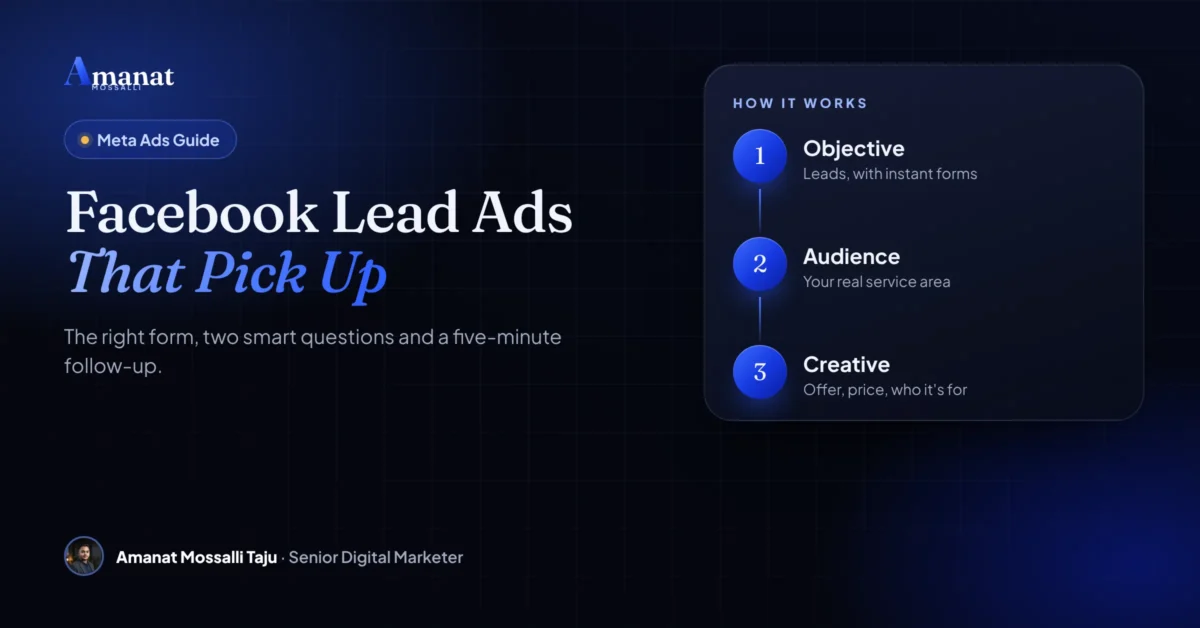
How to Set Up Facebook Lead Ads, Step by Step
Do this in Ads Manager, not with the Boost button. Boosting hides most of the settings you need. If the difference is new to you, read boost vs Ads Manager first.
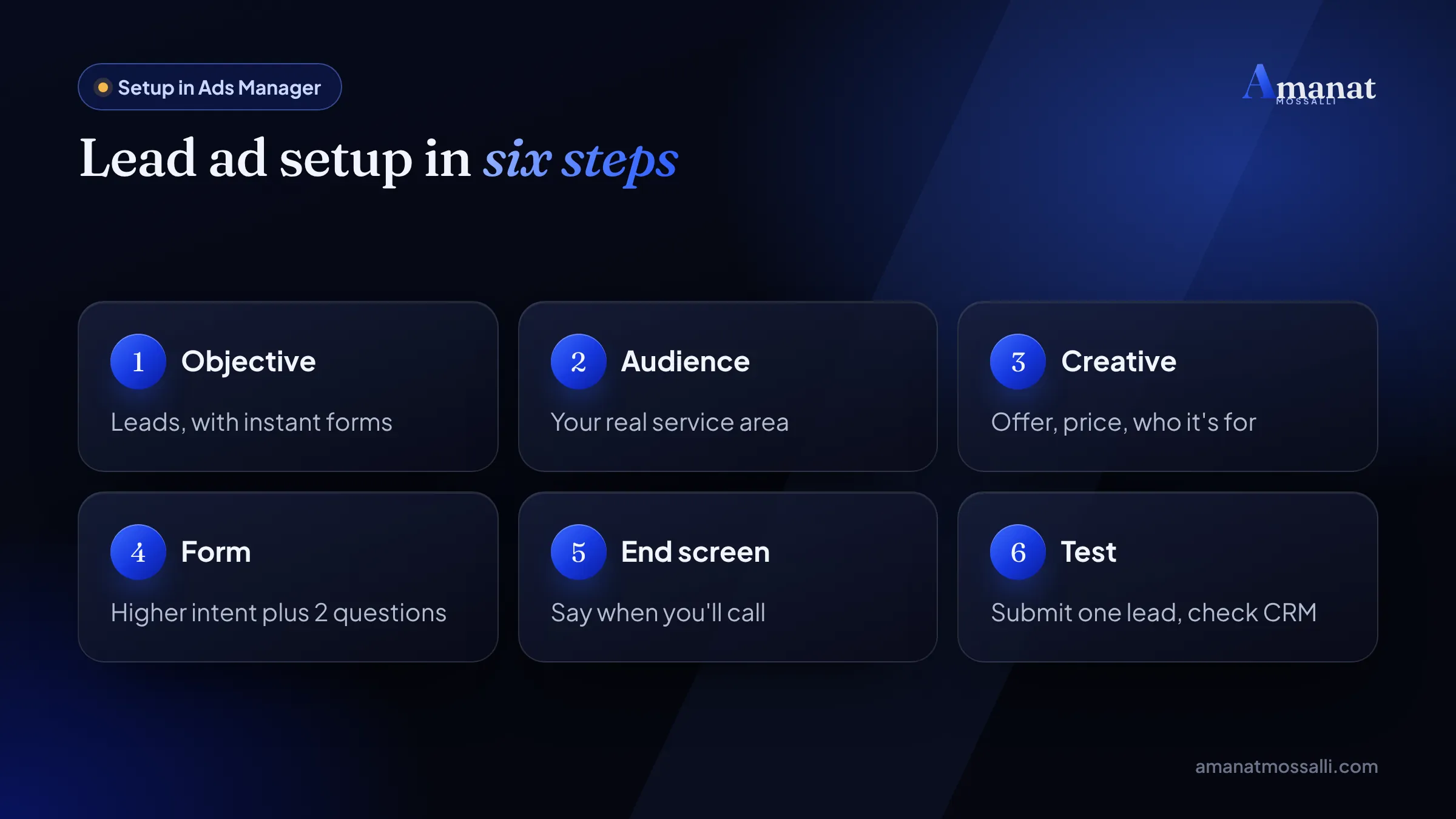
The picture folds the budget step into the audience step, so it shows six boxes for the same seven steps. The order is what matters.
Paying for ads from Bangladesh has its own quirks with cards and limits. I covered them in how to pay for Facebook ads in Bangladesh.
What Should the Ad Above the Form Say?
More than most people think. The ad is your first filter. A clear ad sends warm people to the form and quietly turns the rest away.
Write the ad as if the reader will call you right after. Name the service. Name who it’s for. Give the price or a starting price. Say where you are.
| Weak ad line | Stronger ad line |
|---|---|
| Free consultation, limited seats! | Hair-loss consultation with a doctor, from a stated price, Saturday to Thursday |
| Best coaching in town | HSC physics batch, evening classes, groups of 15 |
| Study abroad made easy | UK master’s intake help for graduates with IELTS ready |
Use real photos of your clinic, classroom or team. Stock images look like every other ad in the feed. A 15-second phone video of the reception desk often does better than a polished poster.
Match the form’s intro to the ad. Same offer, same words. When the form opens and says something different, people back out.
Test two or three ad versions, not ten. Keep the form the same while you test, so you know which change made the difference. I run these tests every week as part of my Meta ads management.
How Fast Should You Contact a New Lead?
Within five minutes, if you can. That’s my working rule, not a law of nature. The person has just tapped your ad and still remembers you.
After an hour, they’ve seen ten other ads. After a day, many don’t remember the form at all. That’s exactly what the Rupganj manager ran into on Friday night.
Speed needs the lead to arrive fast. Meta’s lead retrieval docs (checked 12 November 2026) say webhook pings arrive “with a delay of up to a few minutes”. A manual download once a day throws that advantage away.
A simple follow-up sequence
| When | What | Channel |
|---|---|---|
| Within 5 minutes | Call. If no answer, send a short message with your name and the offer | Phone, then WhatsApp or SMS |
| Same day, evening | Second call attempt | Phone |
| Next day | Message with something useful: price list, timings, location pin | |
| Day 3 | Final call, then mark the lead as cold | Phone |
| Day 14 | One gentle reminder with a fresh reason to book | WhatsApp or SMS |
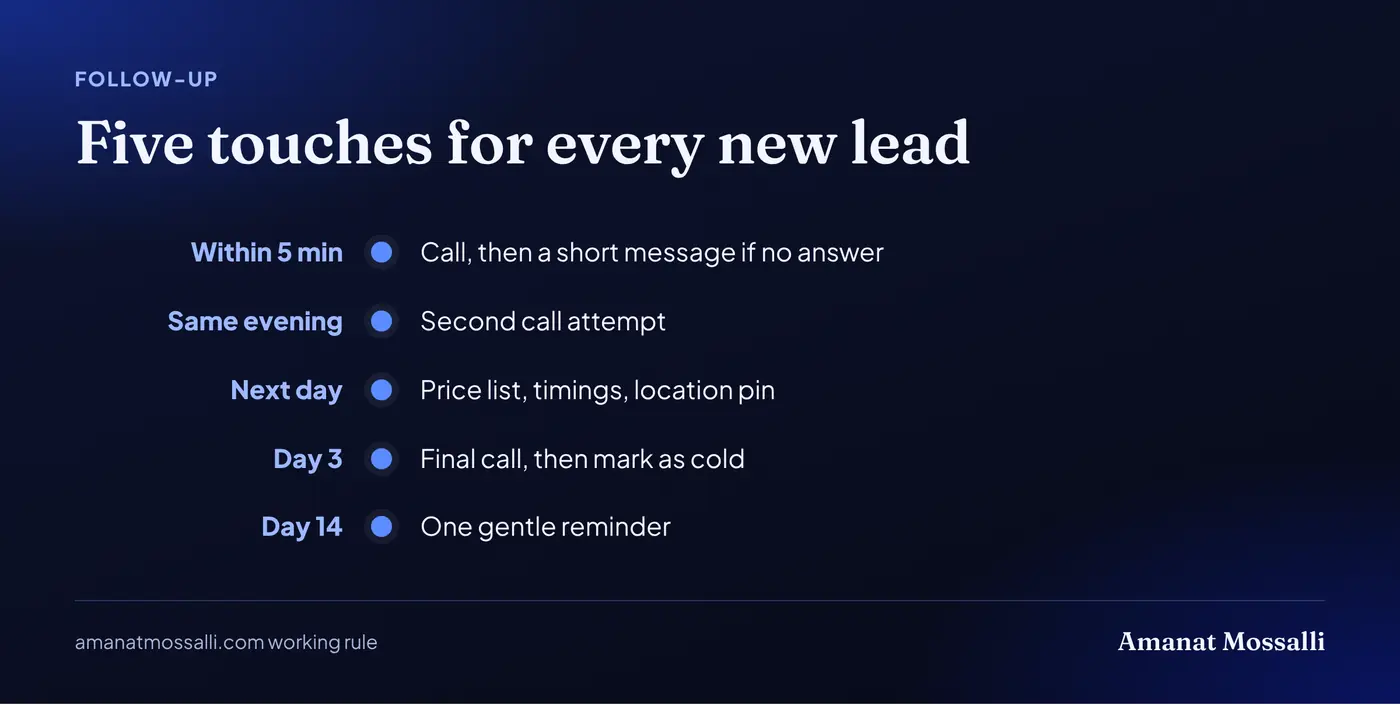
Only message people on WhatsApp if your form says you will, and keep it short. Your first message should say who you are and why you’re writing: “Assalamu alaikum, this is [your name] from the clinic. You asked about a hair-loss consultation on Facebook.”
If WhatsApp is a big part of your sales, my guide to WhatsApp Business marketing in Bangladesh covers templates, labels and quick replies.
How Do You Connect Lead Ads to a CRM?
You have four options, from manual to fully automatic. A good lead ads CRM integration sends each lead to your team the moment it arrives, with the form answers attached.
| Option | How it works | Best for |
|---|---|---|
| Manual download | Export leads as a CSV from Leads Center | Testing, very low volume |
| Built-in CRM link | Connect a supported CRM inside Meta’s settings | Teams already using that CRM |
| Automation tool | Zapier, Make or n8n moves leads to a sheet, CRM or WhatsApp | Small teams who want speed without code |
| Webhooks and API | Your developer pulls leads in real time | High volume, custom systems |
For most small businesses I set up the third option. A new lead arrives and a row lands in a Google Sheet or CRM. The caller gets a WhatsApp alert. The lead gets an instant SMS. It costs little and runs every hour of the day.
Whatever you pick, add a status column: new, called, booked, showed up, paid, junk. You’ll need those stages for the next section.
One more thing on ownership. Make sure the Page, the ad account and the CRM are in your name, not your agency’s. Leads are customer data. You should never lose them because a contract ended.
Want it built for you? An AI agent can send the first WhatsApp reply and answer common questions. Then it hands warm leads to a human.
What Is Conversion Leads Optimisation?
It’s a goal that tells Meta to find people who become customers, not just people who fill forms. You make it work by sending your CRM stages back to Meta.
Meta’s developer guide to conversion leads (checked 12 November 2026) lists the requirements:
- At least 200 leads a month from instant forms.
- Data uploads at least once a day.
- The stage you optimise for happens within 28 days of the lead.
- That stage converts at a rate between 1% and 40%.
- A working lead download link from Meta to your CRM already in place.
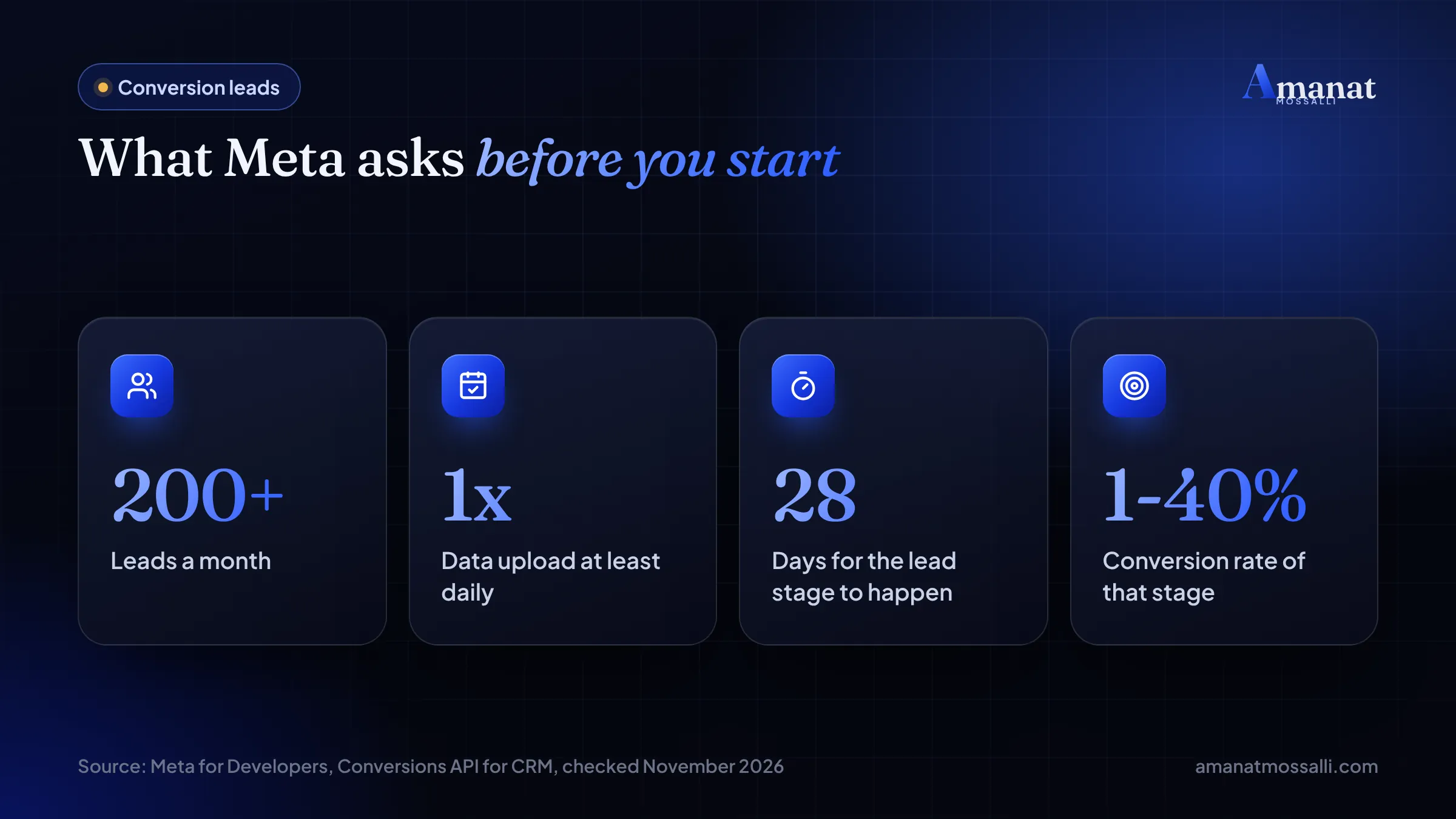
The same guide says to store Meta’s 15 to 17 digit lead ID in your CRM and send it with each event. It expects a learning phase of 2 to 4 weeks before the full effect shows.
Pick the stage carefully. “Called” happens too often to teach Meta much. “Paid” may be too rare. For a clinic, “showed up for consultation” usually sits inside that 1% to 40% band.
If you get fewer than 200 leads a month, don’t force it. Use the Higher intent form, good questions and fast follow-up. Those three fix most problems at small volume.
The Rupganj Clinic, Before and After
Back to that Friday night sheet. The clinic was running a More volume form with name and phone only. The ad said “Free hair consultation”. The front desk downloaded leads each morning and called after lunch.
We changed five things over one weekend:
- 1Offer: a doctor’s consultation at a stated price, shown in the ad.
- 2Audience: adults within a short drive of the clinic, not the whole of Dhaka division.
- 3Form: Higher intent, with two questions on treatment and when they wanted to visit.
- 4End screen: a promise to call within 10 minutes, between 10 am and 9 pm.
- 5Flow: each lead went to a sheet, the front desk got a WhatsApp alert, and the patient got an SMS with the address.
Lead volume dropped, as I’d warned the owner it would. Cost per lead went from about Tk 140 to about Tk 260. But booked consultations rose from roughly 6 in every 100 leads to about 19. So the cost per booked consultation fell from about Tk 2,330 to about Tk 1,370.
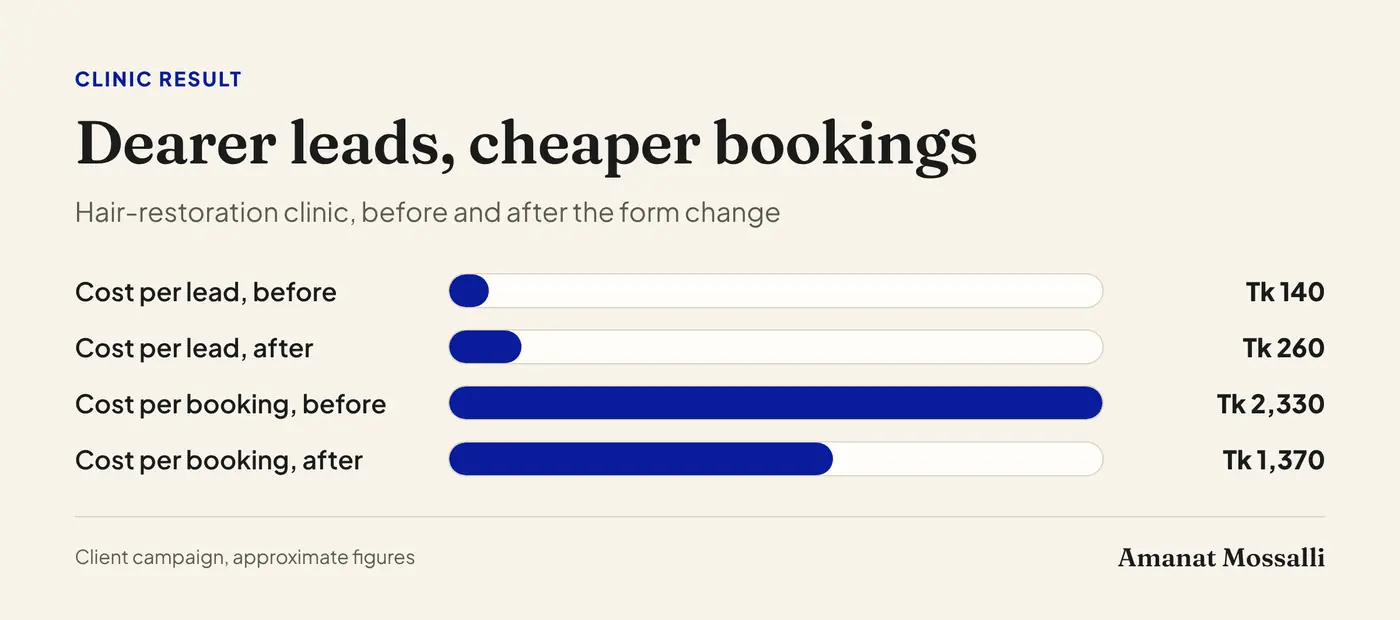
The price in the ad did a lot of quiet filtering. People who couldn’t afford it skipped the form. The ones who submitted already knew the cost, so the calls were shorter too.
The front desk now marks booked, visited and paid in the sheet. When the clinic passes 200 leads a month, that data will feed conversion leads optimisation.
Lead Quality Fixes for Facebook Lead Ads
When the leads stop answering, check these before you blame the algorithm.
- A form with only name and phone. Add one or two real-choice questions.
- A vague offer. Say what they get, for whom, and the price or starting price.
- Calling back tomorrow. Leads cool fast. Aim for five minutes.
- Judging by cost per lead. Track cost per booking or sale instead.
- No status tracking. Without stages you can’t see which ads bring buyers.
- Targeting the whole country for a service people must visit in person.
B2B leads need the same fixes, plus one more: the right person on the form.
An effluent treatment plant servicing firm in Konabari called me on a Monday morning, frustrated. Their lead ads brought about 90 leads a month. Their engineer had visited a dozen sites and found students, job seekers and one man selling chemicals.
The form only asked for name and phone. The ad showed a shiny plant photo with “ETP solutions” and nothing else. We rewrote the ad for factory compliance managers, naming the service and the buyer audit it helped with. The form gained two questions: the number of workers on site, and when the work was needed. “Just researching” went to a polite closing screen.
Leads fell to about 35 a month. Site visits that turned into a quotation went from roughly 1 in 12 to about 1 in 4. The engineer stopped losing his Saturdays.
Same lesson as the clinic, different buyer. Ask who they are, and say who you’re for.
If your cost per lead is the worry, my breakdown of Facebook ads cost in Bangladesh explains what drives it.
FAQ: Facebook Lead Ads
Are Facebook lead ads worth it for small businesses?
Why do my Facebook lead ads bring fake or junk leads?
What is the difference between More volume and Higher intent forms?
How many questions should a lead form have?
How do I get Facebook leads into my CRM automatically?
How quickly should I call a Facebook lead?
Do I need a website to run lead ads?
Should I use lead ads or Messenger ads?
Before Your Next Lead Arrives
Open your current form and read it as a stranger would. Could you submit it in two taps without knowing the price? Then so can everyone else.
The clinic’s manager put it best a month after the change. She said she used to dread the lead sheet. Now she opens it before her tea, because the people on it actually pick up.
That’s the goal. Not more names. Names that answer.

Amanat Mossalli Taju
Senior Digital Marketer & SEO Expert, Dhaka, BangladeshI have grown 235+ brands over more than seven years with SEO, Google and Meta Ads, server-side tracking, WordPress and AI automation. Half of my clients are in the UK, USA, Australia and Canada. Everything I write here comes from real client work.
Want this done for your business?
Book a free 15-minute call. I look at your site and ads before we talk, so you leave with clear next steps.