Google Ads vs Facebook Ads in Bangladesh: Where Should a Small Business Spend First?
Search ads or social ads? A plain decision matrix for Bangladeshi small businesses, with 2026 audience data, two real-life scenarios and a starter budget split.

Tk 30,000 for ads this month, and two tabs open on your laptop. One is Google Ads, full of match types and bidding strategies. The other is Facebook, where your cousin’s shop seems to be doing fine.
Most owners pick Facebook because everyone they know is on it. Sometimes that’s right. Often it isn’t.
Here’s the rule I use with clients. Choose Google when people already search for what you sell. Choose Facebook when you have to create the want first. One catches buyers at the moment of need. The other puts your offer in front of people who weren’t looking yet.
That one split explains why a payroll software firm, a dentist and a home-décor page each get a different answer. Below you’ll find the numbers behind each platform and a worked example in taka. Then what paying from Bangladesh adds, two clients who had it backwards, and a 60-day test that settles it.
The short version
- Google works on intent: people are already searching. Facebook works on interest: you interrupt their scroll.
- Google handled 98.46% of searches in Bangladesh in October 2026. Facebook ads could reach 64.0 million people here in late 2025.
- Clinics, repairs and B2B services usually start better on Google. Fashion, décor, food and gifts usually start better on Facebook and Instagram.
- Judge both by cost per paying customer. A cheap lead is often an expensive customer.
- Budget 15% VAT on top of whatever you spend on either platform with a local card.
Which one is actually better for a Bangladeshi business?
Neither, in general. The better platform is the one that matches how your customer buys. If they search before they buy, start with Google. If they buy because they saw something they liked, start with Facebook.
So “Google Ads or Facebook Ads, which is better?” has no single answer. It depends on your product, your price and your buyer’s habits. This guide gives you a way to decide for your own business, not someone else’s.
| Question | Google Ads | Facebook Ads |
|---|---|---|
| How people find you | They search for it | They see it while scrolling |
| Best at | Capturing existing demand | Creating new demand |
| Typical click price | Higher | Lower |
| Typical lead quality | Higher intent | Mixed, needs filtering |
| Needs good visuals | Helpful | Essential |
| Needs a website | Yes, almost always | Not always: Messenger, WhatsApp and forms work |
Think of search ads and social ads as a shop on a busy road and a flyer pressed into someone’s hand. Both sell. They reach people at different moments.
What's the difference between intent and interest?
Intent advertising shows ads to people who are actively looking. Interest advertising shows ads to people who fit a profile but aren’t looking right now. Everything else on this page follows from that split.
Google: you pay to meet a need
Someone types “root canal cost dhanmondi” or “payroll software bangladesh”. They have a problem today, and your ad answers it. The click costs more, but the person is close to buying.
Facebook: you pay to start a want
Someone scrolls past a video of a new Eid collection at 11pm. They weren’t shopping. Now they want it. The click is cheaper, but plenty of viewers are only browsing.
Would my customer type my product into Google? If yes, Google is a strong start. If they’d never search for it until they saw it, start with Facebook.
One test I add in Keyword Planner: look up your ten main phrases with Bangladesh as the location. If most show tiny or no monthly searches, Google has little demand to catch yet. My guide on Google Ads cost in Bangladesh walks through reading those numbers.
How big is each audience here?
Both are huge. Google owns search. Meta owns the feeds.
StatCounter put Google at 98.04% of search in Bangladesh in September 2026. When I checked again on 12 November 2026, October’s figure was 98.46%, with Bing at 1.01%. Either way, “search” here means Google.
On the social side, DataReportal’s Digital 2026 Bangladesh report (checked 12 November 2026) gives these ad reach figures for late 2025:
| Platform | Ad reach in Bangladesh | What it means for you |
|---|---|---|
| 64.0 million | The default place to create demand | |
| YouTube (Google) | 49.8 million | Google’s own way to reach people who aren’t searching |
| Messenger | 35.0 million | Where most Facebook orders here are actually closed |
| 9.15 million | Smaller, younger and more urban; strong for visual brands |
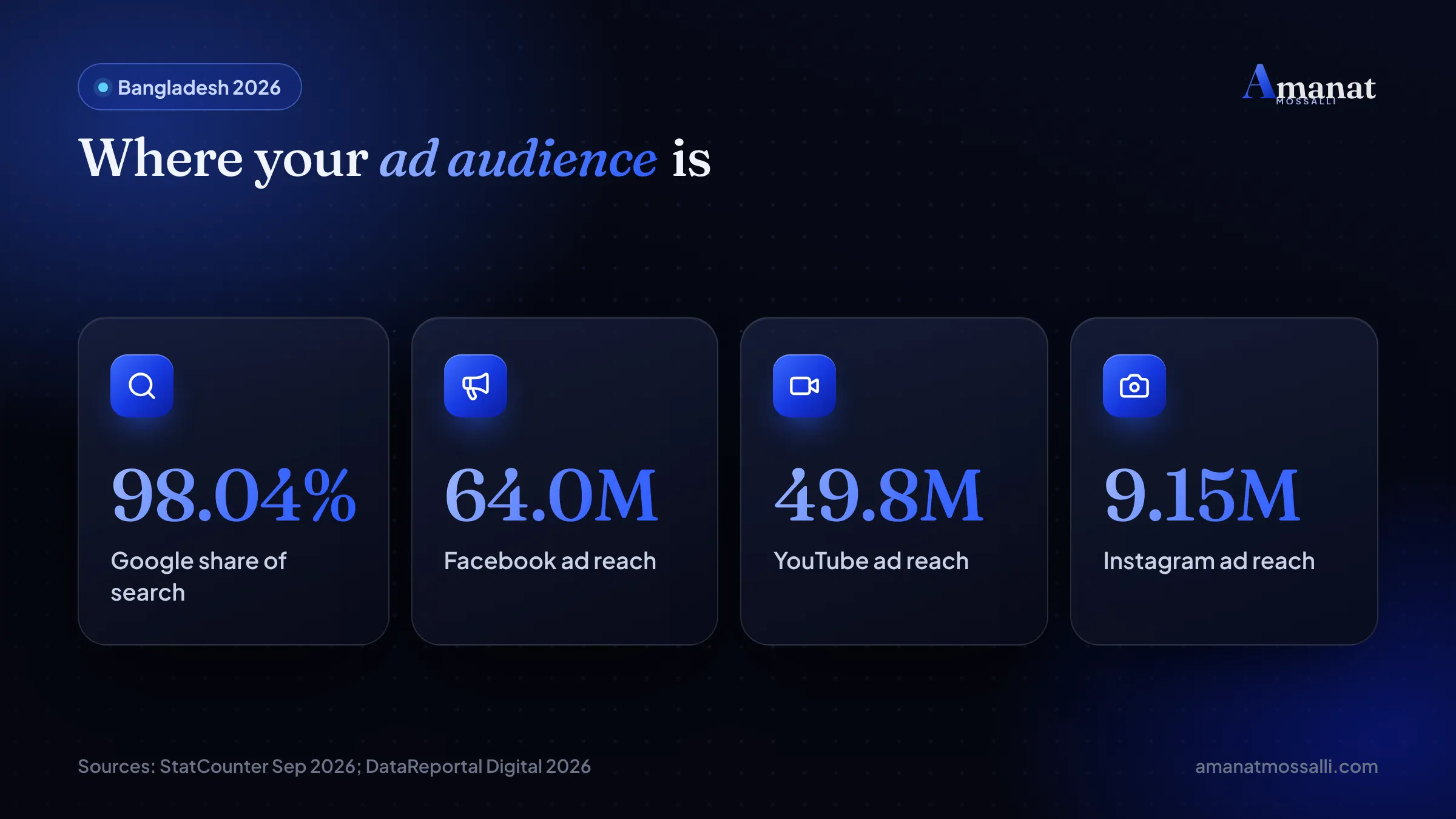
DataReportal warns that ad reach isn’t the same as monthly active users. One more figure from the same report changes targeting decisions. Of adults Facebook ads can reach here, 63.1% are male and 36.9% female.
So if you sell to women, Facebook’s audience is smaller than the headline suggests. That’s one reason I see beauty and fashion brands lean on Instagram more than the reach numbers alone would justify.
Which costs less per click, and per lead?
Facebook clicks and leads are usually cheaper. Google leads usually show stronger intent. The only fair comparison is cost per paying customer.
There’s no reliable public benchmark for Bangladesh. The best large datasets are American, so read them for the pattern, not the price.
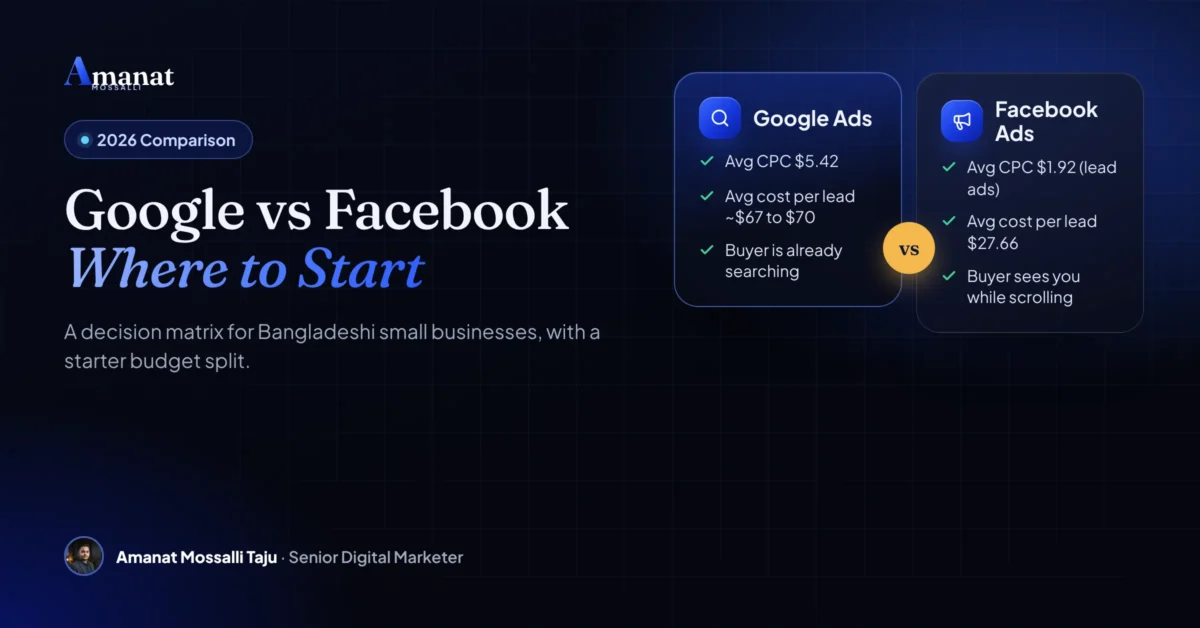
- Facebook: WordStream’s 2025 Facebook benchmarks give lead campaigns a $1.92 cost per click and a $27.66 cost per lead. Traffic campaigns averaged $0.70 a click. The data runs from April 2024 to June 2025.
- Google: WordStream’s 2026 Google Ads benchmarks put the average search click at $5.42 and the average lead at $66.69. That covers 13,474 US search campaigns from April 2025 to March 2026.
The previous edition of the Google report put cost per lead at $70.11. Search Engine Land compared that figure with the Facebook one. Both pages were checked on 12 November 2026.
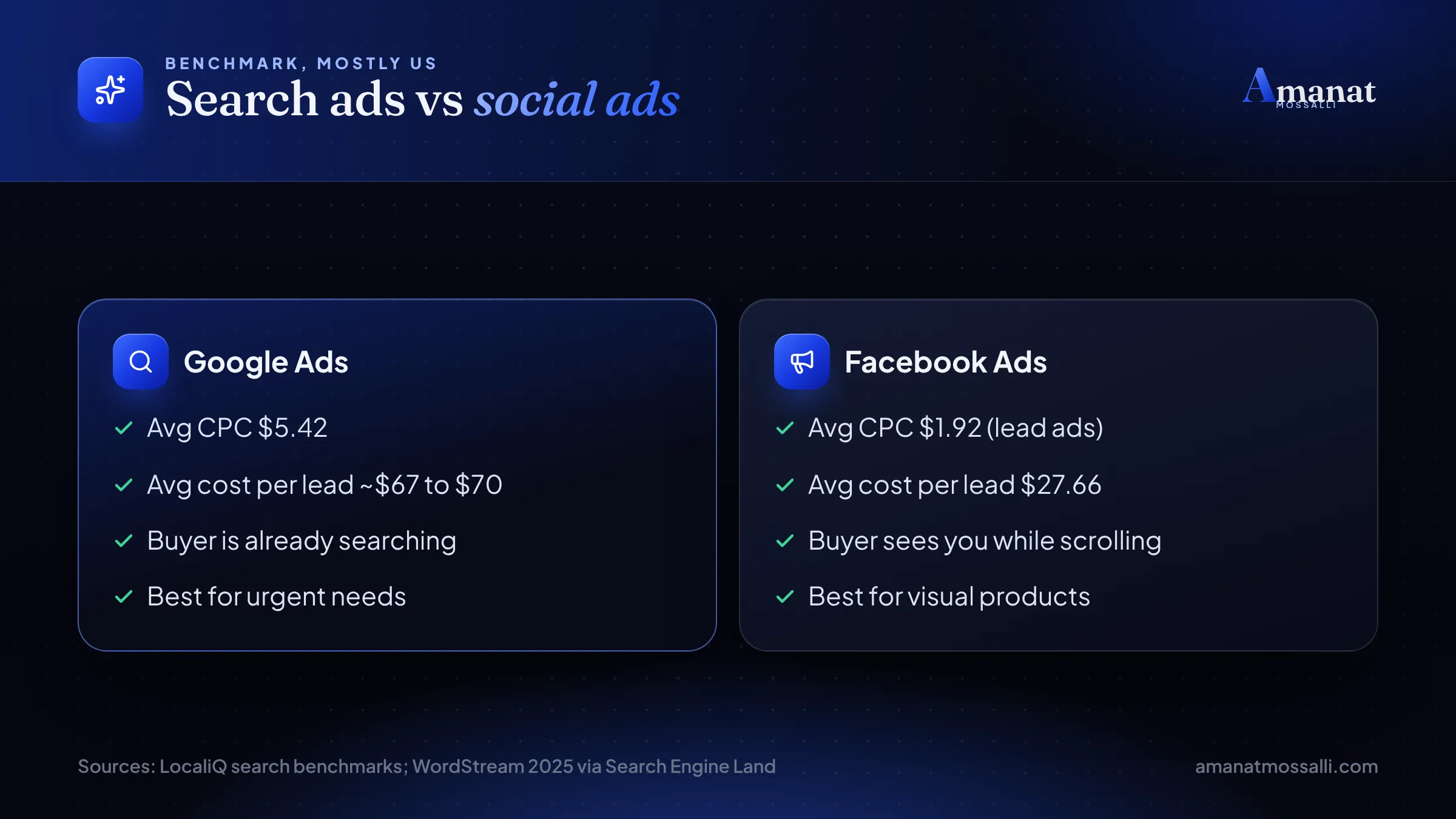
Both are far cheaper in taka here. The pattern often holds anyway. A Facebook lead form is easy to fill, so you get more names and more wrong numbers. A Google searcher who calls you usually has a real need.
About half my clients are in the UK, USA, Australia, Canada and Europe, and the other half are here. The gap between Google and Facebook prices shrinks or widens by market. The direction almost never flips.
A worked example in taka
Here’s how it plays out. Say you spend Tk 24,000 on each platform for a month, selling a service worth a few thousand taka. These rates are for illustration only; your own will differ.
| Step | Google search | Facebook lead ads |
|---|---|---|
| Spend | Tk 24,000 | Tk 24,000 |
| Cost per click | Tk 30 | Tk 10 |
| Clicks | 800 | 2,400 |
| Leads | 40 (5% of clicks) | 96 (4% of clicks) |
| Cost per lead | Tk 600 | Tk 250 |
| Paying customers | 12 (3 in 10 leads) | 8 (1 in 12 leads) |
| Cost per customer | Tk 2,000 | Tk 3,000 |
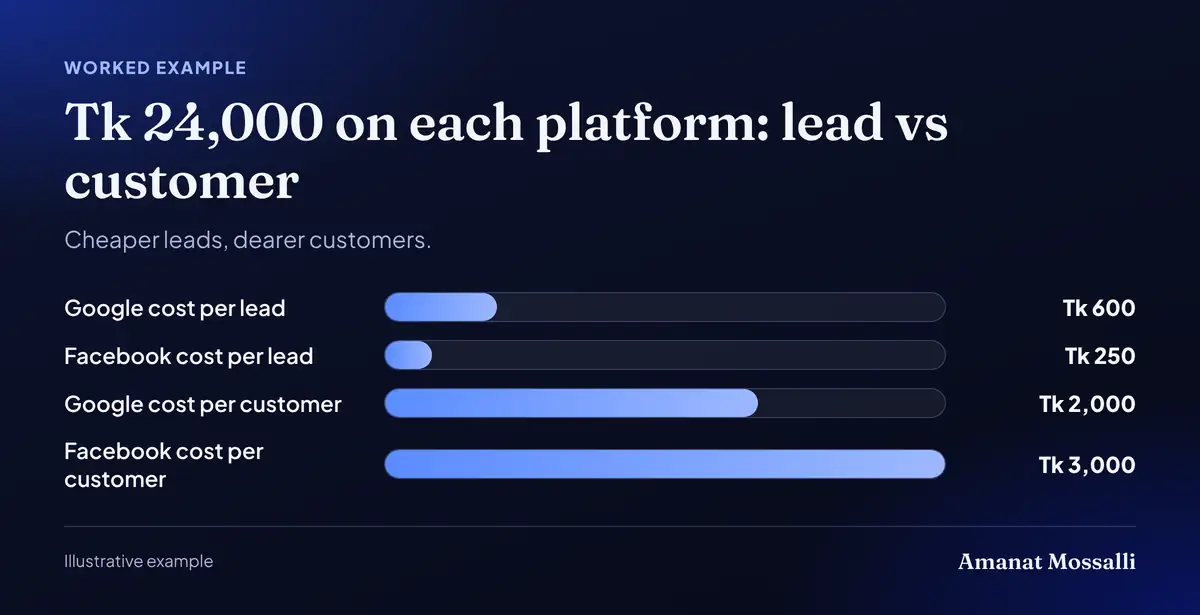
Facebook looks like the winner on the dashboard. Its leads cost less than half. Your bank account says the opposite, because fewer of those 96 people ever pay.
Flip the close rate and the answer flips too. If your Facebook leads close at 1 in 6, the cost per customer drops to Tk 1,500. That’s why I never pick a platform from someone else’s numbers.
What about ROAS on Google vs Facebook?
ROAS means return on ad spend: sales value divided by ad cost. Don’t compare it straight from each dashboard. Each platform counts sales its own way, and both will happily claim the same order.
Check both against your real orders in WooCommerce, Shopify or your order sheet. Cash-on-delivery returns matter a lot here, so count delivered orders, not placed ones. A Tk 1,200 order that comes back unopened earned you nothing and cost you the courier fee twice.
What paying from Bangladesh adds to either bill
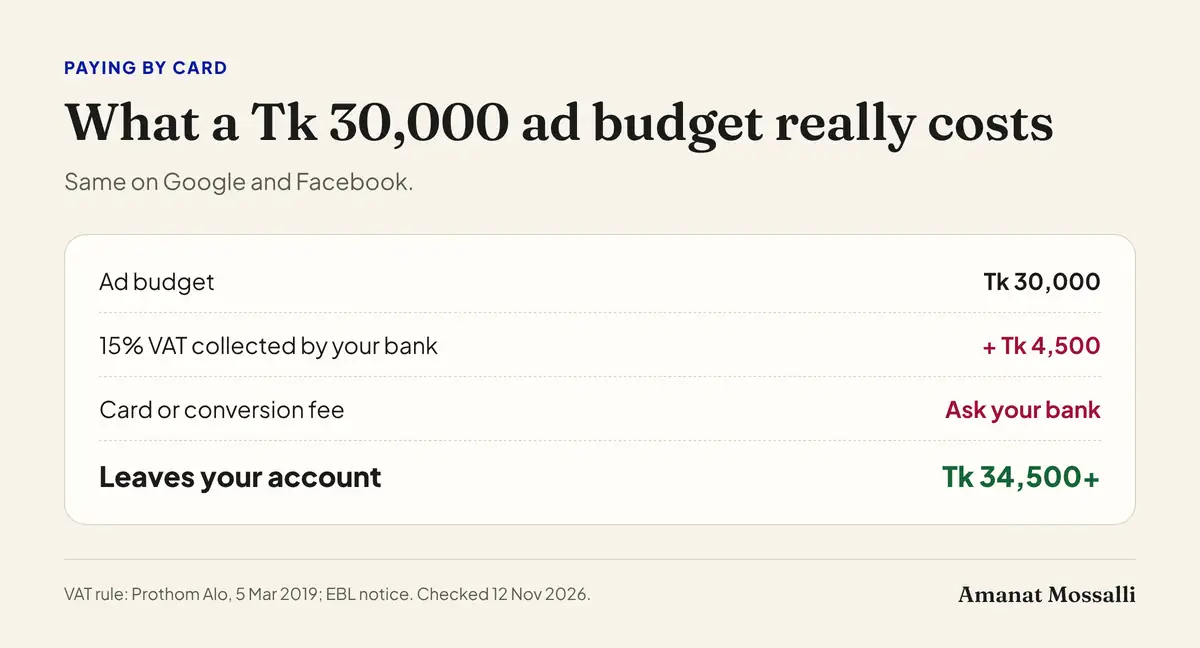
The same thing on both platforms: 15% VAT, plus whatever your bank charges to turn taka into dollars. Plan with those in, or you’ll run short mid-month.
The VAT rule dates from 2019. Prothom Alo reported in March 2019 that Bangladesh Bank told banks to collect 15% VAT on payments to social media platforms. Eastern Bank’s cardholder notice names Facebook, Google and YouTube, from 1 December 2019. Both checked 12 November 2026.
| Line | Amount |
|---|---|
| Ad budget you want to spend | Tk 30,000 |
| 15% VAT collected by your bank | Tk 4,500 |
| Card or conversion fee | Varies by bank; ask yours |
| Total leaving your account | Tk 34,500, plus any bank fee |
No dollar card? There’s a second route. The Daily Star covered a Bangladesh Bank circular dated 17 June 2025. It lets advertisers pay for ads on foreign platforms through local ad agencies, without separate central bank approval.
The agency needs valid agreements and invoices, proof of tax paid, and an undertaking to return any excess remittance. Each payment goes through one designated bank branch. So ask any agency offering this for the invoice trail before you hand over money.
For the card side step by step, see how to pay for Facebook ads in Bangladesh. Google works the same way at the bank.
Google Ads vs Facebook Ads in Bangladesh: the decision matrix
Use this to pick your first channel. It’s based on how customers in each category usually buy. After a month or two, your own data should overrule it.
| Business type | Start with | Why | Add next |
|---|---|---|---|
| Clinic, dentist, diagnostic centre | Patients search by problem and area | Facebook for awareness and reviews | |
| B2B software or services | Buyers search for solutions at work | LinkedIn or Facebook remarketing | |
| Fashion, cosmetics, gifts | Facebook and Instagram | People buy what they see | Google Shopping or brand search |
| Restaurant or cafe | Facebook and Instagram | Food is visual and local | Google Maps profile |
| Coaching and courses | Both | Some search, many need convincing | Remarketing on both |
| Real estate in Dhaka | Both | Search for intent, Facebook for reach | Video and remarketing |
| Emergency services, repairs | Need is urgent, search is instant | Call ads and Maps | |
| Exporters selling abroad | Foreign buyers search for suppliers | LinkedIn and remarketing |
Which platform for leads?
If you sell a service people search for, Google usually brings fewer but better leads. If your service needs explaining, Facebook can build interest first. For many businesses the honest answer is both, in that order.
One warning on Facebook lead forms. The “more volume” setting fills your list fast, often with people who tapped by accident. The “higher intent” setting adds a review step and usually costs more per lead. For anything you call back by phone, I start with higher intent.
When should Google come first?
When people already search for your product or service. Keyword Planner tells you in about ten minutes.
- The need is urgent. AC repair, a lawyer, a dentist, a locksmith.
- The price is high. People research before spending lakhs on software, a flat or a course abroad.
- You sell to businesses. B2B searchers tend to have a budget and a deadline.
- You serve a clear area. “Physiotherapy in Mohammadpur” or “courier service Chattogram” shows local intent.
Last March the founder of a small HR and payroll software company sat across from me in Tejgaon. He’d boosted Facebook posts for eight months. His inbox had about sixty messages a month. Most were students asking about internships. Two or three a month turned into a demo.
I’m Amanat Mossalli Taju, and I’ve managed more than $8M of Google and Meta spend. I see this mismatch often. His buyers were HR managers. HR managers don’t scroll Facebook looking for payroll tools. They search when the spreadsheet breaks.
We kept his Tk 40,000 a month and moved most of it to Google search. Phrases like “payroll software Bangladesh” and “HR software for garments factory”. We added negative keywords for “job”, “internship” and “free”. By month two he had about 22 enquiries instead of sixty, and seven booked demos. His cost per demo fell from roughly Tk 16,000 to under Tk 6,000. Fewer messages, and he finally liked reading them.
Before you spend, read my guide on SEO for Bangladeshi businesses. The same keyword research powers your ads and your free search traffic.
When should Facebook come first?
When your product sells on looks, emotion or impulse. Also when nobody searches for your category yet, because you can’t catch demand that doesn’t exist.
- Visual products. Clothes, home décor, food and cosmetics.
- Low to mid price. People decide in minutes, often in Messenger.
- New ideas. A new snack brand or app that people don’t know to search for.
- Local events. A workshop, a fair or a restaurant opening.
The opposite case came a few weeks later. A young couple in Manikganj made terracotta planters and wall pieces, sold through a Facebook page. Someone had told them Google was “more professional”. So they were paying for clicks on “terracotta planter online” and “clay pot price”.
The searches existed, but they were tiny, and many came from people wanting cheap plain pots. On Tk 15,000 a month they got nine orders. That’s about Tk 1,670 per order, on products that sold for Tk 900 to Tk 2,500.
We moved the whole Tk 15,000 to short Reels. Hands shaping clay, a planter on a sunny balcony, the price on screen, and a Messenger button. In month two they had 31 delivered orders. That’s under Tk 500 per order. Their buyers decided by looking, not by searching, so the ads had to go where people look.
Ecommerce Facebook ads work well here because buying often happens inside Messenger and WhatsApp, with cash on delivery or bKash. My guide to social media marketing for Bangladeshi businesses covers the content side.
YouTube, Demand Gen and click-to-WhatsApp: the middle ground
The choice isn’t as clean as “search vs feed” anymore. Each platform now sells a bit of the other’s strength.
Google can interrupt too. YouTube reaches 49.8 million people here, by the DataReportal figure above. Google’s Demand Gen campaigns show image and video ads on YouTube, Discover and Gmail to people who aren’t searching. That’s Google behaving like Facebook.
Facebook can catch some intent. Click-to-WhatsApp and Messenger ads open a chat straight from the ad. Someone who taps “Send message” has raised a hand. It’s not a search, but it’s closer than a like.
My advice for a first campaign: stay with each platform’s core strength. Run Google search, not Demand Gen. Run Facebook messaging or sales campaigns, not reach. Add the middle-ground formats once the core is working and tracked.
Sending Facebook traffic to WhatsApp? My guide on WhatsApp Business marketing in Bangladesh covers the replies, labels and catalog that close the sale.
Setup, payment and skills: the practical differences
Facebook is easier to start. Google is easier to scale when demand is steady. These practical points matter as much as audience size.
| Practical point | Google Ads | Facebook Ads |
|---|---|---|
| What you need first | Keyword list, landing page, conversion tracking | Page, good photos or video, pixel |
| Creative work | Text ads, a few images | Fresh images and videos every few weeks |
| Where people convert | Your website, a call or WhatsApp | Messenger, instant forms, WhatsApp or your website |
| Payment | International or dual-currency card, or a local agency | Same card options, or a local agency |
| VAT on card payments | 15% | 15% |
| Skill to learn | Keywords, match types, negatives | Audiences, creative testing, offers |
| Time to first results | Days, if demand exists | Days, if the creative is strong |
Creative is the hidden cost of Facebook
On Facebook, the ad is the product photo or video. When people see the same ad too often, results drop and you need fresh creative. Budget time or money for a phone shoot every few weeks.
The landing page is the hidden cost of Google
A searcher who lands on a slow or generic page leaves, and you paid more for that click. Owners always underestimate this part. One page per service, with the price range, the area you cover and a WhatsApp button, beats a pretty homepage.
Why does remarketing work best on both?
Remarketing shows your ad again to people who already visited your site or engaged with your page. Those are often the cheapest sales on either platform, because the person already knows you.
A smart pattern: find people on one platform, follow up on the other. A shopper finds you through Google search, leaves, then sees your Facebook ad with a reason to come back.
Small businesses can do this now too. Search Engine Land reported that Google lowered the minimum size of remarketing and customer lists to 100 users across Search, Display and YouTube.
And the mistakes that wreck comparisons between the two:
- Comparing cost per click instead of cost per sale.
- Boosting posts and calling it a Facebook ads strategy. My Boost vs Ads Manager guide explains the gap.
- Sending Google ads to a Facebook page instead of a real landing page.
- Trusting both dashboards when they claim the same order.
- Judging a platform after one week and a few thousand taka.
- Skipping tracking, so neither platform can learn who buys.
Most of these come down to missing tracking. Without the Meta pixel and Google conversion tracking, you can’t judge either platform fairly. If yours isn’t set up, my tracking and analytics service covers GA4, the Google tag and the Meta pixel with Conversions API.
How do you test the two fairly?
Same goal, same tracking, same time frame. Then compare cost per real customer. Anything else is guessing with extra steps.
Add one question to your form or call script: “Where did you hear about us?” It’s old-fashioned, and it catches what tracking misses.
Here’s the calendar I give clients for that test. Nothing in it is fast, on purpose.
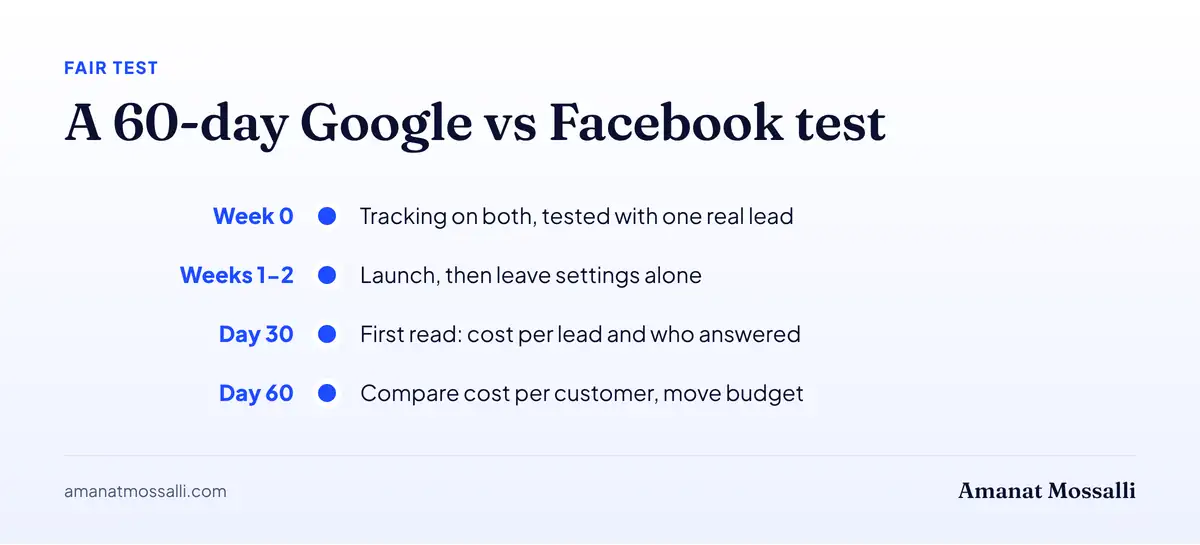
- Week 0: tracking on both platforms, tested with one real order or lead.
- Weeks 1 and 2: launch, then leave the settings alone while each platform learns.
- Day 30: first read of cost per lead, and of which leads actually answered the phone.
- Day 60: compare cost per paying customer and move the budget.
Where should your first taka go?
Put 70% on your main platform and 30% on the second. After 60 days, move money to whichever brings cheaper real customers.
| Business type | Google share | Facebook and Instagram share |
|---|---|---|
| Clinic, B2B, urgent service | 70% | 30% (mostly remarketing) |
| Fashion, gifts, food | 20% (brand and product search) | 80% |
| Courses, real estate, travel | 50% | 50% |
| Tiny budget, under BDT 15,000 | 100% on the better fit | Wait until you have data |
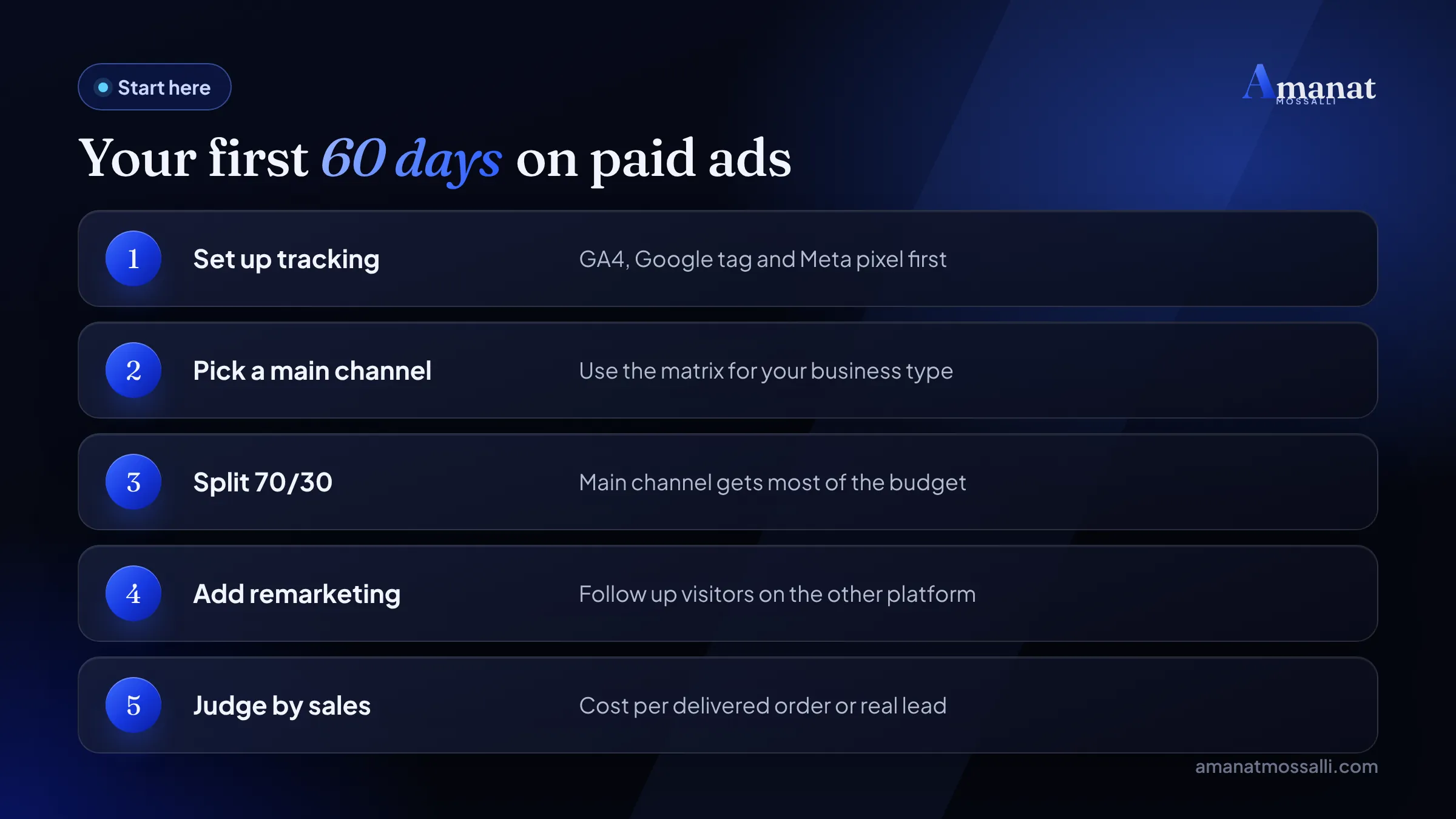
On Tk 30,000, a clinic would put Tk 21,000 on Google search and Tk 9,000 on Facebook remarketing. A décor page would put Tk 24,000 on Facebook and Instagram and Tk 6,000 on Google brand search. Add the 15% VAT on top of both.
These splits are starting points, not rules. I’d rather you ignore my table in month three than follow it blindly.
FAQ: Google Ads vs Facebook Ads in Bangladesh
Is Google Ads better than Facebook Ads in Bangladesh?
Which is cheaper, Google Ads or Facebook Ads?
Can I run Facebook ads without a website in Bangladesh?
Which platform is best for B2B leads?
How much should a small business spend on each platform?
Why do Google and Facebook both claim the same sale?
Should I boost posts or use Ads Manager?
Searching or scrolling? Decide by Friday
You don’t need a month of reading to make the first call. You need one evening and an honest answer about your buyer.
Tonight, open Keyword Planner and check your ten main phrases. Tomorrow, read your last thirty Messenger or WhatsApp enquiries and note how each person found you. By Friday you’ll know whether your buyers are searching or scrolling, and that tells you where the 70% goes.
Then set up tracking before a single taka goes out. The payroll founder and the Manikganj couple made opposite choices, and both were fixed the same way: by counting customers instead of clicks.
If the Meta side is your main channel, my Meta Ads service page shows how I set those campaigns up. If you’re still unsure after the Keyword Planner check, send me your ten phrases and what you sell. I’ll tell you which platform I’d start with.

Amanat Mossalli Taju
Senior Digital Marketer & SEO Expert, Dhaka, BangladeshI have grown 235+ brands over more than seven years with SEO, Google and Meta Ads, server-side tracking, WordPress and AI automation. Half of my clients are in the UK, USA, Australia and Canada. Everything I write here comes from real client work.
Want this done for your business?
Book a free 15-minute call. I look at your site and ads before we talk, so you leave with clear next steps.