SEO vs GEO vs AEO: The Plain-English Difference, and Which One You Need First
Three names, one base. SEO, AEO and GEO explained without jargon, with a comparison table, the platforms' own rules and a clinic example from Dhanmondi.

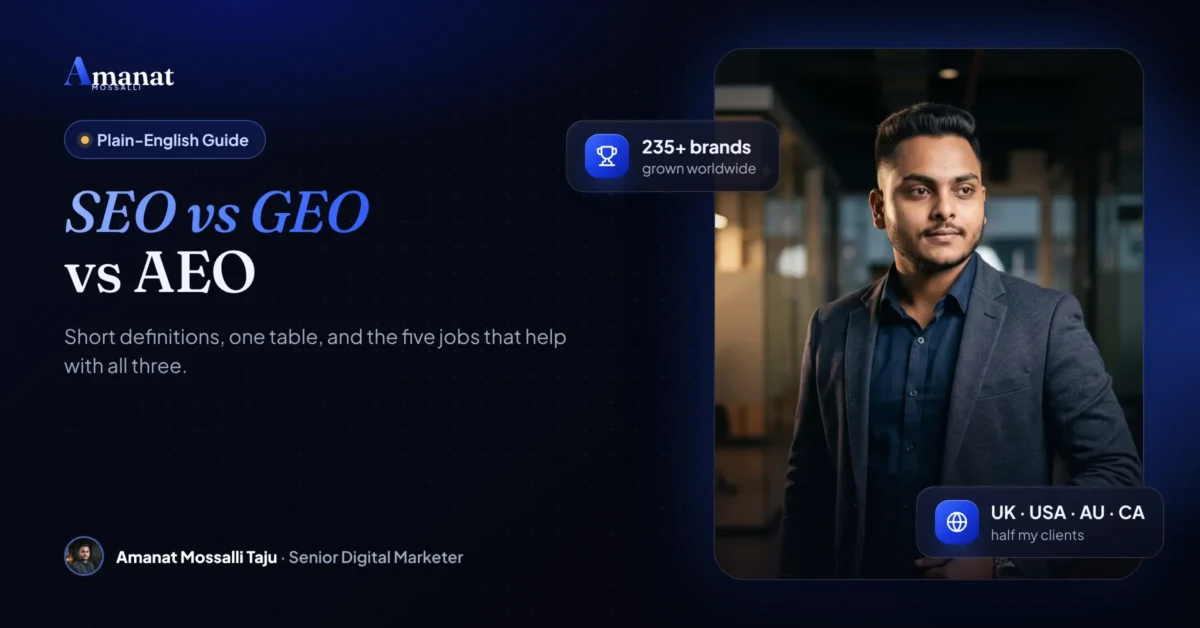
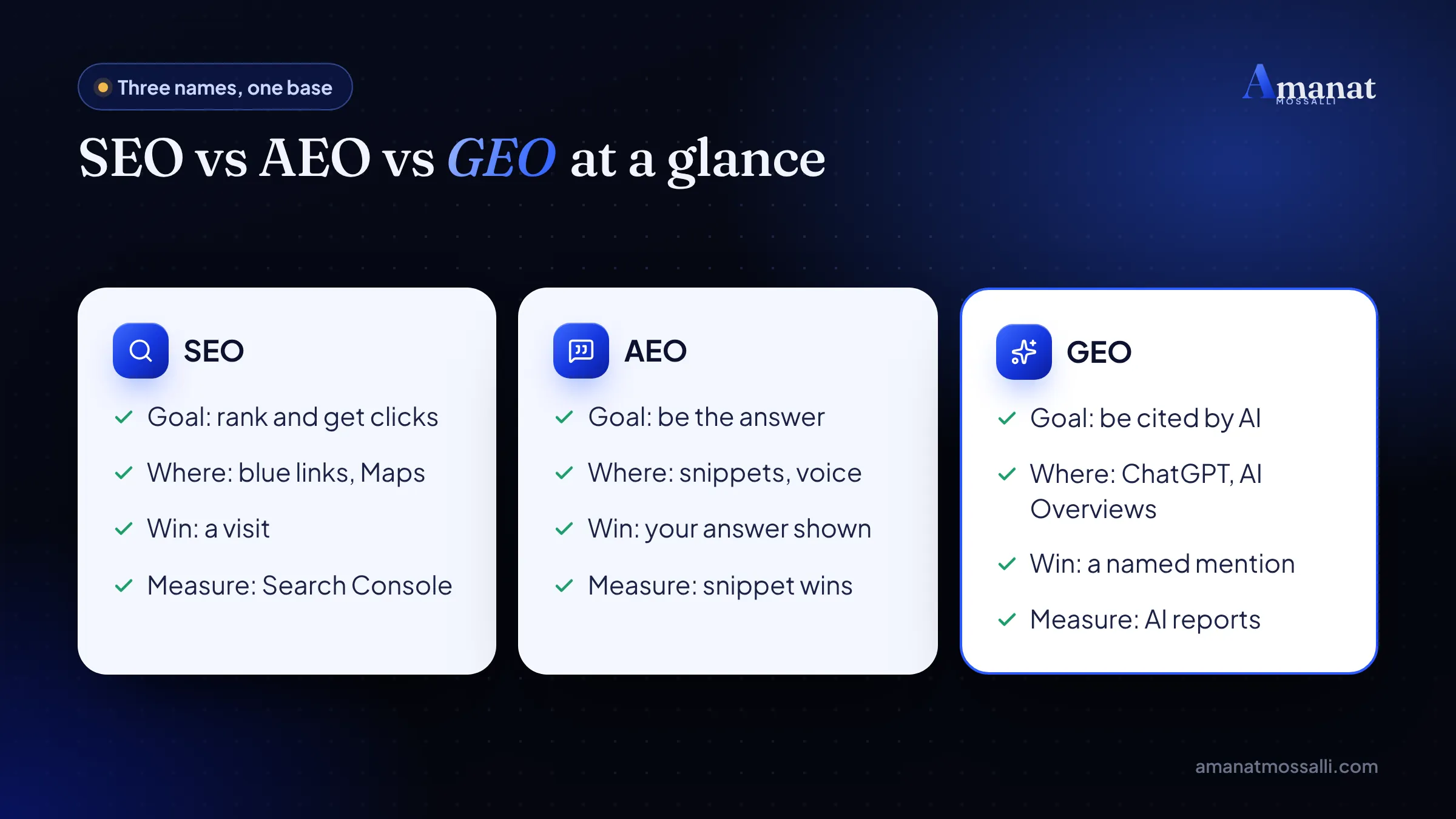
SEO vs GEO vs AEO comes down to where you want to show up. SEO gets a page ranked in search results. AEO gets your answer shown directly, like a featured snippet or a voice reply. GEO gets your content cited inside AI answers from ChatGPT, Gemini or Google AI Overviews. Same page, three places it can win.
The names make them sound like three separate projects. They’re not. Most of what gets a page cited by an AI is the same work that gets it ranked. I’ll show you the overlap, the few real differences, and one search played out on a single screen.
Every claim here about how Google, Bing or ChatGPT behaves links to that platform’s own documentation or to a named study. I checked each link on 12 November 2026. Where nobody has published a rule, I’ll say so rather than invent one.
The short version
- SEO wants a ranking and a click. AEO wants to be the answer box. GEO wants a citation inside an AI-written reply.
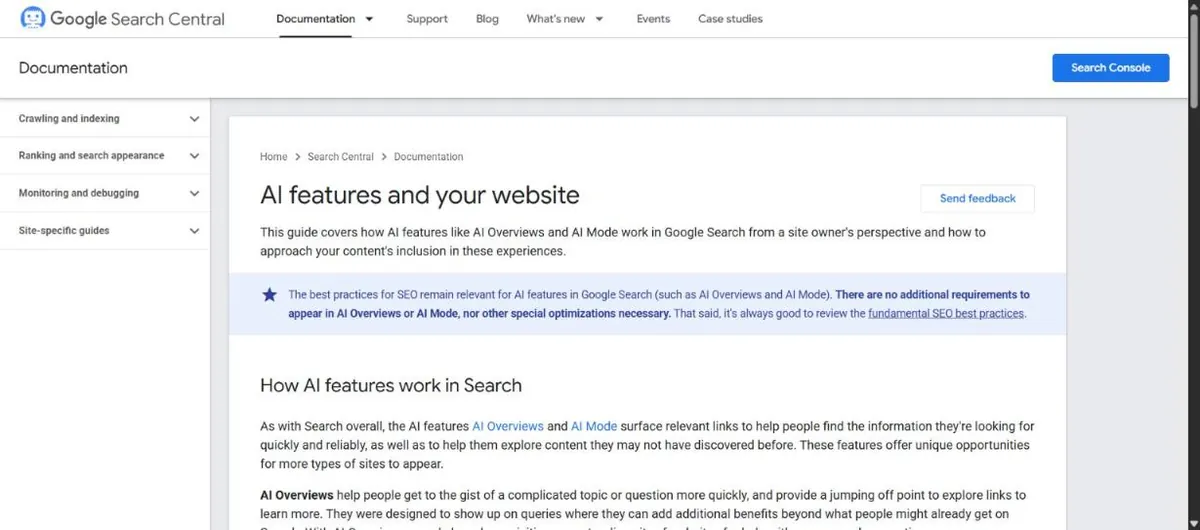
- Google says AI Overviews need nothing beyond being indexed and eligible for a snippet. No special file, no special schema.
- GEO adds a few habits on top: quotable passages, named sources and statistics, brand mentions, and tracking AI visibility.
- No platform has published a list of AI search ranking factors. Anyone selling one is guessing.
- Fix SEO first. Then add the AEO and GEO habits. In that order.
SEO vs GEO vs AEO: What's the Short Answer?
Three goals for the same content. SEO wants a ranking. AEO wants to be the answer. GEO wants a mention in an AI-written reply.
I’m Amanat Mossalli Taju, a senior digital marketer and SEO expert in Dhaka. I’ve helped clients rank #1 on Google in the UK, USA, Australia and Canada. Some of those pages are now cited in AI Overviews. The work behind them was mostly plain SEO done carefully. That’s the bias you should know about before reading on.
One honest note. AEO and GEO are industry labels, not Google terms. Google’s own documentation calls all of this “Search” and treats AI features as part of it.
Why Does This Matter More in Bangladesh Than Most Places?
Because almost all search here is Google, and Google now shows AI answers in Bangla. Your customers see all three kinds of results on one screen, often on a phone, often on mobile data.
The owner called me on a Tuesday afternoon in June, a bit rattled. His daughter had typed “best hearing aid centre in Dhaka” into ChatGPT. It named a competitor across town. Not him. He wanted to know if he should hire a “GEO agency” he’d seen advertised on Facebook.
I opened his site while we talked. No prices, not even a range. No page about the audiologist who does the hearing tests. His reviews lived on Facebook and nowhere else. The competitor’s site had all three on one clean page. I told him the honest thing: the fix wasn’t a new acronym. It was the SEO basics he’d skipped. He didn’t love hearing it.
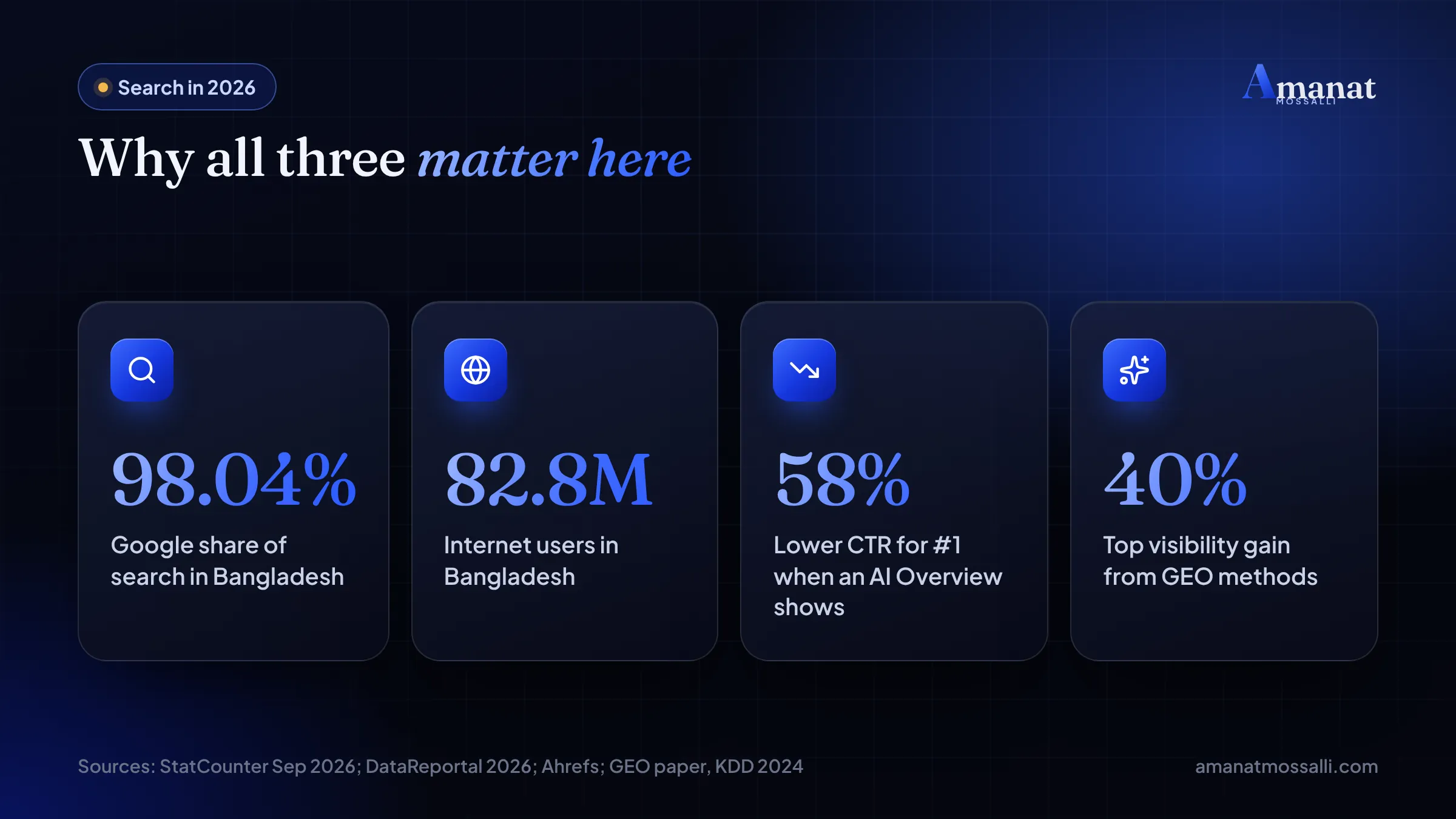
StatCounter gives Google 98.04% of search in Bangladesh for September 2026, and Bing 1.3%. DataReportal’s Digital 2026 report counted 82.8 million internet users in October 2025.
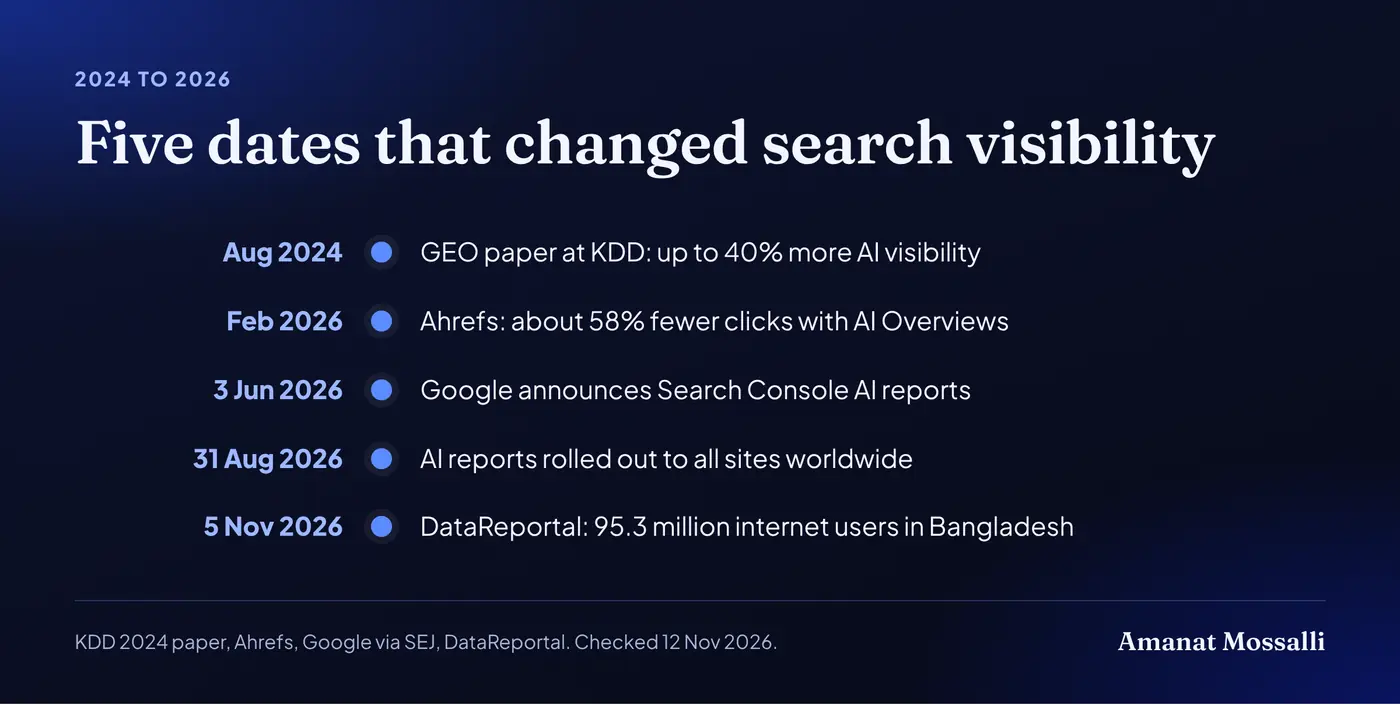
Its newer Digital 2027: Bangladesh report, published on 5 November 2026, puts the figure at 95.3 million. That’s 53.4% of the population. Millions more people are now searching, and a growing share of them see an AI answer first.
Google’s AI Overviews help page lists Bangladesh as a country and Bengali as a language. So a shopper in Sylhet searching in Bangla, English or Banglish can get an AI answer above the links.
That answer costs clicks. Ahrefs’ February 2026 update studied 300,000 keywords. When an AI Overview showed, the top-ranking page got about 58% fewer clicks on average, comparing December 2025 with December 2023. I’ve written more on that in why AI Overviews are cutting traffic.
So ranking alone is no longer the whole job. You also want to be the answer, and the source.
What Is SEO, in Plain English?
Everything you do so search engines can find your pages, understand them and show them to the right people. It’s the base layer. AEO and GEO sit on top of it.
Google’s SEO Starter Guide covers the basics. Google says it “primarily finds pages through links from other pages it already crawled”. It also says Google Search “doesn’t use the keywords meta tag”. That second one still surprises site owners every month.
- Technical SEO. Your pages can be crawled, indexed and load fast on mobile data.
- On-page SEO. Clear titles, headings and content that match what people search.
- Off-page SEO. Links and mentions from other trusted sites.
- Local SEO. Your Google Business Profile and reviews for searches like “dentist near me”.
For the full version for a Bangladeshi website, read my complete SEO guide for Bangladeshi businesses.
What Does Answer Engine Optimization Actually Do?
It writes content so a search engine or assistant can lift one clear answer out of it. The aim is to be the answer, not just a link under it.
AEO became a thing with featured snippets, the “People also ask” box and voice assistants. All of them show or read out one short answer.
AEO examples
- A clinic page that answers “How many visits does a root canal take?” in its first sentence, then explains.
- A shop FAQ that answers “Do you deliver outside Dhaka?” with a plain yes or no, the delivery time and the charge.
- A how-to page with numbered steps a voice assistant can read in order.
- A table comparing two products that Google can show as a snippet.
One rule to remember. Google’s featured snippets documentation says you can’t mark up a page to get a snippet. Asked if you can, it answers: “You can’t.” Google’s systems decide. Clear writing is your only lever.
What Is Generative Engine Optimization?
The work of getting your content cited inside AI-written answers. It covers ChatGPT search, Perplexity, Gemini, Copilot and Google AI Overviews.
The term comes from a research paper presented at KDD 2024 in Barcelona, in August 2024. The authors found that adding citations, quotations and statistics lifted a page’s visibility in AI answers by up to 40%. Keyword stuffing did little or nothing.
You’ll also hear LLM optimization. LLM means large language model, the technology behind ChatGPT and Gemini. In practice people use LLM optimization and GEO to mean the same thing. My longer guide to generative engine optimization goes deeper on the GEO side alone.
ChatGPT search optimization
For ChatGPT the first step is technical, and it’s boring. OpenAI’s crawler documentation says “Sites that are opted out of OAI-SearchBot will not be shown in ChatGPT search answers”. Check your robots.txt and firewall before anything else. I’ve seen a hosting firewall block the bot by default.
Don’t mix up OpenAI’s bots. GPTBot, the same page says, is used to make OpenAI’s foundation models “more useful and safe”. Blocking GPTBot is a choice about training. Blocking OAI-SearchBot is a choice about being found in ChatGPT search. Many site owners block both by accident.
How AI answers pick sources
Google’s AI features guide says AI Overviews and AI Mode may use “query fan-out”. That means running several related searches across subtopics, then pulling sources from all of them. In plain terms, your page can be cited for a question it never ranked for in the normal results. It just needs to answer one slice of that question very well.
The Full SEO vs AEO vs GEO Comparison Table
Everything in one place. The rows that differ most are the goal, where you win and how you measure.
| SEO | AEO | GEO | |
|---|---|---|---|
| Main goal | Rank and earn clicks | Be shown as the direct answer | Be cited or named in an AI answer |
| Where it shows | Search results, Google Maps | Featured snippets, People also ask, voice | AI Overviews, AI Mode, ChatGPT, Perplexity, Copilot |
| Content style | Full pages that match intent | Short, direct answers and lists | Quotable passages with facts and sources |
| Biggest signals | Relevance, quality, links, page experience | Clear answer near the top | Same as SEO, plus mentions across the web |
| Technical must | Crawlable and indexed | Crawlable and indexed | Also allow AI search crawlers like OAI-SearchBot |
| How to measure | Clicks, rankings, leads | Snippet and PAA appearances | AI impressions and citations, brand mentions |
| Free tools | Search Console, GA4 | Search Console, manual checks | Search Console generative AI reports, Bing AI Performance |
Look at the technical row. For all three, a page that can’t be crawled and indexed can’t win anything.
Now the measuring row. SEO has had free, reliable data for years. AEO and GEO data is newer and thinner. The next section shows what you can actually see today.
How Do You Measure AI Visibility in Late 2026?
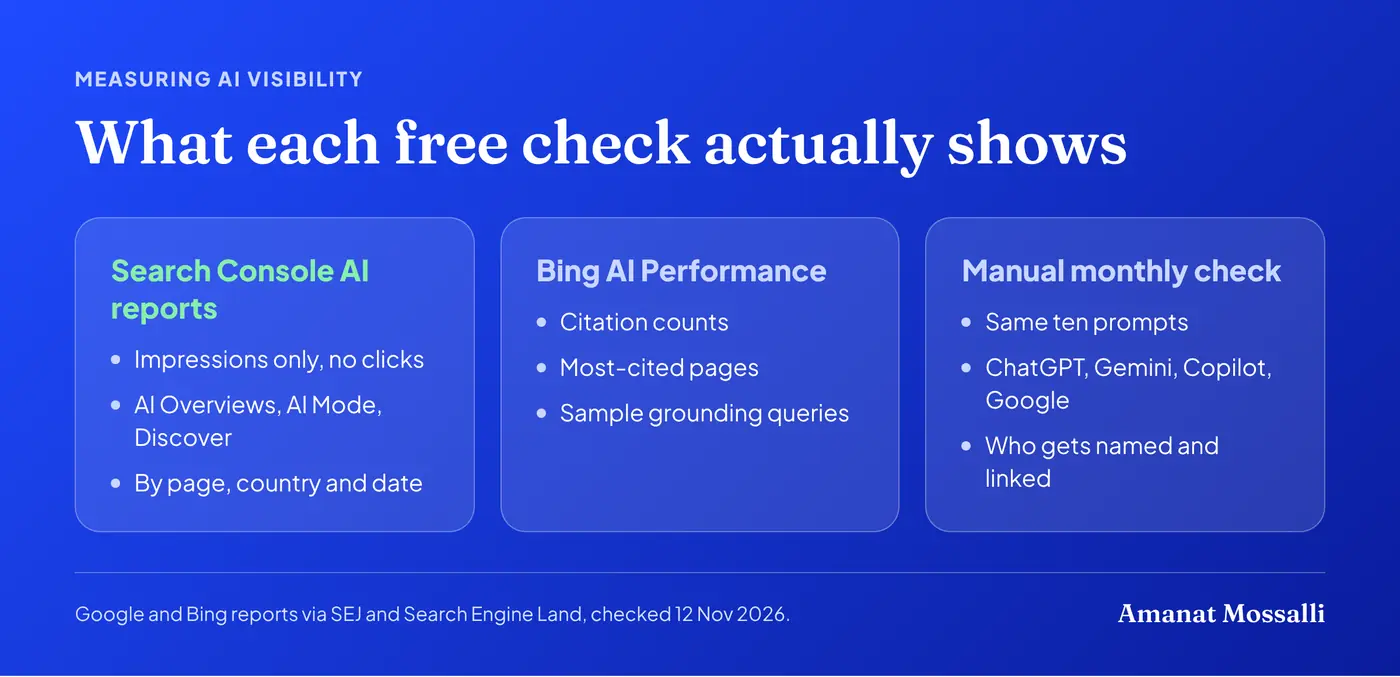
Better than a year ago, still not well. Two free reports now exist, and both count appearances rather than sales. Pair them with a manual check and your own lead tracking.
Google Search Console: generative AI reports
Google announced its Search generative AI performance reports on 3 June 2026. A Search Engine Journal report quotes Google’s update on the rollout. “As of August 31, 2026, we’ve rolled out these insights to all websites worldwide.” They cover AI Overviews, AI Mode and generative AI features in Discover.
The catch: they show impressions only, by page, country and date. No clicks yet. Sites with very few AI impressions may see no report at all. For click data, AI traffic still sits inside the normal Performance report, under the “Web” search type, as Google’s AI features guide says.
Bing Webmaster Tools: AI Performance
Microsoft launched an AI Performance report in beta in early 2026. Search Engine Land’s write-up lists what it shows. Total citations in Copilot and Bing’s AI summaries. Which of your pages get cited. And sample “grounding queries” the AI used to find you. It measures citation counts, not clicks or rankings.
The manual check I still do
On the first of each month I run the same ten prompts for each client. ChatGPT, Gemini, Copilot and a Google search in an incognito window. I note who gets named and which pages get linked. It takes about 40 minutes per client. It’s crude, but it catches things no report shows yet, like a competitor’s new review page suddenly getting quoted.
A new switch you should know about
Search Console has also started showing some site owners a “Search generative AI” setting. It lets you exclude a site from AI Overviews, AI Mode and AI features in Discover. PPC Land reported it’s rolling out to a subset of owners, under pressure from the UK’s competition regulator. Google says it isn’t used as a ranking signal for the rest of Search.
For almost every Bangladeshi business I work with, I’d leave it alone. Being absent from the AI answer rarely brings the click back. It just hands the citation to someone else.
Are There Real AI Search Ranking Factors?
No published list exists, from any AI company. Be careful with anyone selling one. What the platforms do publish is a short set of basics.
- Google: its AI features guide says a page must be indexed and eligible to show with a snippet. “There are no additional requirements”, and “There’s also no special schema.org structured data that you need to add.”
- Google again: its helpful content guidance says trust is the most important part of E-E-A-T, its framework of experience, expertise, authority and trust.
- OpenAI: allow OAI-SearchBot or you won’t appear in ChatGPT search answers.
- Research: the GEO paper found sources, quotes and statistics helped. Stuffing keywords didn’t.
Everything else you read about AI search ranking factors is informed guessing. Some guesses are sensible, like being mentioned on trusted sites. Treat them as habits, not rules.
Would this tactic also help a human reader trust and understand the page? Then it’s probably safe for SEO, AEO and GEO. Does it only exist to trick a machine? Skip it.
What Changes in Practice When You Add GEO?
Three things. How you open each section, how much you care about mentions outside your site, and what you measure. The foundation stays the same.
That’s the real GEO SEO difference. GEO doesn’t throw away SEO. It adds a layer that cares about being quoted and named.
One Search, Three Results
Back to the hearing aid centre in Adabor. Take one search, “hearing aid price in Dhaka”, and his centre wanting that patient. Here’s how each discipline plays out on the same screen.
The AI Overview at the top (GEO)
Google may write a short summary of typical price ranges and what changes the price. It links to sources. If the centre’s page states its own price range clearly, with what’s included, it has a chance to be one of those sources.
The People also ask box (AEO)
Questions like “How long does a hearing aid battery last?” appear below. A one-line answer under a matching heading on the centre’s page gives Google a clean answer to show.
The map pack and blue links (SEO)
Then the map results and normal listings. The centre’s Google Business Profile, reviews and a fast service page decide if it appears here at all. My guide to the Google Business Profile in Bangladesh covers that part.
One page, written well, can compete in all three places. That’s why I treat them as one plan, not three projects. The competitor hadn’t hired a GEO agency, by the way. I checked. They’d just written their prices down.
Five Jobs That Cover All Three
Do these before anything labelled “GEO only”. They’re the core of any sensible AI SEO strategy, and they’re the same five I run for every client.
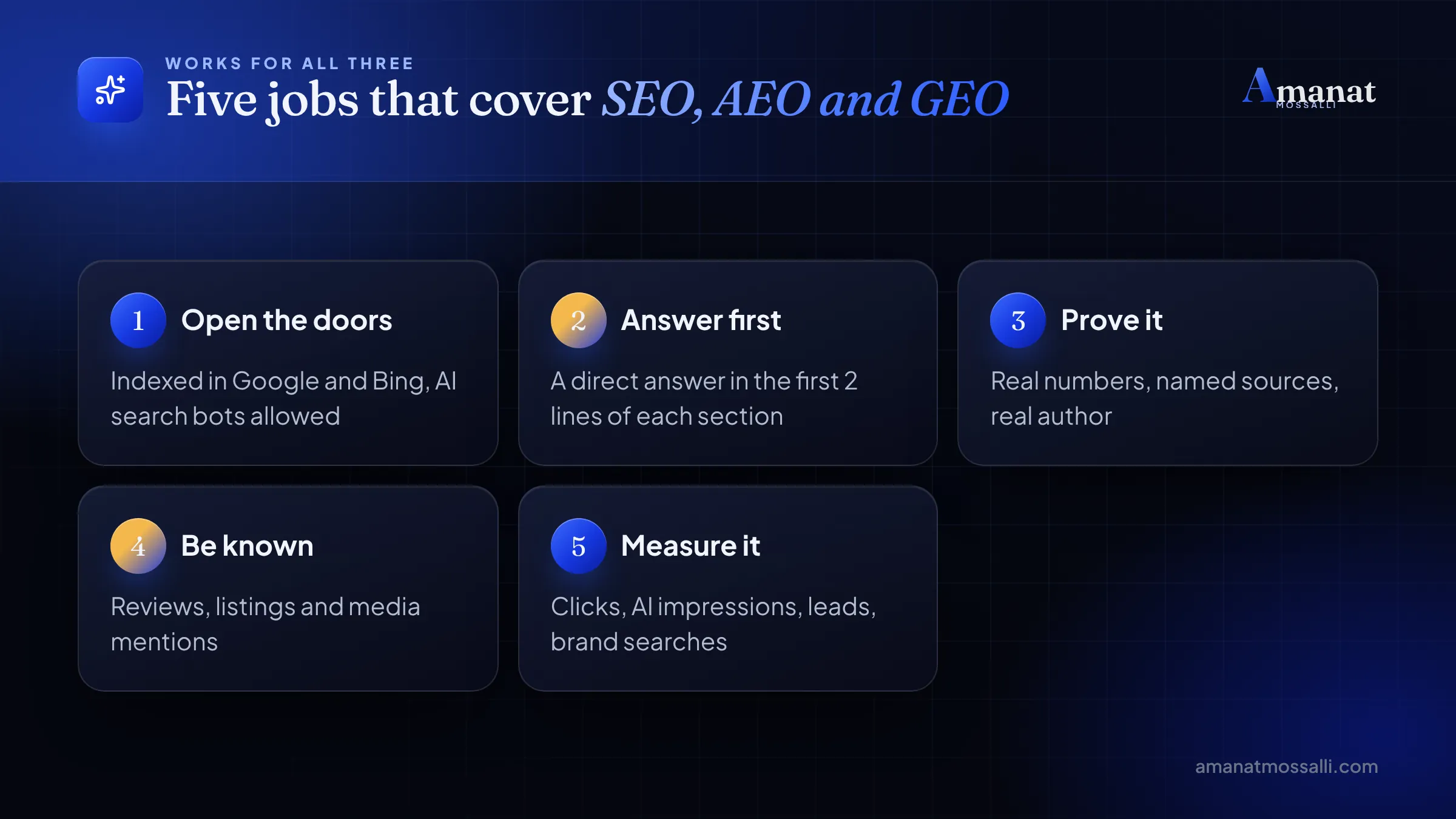
- 1Open the doors. Check indexing in Search Console, submit to Bing Webmaster Tools, and allow Googlebot, Bingbot and OAI-SearchBot.
- 2Answer first. Rewrite the opening of each key section so it answers the heading in one or two sentences.
- 3Prove it. Add prices, facts and statistics with sources. Show who wrote the page and what they’ve done.
- 4Be known. Complete your Google Business Profile, collect reviews, and earn honest mentions in local media and directories.
- 5Measure it. Track clicks, AI impressions, citations, leads and brand searches each month.
Which One Does Your Business Need First?
SEO, almost always, because AEO and GEO are built on it. After that, the mix depends on how your customers search.
| Your business | Start with | Then add |
|---|---|---|
| Local service (clinic, salon, repair) in Dhaka | Local SEO and Google Business Profile | AEO: clear FAQs on prices and timings |
| Online shop | Technical and product page SEO | GEO: comparison tables, reviews, brand mentions |
| B2B or software company | SEO for service and pricing pages | GEO: expert content, data, media mentions |
| Blog or information site | SEO and AEO together | GEO, plus email lists to reduce reliance on clicks |
| Brand new website | Technical SEO and a few strong pages | AEO and GEO once pages are indexed |
For local businesses, Google says local results depend on relevance, distance and prominence. That’s why I start them with local SEO before anything else.
Exporters and firms selling abroad are the exception worth a second look. Their buyers in the UK or the USA are more likely to research suppliers in ChatGPT or Perplexity first. About half my clients are outside Bangladesh, and for them I move GEO work up the list sooner.
Claims I'd Ignore
Anything that promises guaranteed AI citations, or a secret file or markup. Google says plainly that none is needed.
- “GEO replaces SEO.” Google AI features use pages that are indexed and snippet-eligible. That’s SEO.
- “Add llms.txt and ChatGPT will cite you.” It’s a proposal. Google says you don’t need “AI text files”. My explainer on what llms.txt is covers the details.
- “Special AI schema.” Google says there’s no special schema for AI features.
- “We guarantee AI Overview placement.” Google itself says indexing and serving aren’t guaranteed.
- “Mass AI content will win GEO.” Google treats scaled pages made to manipulate rankings as spam.
- “Buy mentions on 500 sites.” Paid links for rankings break Google’s spam policies.
If you’re hiring help, ask how they measure AI visibility and what they won’t promise. My list of top SEO agencies in Bangladesh is a fair place to start comparing.
FAQ: SEO vs GEO vs AEO
What is the difference between SEO, GEO and AEO?
What is generative engine optimization?
What is answer engine optimization?
Is GEO better than SEO?
Do I need different content for ChatGPT and Google?
Which should a small Bangladeshi business focus on?
What is LLM optimization?
How do I measure GEO results?
So Do You Need a GEO Agency, or Just Better SEO?
Usually better SEO, with a few GEO habits added. The SEO vs GEO vs AEO debate matters far less than doing the shared basics well. Get indexed. Answer clearly. Prove what you say. Become known. Measure.
The Adabor owner added a price range, a page about his audiologist and a short test-day guide that same month. By September his new Search Console report showed AI Overview impressions on a handful of price queries. Calls from the website went from about 6 a month to about 10. In my ten-prompt check, ChatGPT now names his centre twice. The competitor still wins the other eight, and I’ve told him so.
What would change my advice
This page reflects the rules as I checked them on 12 November 2026. Three things would make me rewrite it. Google publishing real AI ranking factors. Search Console adding click data to the AI reports. Or ChatGPT search becoming a bigger source of leads than Google for my Bangladeshi clients. None has happened yet. When one does, this page changes first.

Amanat Mossalli Taju
Senior Digital Marketer & SEO Expert, Dhaka, BangladeshI have grown 235+ brands over more than seven years with SEO, Google and Meta Ads, server-side tracking, WordPress and AI automation. Half of my clients are in the UK, USA, Australia and Canada. Everything I write here comes from real client work.
Want this done for your business?
Book a free 15-minute call. I look at your site and ads before we talk, so you leave with clear next steps.