Facebook Retargeting Ads: How to Win Back Visitors Who Didn’t Buy
A stage-by-stage plan for Facebook retargeting ads: the audiences, the time windows, the creative and a sample budget for a shop in Bangladesh.

Most people who visit your shop page don’t buy. They look, they add something to the cart, they get a phone call, and the tab closes. Facebook retargeting ads are how you reach those same people again on Facebook and Instagram, with a message that fits how close they came.
You build each group as a Custom Audience in Ads Manager. Done well, it’s usually the cheapest sale you’ll find on Meta. Done badly, it’s one tired discount banner chasing everyone who visited in six months, until the comments turn rude.
Below is the five-stage plan I start every account with: the audience, the window, the ad and a budget share for each stage. Then a worked plan in taka and a fix for audiences that stay too small. Last, how to tell whether retargeting makes sales or just claims them.
What Do Facebook Retargeting Ads Actually Do?
They follow up. Someone showed interest and left. A retargeting ad reminds them, answers the doubt that stopped them, or gives them a reason to come back today.
I’m Amanat Mossalli Taju. I’ve managed more than $8M in Google and Meta ad spend. Some of it for shops in Dhaka, some for clients in the UK, USA, Australia and Canada. Retargeting is the first thing I open in any account audit. It tells me fast whether the tracking works and whether anyone has thought about the buyer.
Meta retargeting runs on Custom Audiences. A custom audience is a list of people Meta can match to accounts, built from your own sources. Those are your website, app, Facebook page, Instagram profile, videos, lead forms and customer lists.
Retargeting isn’t magic. It can’t fix a bad product or a broken checkout. It just gives a warm person a second, better-timed look.
Why Didn't Your Visitors Buy the First Time?
Usually it wasn’t a firm no. That’s why retargeting works at all. They were busy, unsure about size or delivery, or comparing prices on their phone at night.
The owner sent me a screenshot of Ads Manager on a Sunday afternoon. One campaign, one ad set, everyone who had visited her site in the last 180 days. The same “20% off” banner had run for five weeks. Frequency sat above 9. Under the ad, people had started writing “stop showing me this”.
Her message was short: “Retargeting worked in Ramadan. Why is it dead now?” It wasn’t dead. It was one tired ad shown to every warm person she had. Someone who abandoned a cart yesterday saw exactly what a blog reader from February saw.
We split that audience into four stages, each with its own window and message. Cart abandoners got a size chart and delivery times. Video viewers got customer try-on clips. The discount went only to people who had added to cart and waited more than three days. Within a month her cost per order on retargeting fell from about Tk 410 to about Tk 290, and frequency stayed under 3. No more angry comments.
These are the usual reasons people leave, and what a good retargeting ad does about each one.
| Why they left | What the retargeting ad should show |
|---|---|
| Not sure about size or fit | A size chart, or a short video of someone wearing or using it |
| Worried about delivery | Delivery time inside and outside Dhaka, and cash on delivery if you offer it |
| Price shock | What’s included, a bundle, or the cost per use. A discount is the last tool, not the first |
| Didn’t trust the page | Real reviews, your return policy, a phone or WhatsApp number |
| Just got distracted | A plain reminder of the product they looked at. Often that’s enough |
Which Audiences Should You Retarget First?
Start with the people closest to buying, then work outwards. The budget shares below are a starting split, not a rule. After two weeks, move money towards the stage with the best cost per sale.
| Stage | Audience | Starting window | Ad to show | Starting budget share |
|---|---|---|---|---|
| 1. Hot | Added to cart or started checkout, no purchase | 3 to 7 days | The exact product, delivery and COD info | About 30% |
| 2. Warm | Viewed a product or a service page | 7 to 30 days | Catalog ad or reviews of that product | About 25% |
| 3. Engaged | Messaged the page, saved or commented on a post | 30 to 60 days | Best seller, a clear offer, WhatsApp button | About 20% |
| 4. Aware | Watched 50% or more of a video, or engaged with the page | 30 to 90 days | Proof: reviews, behind the scenes, how it’s made | About 15% |
| 5. Customers | Bought in the past | 30 to 180 days | A matching product, refill or new arrival | About 10% |
Each stage should exclude the stage above it. So the warm ad set excludes cart abandoners, and every ad set excludes people who bought in the last 7 to 14 days. Without exclusions, the same person sits in three ad sets and sees three ads in an hour.
Many local buyers message the page instead of visiting a site. People who messaged your page are often the warmest list a Facebook seller has. Give them their own ad set.
How Long Should Each Retargeting Window Be?
Match the window to how fast people decide. A Tk 800 T-shirt is decided in days. A Tk 80,000 sofa or a study-abroad consultation can take weeks.
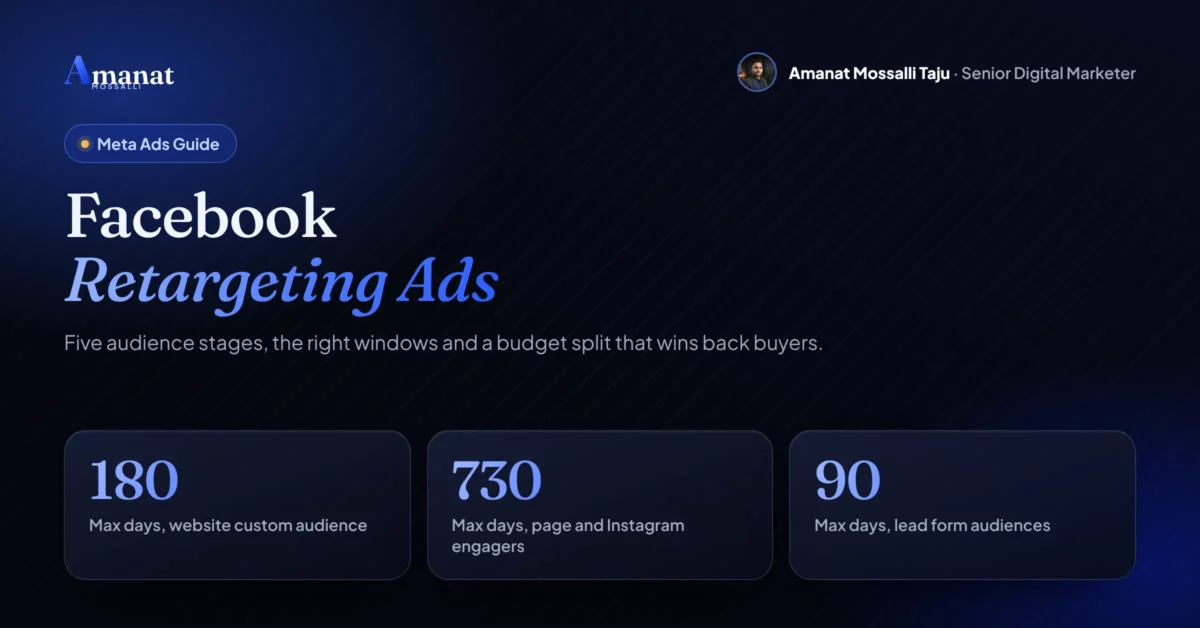
Meta sets the outer limits. Its developer guide to website custom audiences still says retention can run “between 1 and 180 days”. The engagement custom audience guide allows up to 730 days for Facebook Page and Instagram audiences and 90 days for lead form audiences. Both checked 12 November 2026.
One change to watch. Ad-industry write-ups in May 2026, such as this summary from Vizup, reported a bigger limit for purchase audiences. They say it’s moving to 730 days, account by account. I couldn’t confirm it on Meta’s own developer page. Open the retention box in your own account and see what it allows.
That matters for one reason. If your old 180-day buyer list quietly grows to two years, your “recent buyers” exclusion stops being recent. Set the window yourself on every buyer audience.
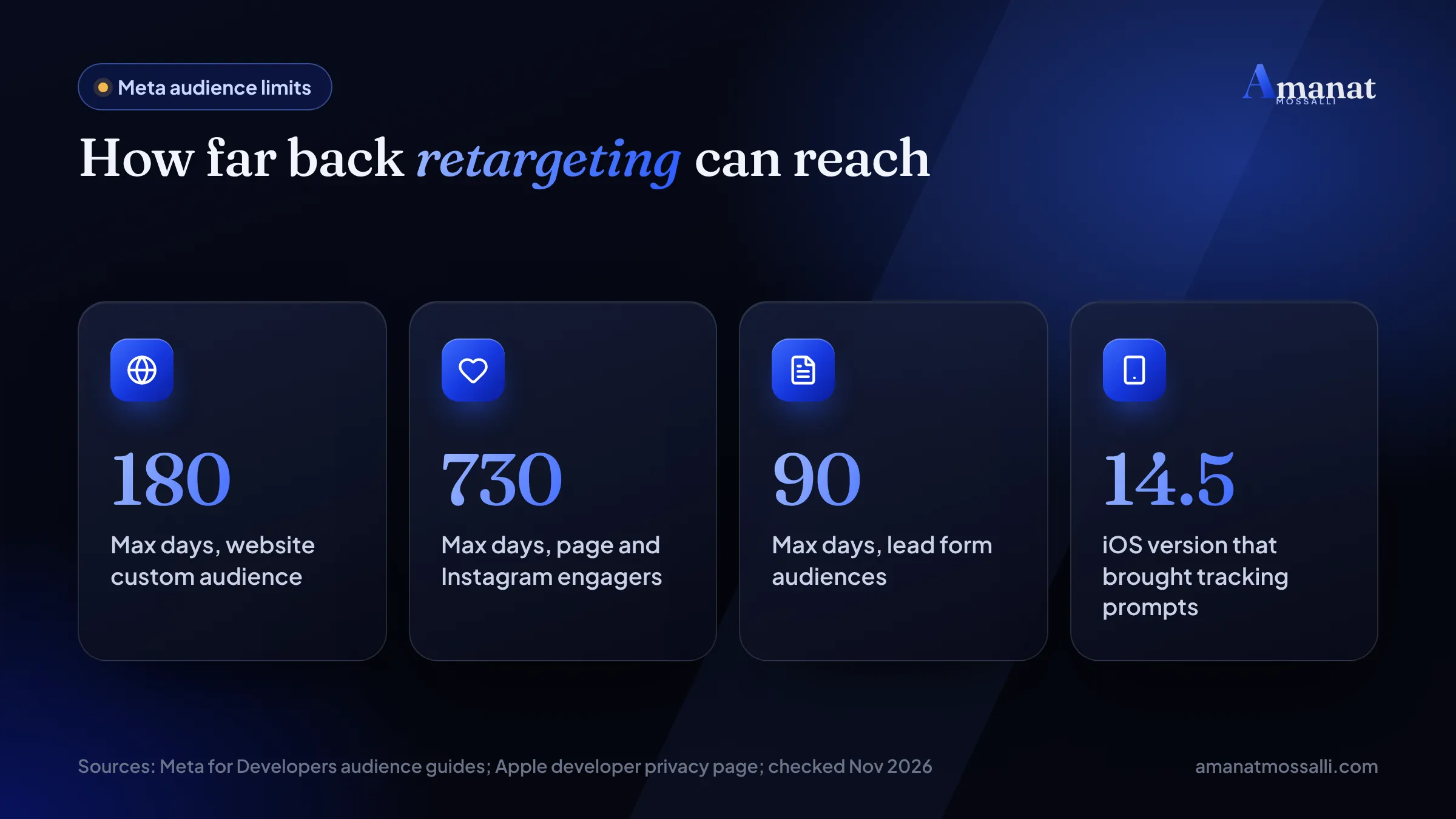
My rule of thumb: the hotter the action, the shorter the window. Cart abandoners after 14 days are mostly cold again. Video viewers stay useful longer, because they never meant to buy yet.
One exception. If your audience is tiny, stretch the window before you widen the definition. A shop with 300 visitors a day has very different lists from one with 30. A 30-day product viewer list beats a 7-day list that never delivers.
Retargeting Campaign Setup in Ads Manager, Step by Step
Say you have a website and a working pixel. This is the setup I’d build. It takes about an hour once the tracking works.
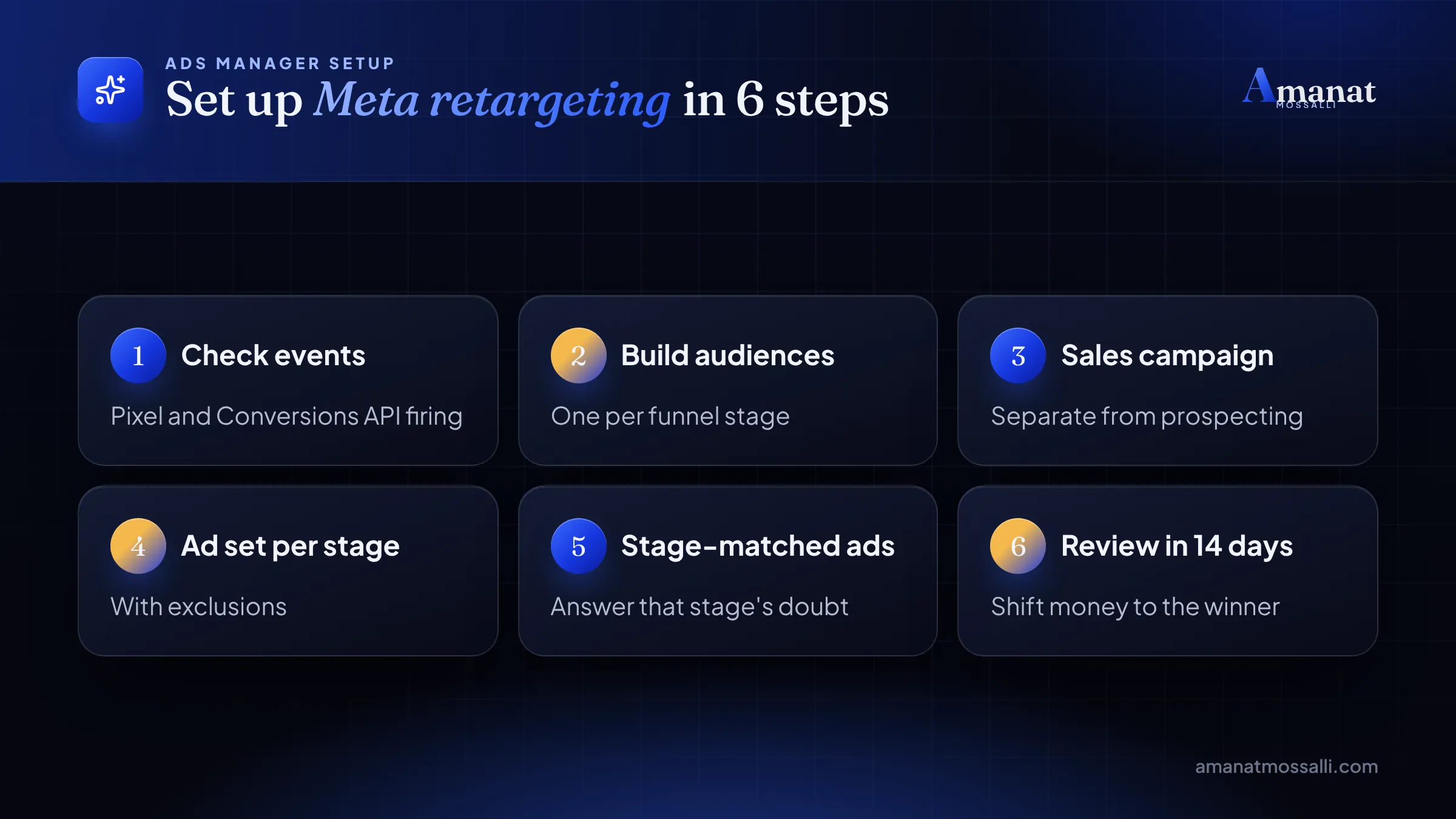
The Advantage+ audience switch
Meta keeps pushing automation, and that’s mostly fine for prospecting. Meta’s full Advantage+ optimisations switch on when you use Advantage+ audience, placements and campaign budget together. Meta said so in February 2025, as Social Media Today reported. The same update renamed Advantage+ shopping campaigns to Advantage+ sales campaigns.
For retargeting, the audience setting is the one to watch. With Advantage+ audience on, your custom audience becomes a suggestion, and Meta may show the ad to people outside it. For a clean retargeting test, use original audience options in the ad set so the custom audience is a hard limit. Then you know who’s really seeing the ads.
New to Ads Manager? Read my comparison of boosting vs Ads Manager first. Boosted posts can’t do most of this.
How Do Advantage+ Catalog Ads Help an Online Shop?
They show each person the exact products they looked at, pulled from your catalog. You build one ad template and Meta fills it with the right product, price and image. People still call them dynamic product ads. In Ads Manager the name is Advantage+ catalog ads.
The setup has firm rules. Meta’s pixel guide for Advantage+ catalog ads lists three events: ViewContent, AddToCart and Purchase. Each needs content_ids or contents, and those product IDs must match the IDs in your catalog (checked 12 November 2026). If they don’t match, the ad can’t find the product.
Meta’s catalog ads setup guide also gives an example audience: people who viewed products in the last 3 to 5 days but didn’t buy. That’s a good first ad set for any store.
Catalog tips for Bangladeshi stores
- Keep catalog prices the same as on the site, in BDT. A mismatch kills trust.
- Mark out-of-stock items quickly. Nothing annoys a buyer more than an ad for a sold-out kurti.
- Use clean product photos on a plain background. Catalog ads crop hard on small screens.
- Add short primary text about delivery and cash on delivery.
WooCommerce and Shopify both have Meta catalog plugins. A custom-built store needs a product feed, usually a CSV or XML file that updates daily.
What Should Each Stage's Ad Say?
Each stage has a different doubt. Write to that doubt, not to a generic “buy now”.
Write ads in Bangla, English or both, matching how your buyers write to you in Messenger. If your inbox is full of Banglish, your ads can be too.
Short vertical videos usually work well for stages 4 and 5. For stages 1 and 2, simple product images often beat polished video, because the person already knows what they want.
Retargeting When Your Shop Lives Only on Facebook
Plenty of sellers here have no website at all. Orders come through Messenger, WhatsApp and comments. You can still retarget. You just build the stages from engagement instead of pixel events.
| Stage | Audience to build | Ad to show |
|---|---|---|
| Hot | People who messaged the page in the last 14 to 30 days | The product they asked about, price, and a Message button |
| Warm | People who saved a post or commented, last 30 to 60 days | Best sellers with clear prices |
| Aware | Watched 50% or more of a video, last 60 to 90 days | Reviews, packing clips, the owner on camera |
| Customers | An uploaded list of past buyers’ phone numbers | New arrivals or a matching item |
Two cautions. A customer list only works if you have permission to use those numbers for marketing. And engagement audiences are noisier than pixel audiences, because a comment isn’t a cart. Expect a higher cost per order than a website shop gets.
Send these ads to Messenger or WhatsApp, where your buyers already talk to you. My guide to WhatsApp Business marketing in Bangladesh covers how to handle the chats once they arrive.
A Retargeting Plan for a Dhaka Clothing Shop
Say you sell women’s clothing from Jatrabari. You have a WooCommerce site, a busy Facebook page and Tk 30,000 a month for retargeting. Here’s how I’d lay it out. The split follows the stage table above: 30%, 25%, 20%, 15% and 10%.
| Ad set | Audience and window | Monthly budget (BDT) | Main ad |
|---|---|---|---|
| Cart abandoners | AddToCart, last 7 days, exclude buyers | 9,000 | Catalog ad with COD and 2-day Dhaka delivery |
| Product viewers | ViewContent, last 14 days, exclude cart | 7,500 | Catalog ad, best reviews |
| Messenger contacts | Messaged the page, last 60 days | 6,000 | New arrivals carousel, Message button |
| Video viewers | 50% viewers, last 60 days | 4,500 | Behind-the-scenes packing reel |
| Past buyers | Purchase, 30 to 180 days | 3,000 | Matching dupatta or new Eid collection |
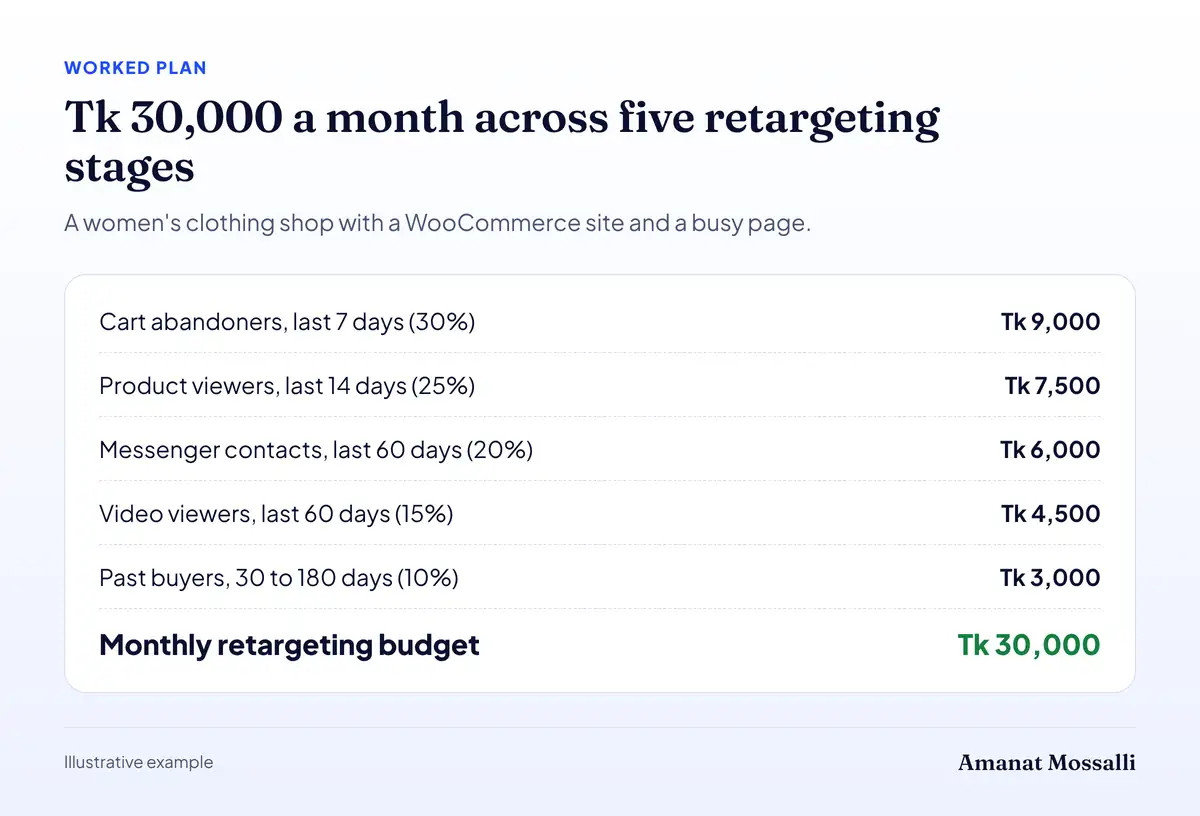
Why so much on the cart stage? Because those people are a day or two from buying. The video stage gets less, since its job is to warm people up, not to close.
In the first month, judge only two things: cost per purchase by stage, and frequency. Don’t touch the plan for 10 to 14 days unless something is clearly broken. Want to know what Tk 30,000 buys in reach? My guide to Facebook ads cost in Bangladesh covers it. If your card keeps failing, see how to pay for Facebook ads from Bangladesh.
Why Is Your Retargeting Audience Size So Small?
Usually because Meta isn’t seeing all your visitors. The browser pixel misses people, and some visitors can’t be matched to an account.
Meta doesn’t publish a fixed minimum. Its developer guide only says you can target an audience “once it reaches a certain size”. In practice, very small lists deliver slowly and unevenly.
Where visitors go missing
- iPhone privacy. Since iOS 14.5, apps need permission to track people, as Apple’s developer privacy page explains. Many people say no.
- Browsers and ad blockers that stop the pixel loading.
- Slow pages. Visitors leave before the pixel fires, common on weak mobile signal.
- People not logged in to Facebook or Instagram on that browser.
- Wrong setup: pixel missing on some page templates, or events firing twice.
The fix most accounts need is the Conversions API. It sends events from your server or platform straight to Meta, so you’re not relying on the browser alone. Run it with the pixel and make sure events are deduplicated.
This got easier in 2026. AdExchanger reported on 15 April 2026 that Meta added a one-click Conversions API setup inside Events Manager, aimed at smaller advertisers. Existing pixel users get a notice and 30 days to review before a related pixel feature turns on by default. If you’ve put off server-side tracking because you have no developer, check Events Manager first.
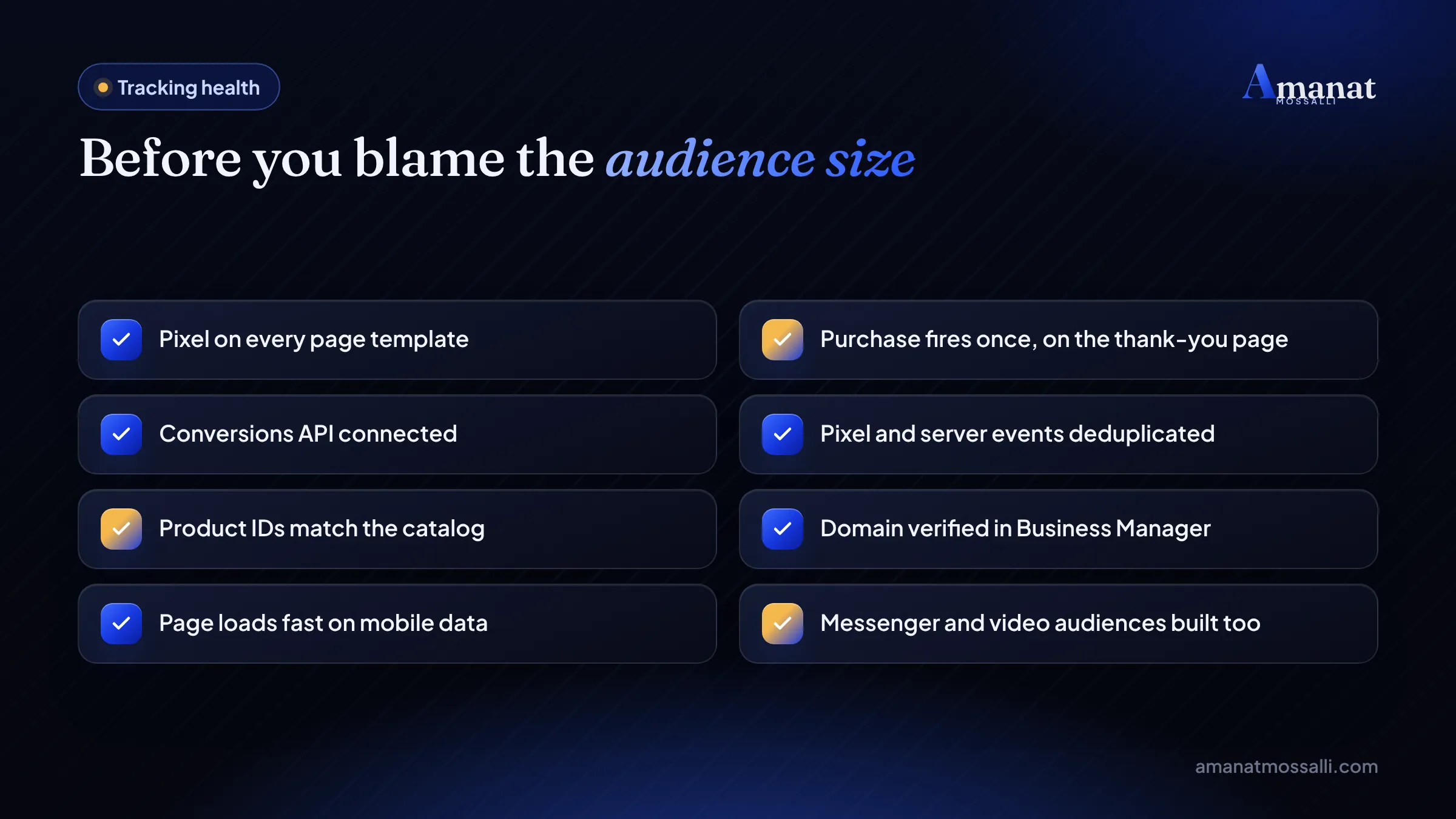
Want the full method? My guide to the Facebook Conversions API walks through setup and testing. If you’d rather hand it over, I do this as part of my tracking and analytics service.
Mistakes That Burn Retargeting Budgets
I see the same few mistakes in nearly every account I open. Each one takes minutes to fix.
- One audience for everyone, from yesterday’s cart abandoner to a visitor from five months ago.
- No buyer exclusion, so happy customers keep seeing ads for what they just bought.
- Discount first, every time, which trains people to wait for the offer.
- Frequency ignored until comments turn angry.
- Retargeting inside the prospecting campaign, where the budget drifts to cold audiences.
- Advantage+ audience left on in a test you think is pure retargeting.
- Purchase tracked wrongly, so the cart audience is really just everyone.
- Sending ads to the home page instead of the product they looked at.
The Lakshmipur abaya page had four of these at once. Fixing the first one did most of the work.
How Do You Know If Retargeting Is Working?
Compare it with your prospecting results. Retargeting should usually bring sales at a lower cost per purchase. If it doesn’t, something is off with the audience, the offer or the tracking.
The numbers I check weekly:
- 1Cost per purchase, by stage.
- 2Frequency per ad set, over seven days.
- 3Share of total sales that come from retargeting.
- 4Click-through rate per ad, to spot tired creative.
- 5Comments and hides, as an early warning.
A harder question is whether retargeting creates sales or just claims them. Some people would have come back anyway. If your spend is large, run a holdout test: pause one stage for two weeks and watch total store sales, not only Meta’s report.
Last winter I worked with a gift-hamper shop in Baridhara. Meta’s report said retargeting brought in almost half their online sales. The owner wanted to double that budget before the wedding season.
Before we did, we paused the video-viewer and page-engager ad sets for two weeks and left everything else alone. Total store orders dipped by roughly 5%. The ad sets Meta credited with far more than that had mostly been taking credit for people who were coming back anyway.
So we didn’t double the budget. We moved that money into prospecting and kept only the cart and product-viewer stages running. Cost per new customer came down a little, and the owner stopped trusting one report on its own.
Honest caveat: in a small account, a clean test is hard, because sales swing a lot week to week. A rough answer still beats none.
FAQ: Facebook Retargeting Ads
What is the difference between retargeting and remarketing on Facebook?
How long can a website custom audience go back?
Do Facebook retargeting ads work without a website?
How much should I spend on retargeting?
What are dynamic product ads called now?
Why does my retargeting audience show as too small?
Should I exclude past buyers from retargeting?
Retargeting Works as Well as the Tracking and Stages Behind It
If you do one thing this week, do this. Open Audiences, find your biggest retargeting audience, and check its window and its exclusions. If it’s “all visitors, 180 days, no exclusions”, you’ve found your leak.
Split it into the cart, viewer and engager stages from the table. Give each its own ad. Then leave it alone for two weeks and read cost per purchase by stage.
Retargeting only ever works as well as the tracking under it. So if the cart audience looks suspiciously like your whole site, fix the events first and come back to the ads. For the wider picture of organic and paid social, see social media marketing for Bangladeshi businesses.

Amanat Mossalli Taju
Senior Digital Marketer & SEO Expert, Dhaka, BangladeshI have grown 235+ brands over more than seven years with SEO, Google and Meta Ads, server-side tracking, WordPress and AI automation. Half of my clients are in the UK, USA, Australia and Canada. Everything I write here comes from real client work.
Want this done for your business?
Book a free 15-minute call. I look at your site and ads before we talk, so you leave with clear next steps.