How Long Does SEO Take? A Realistic Month-by-Month Timeline
SEO is not slow by accident. Here is what really happens between month 1 and month 12, what to measure at each stage, and which promises should make you leave.

There’s a story going round that SEO takes “about three months”. Agencies say it, YouTube says it, and clients repeat it to me on the first call. It’s wrong often enough to cost people money.
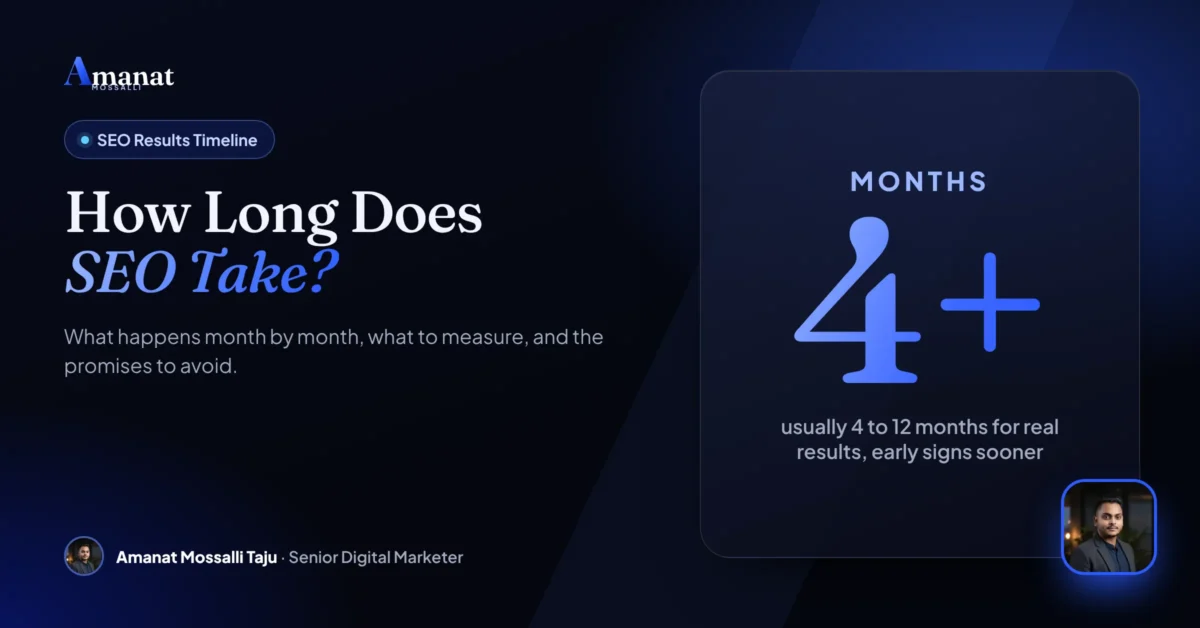
So, how long does SEO take? For most businesses, early signs show within 1 to 3 months, and real traffic and leads arrive within 4 to 12 months. A brand-new website in a crowded market sits at the slow end. An older site fixing clear problems sits at the fast end.
“When will I see results?” is the first question nearly every SEO client asks me. I’ve been answering it for over seven years, for businesses in Dhaka and for clients in the UK, the USA, Australia and Canada. The honest answer has never been one number.
This page gives you the honest version. What Google itself says about timing. What a large study of real rankings found. What usually happens month by month, what to measure at each stage, and the promises that should make you walk away.
How Long Does SEO Take? The Short Answer
Plan on 4 to 12 months for real business results, with early signs much sooner. That range matches what Google has said, and it matches what I see in my own projects.
Google’s own SEO Starter Guide says: “Some changes might take effect in a few hours, others could take several months”. It also suggests you “wait a few weeks to assess whether your work had beneficial effects” (checked 12 November 2026).
In February 2017, Google published a video called “How to hire an SEO”. In it, Google’s Maile Ohye said “SEOs need four months to a year”. That covers helping a business make improvements first, and then seeing potential benefit. Old advice, still true.
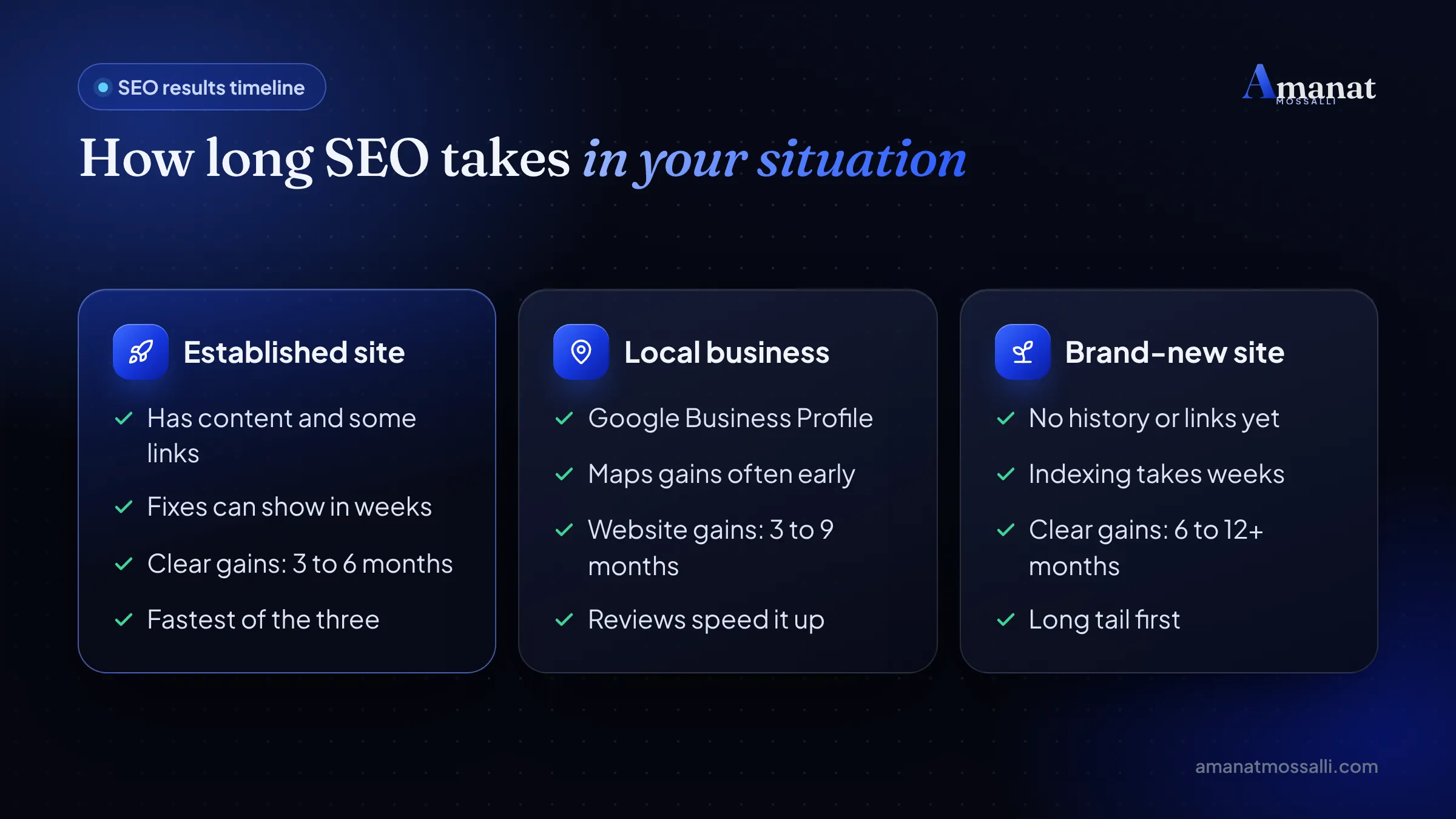
Here is how those ranges usually split in my own client work. An established site fixing clear problems tends to show clear gains in 3 to 6 months. A local business often sees Maps gains early, and website gains in 3 to 9 months. A brand-new site needs 6 to 12 months or more, starting with long tail keywords.
Treat these ranges as typical, not promised. A dentist in a district town competes with a handful of clinics. A new online electronics shop competes with marketplaces that have years of content and links behind them.
What the Ranking Data Says About New Pages
It says most new pages never reach page one, and the ones that do usually aren’t new any more. The best public data on this comes from Ahrefs, an SEO tool company that crawls billions of pages.
Its study “How long does it take to rank in Google?” was updated on 15 May 2025, using samples from late 2023. I checked it on 12 November 2026.
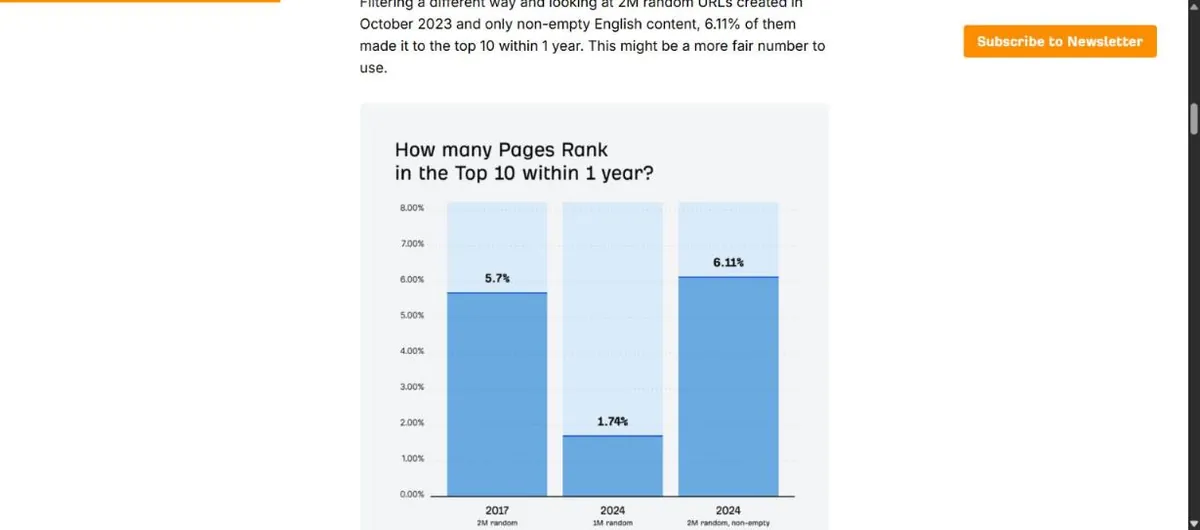
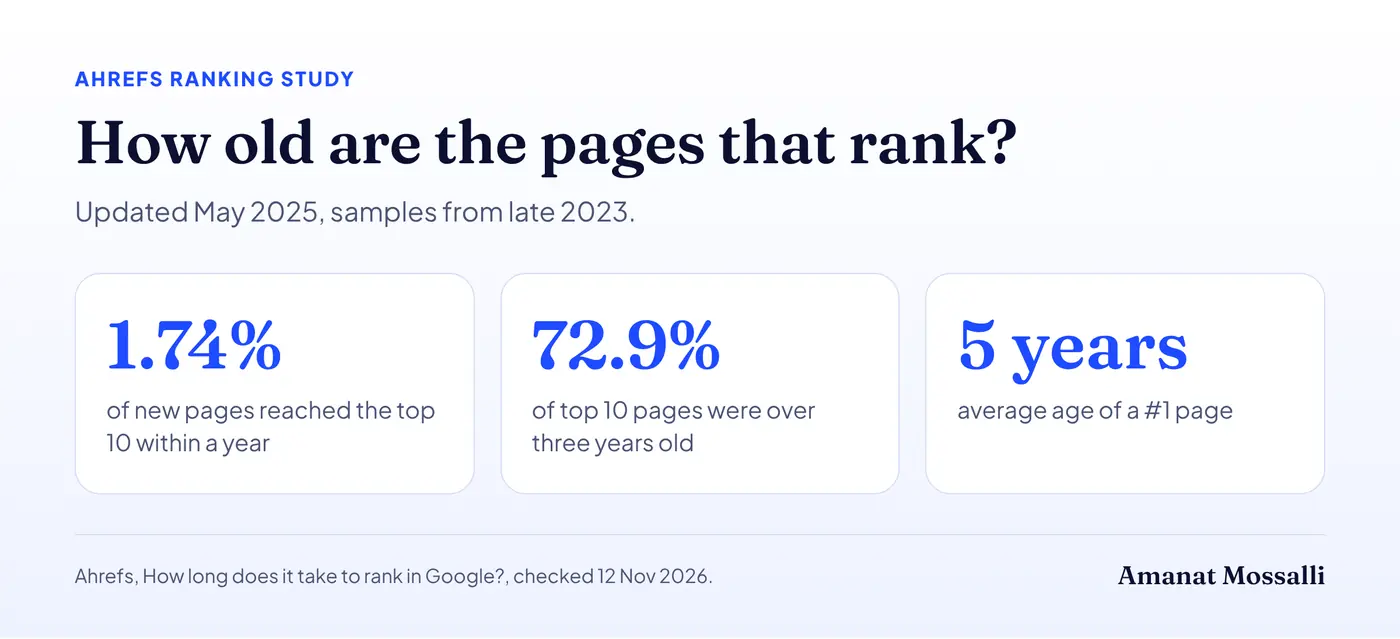
- Only 1.74% of a random sample of 1 million newly published pages reached Google’s top 10 within a year. In 2017 the same test found 5.7%. Counting only real English pages with content, the share was 6.11%, which is fairer but still small.
- Of the pages that did reach the top 10, 40.82% got there within one month. Good pages on strong sites can move fast.
- 72.9% of pages in the top 10 were more than three years old.
- The average page ranking #1 was 5 years old, up from 2 years in 2017.
Two cautions. The age data comes from US keywords, and the sample includes plenty of thin pages that never deserved to rank. Bangladeshi local and Bangla searches are often less crowded, which is why I see faster movement there. Still, the direction is clear. Rankings reward pages and sites that have been around, been linked to and kept improving.
Why the Wait Exists at All
Google must find your changes, process them, then gather signals that your page deserves to rank. Each of those steps has its own delay.
Competitors move too. Improve while they stand still and you climb. If they improve faster, you wait longer. That’s why SEO takes time even when the work is good.
You can ask Google to recrawl a page with the URL Inspection tool in Search Console. Google’s recrawl guide notes there’s a quota. It also says “requesting a recrawl multiple times for the same URL won’t get it crawled any faster”. (I still see people do it daily.)
What Speeds SEO Up or Slows It Down
Five things decide most of it. The age and health of your site. The competition. How much useful content you publish. Links and mentions. And how local your market is.
| Factor | Faster when | Slower when |
|---|---|---|
| Site history | The site has years of content and some links | The domain is brand new |
| Competition | Few strong pages target your keywords | Big brands and marketplaces dominate |
| Technical health | Pages are indexed and fast on mobile data | Indexing errors, slow hosting, broken pages |
| Content | You publish or improve pages every month | One burst of posts, then nothing |
| Links and mentions | Real sites mention you naturally | No one outside your site knows you |
| Market | Local, niche or Bangla keywords | National English keywords with high bids |
Language matters as well. Bangla and Banglish keywords often have fewer strong competing pages than English ones. A business willing to write in its customers’ language can shorten the wait.
SEO Month by Month: What Happens From Month 1 to 12?
Below is the SEO month by month plan I usually follow, with what to measure at each stage. Your pace depends on the factors above.
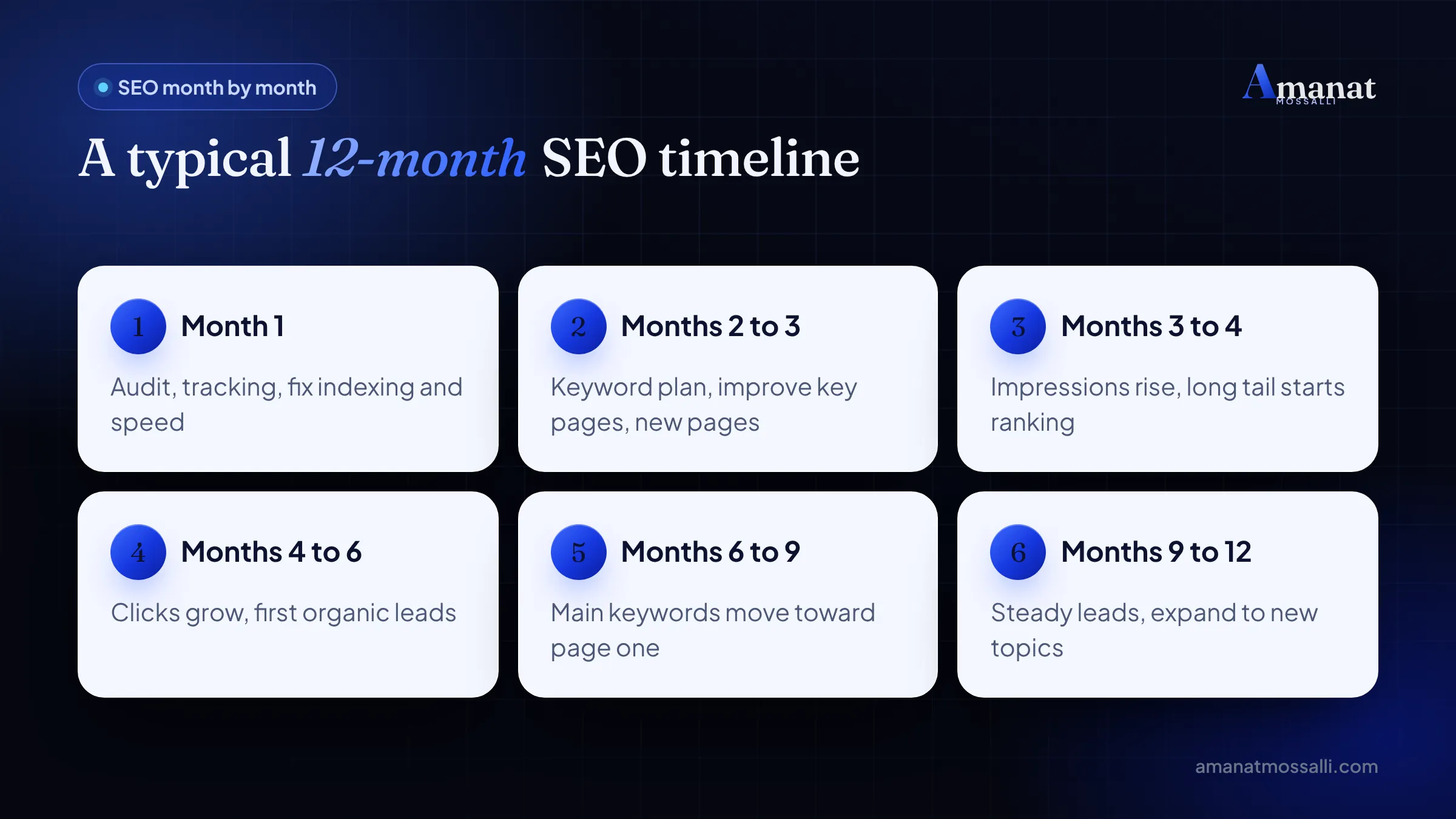
Month 1: Audit and foundations
I check indexing, speed, mobile layout, site structure and tracking. If Google Search Console or GA4 conversions are missing, I set them up. Measure: pages indexed, errors fixed, tracking working. My guide on how to do an SEO audit walks through this month in detail.
Months 2 to 3: Keywords and pages
I map keywords to pages, then improve the most important service or product pages first. New pages fill the gaps. Measure: pages improved or published, impressions starting to move.
Months 3 to 4: First signals
Impressions usually rise before clicks. Longer, specific phrases start ranking on page one or two. Measure: impressions, number of keywords ranking, average position for target pages.
Months 4 to 6: Clicks and first leads
Pages that reached the top of page two push onto page one. Clicks grow and the first organic enquiries arrive. Measure: clicks, organic leads, calls and WhatsApp clicks from organic visitors.
Months 6 to 9: Main keywords move
Harder keywords start moving as the site gains trust and mentions. This is the point where owners usually feel SEO “working”. Measure: positions on money keywords, leads per month, cost per lead against ads.
Months 9 to 12: Compounding
Good pages keep bringing visitors without new spend. You expand into new topics and areas. Measure: total organic leads and revenue, brand searches, share of leads that come from organic.
Compare the same months year on year, or 3 months against the previous 3. In Bangladesh, Ramadan, Eid and exam seasons can swing traffic a lot for some businesses.
New Websites Wait Longer, and Here's Why
Expect a new website to take 6 to 12 months or more for steady traffic. It starts with no history, no links and no pages Google already trusts.
The first weeks are mostly about getting found at all. Submit a sitemap in Search Console and check that key pages are indexed. Google says crawling alone can take days to weeks.
A small coffee grower in Bandarban launched his first website last November. He roasts beans from hill farms and ships to Dhaka and Chattogram. He’d read that SEO takes three months, so in February he sent me a screenshot of Search Console. Forty impressions. Zero orders. “Bhai, eta ki kaj korche?” (Is this even working?)
It was, just slowly. His home page was chasing “coffee beans bangladesh”, where importers and big shops had years of head start. We moved his effort to narrow phrases: “bandarban coffee beans”, “hill coffee bangladesh”, “arabica beans from bandarban”. Each got a real page with photos of the farm and the roasting date.
The first order from Google search came in month five. By month nine, search brought him about 12 orders a month, roughly one in five of his total. The broad keyword still sits on page three. He’s stopped checking it every morning.
So the answer to SEO for new website how long depends on your first targets. Start with long, specific keywords where competition is thin, like “eid panjabi wholesale in chattogram”. Those can rank early and bring the first real visitors while the bigger keywords build.
Build the site right from day one. Moving or rebuilding later costs months, and I’ve watched it happen more than once. For a full checklist, see my complete SEO guide for Bangladeshi businesses.
How Long Does Local SEO Take?
Local SEO through Google Business Profile is often the fastest part of SEO. Maps gains can show within weeks of a complete, verified profile. Website rankings for local searches usually follow over months.
Google’s local ranking help page says local results are based on relevance, distance and prominence. It also says “More reviews and positive ratings can help your business’s local ranking”.
- Relevance: pick the right categories and describe your services fully.
- Distance: you can’t change this, so focus on searches near you.
- Prominence: reviews, photos, mentions and your website all add up.
Google is also blunt that “There’s no way to request or pay for a better local ranking on Google”. So local SEO how long depends on two things. How complete your profile is, and how steadily you collect reviews. More in my guides to local SEO for Bangladeshi businesses and the Google Business Profile in Bangladesh.
The Order Results Show Up In
Impressions first. Then rankings. Then clicks. Then leads. If you only watch leads, you’ll believe nothing is happening for months, and you’ll be wrong.
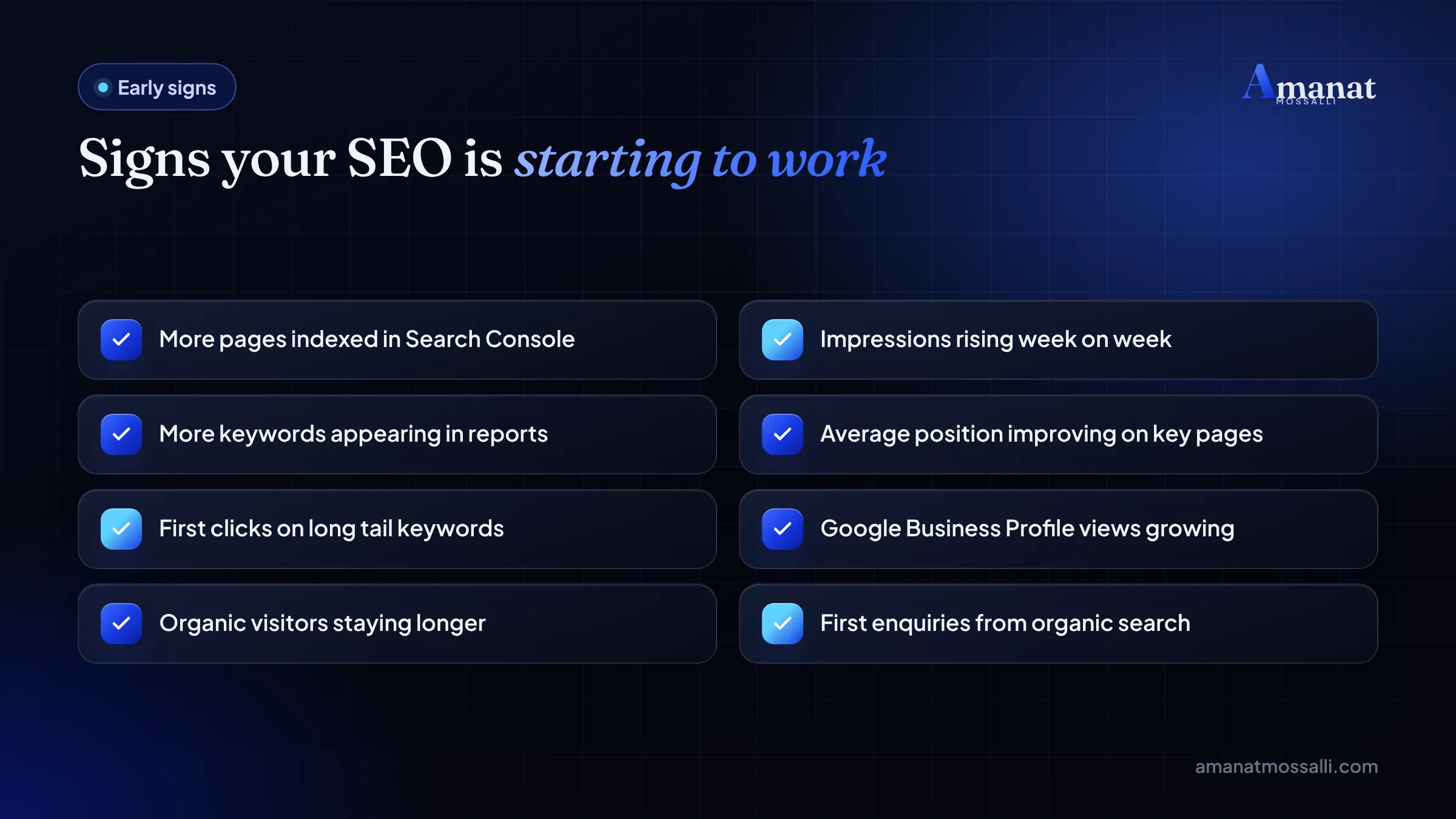
All of these live in free tools. Google’s Performance report in Search Console gives clicks, impressions, CTR and average position for every query and page.
AI Overviews have stretched the gap between impressions and clicks
One thing changed since I first wrote this. On many question searches, Google now shows an AI Overview above the links. Ahrefs’ February 2026 update found the top-ranking page got about 58% fewer clicks on average when an AI Overview appeared.
So impressions can climb nicely while clicks lag behind. That isn’t always a sign the SEO is failing. Check leads and calls before you judge. Since the end of August 2026, Search Console has had separate generative AI reports worldwide. They show impressions in AI Overviews and AI Mode. I cover what that means in why AI Overviews are cutting traffic.
What Should a Monthly SEO Progress Report Show?
Work done, leading signals, then business results, in that order. If a report only shows rankings, or only shows traffic, ask for more.
| Section | What it should include | Why it matters |
|---|---|---|
| Work done | Pages fixed, written or improved; links earned | Shows effort and where time went |
| Visibility | Impressions, keywords ranking, average position | Early signs before clicks arrive |
| Traffic | Organic clicks and sessions on key pages | Shows rankings turning into visits |
| Results | Leads, calls, WhatsApp clicks, sales from organic | The number that pays for SEO |
| Next month | The plan and what is blocking progress | Keeps both sides honest |
The results row only works when tracking is set up properly. Without conversion tracking, a SEO progress report can’t prove value, no matter how pretty the charts are. My tracking and analytics service sets that up.
Why Is My SEO Taking So Long? A Quick Diagnosis
Look at the early signs before you blame the strategy. Most stalled projects I’m asked to rescue fail one of these checks, and the first one is more common than you’d think.
He messaged me on a Tuesday night in May. He’d paid a provider for two months, seen nothing, and decided SEO “doesn’t work for accountants”. He prepares income tax returns and VAT filings, for local traders and for clients who send papers from Dhaka. He shared his Search Console. Zero pages indexed.
One checkbox in WordPress, “Discourage search engines from indexing this site”, had been ticked since launch. The monthly reports only showed rankings for his own business name, which anyone typing it would find anyway. Nothing had actually started. We cleared the setting and submitted the sitemap. The clock began from that day, not from the day he first paid. He wasn’t thrilled to hear that.
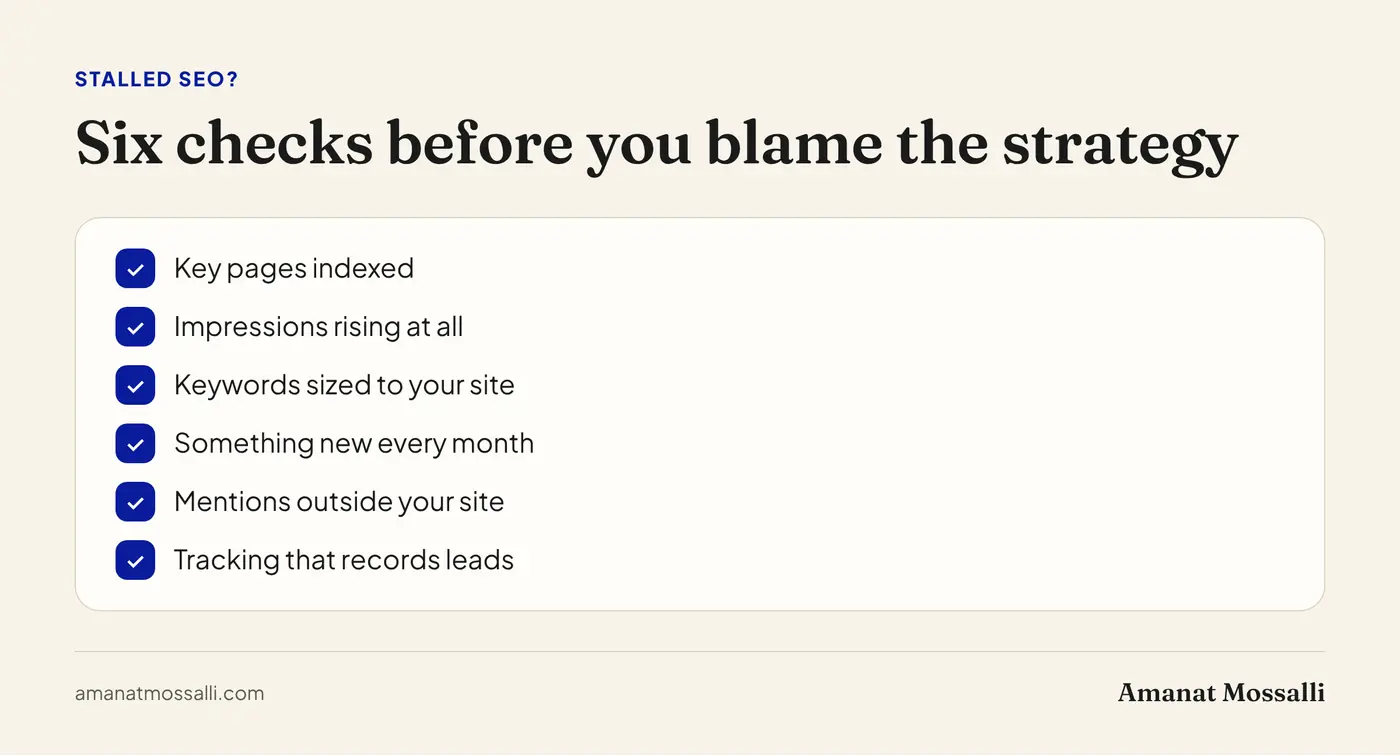
- Are your key pages indexed? Use URL Inspection in Search Console on each money page.
- Are impressions rising at all? Flat impressions after three months usually mean a technical or targeting problem.
- Are you chasing keywords too big for your site? A new site aiming only at national head terms will wait a long time.
- Is anything new published or improved each month? One burst of work, then silence, rarely moves anything.
- Does anyone outside your site mention you? Reviews, directories, suppliers and local news all count.
- Is tracking working? Leads you can’t see look exactly like leads you didn’t get.
SEO Against Ads: Speed Versus Staying Power
Ads bring visitors the day they go live. SEO takes months. But ads stop the day you stop paying, and SEO keeps working while you sleep.
| SEO | Google Ads | Facebook and Instagram ads | |
|---|---|---|---|
| First visitors | Weeks to months | Same day once approved | Same day once approved |
| Cost model | Monthly work, no cost per click | Pay for each click | Pay for reach or results |
| When you stop | Rankings fade slowly | Traffic stops at once | Traffic stops at once |
| Best for | Long-term, steady leads | People already searching | Creating demand and retargeting |
| Common in Bangladesh for | Clinics, schools, B2B, e-commerce | Services people search for | Fashion, food, events |
For a clothing brand in Dhaka, Facebook ads usually bring the first sales. SEO then builds a second stream from searches like “cotton panjabi online bd”, which costs nothing per click once it ranks.
For a B2B supplier selling to factories, Google Ads can test which keywords bring real enquiries. Those keywords become the SEO plan, so the long wait goes into words that already proved themselves.
The smarter question isn’t “SEO or ads?” It’s “what mix gets me leads now and cuts my cost later?”
If you’re weighing the monthly cost of each, my breakdown of SEO service prices in Bangladesh helps.
Can You Make SEO Work Faster?
Yes, within limits. You can’t force Google to rank you. You can remove delays and start where results come quickest.
- 1Fix indexing and speed problems first. A page Google can’t index never ranks.
- 2Improve pages already ranking 8 to 20 before writing new ones.
- 3Target long tail and local keywords in month one, not the hardest terms.
- 4Complete your Google Business Profile and ask every happy customer for a review.
- 5Write answer-first content that shows real experience, as Google’s helpful content guidance asks.
- 6Run Google Ads on key terms while SEO builds, so leads don’t wait.
Ads and SEO work well together. Ads bring leads now, and their search terms report shows which keywords convert. See my Google Ads service if you need leads during the SEO build.
Which Promises Should Make You Walk Away?
Any guarantee of rankings or instant results. Google’s own page on hiring an SEO says: “No one can guarantee a #1 ranking on Google”.
- “Page one in 30 days, guaranteed”. Nobody controls Google’s rankings.
- “1,000 backlinks for 5,000 taka”. Bought links break Google’s spam policies and can hurt you.
- Reports with no leads or sales. Rankings for words nobody searches mean nothing.
- No access to your own accounts. Search Console and GA4 should be in your name.
- Long lock-in contracts before any work is shown.
- Secret methods. Good SEO can be explained in plain language.
The same Google page lists questions worth asking before you hire. One of them is exactly this article’s topic: what results they expect, over what timeframe, and how they’ll measure success. A good provider answers that in writing.
Healthy SEO expectations are simple: steady work, clear monthly reporting, and results that grow over months. I’ve worked as lead digital marketer with agencies in Bangladesh and abroad, and the best ones all sold patience honestly. If you’re comparing providers, my list of top SEO agencies in Bangladesh is a fair place to start.
FAQ: How Long Does SEO Take?
When do the first SEO results usually appear?
What does Google say about how long SEO takes?
How long does SEO take for a new website?
How long does local SEO take?
Why is my SEO taking so long?
Can SEO results be guaranteed?
Should I stop SEO if I see no results after 3 months?
Is SEO worth it if it takes so long?
So Is the Wait Worth It for You?
For most businesses, yes, because the results stack. The page you improve in month two can still bring customers years later.
The Barguna tax consultant is a fair example. Google indexed his main pages within about nine days of the fix. The first enquiry from search came in month four. By month seven, as the tax-return season built up, search brought him about 8 enquiries a month, up from none. Small numbers. But they come from searches he never paid a taka for, and they’ll be back next season.
Here’s my rough way to place yourself. Count how many of these are true for you:
- Your site is more than two years old and already indexed.
- You target local, niche or Bangla keywords, not national head terms.
- You can publish or improve at least two pages a month.
- Real customers already review or mention you online.
Four ticks: plan for the 4-month end. Two or three: about 6 to 9 months. One or none: give it a year, and run ads alongside so the wait doesn’t hurt.

Amanat Mossalli Taju
Senior Digital Marketer & SEO Expert, Dhaka, BangladeshI have grown 235+ brands over more than seven years with SEO, Google and Meta Ads, server-side tracking, WordPress and AI automation. Half of my clients are in the UK, USA, Australia and Canada. Everything I write here comes from real client work.
Want this done for your business?
Book a free 15-minute call. I look at your site and ads before we talk, so you leave with clear next steps.