Keyword Research in Bangladesh: Free Tools and How to Find Bangla Keywords
Tools say nobody in Bangladesh searches for your product. They're wrong. A step-by-step method with free tools, Bangla and Banglish searches, and a template to copy.

“The tool shows zero searches, so there’s no point.” A shrimp-farm supplies dealer in Bagerhat said that to me on a video call in March. His nephew had run his main products through a paid keyword tool and sent him a spreadsheet. Feed, lime, aerators, probiotics: mostly zeros.
So I asked him to open WhatsApp on his phone instead. Farmers were writing “চিংড়ির খাবারের দাম” (shrimp feed price) and “golda pona koi pabo” (where to get prawn fry) almost every day. Same words, typed into Google too. No tool had picked them up. The spreadsheet was empty. His inbox wasn’t.
That’s the most common myth about keyword research in Bangladesh. Blank numbers mean the tool can’t see the demand, not that the demand isn’t there. Real keyword research here means finding the exact words your customers type into Google, in English, Bangla and Banglish. Then you pick the ones you can actually rank for.
I’m Amanat Mossalli Taju, an SEO specialist in Dhaka. I’ve had clients ranked #1 on Google in Bangladesh and abroad, and keyword research was the first job on every one of those projects. Everything below runs on free tools: Search Console, Keyword Planner, Trends and plain Google suggestions. I checked every Google help page quoted here on 12 November 2026. You’ll find a worked example and a template to copy into Google Sheets further down.
Why Is Keyword Research in Bangladesh Different?
Keyword research is finding the words people use to search, then deciding which ones deserve a page on your site. Here it comes with two twists: three ways of writing, and thin volume data.
The search engine part is easy. StatCounter shows Google with 98.04% of search in Bangladesh in September 2026, and Bing with 1.3%. So you research for Google first.
The audience keeps growing too. DataReportal’s Digital 2027: Bangladesh report, published 5 November 2026, counts 95.3 million internet users. Many of them are new to search, and they type the way they talk.
The language part isn’t easy at all. The same customer might type “cake delivery dhaka”, “কেক ডেলিভারি ঢাকা” or “cake er dam koto”. Each is a separate keyword with its own results page.
The data needs care too. Tools built for big English markets often show tiny or blank numbers for Bangladeshi keywords. That’s a visibility problem, not a demand problem, and I explain it below. These twists are why keyword research in Bangladesh looks so different from a US guide.
One thing you can skip: the old keywords meta tag. Google’s SEO Starter Guide says Google Search “doesn’t use the keywords meta tag”. Keyword research is about your content, not hidden tags.
Bangla, Banglish or English: How Do Bangladeshis Search?
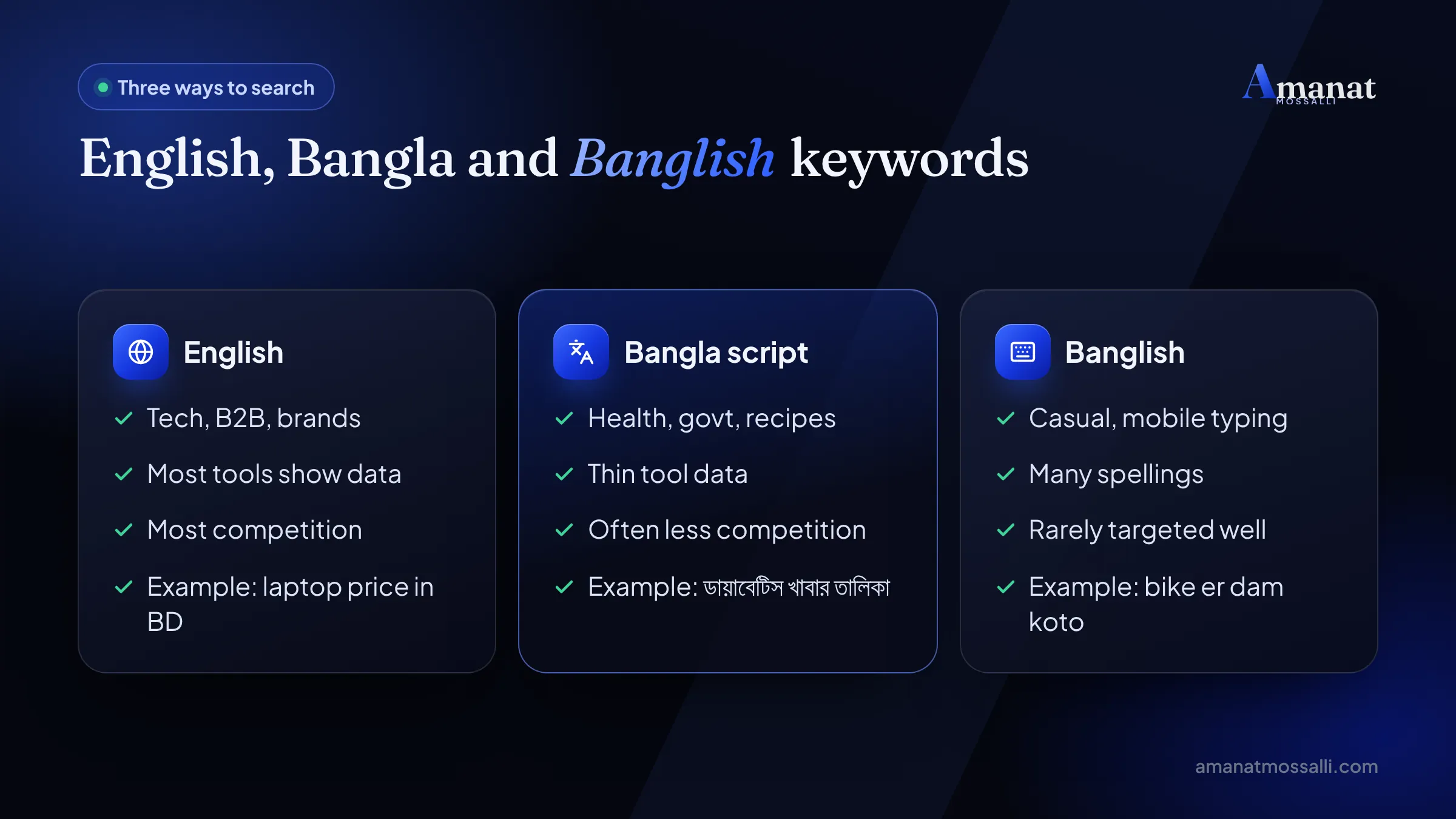
All three, often on the same day. Which one dominates depends on the topic, the buyer’s age and how formal the product is.
English keywords
Common for technology, education abroad, B2B services and brand names. “Best laptop under 60000 taka” and “IELTS coaching Dhaka” are typical. Most tools show some data here.
Bangla keywords
Common for health, religion, government services, recipes, farming and news. People type them with keyboards like Avro or the Bangla layout on their phone. Bangla keyword research often turns up topics where few businesses have written good pages.
Banglish keywords
Bangla words in English letters, like “basa vara mirpur”. Banglish keywords are messy because spelling varies: “vara”, “bhara” and “bhada” can all mean rent. Search engines usually understand the variants, so one page can rank for several spellings.
Voice search adds a fourth shape
More people now speak to their phone, especially older buyers and farmers. Spoken searches come out as full questions, like “chingri macher khabar kothay pawa jay”. Those long, natural phrases are worth a heading and a plain answer on your page.
Type your main product into Google three ways: English, Bangla and Banglish. Look at who ranks. If the Bangla results are weak or old, that’s your opening.
Which Free SEO Tools Actually Work Here?
Google’s own, mostly. They use Google’s data, and that’s where your customers search. Paid tools help, but you can start without them.
| Free tool | Best for | Watch out for |
|---|---|---|
| Google autocomplete and People also ask | Real phrasing, Bangla and Banglish ideas | No volume numbers |
| Google Search Console | Keywords you already appear for | Needs a live site; rare queries are hidden |
| Google Keyword Planner | Volume ranges and new ideas | Needs a Google Ads account with billing set up |
| Google Trends | Seasons like Eid, Puja, exams | Relative interest, not real search counts |
| Bing Webmaster Tools | A second opinion on keyword ideas | Bing is about 1.3% of search here |
| Free plans of paid tools | Keyword difficulty estimates | Their own estimates, not Google data |
These free SEO tools cover almost everything a small business needs. If your site is already live, start with Search Console. It shows real queries, not estimates. The Performance report help page explains clicks, impressions, CTR and position.
How Do You Use Google Keyword Planner in Bangladesh?
Create a Google Ads account, set the location to Bangladesh, and use “Discover new keywords” with a few seed words. You don’t have to run ads to see ideas. You do have to finish account setup first, which annoys a lot of people.
The Keyword Planner help page says: “You must complete your account setup by entering your billing information to access basic features”. Getting keyword ideas is one of those basic features. If you’ve never paid for Google ads from Bangladesh, my guide to Google Ads cost in Bangladesh explains the card side.
How to read the numbers
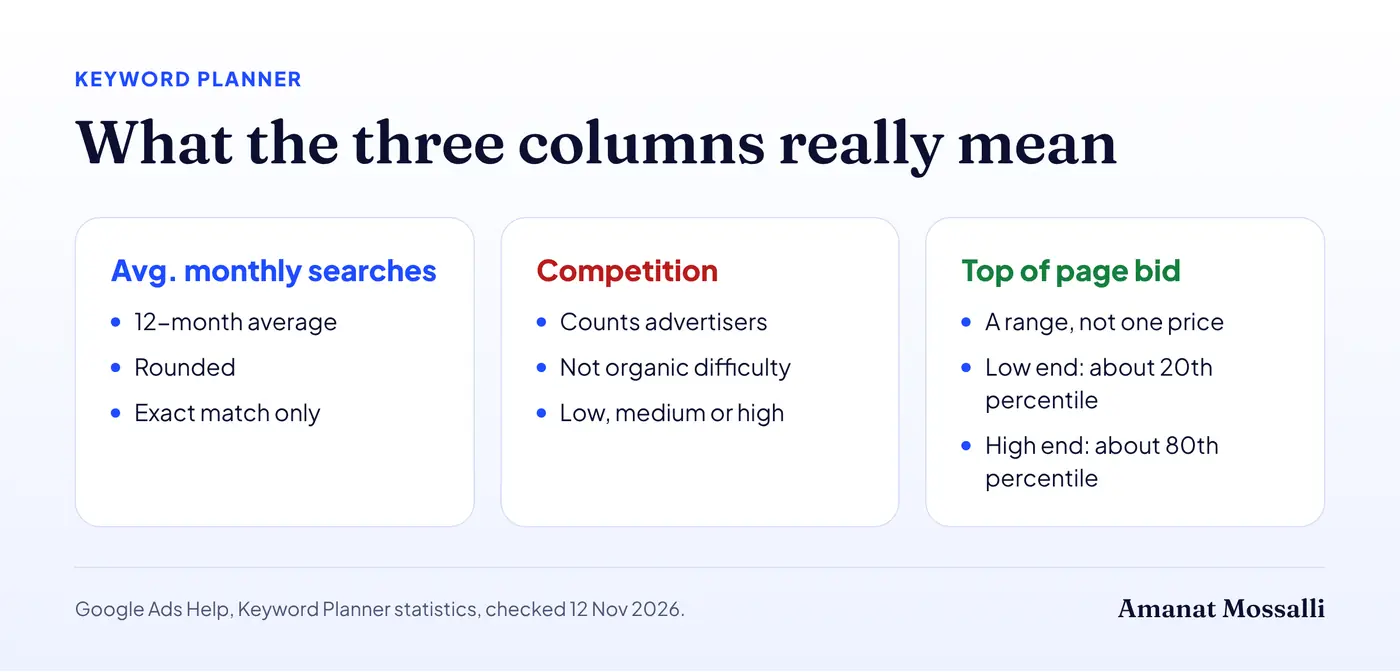
Each column means something narrower than it looks. The Keyword Planner statistics page spells it out.
- Avg. monthly searches is averaged over 12 months by default, and Google says “Your search volume statistics are rounded.”
- Exact match only. Historical figures are “only shown for exact matches”, so “cake dam” and “cake er dam” are counted apart.
- Competition counts advertisers, not organic rivals. It’s “the number of advertisers that showed on each keyword relative to all keywords across Google.”
- Top of page bid comes as a range. The low end is roughly the 20th percentile of what advertisers paid, the high end roughly the 80th.
- Missing keywords. The setup help page says keywords “with very low search volumes” are not “discoverable or forecastable”.
That last point matters most for Google Keyword Planner Bangladesh research. Plenty of good local and Bangla keywords sit below the tool’s threshold. Remember the shrimp feed dealer’s spreadsheet.
A high top-of-page bid is still useful, even for SEO. It tells you a keyword makes money for somebody. If advertisers pay well for a phrase, ranking for it free is worth real effort.
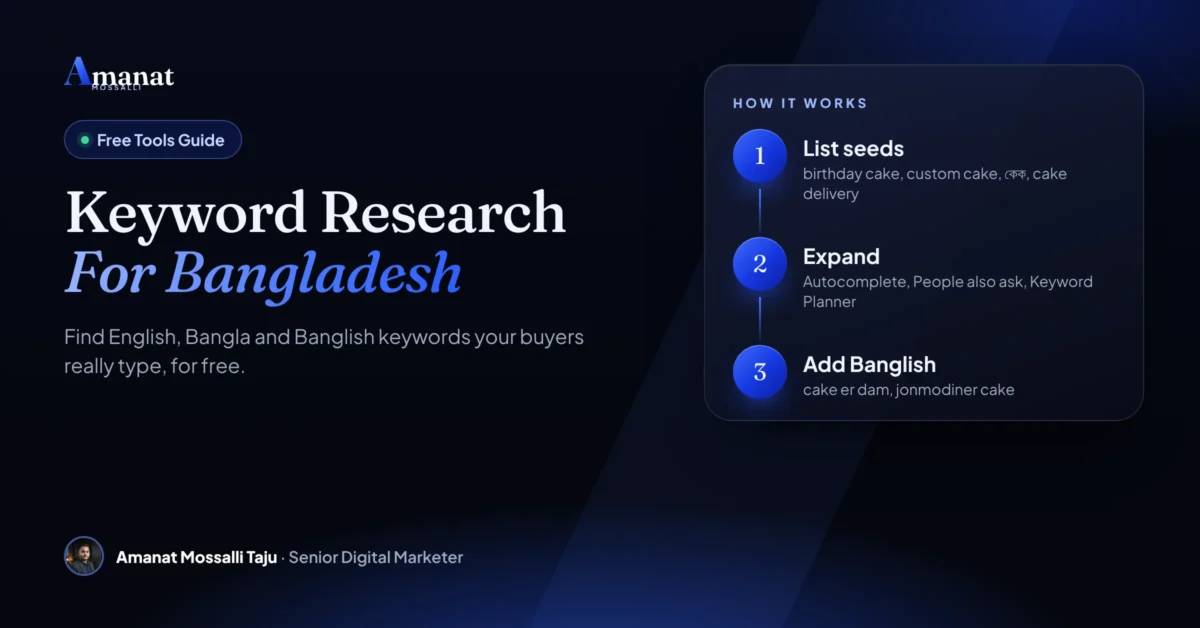
How Do You Find Bangla Keywords Step by Step?
Start from your customers’ own words, then use search suggestions to expand them. Bangla keyword ideas rarely come from tools alone.
- 1Write down how customers ask on Facebook, WhatsApp and the phone. Copy their exact words.
- 2Type each phrase into Google in Bangla script and note the autocomplete suggestions.
- 3Scroll to “People also ask” and “Related searches” at the bottom of the page.
- 4Repeat in Banglish. Try two or three spellings of key words.
- 5Check which phrases already appear in your Search Console queries.
- 6Group phrases that mean the same thing. One group usually becomes one page.
A handy trick: type a word followed by each Bangla letter, like “কেক ক”, “কেক খ”. The suggestions change each time. It’s slow, and I usually do it with tea on a Friday morning, but it finds phrases no tool lists.
For the Bagerhat dealer, this step turned up about 60 phrases in one sitting. Most were Bangla. A handful were Banglish, like “bagda feed price”. Almost none appeared in his nephew’s spreadsheet.
Seasons Change What People Type
The same buyer searches differently in different months. Google Trends is the free way to see it, as long as you remember it shows relative interest, not counts.
- Eid and Puja. Clothing, gifts, cakes and travel phrases rise in the weeks before. Publish or refresh pages a month ahead, not the week of.
- Admission and exam seasons. Coaching, guide books and form-fill-up phrases jump around results and admission dates.
- Monsoon and winter. Rain gear, water pumps and dehumidifiers in one season. Heaters, blankets and skin care in the other.
- Farming calendars. Feed, seed and fertiliser phrases follow stocking and planting months. The Bagerhat dealer’s busiest searches came before shrimp stocking.
In Trends, set the region to Bangladesh and the time range to five years. One year can mislead you, because Eid falls earlier every year on the solar calendar.
Worked Example: A Cake Shop in Mohammadpur
Here’s the full method on one example business. The cake shop sells custom birthday and wedding cakes and delivers across Dhaka. I’ve used a cake shop because everyone understands the product, so you can watch the method instead of the details.
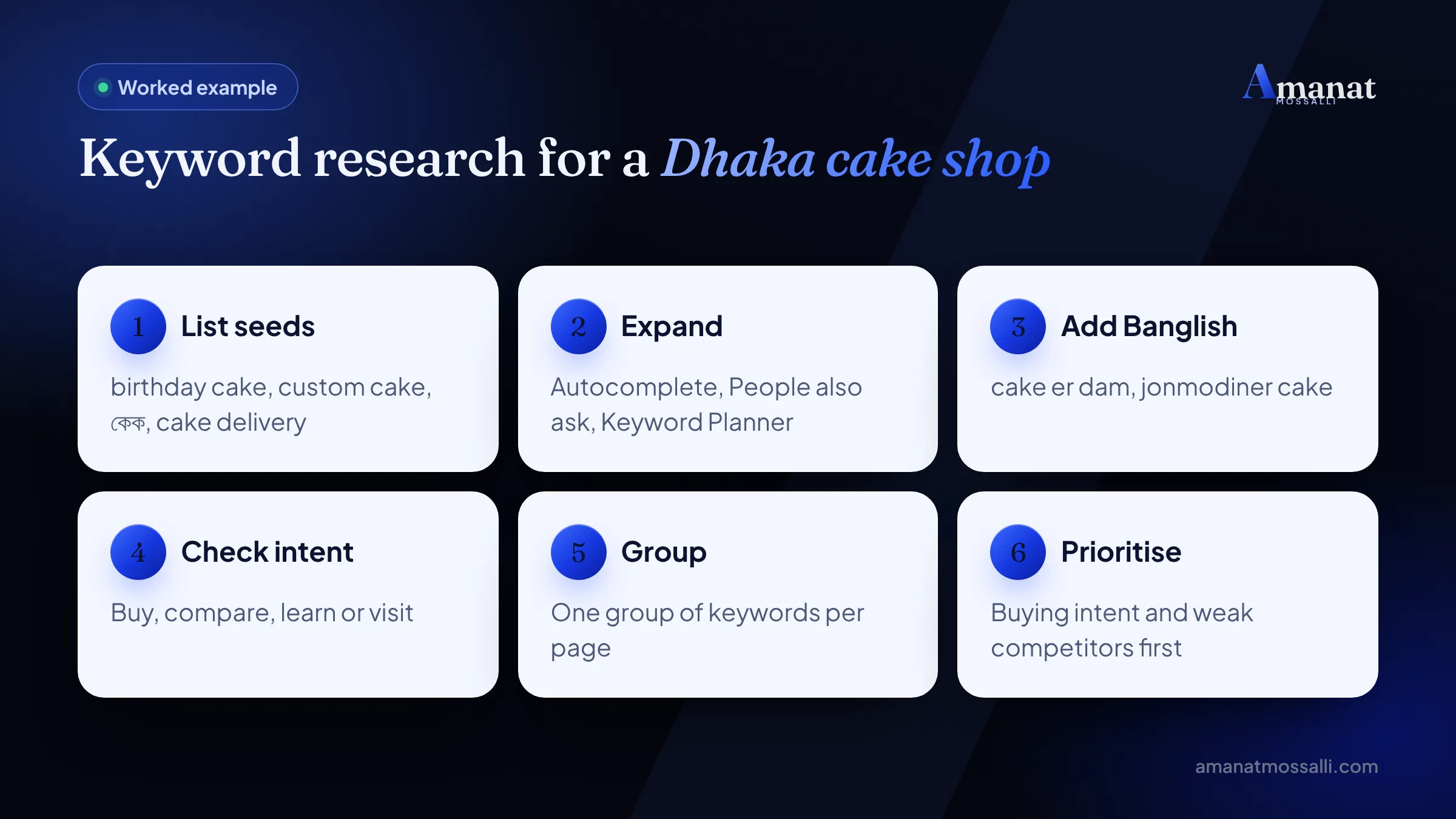
After expanding, the shop has a long, messy list. Grouping turns it into a short plan.
| Keyword group | Example phrases | Intent | Page to build |
|---|---|---|---|
| Custom birthday cakes | custom birthday cake dhaka, জন্মদিনের কেক অর্ডার | Buy | Birthday cakes category page |
| Cake prices | cake price in bangladesh, cake er dam koto | Compare | Price list page with real BDT prices |
| Same-day delivery | same day cake delivery dhaka, cake home delivery mohammadpur | Buy | Delivery areas and times page |
| Wedding cakes | wedding cake dhaka, biyer cake design | Buy | Wedding cakes page with photos |
| Cake care questions | how long can cake stay outside fridge | Learn | Short FAQ or blog post |
The shop now knows its first five pages. Notice that only one group is “learn”. For a small business, most pages should match buying searches.
Why Does Search Volume in Bangladesh Look So Small?
Because every tool rounds, averages or hides small numbers. Each does it in its own way. A keyword showing “10 to 100” can still bring you real customers every week.
- Keyword Planner rounds and hides. Volumes are rounded, so city totals may not add up. Very low-volume keywords aren’t shown at all.
- Each spelling counts alone. Historical statistics are exact match only, so demand split across five spellings looks five times smaller.
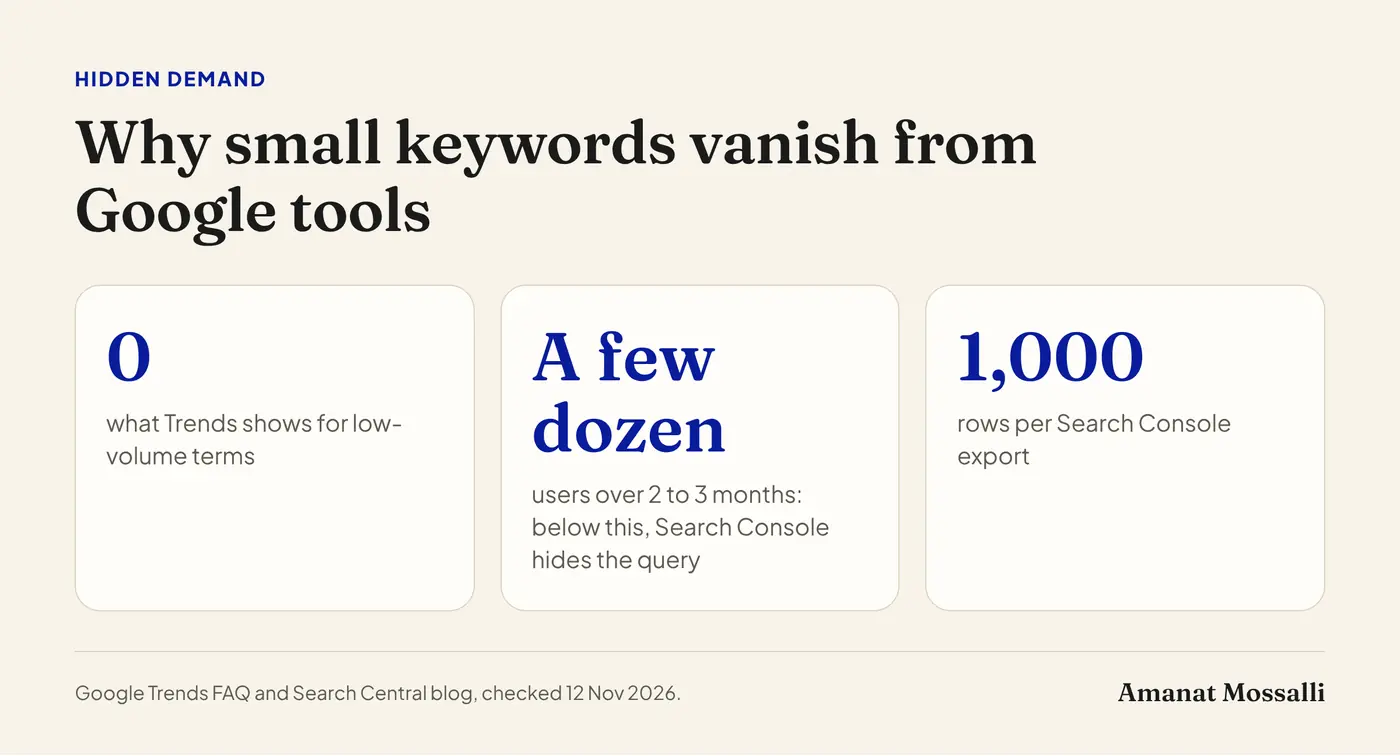
- Trends is relative. Google Trends scales interest from 0 to 100 against all searches in that place and time. It doesn’t show counts. Its FAQ adds that terms with low volume appear as “0”.
- Search Console hides rare queries. More on that below.
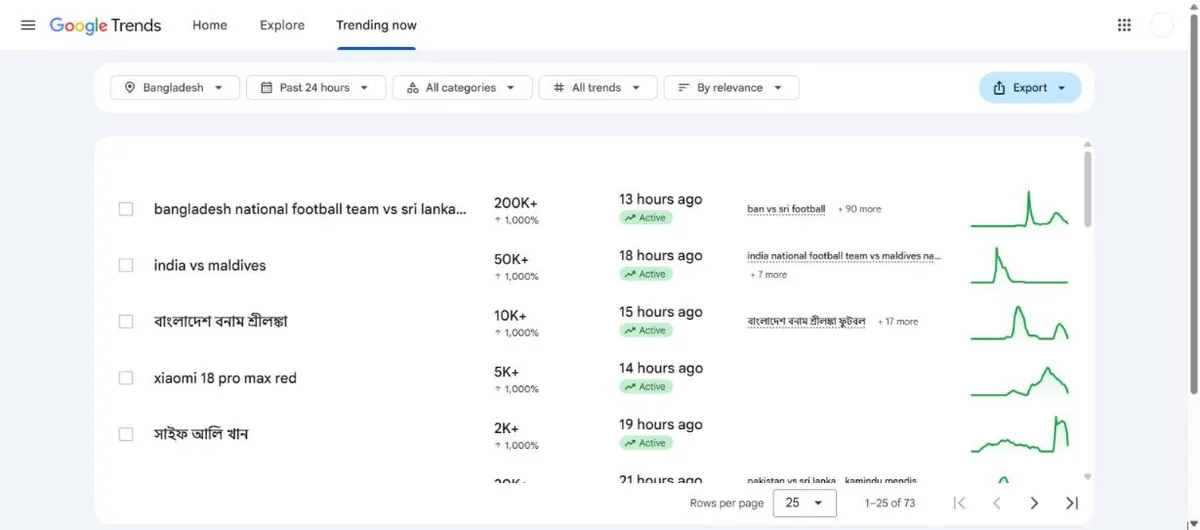
So judge search volume in Bangladesh with care. If a keyword has clear buying intent and a high top-of-page bid, a small number can still earn a page. A clinic or a feed dealer only needs a few new customers a month to justify one good page.
What Search Console doesn’t show you
Even your own data has gaps. Google’s Search Central post on performance data explains anonymized queries. They are queries “that aren’t issued by more than a few dozen users over a two-to-three month period”. Google hides their text to protect privacy.
That hits small Bangla and local searches hardest. Your page may get clicks from phrases you’ll never see listed. The same post says the Search Console screen exports only 1,000 rows at a time. Bigger sites need the API or Looker Studio to see the long tail.
The fix is simple. Treat your Search Console list as a sample, not the full picture. Your inbox and call notes fill in the rest.
Long Tail Keywords You Can Actually Win
Longer, specific phrases with clear intent, where the current top results are weak. Each brings fewer searches. They’re easier to rank for and they convert better.
Long tail keywords are phrases of three or more words, like “eggless birthday cake delivery dhanmondi”. Each one is small. Together they often make up a large share of a local business’s traffic.
Judge keyword difficulty by looking, not only by a score
Keyword difficulty scores come from third-party tools and are their own estimates. There’s no official Google score. For Bangladeshi keywords, I trust a manual check more.
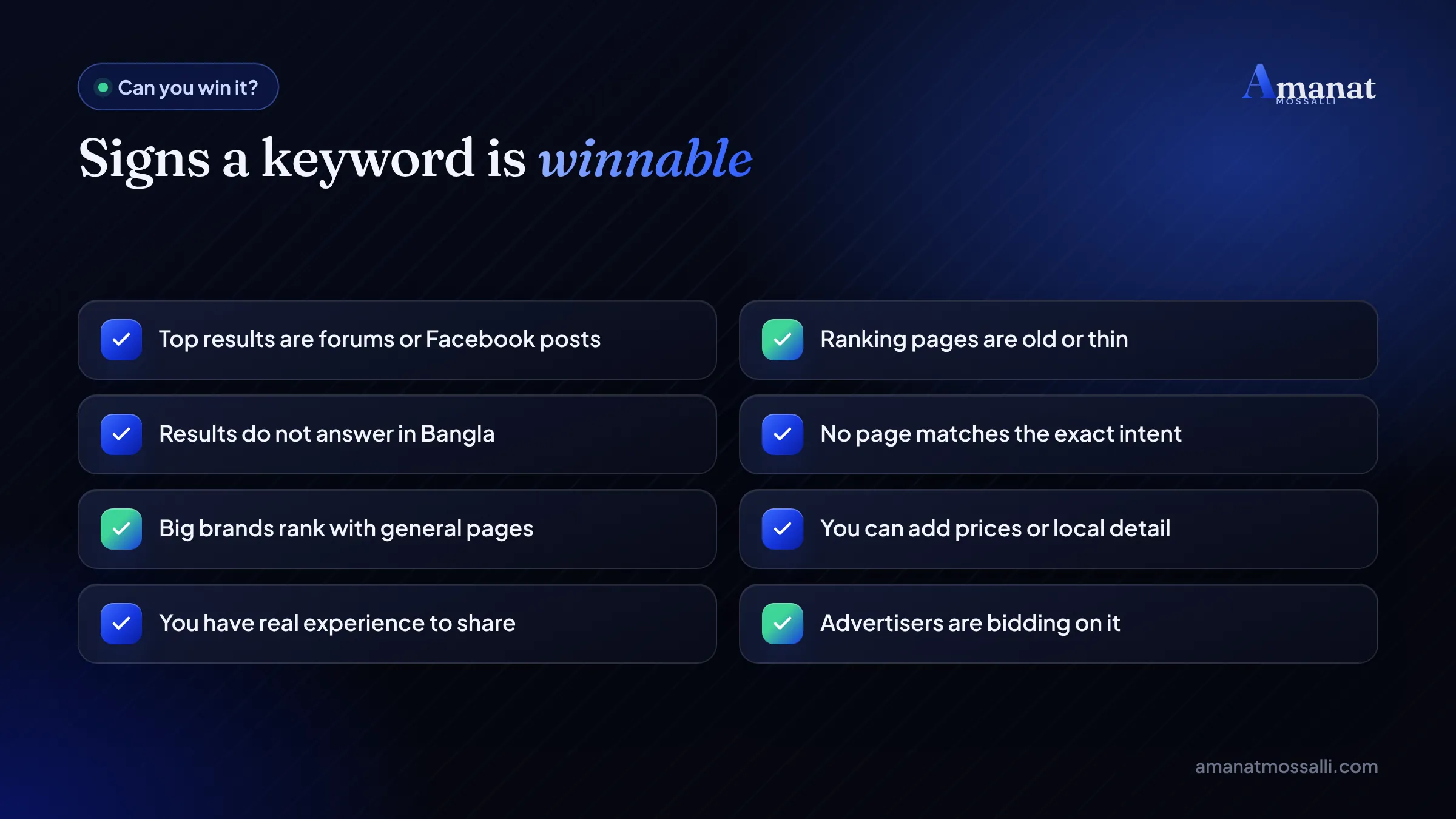
First page full of national news sites and big marketplaces with strong, specific pages? Pick a longer phrase. There’s almost always a narrower version you can own.
Question keywords and AI answers
Question phrases (“koto din lage”, “how long does”, “which is better”) now often trigger an AI Overview in Google. They still deserve a page. A clear, sourced answer can be quoted in that AI box, even when fewer people click. I explain how that works in my guide to generative engine optimization.
FAQ: Keyword Research in Bangladesh
What is the best free keyword research tool in Bangladesh?
Is Google Keyword Planner free?
How do I find Bangla keywords?
Should I target Bangla or English keywords?
Why does Keyword Planner show zero or no data for my keyword?
What are long tail keywords?
How often should I do keyword research?
How Do You Map Keywords to Pages Without Overlap?
One keyword group, one page, one main intent. When two pages chase the same group, they compete with each other and both rank lower.
Should Bangla and English get separate pages?
Only if the content is truly different. A product page can carry an English title and a Bangla description, and rank for both. A full Bangla version is worth building when your Bangla buyers need different answers, not just translated ones. The Bagerhat dealer’s farmers asked about dosage and pond size. His English page never covered that, so his Bangla pages became separate guides.
Once your pages are live, Search Console shows how they’re doing. My guide on how to increase organic traffic in Bangladesh explains how to lift pages stuck on page two.
A Free Keyword Research in Bangladesh Template
Open a new Google Sheet and add these columns. One row per keyword, sorted by group. It’s the same structure I use with clients.
| Column | What to write | Example |
|---|---|---|
| Keyword | The exact phrase | cake home delivery mohammadpur |
| Language | English, Bangla or Banglish | English |
| Source | Where you found it | Autocomplete |
| Volume range | From Keyword Planner, or “not shown” | not shown |
| Intent | Buy, compare, learn or visit | Buy |
| Group | The topic it belongs to | Same-day delivery |
| Winnable? | Your manual check: yes, maybe, no | Yes |
| Target page | The URL that should rank | /delivery-areas/ |
| Status | Planned, written, live | Planned |
Review the sheet every three months. Add new queries from Search Console and move finished groups to “live”.
It works as keyword research for small business because it fits in one sheet and needs no paid tool.
What Mistakes Waste the Most Time?
Most come from copying methods built for English-speaking markets. These are the ones I see every month.
- Researching only in English. You miss Bangla and Banglish buyers.
- Chasing big numbers. “Mobile” has huge volume and almost no chance for a small shop.
- Treating Keyword Planner competition as SEO difficulty. It measures advertisers, not organic rivals.
- Ignoring “not shown” keywords. Low tool volume is not zero demand.
- One page per spelling. “vara” and “bhara” belong on the same page.
- Skipping Search Console. Your real queries are the best keyword list you have.
- Stuffing keywords. Write for people. Repeating a phrase does not help.
So Where Do You Start on Day One?
With your inbox, not a tool. The Bagerhat dealer’s research had been sitting in WhatsApp all along. We built three Bangla pages from it: feed prices, prawn fry sources and pond lime dosage. Four months later his Search Console listed about 40 Bangla queries. Calls that started on the website rose from about 2 a month to about 7. Not dramatic. But those were farmers ready to order by the sack.
Here’s the same process as a one-week plan.
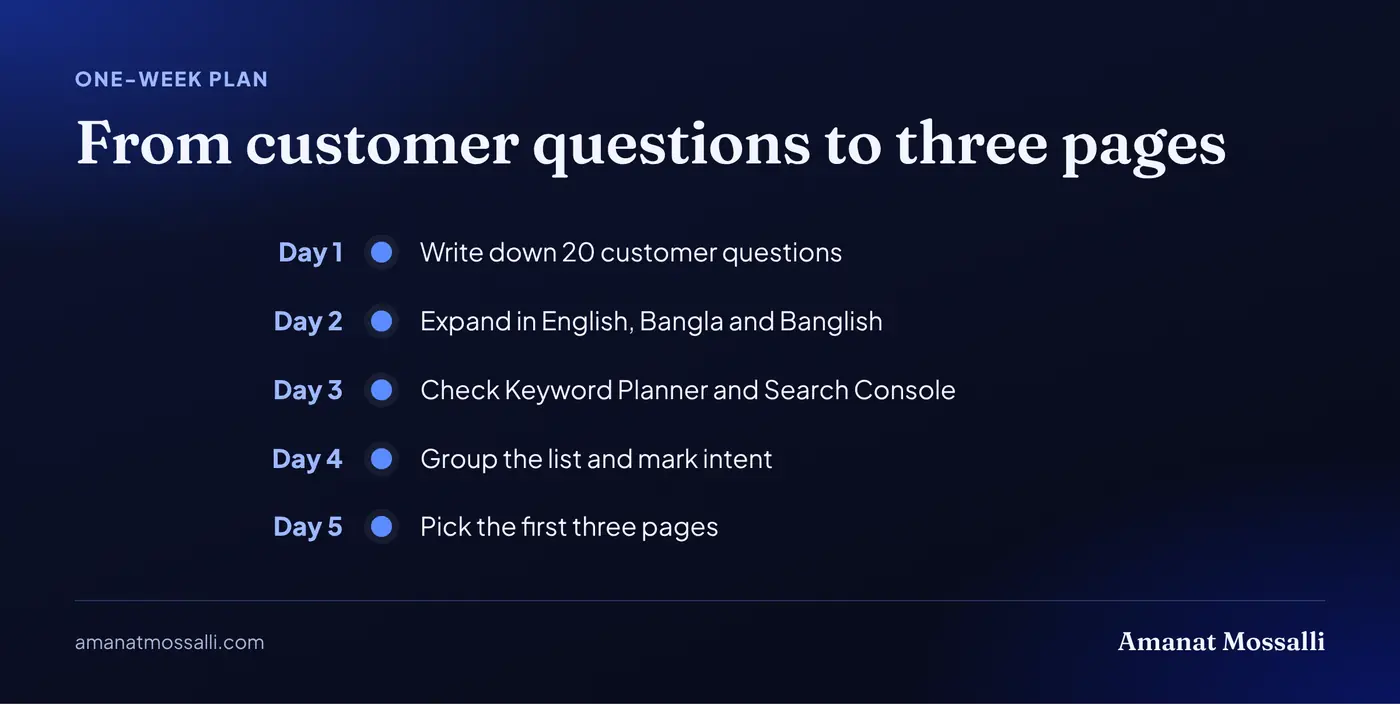
- 1Day 1: write down 20 questions customers ask, in their own words.
- 2Day 2: expand them with autocomplete in English, Bangla and Banglish.
- 3Day 3: check Keyword Planner and Search Console for numbers.
- 4Day 4: group the list and mark intent.
- 5Day 5: pick the first three pages to build or improve.
If you also run ads, the same keyword list sharpens your campaigns. My Google Ads service shows how I use it there. For local businesses, read why local SEO matters in Bangladesh.

Amanat Mossalli Taju
Senior Digital Marketer & SEO Expert, Dhaka, BangladeshI have grown 235+ brands over more than seven years with SEO, Google and Meta Ads, server-side tracking, WordPress and AI automation. Half of my clients are in the UK, USA, Australia and Canada. Everything I write here comes from real client work.
Want this done for your business?
Book a free 15-minute call. I look at your site and ads before we talk, so you leave with clear next steps.