Exploring the Future of E-commerce in Bangladesh for 2026
Where Bangladesh e-commerce really stands in 2026, the trends that will shape the next few years, and what to fix in your shop first.


Your Facebook page did well during Eid. Orders poured in, the courier van came twice a day, and for a week it felt like the business had finally arrived.
Then the boosted posts got more expensive and too many parcels came back. A page with a near-identical name started copying your photos.
Exploring the future of e-commerce in Bangladesh starts with that week, because almost every online seller here has lived it. The question isn’t whether people will keep buying online. They will. The question is which shops will still be standing when they do.
My short answer: online shopping will keep growing, but the easy days are over. The shops that win from here will own a website and take digital payments. They’ll track every taka of ad spend and earn trust on purpose. Pure “boost and pray” selling gets harder every month.
This isn’t a theory piece. It’s what I see inside ad accounts, order sheets and courier reports. I’ve checked it against public data from DataReportal, Bangladesh Bank reporting and the national press. Every source below was opened on 11 November 2026.
Growing up, not slowing down
Think of it like a new highway. Traffic grows every year. But the highway now has rules, police and toll gates. Shops that follow the rules move faster.
I’m Amanat Mossalli Taju. I’ve worked in digital marketing for over seven years and hold a Digital Marketing Strategy certificate from Harvard Business School Online. Order sheets taught me more than the course did, and one pattern keeps repeating in them. The shops that survive a bad month are the ones that own something. A site, a list, a name people search for.
A woman who sells Tangail and Jamdani sarees from a busy Facebook page in Mirpur messaged me late one Wednesday. Eid was three weeks away. Her page had been disabled overnight, after a login from a phone she didn’t recognise. Years of photos, reviews and Messenger chats were gone.
She had no website and no customer list outside Messenger. The Eid stock was already paid for. The people who had bought from her for years had no idea where she went.
We got a simple WooCommerce site live in 19 days, with bKash and a WhatsApp button. Old buyers found it through a new page and her own phone contacts. Eid sales came in at about 60% of the year before. Painful, but not the end.
A year on, about a third of her orders come through the site. Returns on those prepaid orders run at roughly one in fifteen, against about one in five for Facebook COD. I get a message like hers every few months. It teaches more about the future of online selling here than any report.
Here’s what I expect to shape the next two to three years:
- More buyers from districts. Rangpur, Sylhet and Barishal will matter as much as Gulshan.
- Fewer cash-only orders. bKash, Nagad and cards will slowly replace cash on delivery.
- Video-first selling. Live selling and short videos will outsell photo posts.
- AI search. People will ask ChatGPT or Google’s AI where to buy, not only scroll Facebook.
- Stricter rules. Registration and consumer protection will push out fake sellers.
E-commerce growth in Bangladesh: where it stands in 2026
Real, but still early. Online shopping is a small slice of all retail, so most of the growth is ahead of us.
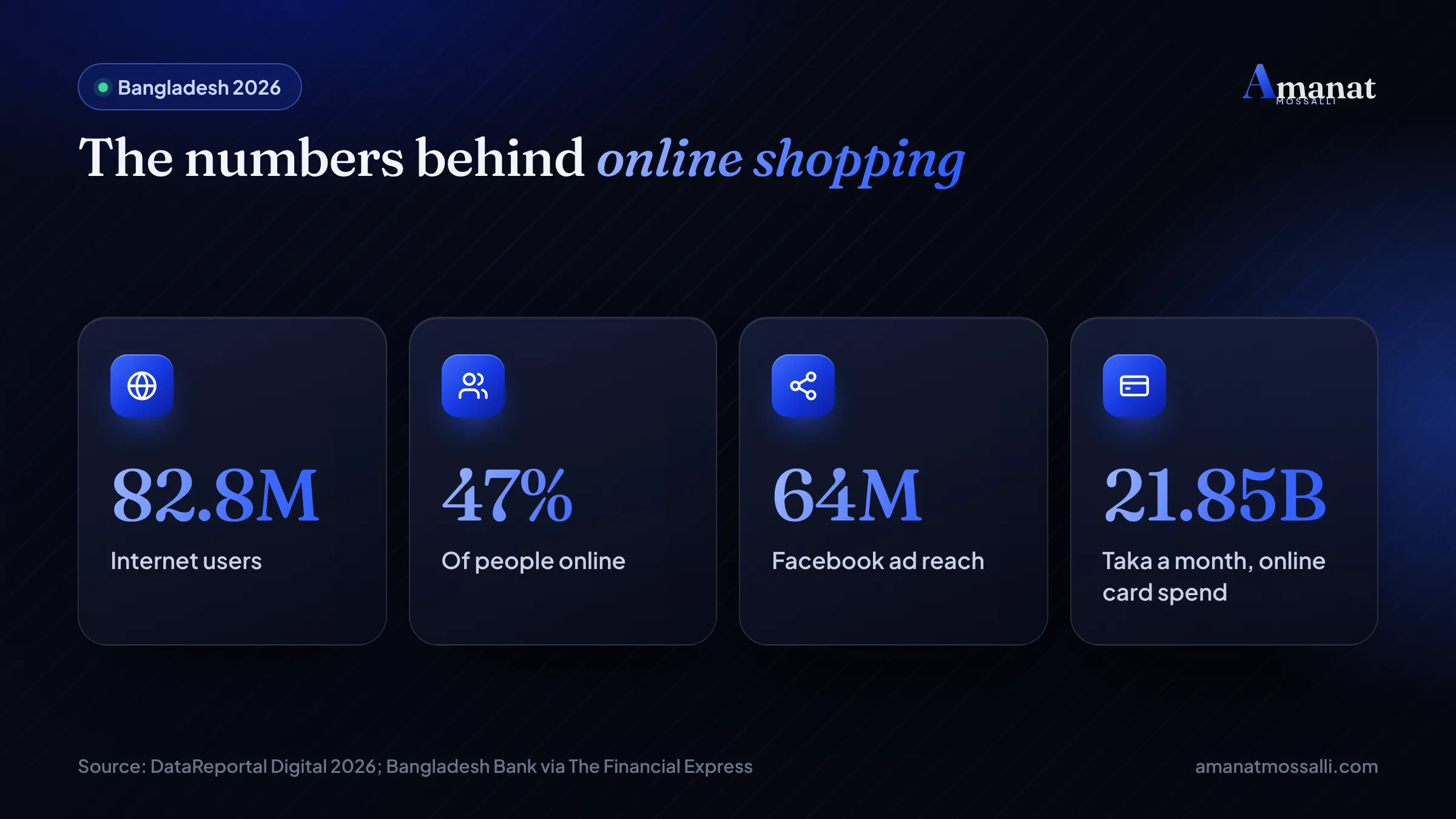
Start with who is online. DataReportal’s Digital 2027 report, published on 5 November 2026, counts 95.3 million internet users. That’s 53.4% of a population of 178 million. A year earlier, the Digital 2026 report counted 82.8 million, or 47%.
So for the first time, more than half the country is online. The other 46.6% is your future market.
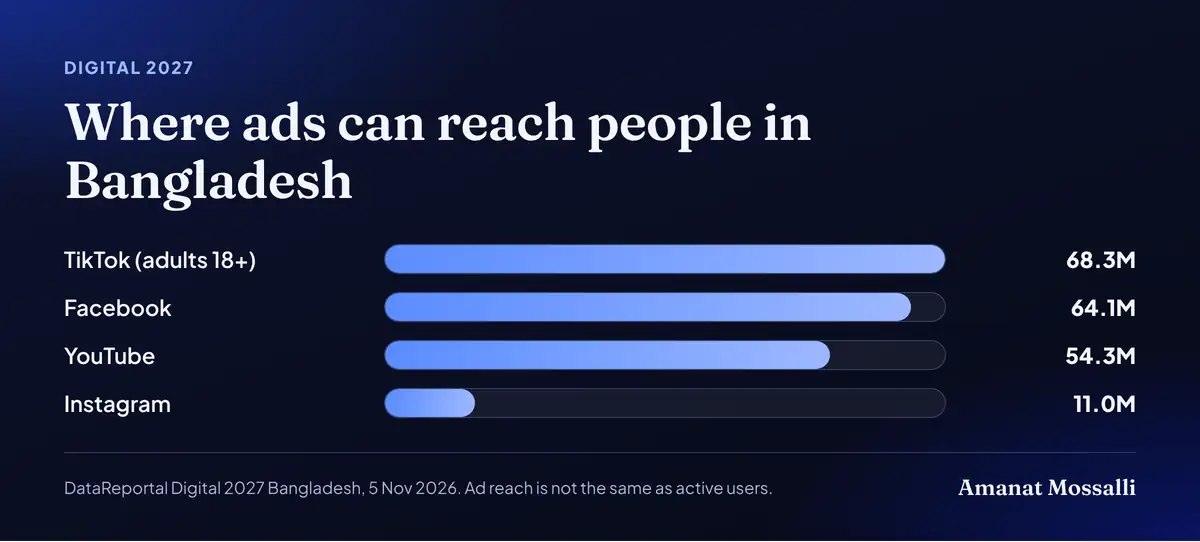
| Platform | Ad reach in Bangladesh (Digital 2027) |
|---|---|
| 64.1 million | |
| TikTok (adults 18+) | 68.3 million |
| YouTube | 54.3 million |
| 11.0 million |
Two notes on that table. DataReportal warns that ad reach is not the same as active users, and that figures get revised. Still, one thing stands out. TikTok’s adult ad reach now sits above Facebook’s. If your shop has no short video, you’re missing the biggest room.
The same report puts median mobile download speed at 38.67 Mbps. That is fast enough for video and for a properly built shop site. A slow site is now your fault, not the network’s.
What the payment data says
The Financial Express reported Bangladesh Bank data on card payments. Card-based e-commerce spending averaged about Tk 21.85 billion a month from August 2025 to June 2026. May 2026, the Eid month, peaked at Tk 24.67 billion. February 2026 was the low, at Tk 18.15 billion.
The same report puts the market near US$7.5 billion in 2024, with a projection of US$9.8 billion by 2028. Online sales are still only about 3% to 5% of total retail. Plenty of room left.
Remember what that card figure leaves out. It doesn’t count cash on delivery, and it doesn’t count most bKash payments. The real market is larger than the card data shows.
In the accounts I manage, Eid ul-Fitr, Eid ul-Adha and Pohela Boishakh still bring the biggest spikes. Plan stock, ads and courier capacity at least six weeks before each one, not the week before.
Eight trends worth planning around
Some are already here. Others are just starting. When I plan with a new client, I map their shop against these eight. It shows quickly where they’re behind.
1. F-commerce grows up
F-commerce means selling through Facebook pages, groups and Messenger. It’ll stay big, because that’s where Bangladeshi buyers spend their evenings. Page-only shops will struggle, though, with rising ad costs and trust problems.
2. Live selling and short video
Live selling means showing products on a live video and taking orders in the comments. It works well for clothes, cosmetics and gadgets. Reels and TikTok videos now do the job a shop window used to do.
3. Digital payments chip away at cash on delivery
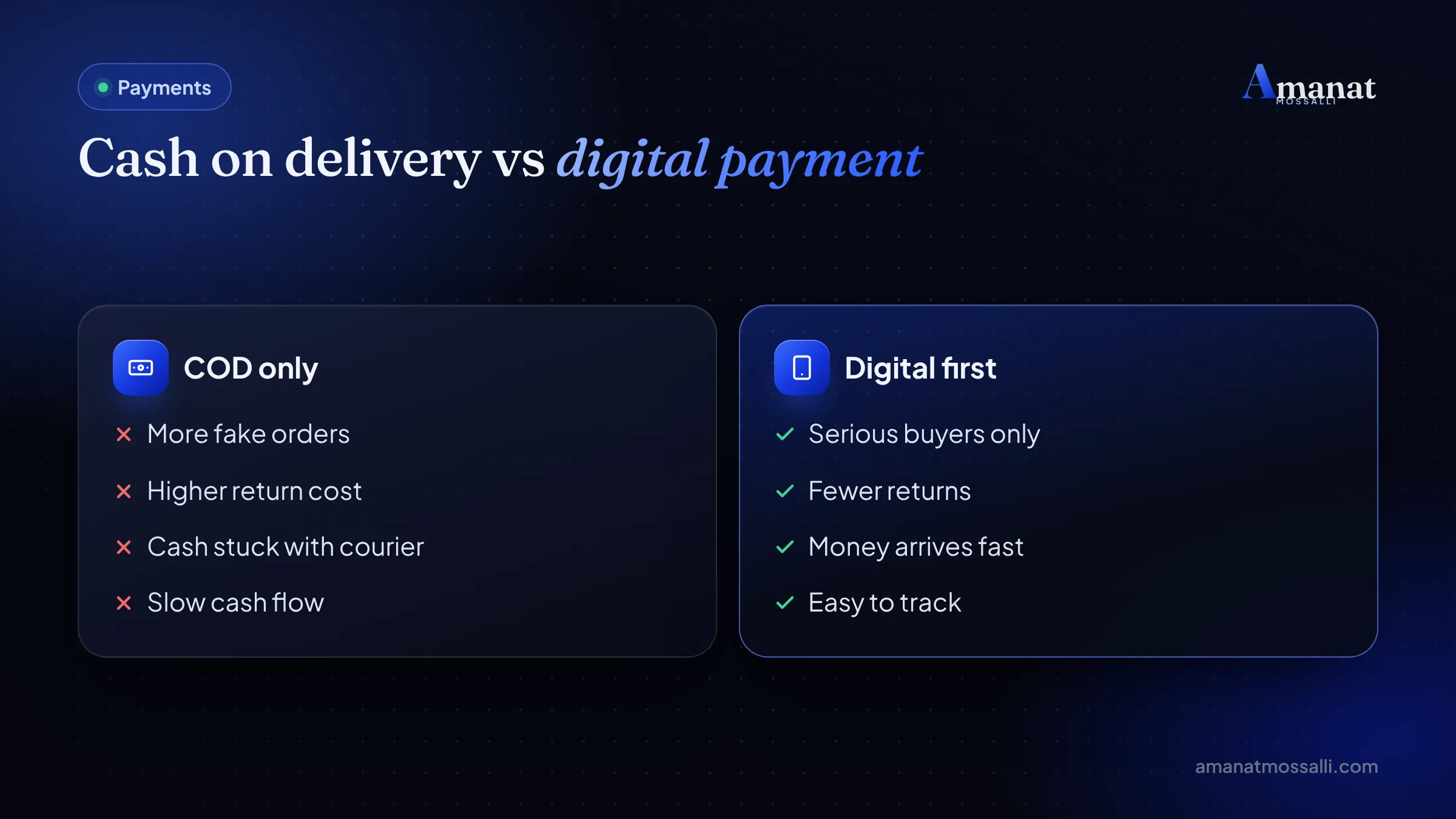
Cash on delivery (COD) means the buyer pays the rider at the door. It builds trust, but it brings fake orders and returns. Digital payments through mobile financial services (bKash, Nagad, Rocket) and cards are slowly taking its place.
4. AI search changes how people find shops
ChatGPT, Gemini and Google’s AI Overviews now answer shopping questions directly. If your shop has no website and no reviews, these tools have nothing to recommend.
Few local shops are ready for this. AI tools pull answers from websites, reviews and trusted articles. A clear product page with price, size, delivery time and return policy gives them something to quote. My SEO, GEO and AEO service is built around exactly that. The method is in my guide to generative engine optimization.
Every one of these rewards shops that look real, are easy to pay, and deliver what they promise. None of them rewards a cheaper price on its own.
A ninth, small but real: paying for ads got easier
On 10 September 2026, The Financial Express reported that businesses can now pay for Meta ads with bKash. Until then you needed a card enabled for foreign currency. The report counts about 3 million such cards, against more than 82 million registered bKash users.
That removes one of the oldest walls for small sellers. It also means more sellers bidding in the same auction. I explain the payment routes in how to pay for Facebook ads in Bangladesh.
Will digital payments replace cash on delivery?
Not fully, and not soon. Their share will keep rising, though. Many buyers still fear paying first because of past scams, and that fear fades slowly.
Mobile banking is already huge. Bangladesh Bank data reported by The Financial Express showed MFS transactions of about Tk 1.58 trillion in October 2025 alone. The report lists 79.61 million male and 61.80 million female accounts, about 141 million together. It also notes that Nagad’s data was missing, so the true total is higher.
Buyers already pay bills and send money with their phones. Paying for a shirt is a small step from there.
What one COD parcel really costs you
Sellers often know their ad cost and forget the courier maths. Here is one real rate card. Paperfly’s published charges list these prices per parcel, VAT included.
| Up to 1 kg | Same city | Suburb | Rest of Bangladesh |
|---|---|---|---|
| Delivery charge | Tk 70 | Tk 100 | Tk 130 |
| Each extra kg | Tk 20 | Tk 25 | Tk 20 |
| Cash on delivery fee | 0% | 1% of the amount collected | 1% of the amount collected |
The page also says a return charge of up to 50% of the delivery charge may apply. Steadfast’s terms are similar. They list a 1% cash handling charge on COD parcels and no charge for return parcels. Other couriers differ, so read your own rate card.
Now the sum. Say you send a Tk 1,200 order from Dhaka to Rangpur on that Paperfly card. Delivery is Tk 130 and the COD fee is Tk 12. If the buyer accepts, you’ve paid Tk 142 to collect Tk 1,200.
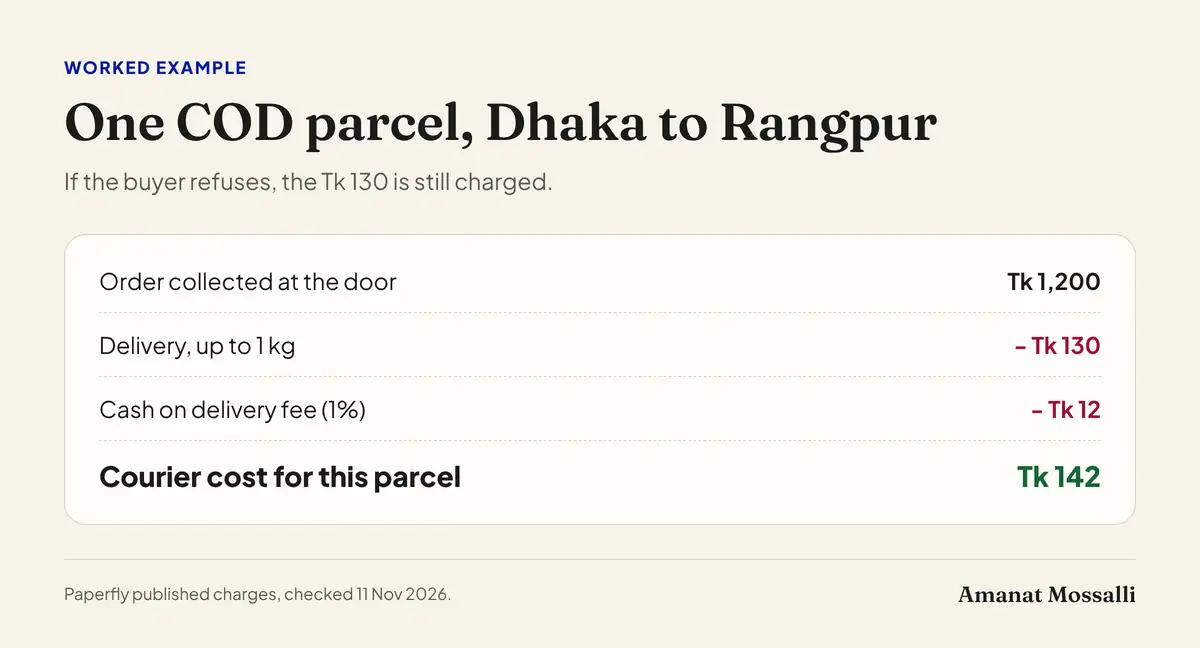
If the buyer refuses, you still pay the Tk 130, plus up to Tk 65 in return charge. You also lose the packaging, the ad cost that won the order, and a week of that stock being on the road. This is why a returned parcel hurts far more than its courier fee.
My advice: keep COD, but give people a small reason to pay first. Free delivery or faster dispatch works well. Even asking for the delivery charge in advance cuts fake orders a lot.
Make payment easy on the website too. A checkout that takes bKash, Nagad and cards through a gateway like SSLCOMMERZ or aamarPay removes friction. When I do WordPress development for shops, that’s part of the first build, not an add-on. The technical side is in my guide to bKash payment gateway integration.
The rules arriving in 2026
Four things to know. Digital Business Identity (DBID) registration. Escrow for customer payments. The draft cross-border policy. And a much louder consumer complaints system. Together they push the market toward honest, registered shops.
DBID registration
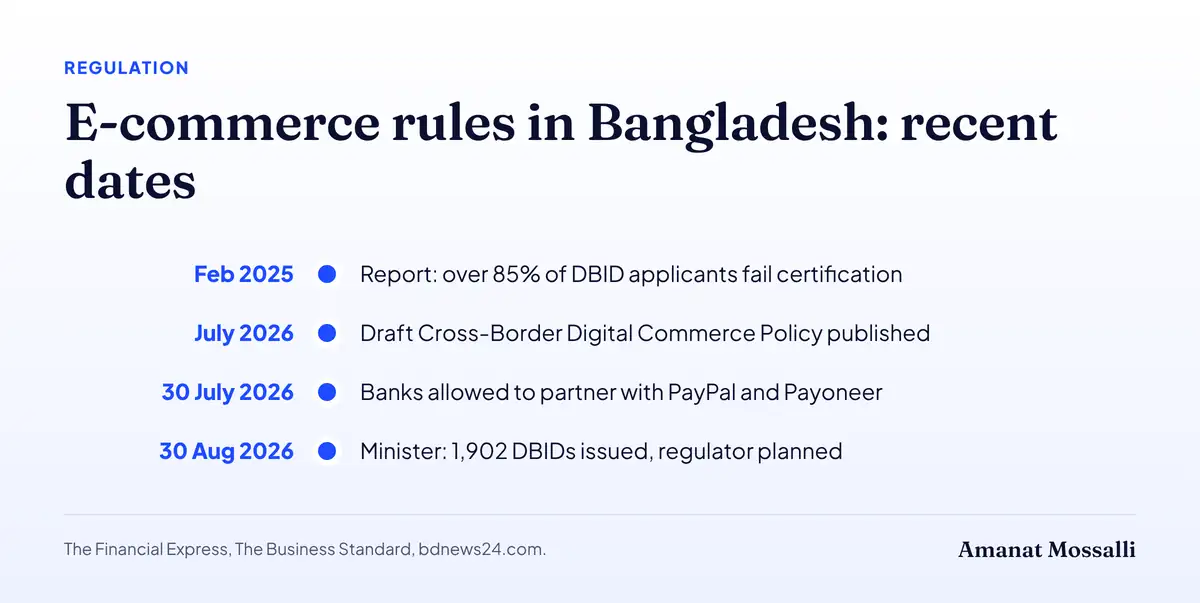
DBID is a Ministry of Commerce registration for online businesses, including Facebook-based shops. Uptake is still tiny. On 30 August 2026 the commerce minister told parliament that 1,902 companies had been issued a DBID so far, as bdnews24.com reported.
Why so few? An earlier report in The Financial Express, from February 2025, found that more than 85% of applicants had failed to get certified. Most rejections came down to missing documents. An official said many shops had not published their terms and conditions in Bangla on their site or page.
That report holds two useful tips. The DBID number must be displayed on your website or page. And a business with an official website or social media page could apply without a trade licence. Rules shift, so confirm the current list before you apply.
Escrow and a planned regulator
The same bdnews24.com report describes Bangladesh Bank’s Merchant Acquiring and Escrow Service Policy. Under it, a customer’s payment is held and released to the seller only after the buyer confirms receipt.
The minister also said the government plans a Digital Commerce Regulatory Authority, with mandatory registration for e-commerce firms. No date was given. I’d plan as if it will happen and be pleased if it’s slow.
Cross-border e-commerce policy
In July 2026 the Ministry of Commerce published a draft Cross-Border Digital Commerce Policy 2026 for public feedback. It proposes that foreign platforms like Facebook, YouTube and Google register before running ads aimed at Bangladeshi buyers.
There is good news in the draft for exporters. The Financial Express reported on 28 July 2026 that cross-border e-commerce earnings would be treated like ordinary export receipts. It also proposes support and insurance for small businesses that export small parcels.
It’s still a draft. How the final version will treat small advertisers, I don’t know yet, and I’d be wary of anyone who says they do.
Getting paid from abroad may also get easier. On 30 July 2026, bdnews24.com reported a Bangladesh Bank circular that lets banks partner with providers such as PayPal and Payoneer. Banks need central bank approval before launching. I can’t confirm any live service yet. About half my clients are in the UK, USA, Australia, Canada and Europe, so I follow this one closely.
Consumer complaints and the Evaly lesson
According to Dhaka Tribune, 58,720 complaints were filed against platforms like Evaly, E-orange and Alesha Mart. Customers claimed about Tk 3,869 crore, and only Tk 472 crore had been refunded by August 2026.
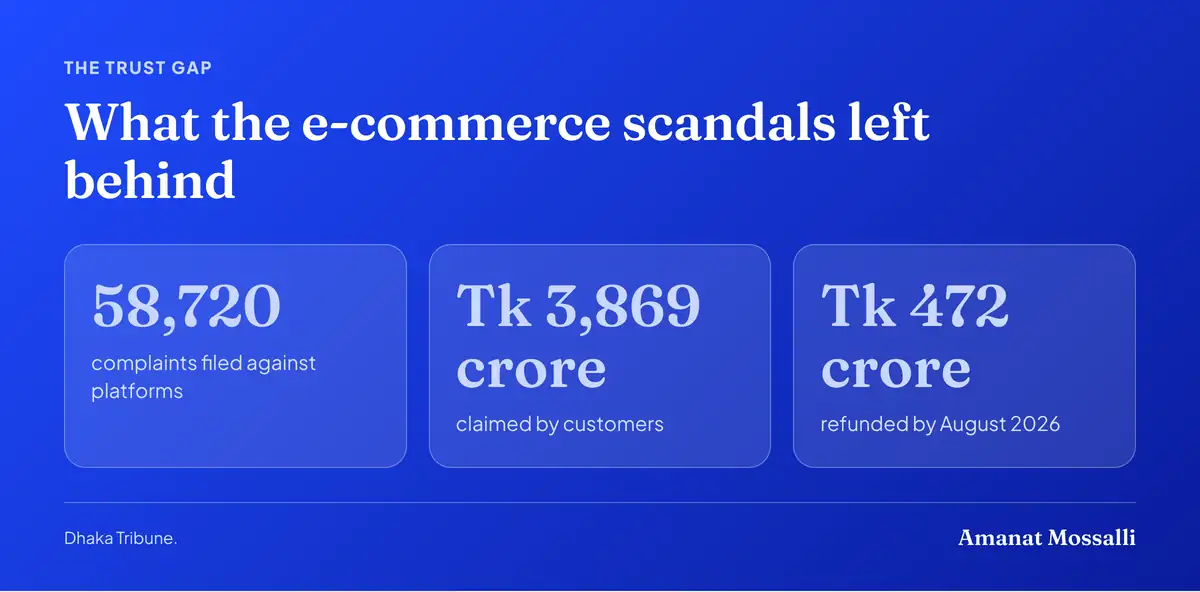
After those years, buyers learned to pay for safety. In my accounts, shops with a real address, a clear return policy and genuine reviews convert better than cheaper shops without them.
This is general guidance, not legal or financial advice. Check the latest rules with the Ministry of Commerce or a lawyer before you register or scale.
Facebook page or your own website?
Both, but the website should be your base. A Facebook page brings attention fast. A website builds trust, ranks on Google and gets picked up by AI search. Ask the saree seller from the top of this page which one she’d build first now.
| Point | Facebook page only | Own website + Facebook |
|---|---|---|
| Start cost | Almost zero | About Tk 25,000 to Tk 1.5 lakh |
| Trust | Low, easy to copy | Higher, real brand |
| Google and AI search | Rarely shows | Can rank and get cited |
| Ad tracking | Weak | Full pixel and server tracking |
| Risk | Page ban or hack ends business | You own the asset |
| Best for | Testing a product | Growing a brand |
The cost range above is what I see for small to medium WooCommerce shops in Dhaka. It is a typical range, not a quote. A basic theme site sits at the low end. A custom design with a payment gateway and courier tools sits higher. I break the numbers down in website development cost in Bangladesh.
A website keeps your customers, your content and your data in your hands. For more on why that matters in search, read my guide on why SEO is important for e-commerce in Bangladesh.
The hard parts nobody puts in the pitch deck
Trust, returns, delivery cost and weak tracking. Policy gaps and patchy internet outside the cities hold things back too.
- Fake orders and returns. COD buyers who never collect the parcel cost you twice.
- Rising ad costs. More sellers bid for the same Facebook audience every Eid.
- Broken tracking. Many pixels I audit miss sales or count them twice, so ads learn from the wrong people.
- Delivery cost outside Dhaka. Higher charges and slower delivery cut district orders.
- Slow registration. Fewer than 2,000 DBIDs have been issued, so most sellers still can’t show one.
- Nearly half the country offline. 46.6% of people were still not using the internet in late 2026.
None of these is a reason to quit. They’re reasons to run the shop like a real business, with numbers, systems and some patience.
If you don’t know your return rate by district, more ads will make the problem bigger. Fix product photos, size guides and confirmation calls first. This is the advice people least want to hear from me.
Six steps to get your shop ready
Same order I use with my own e-commerce clients. Register first, advertise last.
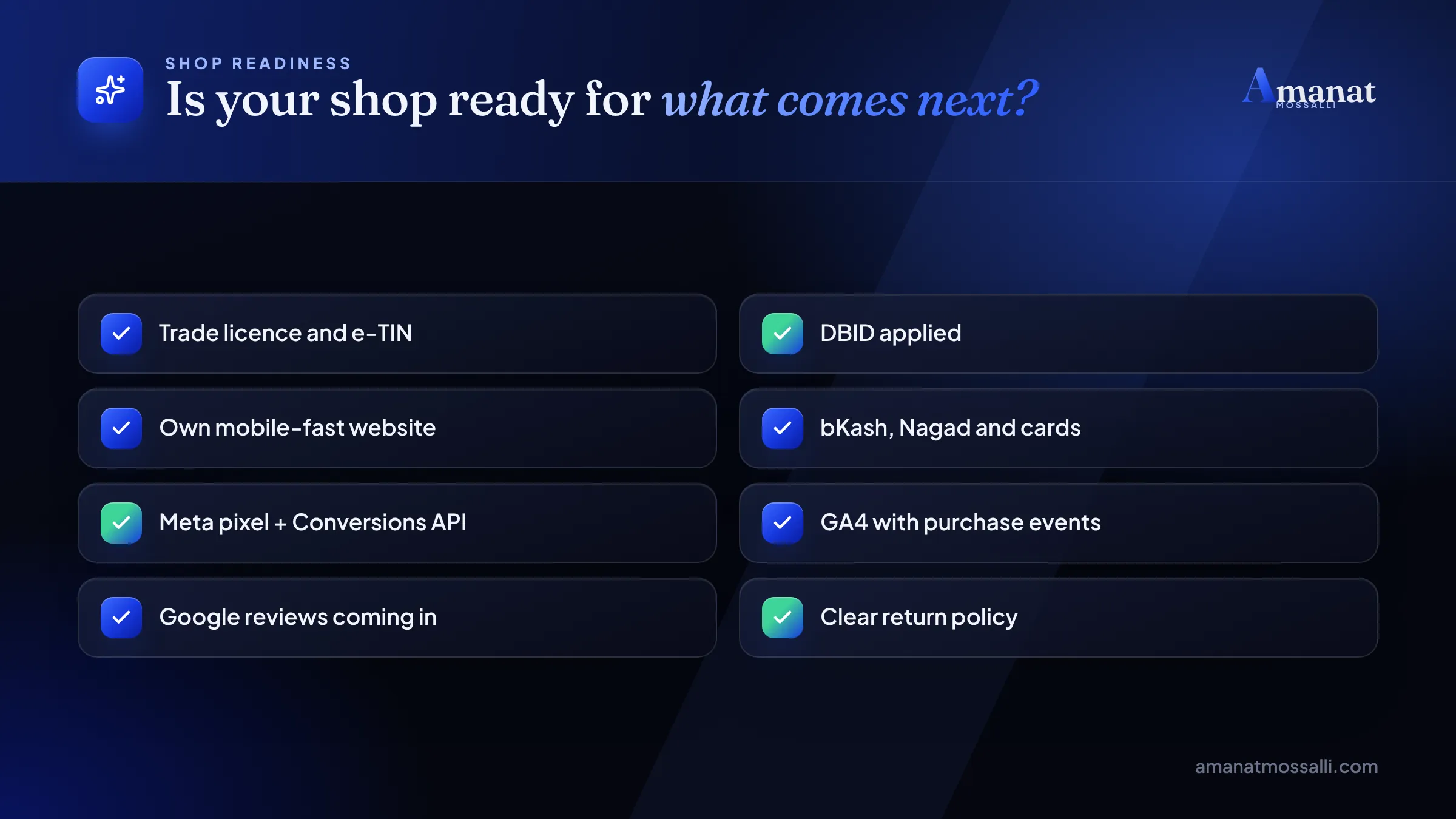
Don’t try to do all of it in one month. Pick the step you’re weakest at and fix that first.
Ads come after tracking, not before
Run ads only once conversion tracking works, then scale what makes a profit. Conversion tracking means your website tells Facebook and Google exactly who bought and for how much.
Since iOS privacy changes and browser blockers, the pixel alone misses many sales. So I add the Conversions API, which sends sales data from your server. In most audits I run, fixing tracking does more for profit than changing the ad design. That’s why tracking and analytics setup comes before any big ad budget. You can do much of it yourself with my guide on how to set up GA4 and Facebook Pixel.
- Start with retargeting. Show ads to people who visited your site or watched your videos.
- Then test cold audiences. Use broad targeting and let good data guide Meta.
- Measure profit, not likes. Track cost per purchase and return on ad spend.
- Keep Google too. People who search a product name are ready to buy.
Just starting out? My guide to social media marketing for Bangladeshi businesses covers the basics of content and posting.
Where are the best opportunities right now?
Categories with repeat buyers, clear quality and growing district demand. These are the ones I watch most closely.
Want more ideas with costs attached? See my list of the best online business ideas in Bangladesh.
Don't ignore buyers outside Dhaka
District buyers are often more loyal than Dhaka buyers. They have fewer choices, so a shop that delivers on time earns repeat orders. Write product pages in simple Bangla, show delivery charges clearly, and run Meta ads that target specific divisions.
Here is a habit worth copying. Last year I worked with a seller who ships Sundarbans honey from Satkhira. He ran ads to the whole country and blamed the courier for his returns. On a video call one evening, I asked him to colour each row of his order sheet by district. Green for delivered, red for returned.
Two divisions came out nearly all green. One was mostly red. We moved most of his ad budget to the green ones and kept a small test running elsewhere. Over the next three months his return rate fell from about 22% to about 12%. His cost per delivered order dropped from roughly Tk 390 to Tk 280. It isn’t clever. It’s just looking at your own data before spending more.
So start with one or two divisions where your courier performs well. Check return rates by district every month. Cut the areas where returns eat your profit, and push harder where buyers keep coming back.
FAQ: Exploring the Future of E-commerce in Bangladesh
Is e-commerce growing in Bangladesh?
Is e-commerce a good business in Bangladesh in 2026?
What is f-commerce in Bangladesh?
Do I need a licence to sell online in Bangladesh?
Will cash on delivery disappear in Bangladesh?
Which is the biggest e-commerce platform in Bangladesh?
What should I budget for an online shop website in Bangladesh?
What to fix in your shop this month
Exploring the future of e-commerce in Bangladesh leads to one plain lesson. The market will reward real brands, not quick tricks. More buyers, more payments and more rules are all arriving at once.
So pick one thing this month. If you have no website, start there. If you have one, check that tracking works. If both are done, colour your order sheet by district. Stuck on which comes first for your shop? Ask me. A free 15-minute call is usually enough to settle it.
Four things I'm watching over the next year
- The final cross-border policy. The draft is public. The final text will decide how foreign platforms and small exporters are treated.
- The Digital Commerce Regulatory Authority. If it arrives with mandatory registration, unregistered pages will feel it first.
- bKash payments for Meta ads. Payment limits aren’t public yet. They will shape how many new sellers start advertising.
- The next DataReportal count. Internet use passed half the population this year. Watch where the next ten million come from.
The saree seller from the top of this page now has a website and a WhatsApp list of about 1,100 buyers. She still sells on Facebook. But Facebook is no longer the whole shop, and that is the future in one sentence.
Amanat Mossalli Taju
Senior Digital Marketer & SEO Expert, Dhaka, BangladeshI have grown 235+ brands over more than seven years with SEO, Google and Meta Ads, server-side tracking, WordPress and AI automation. Half of my clients are in the UK, USA, Australia and Canada. Everything I write here comes from real client work.
Want this done for your business?
Book a free 15-minute call. I look at your site and ads before we talk, so you leave with clear next steps.